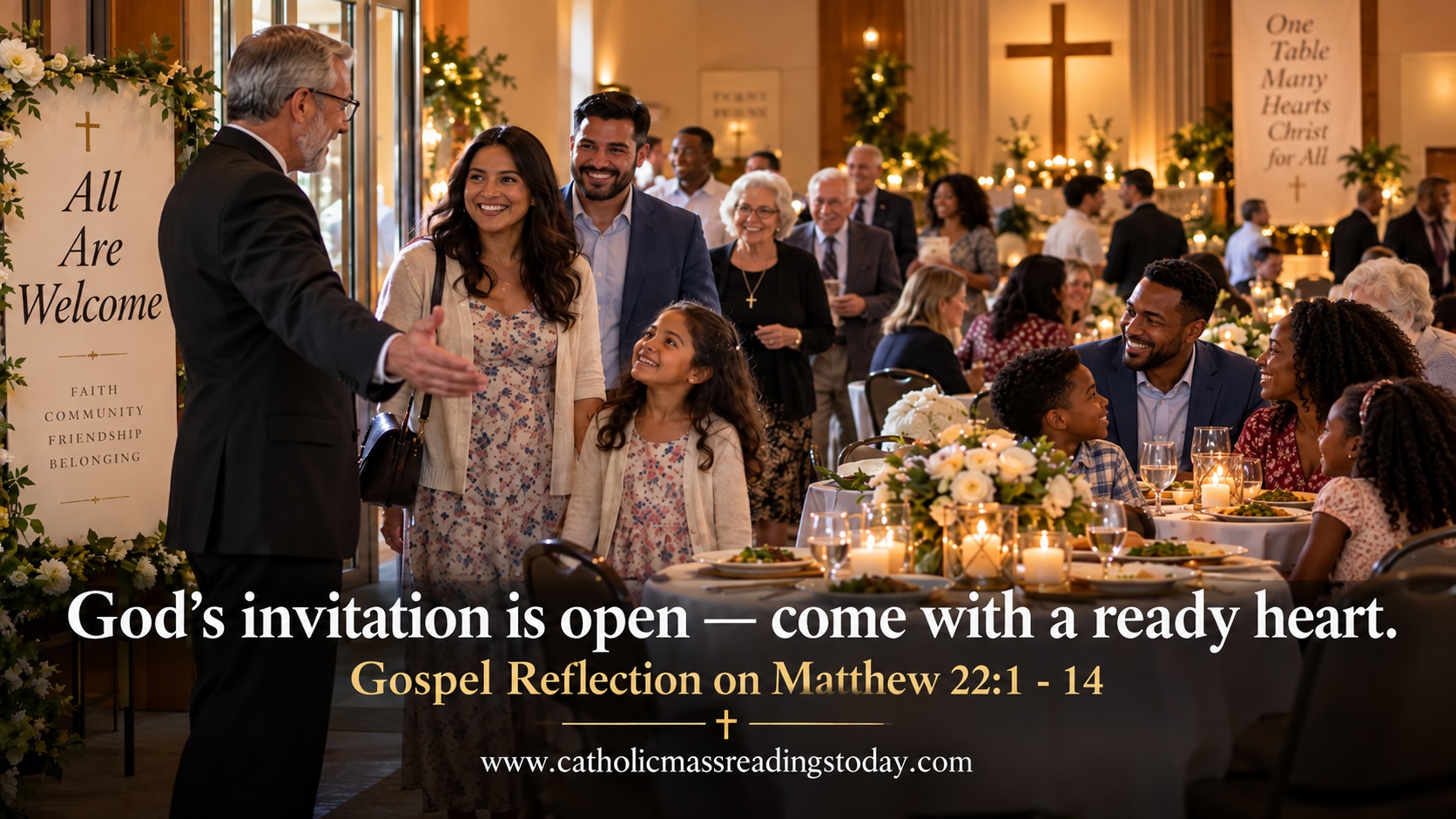
Today’s Gospel presents us with one of Jesus’ most striking images of the Kingdom of Heaven: a wedding feast prepared by a king for his son. Everything is ready. The table has been set. The invitation has gone out. Nothing remains except for the invited guests to come.
And yet, astonishingly, many refuse.
Some are too occupied with their farms and businesses. Others treat the invitation with contempt. Eventually, the king sends his servants into the streets and tells them to invite everyone they can find. The hall fills with guests, but the parable does not end there. One man enters without a wedding garment and is confronted by the king.
The message is both beautiful and demanding. God’s invitation is generous beyond measure, but it is not something we should receive casually.
God Has Prepared the Feast
The first thing Jesus wants us to see is the generosity of the king.
The feast is already prepared.
The guests are not being asked to provide the food, arrange the tables, or earn their place at the celebration. They are simply being invited to come and receive what has already been prepared for them.
This tells us something fundamental about our relationship with God.
Grace begins with Him.
Before we ever searched for God, He was already calling us. Before we could offer Him anything, He had already offered us mercy. Before we could make ourselves worthy, Christ had already opened the way to salvation.
The Christian life begins with an invitation.
“Come.”
Come to the feast. Come into relationship with God. Come receive His mercy. Come listen to His Word. Come to the Eucharistic table. Come and share in the life He desires for you.
The tragedy of the parable is not that there is no place at the feast. There is plenty of room.
The tragedy is that some simply refuse to come.
When Ordinary Things Become More Important Than God
The first invited guests do not all reject the king because they are engaged in obviously evil activities.
One goes to his farm and another goes to his business.
These are ordinary responsibilities. There is nothing wrong with farming or working. The problem is that good and necessary things have become more important than the king’s invitation.
That danger is very real in our own lives.
Most people do not wake up one morning and decide that God no longer matters. Faith can slowly become secondary because life becomes crowded.
There is work to finish, bills to pay, children to care for, messages to answer, appointments to keep, plans to make and entertainment to enjoy.
None of these things is necessarily wrong. But when every other part of life is given our best attention and God receives only whatever time remains, something has become disordered.
The invitation is still there, but we keep saying, “Later.”
Later I will pray, later I will return to Mass, later I will go to Confession, later I will forgive, later I will change and later I will take my faith seriously.
The Gospel reminds us that the invitation of God deserves a response now.
The Invitation Reaches Everyone
When the original guests refuse to come, the king sends his servants into the streets.
“Invite to the marriage feast as many as you find.”
Suddenly, the invitation reaches people who probably never imagined themselves sitting at the king’s table.
The servants gather everyone they find, “both bad and good.”
There is something profoundly hopeful in these words.
God’s mercy is not reserved for people who already have perfect lives.
The Church is not a gathering of people who have never made mistakes. The Gospel is not offered only to those who have an impressive spiritual history.
Christ calls sinners.
- He calls the wounded.
- He calls people who have wandered far away.
- He calls those who have failed repeatedly.
- He calls those who are still trying to find their way home.
The doors of the feast are opened widely.
No one should look at his or her past and conclude, “There could never be a place for me with God.”
If the invitation has reached you, there is a place.
The Wedding Garment Matters
Then the parable takes a surprising turn.
The king notices one guest who is not wearing a wedding garment and asks, “Friend, how did you get in here without a wedding garment?”
The man has no answer.
This part of the Gospel reminds us that accepting God’s invitation involves more than simply showing up.
Grace is freely given, but grace is meant to change us.
We cannot encounter Christ seriously and insist that nothing in our lives should be different.
The wedding garment can be understood as the transformed life of someone who has responded to God’s grace. It points toward conversion, repentance, faith, and the willingness to live according to the Gospel.
We do not earn salvation by making ourselves perfect. But when God welcomes us, He also calls us to leave behind whatever prevents us from belonging fully to Him.
The invitation is free.
The response costs us something.
- It may cost our pride.
- It may require forgiveness.
- It may mean walking away from a sinful habit.
- It may require repairing a relationship.
- It may mean changing priorities that have slowly pushed God out of our lives.
God receives us as we are, but His love is too great to leave us exactly as He found us.
Many Are Called, but Few Are Chosen
Jesus ends the parable with the words, “For many are called, but few are chosen.”
These words are not meant to make faithful people live in constant fear. They are meant to shake us out of spiritual indifference.
The call of God is not something to take for granted.
Faith requires a response.
We can hear the Gospel without allowing it to change us. We can attend Mass while keeping God at a safe distance from the rest of our lives. We can know the teachings of Christ without actually following them.
Jesus invites us to something deeper.
He wants disciples, not spectators.
The question is not simply whether we have received the invitation.
The question is what we are doing with it.
The Eucharist and the Wedding Feast
For Catholics, the image of the wedding banquet carries a particularly beautiful meaning.
Every time we gather for Mass, we come to a sacred feast.
We listen to God’s Word and we gather as His people.
And above all, we approach the table where Christ gives us His own Body and Blood in the Eucharist.
The earthly liturgy points beyond itself toward the eternal banquet of Heaven.
When we approach the Eucharist, therefore, we are being reminded of where our entire Christian life is heading.
God wants us with Him.
The final destiny of the faithful is not loneliness, fear, suffering, or death.
It is communion, it is joy, it is the feast of the Kingdom.
This makes every Mass both a gift and an invitation to prepare our hearts for the life to come.
There Is Still Room at the Table
Perhaps one of the most beautiful truths in this Gospel is that the king refuses to celebrate with an empty hall.
He keeps sending servants out.
He keeps inviting.
He wants the room filled.
That image gives hope to anyone who believes he or she has waited too long to return to God.
The invitation remains.
- For someone who has been away from the Church, the invitation remains.
- For someone carrying shame from past mistakes, the invitation remains.
- For someone whose prayer life has grown cold, the invitation remains.
- For someone who has fallen into the same sin many times, the invitation remains.
God continues to call.
But He asks us not merely to hear the invitation.
He asks us to come.
Our Response to Today’s Gospel
Today’s Gospel invites us to examine what place God truly has in our lives.
Have we become too busy for the One who gave us life?
Have ordinary concerns slowly become more important than our relationship with Him?
Have we accepted His invitation outwardly while resisting the conversion He asks of us inwardly?
There is still time to respond, the feast is prepared, the doors are open, the King is calling and the invitation is more personal than we sometimes realize.
God is not simply inviting humanity in general.
He is inviting you.
The only question that remains is how you will answer.
Let us Pray
Lord Jesus,
thank You for calling me to Your Kingdom and inviting me to the feast of Your love.
Forgive me for the times I have allowed the worries, responsibilities, and distractions of life to become more important than You.
Help me never to take Your invitation for granted.
When I wander, call me back.
When I become spiritually indifferent, awaken my heart.
When sin separates me from You, give me the humility to repent and begin again.
Clothe me with the grace of a life transformed by Your love.
Teach me to welcome Your Word, receive Your mercy, and approach the Eucharist with faith and reverence.
And Lord, help me remember those who have not yet discovered Your invitation. Make my life a witness that draws others toward You rather than away from You.
May I one day enter the eternal wedding feast of Heaven, where every sorrow is ended and Your people rejoice forever in Your presence.
Until that day, keep my heart ready, faithful, and close to You.
Amen.