Every year on 11 November, the Catholic Church celebrates the Memorial of Saint Martin of Tours, Bishop, honouring one of the most beloved saints of early Christianity. His life is remembered for an extraordinary act of charity, his deep love for the poor, his commitment to prayer, and his courageous service as Bishop of Tours during the fourth century.
Saint Martin of Tours was a Roman soldier who became a monk and later a bishop. Although he lived during a period of great political and religious change, he chose to place his trust in Jesus Christ rather than pursue military honour, wealth, or worldly recognition.
His story has inspired Christians for more than sixteen centuries. He is especially remembered for dividing his military cloak and giving half of it to a poor man suffering in the cold, an act that would become one of the most recognisable images of Christian charity.
Yet Saint Martin’s greatness cannot be understood through that single act alone. Behind the familiar story of the cloak was a man who spent his life seeking God, caring for the suffering, preaching the Gospel, establishing monastic communities, and working tirelessly for the salvation of souls.
His life reminds us that holiness is not measured by the honours a person receives, but by the sincerity of the love with which that person serves God and others.
The Birth and Early Life of Saint Martin of Tours
Saint Martin of Tours was born around AD 316 or 317 in Sabaria, a town in the Roman province of Pannonia, located in what is now Szombathely, Hungary.
He was born into a family that followed the traditional religious beliefs of the Roman world. His father was an officer in the Roman army who held the rank of military tribune.
The Roman Empire was undergoing important changes during Martin’s childhood. Christianity, which had suffered centuries of persecution, had received legal recognition under Emperor Constantine and was becoming increasingly influential throughout the Empire.
However, Christianity had not yet become the faith of every Roman family, and many people continued to worship the traditional Roman gods.
Martin’s family eventually moved to Pavia in northern Italy, where his father had been granted land following his military service. It was in this environment that Martin grew up and received his early education.
Although his parents were not Christians, the young Martin became increasingly interested in the Christian faith.
According to early accounts of his life, he was drawn to Christianity from childhood and expressed a desire to devote himself to God. He was attracted particularly to the simplicity, prayer, and self-denial associated with the Christian ascetic life.
At an age when many young people were beginning to think about their future careers, Martin was already considering a life of spiritual service. His father, however, had different expectations.
As the son of a Roman military officer, Martin was expected to follow the family tradition and enter the imperial army.
This created an early struggle between the life his family expected him to pursue and the religious vocation gradually taking shape within his heart.
Saint Martin’s Early Years as a Roman Soldier
Around the age of fifteen, Martin entered military service in the Roman army. His enlistment was connected with the military obligations imposed upon sons of veterans, and it placed him in a world very different from the quiet life of prayer he desired.
The Roman army was an institution built upon discipline, hierarchy, loyalty, and military strength. Soldiers were trained to obey their commanders and defend imperial interests, often in regions far from their homes.
Martin served in the imperial military establishment and was stationed in Gaul, a territory covering much of present-day France and neighbouring regions. Although he fulfilled his military responsibilities, his growing Christian faith influenced the way he treated others.
Early accounts describe him as unusually gentle, disciplined, and generous. He avoided the excesses associated with military life and sought to live with humility and consideration for those around him.
He treated his fellow soldiers and attendants with respect, refusing to allow his position to become an excuse for arrogance or cruelty.
For Martin, the dignity of a human being did not depend upon military rank, wealth, or social standing. This attitude would become one of the defining characteristics of his entire life.
Even before becoming a bishop or monk, Martin was learning that following Christ meant living differently from the world around him.
The Cloak of Saint Martin: An Extraordinary Act of Christian Charity
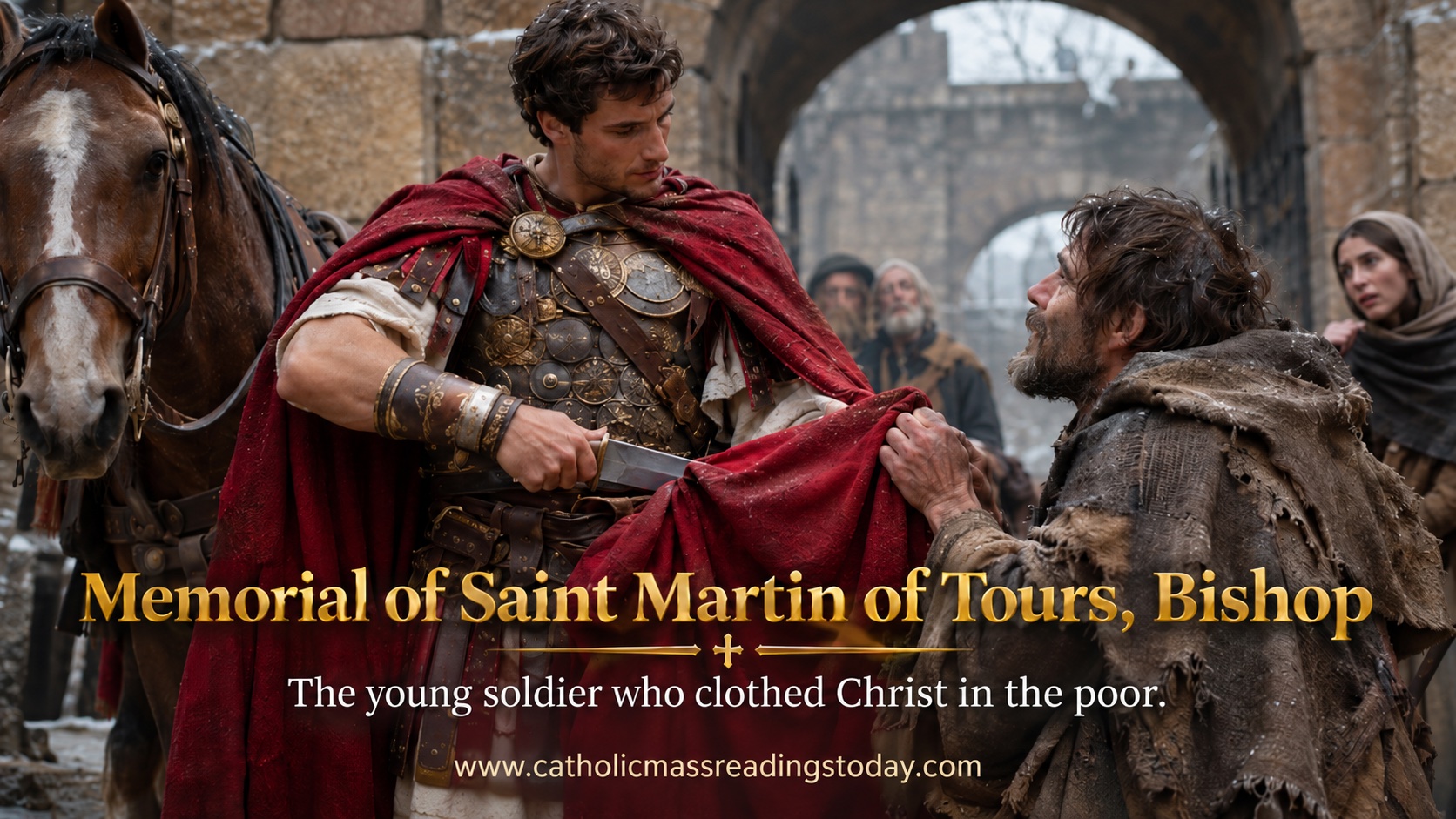
The most famous event in the life of Saint Martin of Tours occurred while he was serving as a Roman soldier in Amiens, in northern Gaul. It was a bitterly cold day when Martin encountered a poor man near the city gates.
The man was inadequately clothed and suffering from the cold. He begged for assistance, but the people passing by did not provide the help he desperately needed.
Martin saw the man’s distress and was moved with compassion. He had little available to give him, but he could not bring himself to continue walking while another human being suffered before his eyes.
According to the traditional account, Martin drew his sword, divided his military cloak into two pieces, and gave one half to the poor man. He retained the remaining portion for himself. It was a simple act, yet it revealed something profound about his character.
Martin did not wait until he possessed more money or better circumstances before helping someone in need. He shared what he had, even though doing so meant sacrificing something necessary for his own comfort.
For him, compassion required more than kind thoughts. It demanded action.
This encounter would become one of the most enduring stories in Christian history because it expresses the teaching of Jesus in the Gospel according to Matthew:
“As you did it to one of the least of these my brethren, you did it to me.” (Matthew 25:40)
Saint Martin recognised the suffering of another person and responded with generosity, even at personal cost. His example reminds us that Christian charity begins when we refuse to remain indifferent to the needs of those around us.
The Vision of Jesus Christ Wearing Saint Martin’s Cloak
The story of Martin’s cloak does not end at the gates of Amiens. According to the account preserved by his early biographer, Sulpicius Severus, Martin experienced an extraordinary dream that night.
He saw Jesus Christ wearing the portion of the cloak he had given to the poor man.
Christ appeared in the company of angels and identified Martin as the soldier who had clothed Him, even though Martin had not yet received Baptism.
For Martin, the experience revealed a truth that would shape the rest of his life. The poor man he had helped was not merely an unfortunate stranger. In serving the suffering man, Martin had served Christ Himself.
The vision strengthened his desire to belong completely to Jesus. It also gave a deeper meaning to the charity he had shown. The cloak had provided warmth to a man in need, but the love behind the gift had become an expression of faith.
This story is treasured within Catholic tradition because it brings to life one of the central teachings of the Gospel.
Jesus identifies Himself with those who hunger, thirst, suffer, or lack the necessities of life.
Whenever Christians respond to such needs with sincere love, they are honouring Christ.
Saint Martin’s cloak reminds us that what we give to the poor out of love for God is never wasted. It becomes a gift offered to Christ Himself.
Saint Martin’s Baptism and His Decision to Leave the Army
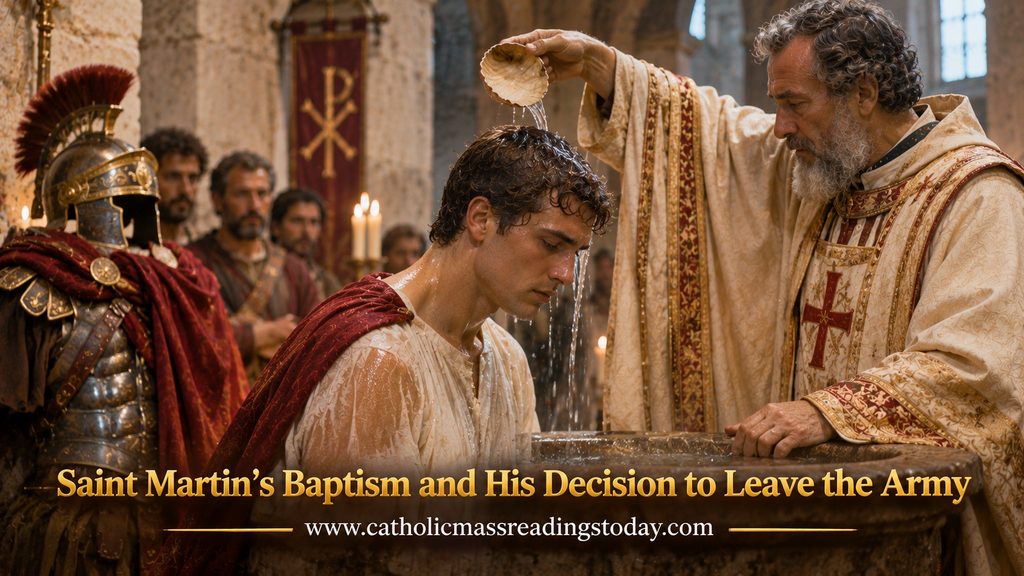
Martin’s encounter with Christianity gradually developed into a firm personal commitment.
Although the exact chronology of his Baptism is not entirely certain, early accounts place it during his years of military service, while he was still a young man.
Through Baptism, Martin entered fully into the life of the Church. His desire for a life dedicated to Christ continued to grow.
Military service had taught him discipline and perseverance, but he increasingly felt called to serve a different Master.
The turning point came when Martin sought to leave the army. Sulpicius Severus recounts that, when military preparations were being made for a campaign, Martin declared his desire to serve Christ rather than continue fighting. He was challenged over his decision and accused of cowardice.
Martin rejected that accusation. According to the traditional account, he offered to stand before the opposing army without weapons, trusting in God rather than military protection.
The confrontation ended without the battle that had been expected.
The precise circumstances and chronology of his departure from military service have been discussed by historians, but the central direction of his life is clear.
Martin eventually left the army, traditionally dated to around AD 356, and devoted himself to the religious vocation he had long desired.
The man who had once worn the uniform of a Roman soldier was preparing to become a servant of Christ through prayer, sacrifice, and pastoral ministry.
His courage would no longer be measured by military achievements, but by his faithfulness to the Gospel.
Saint Martin Meets Saint Hilary of Poitiers
After leaving military service, Martin travelled to Poitiers in Gaul, where he came under the spiritual guidance of Saint Hilary, the Bishop of Poitiers.
Saint Hilary was one of the leading defenders of Catholic doctrine during the controversies surrounding Arianism.
Arian teaching denied the full divinity of Jesus Christ, threatening the Church’s understanding of the relationship between the Father and the Son.
Saint Hilary strongly defended the teaching that Jesus Christ is truly divine and eternally one with the Father.
Martin found in Hilary an experienced spiritual guide whose faith, theological understanding, and pastoral courage deeply influenced him. The relationship between the two saints became an important part of Martin’s religious formation.
Hilary recognised Martin’s sincerity and encouraged him in his desire to serve the Church.
According to early sources, Martin initially preferred a humble position within the Church rather than seek important ecclesiastical responsibilities. He did not desire public recognition. His deepest wish was to live close to God through prayer, simplicity, and service.
Under Saint Hilary’s influence, Martin grew in his understanding of the Christian faith and strengthened his commitment to the truth taught by the Church.
This period helped prepare him for the greater responsibilities he would eventually carry as Bishop of Tours.
Saint Martin’s Journey Home and His Efforts to Convert His Family
Martin did not forget his family after embracing the Christian faith. He returned to Pannonia, hoping to share the Gospel with his parents and others who had not yet accepted Christianity.
The journey took him into regions where religious disagreements were intense and where defenders of orthodox Catholic teaching sometimes faced opposition.
According to traditional accounts, Martin succeeded in bringing his mother to the Christian faith. His father, however, appears to have remained attached to his earlier religious convictions.
Martin also encountered hostility because of his opposition to Arian teaching. His commitment to the divinity of Jesus Christ brought him into conflict with those who rejected the Church’s doctrine.
These difficulties revealed another aspect of his character.
Martin was gentle towards the poor and compassionate towards sinners, but he was not indifferent when the truth of the Christian faith was challenged. He understood that charity and fidelity to the Gospel must belong together.
His travels eventually took him through northern Italy, where he spent a period living an ascetic life. Among the places associated with this stage of his journey was the island of Gallinaria, off the Italian coast, where he sought solitude and prayer.
These years were important in his spiritual development.
Martin was learning to surrender the security of ordinary life in order to follow Christ more completely.
The Foundation of the Monastery at Ligugé
Around AD 360 or 361, after Saint Hilary had returned from exile, Martin returned to the region of Poitiers. With Hilary’s support, he established a small monastic community at Ligugé, near Poitiers.
This community is widely recognised as one of the earliest organised monasteries in Western Europe and the earliest well-documented monastic foundation in Gaul.
The monastery became a place where Martin could pursue the life he had desired since his youth. He lived simply, devoted himself to prayer, studied Sacred Scripture, and practised fasting and self-denial.
Other men who wished to follow a similar spiritual path gradually gathered around him. They were drawn by his example and his commitment to living the Gospel.
For Martin, monastic life was not an escape from Christian responsibility. It was a way of placing God at the centre of everything.
The silence of prayer strengthened his ability to serve others, while community life taught the importance of humility, obedience, and charity.
The monastery at Ligugé also became a centre from which the Christian faith spread into the surrounding countryside.
Martin’s influence extended beyond the walls of the monastery as people came seeking prayer, counsel, and spiritual assistance.
Early Christian accounts attribute numerous miracles and healings to his prayers during this period.
Although individual miraculous accounts belong to the testimony of his early biographers and the devotional tradition of the Church, they demonstrate the extraordinary reputation for holiness that Martin had acquired.
His years at Ligugé established a pattern he would maintain throughout his life: deep personal prayer combined with active service to the people of God.
The Election of Saint Martin as Bishop of Tours in AD 371
By the early 370s, Saint Martin had become widely respected for his holiness, compassion, and dedication to the Christian faith.
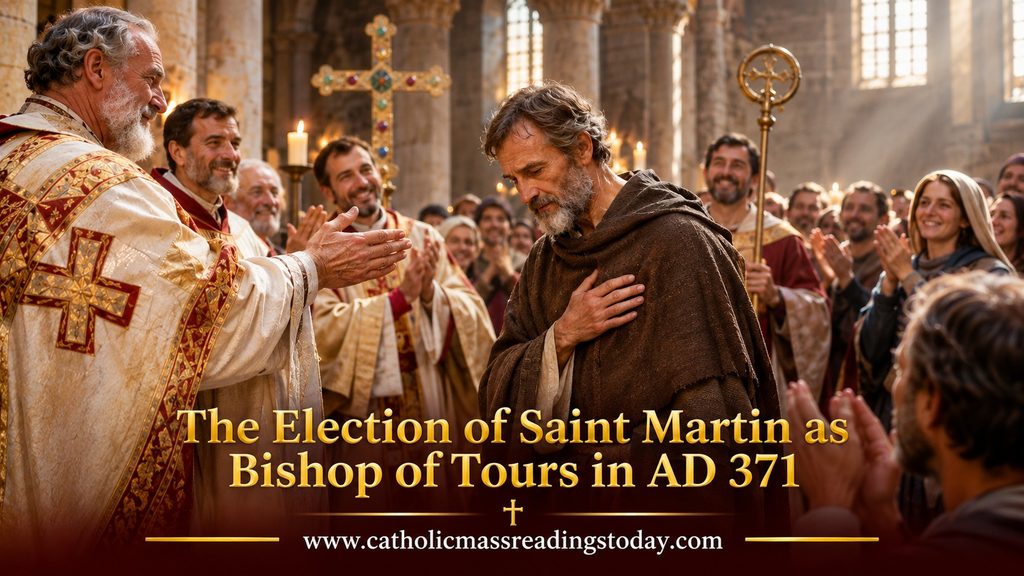
When the episcopal see of Tours became vacant, the people wanted him to become their bishop.
Martin, however, was reluctant to accept the position. He had chosen a life of simplicity and prayer, and he feared that the responsibilities of episcopal leadership would separate him from the monastic vocation he loved.
According to early tradition, the people of Tours arranged for him to come to their city under the pretext of visiting someone who was seriously ill.
Once he arrived, he discovered that the faithful were determined to have him as their bishop.
Some of the bishops present reportedly questioned whether Martin’s modest appearance and simple clothing made him suitable for such an important office.
But the people recognised something more valuable than outward distinction.
They had witnessed his faith, compassion, and holiness.
In AD 371, Martin was consecrated Bishop of Tours. His election marked a significant turning point in his life. The former soldier and humble monk was now entrusted with the spiritual care of an entire Christian community.
Yet Martin did not abandon the way of life that had shaped him. He continued to value prayer, simplicity, and service to the poor.
Unlike leaders who sought prestige through their office, he regarded episcopal authority as a responsibility entrusted by God.
Saint Martin understood that becoming a bishop did not mean being placed above others for personal honour. It meant being called to serve them more faithfully.
A Bishop Who Refused Wealth and Worldly Privilege
As Bishop of Tours, Saint Martin had opportunities to live with greater comfort and enjoy the privileges associated with his office. He chose a different path. His manner of life remained simple, disciplined, and deeply rooted in prayer.
Martin did not believe that his position entitled him to luxury while people around him suffered.
He understood that the bishop was called to imitate Jesus Christ, the Good Shepherd, who came not to be served but to serve. This conviction influenced his relationships with the faithful.
He showed particular concern for the poor, the sick, prisoners, and those who had been forgotten by society. He was willing to visit those in need, listen to their difficulties, and offer whatever assistance he could.
His episcopal ministry was not limited to preaching inside churches. He travelled among the people, including those living in rural communities where Christianity had not yet become firmly established.
Martin’s example offered a different understanding of religious leadership from that associated with worldly influence and personal advantage.
He demonstrated that the authority of a bishop should be exercised with humility, compassion, courage, and fidelity to the Gospel.
His life remains a powerful reminder that spiritual leadership must never become separated from the needs of the people being served.
The Monastery of Marmoutier and the Growth of Monastic Life in Gaul
After becoming Bishop of Tours, Martin continued seeking opportunities for solitude and prayer. He eventually established another monastic community at Marmoutier, near Tours, along the banks of the River Loire.
The location offered a degree of separation from the activity of the city while remaining close enough for Martin to fulfil his responsibilities as bishop. The community grew as men from different backgrounds sought to live under his spiritual guidance.
Some were from wealthy or influential families, yet they willingly embraced the simplicity and discipline of monastic life.
Early accounts describe a community committed to prayer, fasting, study, and a common life of self-denial.
Martin encouraged his companions to seek holiness through humility and fidelity rather than through public recognition.
The monastery became an important centre of Christian spiritual life and helped influence the development of Western monasticism.
It also contributed to the formation of men who would later serve the Church as missionaries, priests, and bishops.
Martin’s ability to combine monastic prayer with episcopal responsibility was especially significant. He demonstrated that an active life of pastoral service does not have to weaken a person’s relationship with God. Instead, prayer can become the source of strength that makes faithful service possible.
For Saint Martin, time spent in the presence of God prepared him to meet the spiritual and material needs of others.
Saint Martin of Tours and the Evangelisation of Rural Gaul
One of Saint Martin’s greatest contributions to the Church was his missionary work in the countryside of Gaul.
During the fourth century, Christianity was well established in many Roman towns and cities, but traditional religious practices continued to be widespread in rural communities.
Martin recognised that the Gospel needed to reach people beyond the major urban centres. He travelled from village to village, preaching the Christian faith and encouraging people to abandon practices he believed were incompatible with worship of the one true God. His missionary journeys were often difficult.
Rural travel could involve poor roads, dangerous conditions, and communities that were suspicious of Christian missionaries.
Martin nevertheless persevered. He understood that proclaiming the Gospel required patience, courage, and a willingness to encounter people where they lived.
Early accounts describe his confrontations with pagan religious practices and his efforts to establish places of Christian worship.
They also attribute remarkable healings and other miracles to his intercession. These stories contributed to his reputation as a powerful missionary and holy bishop.
His ministry helped strengthen Christianity throughout the region and contributed to the development of rural Christian communities.
For this reason, Saint Martin came to be remembered as one of the great apostles of Gaul. His missionary work also teaches an enduring lesson.
The Church must never become so comfortable within established communities that she forgets those who have not yet encountered the Gospel.
The call to evangelisation extends beyond familiar surroundings and requires Christians to approach others with courage, patience, and genuine love.
The Miracles Attributed to Saint Martin of Tours
Throughout his life, Saint Martin became known as a man of extraordinary prayer. His earliest biographers recorded numerous miracles attributed to his intercession, including healings, deliverance from spiritual affliction, and accounts of people being restored to life.
One of the important sources for these traditions is Sulpicius Severus, a Christian writer who knew Martin and admired his holiness.
Sulpicius wrote his Life of Saint Martin while the saint was still alive, preserving stories that later became central to Martin’s devotional reputation.
Among the miracles traditionally attributed to him are the healing of people suffering from serious illnesses and the restoration of life to individuals whose deaths had been mourned.
Accounts of healing also became associated with his missionary travels.
The Church’s devotion to Saint Martin developed partly through these stories, which portrayed him as a bishop whose faith was strengthened by deep prayer and trust in the power of God.
It is important to distinguish these early devotional accounts from events that can be independently established through modern historical investigation.
The miraculous stories are part of the Church’s received tradition concerning Martin, but the precise details of individual events cannot always be historically verified.
Their spiritual meaning, however, remains closely connected with his life. Saint Martin did not seek extraordinary signs for personal glory. His desire was to lead people towards Jesus Christ, the true source of healing and salvation.
Saint Martin’s Defence of Mercy During the Priscillian Controversy
One of the most revealing episodes in Saint Martin’s episcopal ministry concerned the controversy surrounding Priscillian, a Christian leader from Spain whose teachings had been condemned by other bishops.
The dispute became increasingly serious when ecclesiastical accusations were brought before the imperial authorities.
Priscillian and several of his followers were eventually sentenced to death under Emperor Magnus Maximus in 385.
Saint Martin was deeply troubled by the use of imperial punishment in what had become a religious controversy.
Although he did not support teachings he considered contrary to the Catholic faith, he believed that executing people over such disputes was a grave misuse of authority.
Martin intervened with the emperor and sought to prevent bloodshed.
According to early accounts, he obtained assurances that the accused would not be executed, but those assurances were not ultimately honoured.
After the executions, Martin continued opposing the persecution and sought to protect others who were threatened. His actions remain an important part of his legacy. He demonstrated that defending Catholic doctrine does not require cruelty towards those who hold different beliefs.
For Martin, fidelity to the truth had to remain joined to mercy and respect for human life. This distinction remains important in the life of the Church.
Christians are called to uphold the teachings of their faith, but they must do so without hatred, vengeance, or disregard for the dignity of others.
Saint Martin showed that courage is sometimes found not in condemning the accused, but in standing before those in power and pleading for mercy.
The Final Years of Saint Martin of Tours
Saint Martin continued serving the Church well into old age.
By the final years of his life, he had spent decades preaching, establishing monastic communities, caring for the poor, and guiding Christians throughout Gaul.
His physical strength had begun to decline, but his commitment to his pastoral responsibilities remained strong. He continued travelling when the needs of the faithful required his presence.
Martin’s final journey took him to Candes, near the meeting of the Loire and Vienne rivers.
According to the early accounts, he travelled there to help reconcile clergy who had become divided by a dispute.
Even in old age, Martin remained concerned about unity within the Church.
He understood that disagreements among Christians could damage the community and weaken its witness to the Gospel. His final mission was therefore an act of pastoral service. Rather than remain in comfort, he travelled to help restore peace.
He succeeded in addressing the disagreement, but while preparing to return to Tours, he became seriously ill. It gradually became clear that his earthly life was approaching its end.
The Death of Saint Martin of Tours in AD 397
Saint Martin of Tours died at Candes on 8 November 397, traditionally understood to have been around eighty years old.
His death was mourned by the monks and Christians who had come to love and respect him.
Early accounts describe him spending his final moments in prayer, remaining peaceful and devoted to God despite his physical weakness. He had spent his life rejecting worldly comfort, and even at the end, he remained faithful to the simplicity he had embraced as a monk.
His companions surrounded him, grieving the loss of a bishop who had become both a spiritual father and a living example of Christian charity. Yet Martin’s death was also understood within the hope of the Resurrection.
He had devoted his life to Jesus Christ, and the faith he preached assured Christians that death does not have the final word.
Following his death, his body was taken to Tours. He was buried on 11 November 397, the date that became associated with his annual liturgical celebration. His tomb soon became a place of prayer and pilgrimage.
Christians came to honour the bishop who had devoted his life to God and to seek his intercession.
The man who had once divided his cloak to help a stranger was now remembered throughout the region as a model of holiness and a powerful witness to the Gospel.
The Tomb of Saint Martin and the Growth of Devotion in Tours
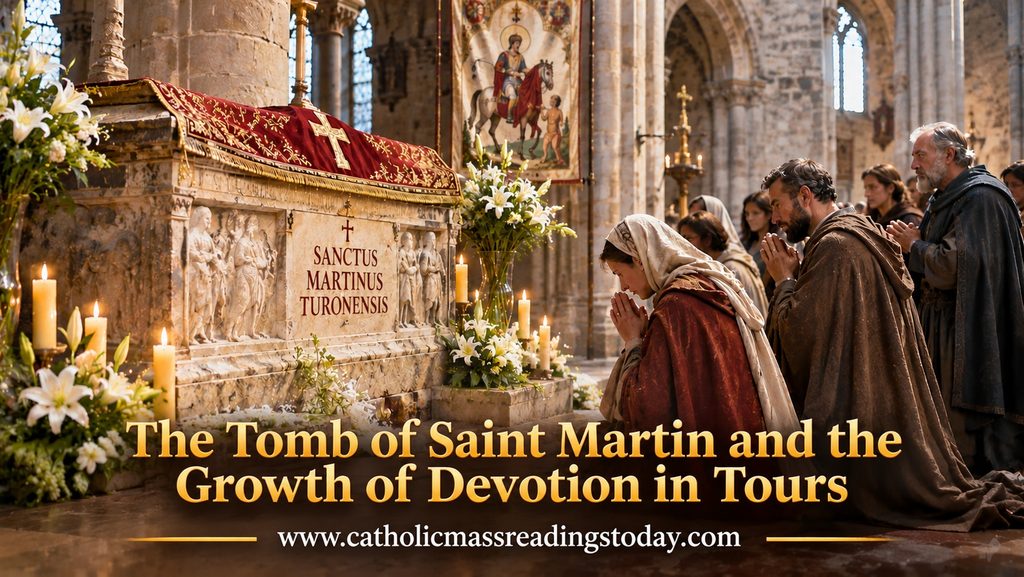
After Saint Martin’s death, devotion to him spread rapidly. His burial place in Tours became an important centre of Christian pilgrimage.
During the fifth century, a shrine was established over his tomb, and a larger basilica was subsequently built to accommodate the growing number of pilgrims.
The sanctuary became one of the most famous religious sites in medieval France.
Kings, bishops, monks, pilgrims, and ordinary families travelled to Tours to honour Saint Martin and seek his intercession. His reputation spread far beyond Gaul.
Churches were dedicated to him across Europe, and his name became associated with towns, monasteries, charitable institutions, and places of pilgrimage.
Saint Gregory of Tours, who served as Bishop of Tours during the sixth century, contributed greatly to preserving and spreading devotion to Saint Martin.
Through his writings, the saint’s reputation for holiness and miraculous intercession became known to an even wider Christian audience.
The shrine also played an important role in the religious and cultural history of France.
Over the centuries, it experienced periods of rebuilding, destruction, restoration, and renewed devotion.
Although the medieval basilica did not survive intact, a later basilica was constructed in Tours, where Saint Martin’s tomb continues to be honoured.
His resting place remains a reminder that the witness of a faithful Christian can continue inspiring others long after death.
The Cloak of Saint Martin and the Origin of the Word Chapel
The cloak associated with Saint Martin became one of the most famous relics in medieval European Christianity.
According to tradition, a portion of his cloak was preserved and came into the possession of the Frankish rulers.
The relic was treated with great reverence and was associated with royal prayer and religious ceremonies.
The Latin word cappella, meaning a small cloak, became connected with the place where the relic was kept.
This tradition is widely associated with the development of the word chapel, which eventually came to describe a smaller place of Christian worship.
The religious attendants responsible for the sacred place also became associated with the development of the term chaplain.
These linguistic traditions illustrate the remarkable influence that the memory of Saint Martin exercised upon European religious life.
A simple act of charity performed by a young Roman soldier became connected, across the centuries, with words still used in Christian worship and pastoral ministry today.
The significance of the cloak, however, remains greater than its historical or linguistic influence.
It continues to represent the Christian responsibility to recognise Christ in the suffering and to offer practical assistance to those in need.
The History of the Memorial of Saint Martin of Tours
The Memorial of Saint Martin of Tours has been celebrated for many centuries, making it one of the oldest and most enduring commemorations of a non-martyr saint in Western Christianity.
During the earliest centuries of the Church, public devotion to saints was especially associated with those who had died as martyrs for their faith.
Saint Martin became one of the most prominent examples of a saint honoured for a life of heroic Christian virtue rather than martyrdom.
His reputation demonstrated that holiness could be achieved through prayer, charity, pastoral service, and faithful perseverance.
The date of 11 November became associated with his burial and was established as his feast day in the Western Church.
In medieval Europe, the feast became widely known as Martinmas. It held both religious and cultural importance.
In many farming communities, November marked the completion of agricultural work and preparations for the winter season.
The feast of Saint Martin became associated with thanksgiving for the harvest, hospitality, generosity, and the sharing of food.
In some regions, customs developed involving special meals, processions, lanterns, and charitable activities.
These traditions varied across countries and communities, but many were inspired by the saint’s reputation for kindness towards the poor.
The period following his feast was also associated in some Christian traditions with a season of fasting and preparation for Christmas, sometimes called Saint Martin’s Lent.
Although not all these customs remain part of modern Catholic liturgical practice, they reflect the influence of his feast upon the religious life of Europe.
Today, the Roman Catholic Church celebrates his memorial annually on 11 November.
Through the Mass, the Liturgy of the Hours, and the prayers of the faithful, Catholics continue to honour his witness and seek his intercession.
Saint Martin of Tours as a Patron Saint
The influence of Saint Martin of Tours extends beyond the communities in which he lived and ministered.
He is widely honoured as a patron saint of soldiers, military chaplains, and people whose work involves service and protection.
His association with soldiers comes from his early life in the Roman army.
Yet his example is especially meaningful because he used his position to practise compassion rather than seek personal glory.
Martin is also associated with the poor, those in need of assistance, and charitable service.
His famous act of sharing his cloak has made him an enduring symbol of generosity.
In various countries and local traditions, he is also invoked as a patron of particular towns, occupations, and communities, including groups associated with hospitality and agricultural life.
He is especially important in France, where he is remembered as one of the great missionary bishops who helped establish and strengthen Christianity.
Churches dedicated to Saint Martin can be found throughout Europe and in many other parts of the world.
His name remains familiar in Catholic schools, parishes, charitable organisations, and religious communities.
These patronages reveal the breadth of his influence.
Saint Martin’s holiness speaks not only to priests, bishops, and religious, but also to soldiers, workers, families, young people, and anyone who wishes to live the Gospel faithfully.
Why Saint Martin of Tours Is Important to the Catholic Church Today
The importance of Saint Martin of Tours lies in the extraordinary way he brought together prayer, charity, courage, and pastoral service.
- He was a soldier who learned to see Christ in the poor.
- He was a monk who understood that prayer must lead to love.
- He was a bishop who recognised that spiritual authority exists for the good of others.
And he was a defender of Catholic faith who refused to abandon mercy when dealing with those accused of religious error.
Each stage of his life offers an important lesson for the Church.
- His encounter with the poor man at Amiens reminds Catholics that love for Jesus Christ must be expressed through practical charity.
- His decision to leave the army reveals the importance of listening carefully to God’s call, even when that call requires difficult personal choices.
- His monastic foundations show the value of prayer, simplicity, and spiritual discipline.
- His work as Bishop of Tours demonstrates the responsibility of Church leaders to remain close to the faithful, especially those who are poor or vulnerable.
- His opposition to the execution of religious opponents reminds Christians that the defence of truth must never become an excuse for cruelty.
In a world where success is often measured by wealth, influence, and recognition, Saint Martin presents a different understanding of greatness.
He teaches that the most meaningful life is one offered in service to God and neighbour.
What Saint Martin of Tours Teaches Us About Christian Charity
One of the most important lessons from the life of Saint Martin is that charity cannot be postponed indefinitely.
It is easy to promise that we will help others when we have more money, when our responsibilities become lighter, or when our circumstances improve.
Martin could have made similar excuses when he encountered the poor man outside Amiens.
He was a young soldier with limited possessions. Yet he recognised an immediate need and responded with what he had.
His example invites us to examine our own attitudes towards those who suffer.
When we encounter poverty, illness, loneliness, or hardship, do we recognise the dignity of the person before us?
Are we willing to share something of our time, resources, or attention?
Or do we become so occupied with our own concerns that we overlook those who need our help?
Christian charity does not always require extraordinary wealth or dramatic sacrifices.
Sometimes it begins with a meal shared with someone who is hungry, a visit to a sick neighbour, forgiveness offered to someone who has caused pain, or a few moments spent listening to a person who feels forgotten.
The important thing is the love with which these actions are performed.
Saint Martin’s life reminds us that Jesus Christ is not encountered only in prayer and worship.
He also calls us to recognise His presence in those who suffer and depend upon the kindness of others.
We cannot claim to love Christ deeply while remaining indifferent to the suffering of the people He asks us to love.
The Enduring Legacy of Saint Martin of Tours
More than sixteen centuries after his death, Saint Martin of Tours remains one of the most widely recognised saints of the early Church.
His life has inspired countless works of Christian art, literature, church architecture, and religious devotion.
Yet the deepest reason for his enduring influence is not the fame of his name or the number of churches dedicated to him.
It is the simplicity and power of the Gospel message reflected in his actions.
Martin understood that every human being possesses dignity because every person is created and loved by God.
He recognised that a faithful Christian must be willing to serve, even when service requires sacrifice.
He embraced a life of prayer because he knew that human strength alone is not enough to sustain holiness.
He accepted the responsibilities of a bishop because he recognised the needs of the Church, even though he would have preferred the quiet life of a monk and until his final days, he continued seeking peace and reconciliation among the people entrusted to his care.
As the Catholic Church celebrates the Memorial of Saint Martin of Tours, Bishop, we are invited to reflect upon the direction of our own lives.
Are we becoming more generous towards those in need?
Are we allowing prayer and the sacraments to strengthen our love for God?
Are we willing to fulfil our responsibilities with humility, even when doing so brings no worldly recognition?
Saint Martin reminds us that holiness does not begin with extraordinary achievements.
It begins when we open our hearts to God and allow His grace to transform the ordinary choices of daily life.
The soldier who shared his cloak with a stranger became a saint because he recognised that, in loving the poor, he was loving Jesus Christ Himself.
May his example inspire us to live with greater compassion, remain steadfast in faith, and serve others with the same generous love that shaped his life.
Let Us Pray
O God, who were glorified in the life and death of Saint Martin of Tours, Your faithful Bishop and servant,
You filled his heart with compassion for the poor and strengthened him to proclaim the Gospel with courage and humility.
Through his intercession, grant us the grace to recognise Your Son, Jesus Christ, in those who suffer, and teach us to share Your blessings with generous and loving hearts.
Strengthen our faith, deepen our devotion to prayer, and help us to serve our brothers and sisters with patience, mercy, and sincere charity.
May we follow Saint Martin’s example of holiness and remain faithful to You throughout our earthly pilgrimage, until we rejoice with him and all the saints in Your eternal Kingdom.
Through our Lord Jesus Christ, Your Son, who lives and reigns with You in the unity of the Holy Spirit, God, for ever and ever.
Amen.
Saint Martin of Tours, Bishop, pray for us.