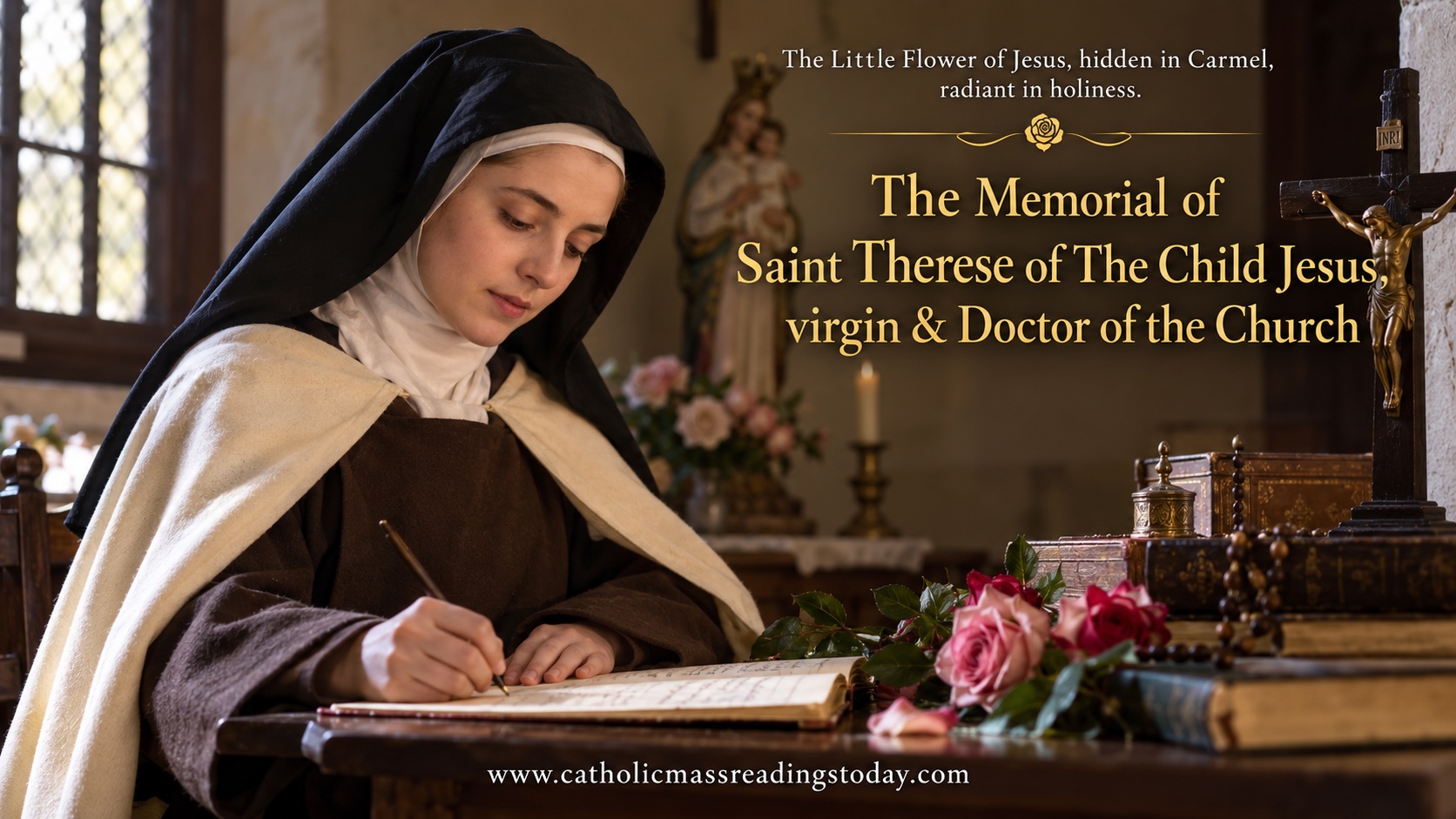
Every year on October 1, the Catholic Church celebrates the Memorial of Saint Therese of the Child Jesus, Virgin & Doctor of the Church, one of the most beloved saints of modern Catholicism. Known throughout the world as Saint Therese of Lisieux, the Little Flower, and Saint Therese of the Child Jesus and the Holy Face, she lived only twenty-four years, spent most of her adult life hidden within a Carmelite monastery, never founded a religious congregation, never taught at a university, and never travelled to the missions.
Yet from that hidden life came one of the most influential spiritual teachings of the modern Church.
Saint Therese taught that holiness is not reserved for the extraordinary. It is found in trusting God completely, accepting our littleness, receiving His mercy, and doing ordinary things with extraordinary love. Her spirituality, often called the “Little Way,” spread across the world after her death and touched millions of Catholics because it made holiness seem not easier, but more accessible. It showed that sanctity begins not with human greatness, but with confidence in the mercy of God.
The Church celebrates her memorial on October 1 and honours her as a virgin, Carmelite, Doctor of the Church, patroness of the missions, and one of the great teachers of spiritual childhood.
The Birth of Saint Therese
Saint Therese was born Marie Françoise Thérèse Martin on January 2, 1873, in Alençon, France. She was the youngest surviving daughter of Louis Martin and Zélie Guérin Martin, a deeply devout Catholic couple whose family life would later be recognized by the Church as a remarkable school of holiness. Therese was baptized two days after her birth in the Church of Notre-Dame in Alençon.
Her parents had once considered religious life themselves. Louis had hoped to become a monk, while Zélie had desired to enter religious life. When those paths did not open for them, they married and built a family centred upon faith, prayer, work, generosity, and trust in God.
Their home was affectionate and deeply Christian, but it was not spared suffering. Several of their children died in infancy. Therese therefore grew up in a family that knew both joy and grief.
From her earliest years she was intense, sensitive, affectionate, strong-willed, and deeply attached to her mother.
That attachment would make the first great loss of her life particularly painful.
The Death of Her Mother and the Move to Lisieux
On August 28, 1877, when Therese was only four years old, her mother Zélie died after suffering from breast cancer.
The loss deeply affected the young child.
After Zélie’s death, Louis Martin moved the family from Alençon to Lisieux, where they lived at a house known as Les Buissonnets. Therese was surrounded by the affection of her father and older sisters, but something within her had changed. The confident little girl became more emotionally fragile, sensitive, and dependent upon those she loved.
Her sister Pauline gradually became like a second mother to her.
Then another wound came.
When Pauline entered the Carmelite monastery in Lisieux in 1882, Therese experienced the separation almost as another bereavement.
Her emotional vulnerability became so intense that in the following year she fell seriously ill.
The Smile of the Blessed Virgin Mary
In 1883, Therese suffered a mysterious illness involving weakness, fever, nervous distress, and frightening symptoms that deeply alarmed her family.
On Pentecost that year, as her sisters prayed near her bed before a statue of the Blessed Virgin Mary, Therese later said that she saw the Virgin’s face become radiant and smile upon her.
She experienced a sudden peace and recovery.
For the rest of her life, she attributed her healing to the intercession of Our Lady. The experience became one of the defining moments of her childhood and strengthened her already profound love for the Blessed Virgin Mary. The biography of Therese records this healing as occurring through the intercession of Our Lady of Victories.
It was an early sign of the spirituality that would later characterize Therese: she did not see God as distant, but as a Father who draws near to the weak.
First Holy Communion and Confirmation
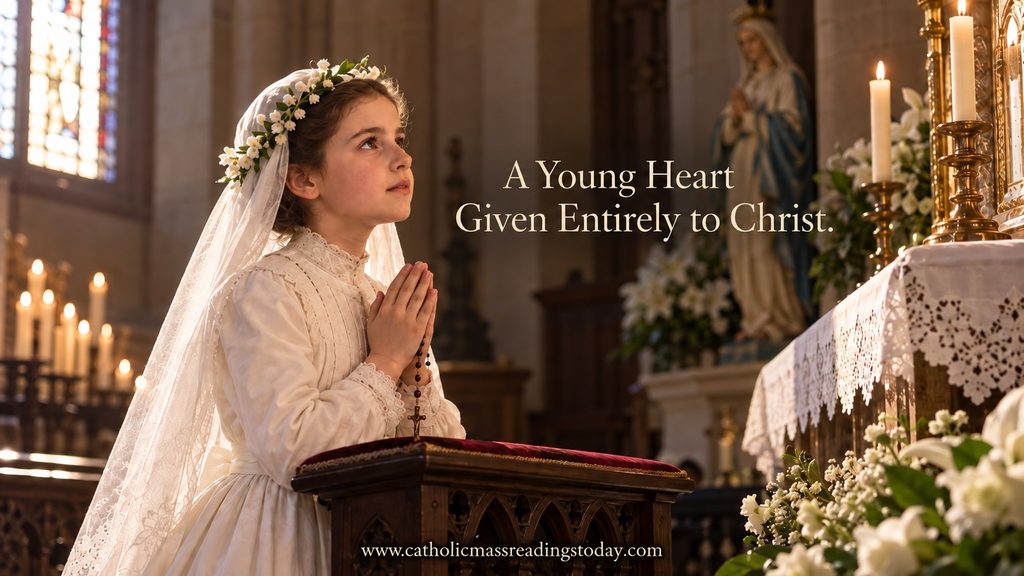
Therese received her First Holy Communion on May 8, 1884.
She had prepared intensely for the day and experienced it not simply as a ceremony, but as a deeply personal encounter with Jesus.
Later she described the moment in terms of union, love, and belonging.
A few weeks later, on June 14, she received the Sacrament of Confirmation. These sacramental experiences deepened her desire to belong completely to Christ.
Even at a young age, Therese had begun to develop the central desire that would dominate the rest of her life: to become a saint.
But the route by which she would understand sainthood was still unfolding.
The Christmas Grace of 1886
One of the most important moments in Saint Therese’s spiritual life came on Christmas night in 1886.
She was thirteen.
Until then, Therese remained unusually sensitive and easily wounded emotionally. But after Midnight Mass that Christmas, something changed.
She later described it as a “complete conversion.”
A small incident at home became the occasion. Her father, exhausted after Mass, made an impatient remark when he saw her shoes waiting to be filled with Christmas gifts. Normally Therese would have burst into tears. Instead, she suddenly found an inner strength she had not possessed before.
She chose joy.
She chose self-control.
She chose love.
She later saw that night as the moment when Jesus freed her from the emotional weakness that had followed her mother’s death and gave her the strength to begin what she called a new stage of her life. Pope John Paul II’s account of her life specifically identifies Christmas 1886 as the moment of this profound conversion.
From that point forward, Therese became increasingly focused upon living for others and giving herself to Christ.
The Desire to Enter Carmel
Therese’s older sisters Pauline and Marie had entered the Carmelite monastery at Lisieux.
Therese felt called to follow them.
But she wanted to enter extraordinarily young.
At fourteen, she requested permission to enter the Carmel at fifteen. Church authorities hesitated because of her age.
Therese was not easily discouraged.
In 1887 she travelled with her father and other pilgrims to Rome. During an audience with Pope Leo XIII on November 20, 1887, she broke protocol and directly asked the Pope to allow her to enter the Carmel at fifteen.
The young girl kneeling before the Pope was determined, emotional, and fearless.
Leo XIII did not simply issue the permission she hoped for. He told her, in essence, to obey God’s will and the judgment of her superiors.
Yet the episode revealed something important about Therese.
Her spirituality of littleness was never passivity.
She could be remarkably bold.
Her trust in God gave her courage.
The following year, the door finally opened.
Saint Therese Enters the Carmel of Lisieux
On April 9, 1888, at the age of fifteen, Therese entered the Carmelite monastery of Lisieux.
She received the Carmelite habit on January 10, 1889, and made her religious profession on September 8, 1890, the Feast of the Nativity of the Blessed Virgin Mary.
Inside the Carmel, Therese’s life became outwardly very small.
There were no great public achievements.
No crowds.
No dramatic apostolic journeys.
Her days were filled with the ordinary rhythm of Carmelite life: prayer, silence, community work, liturgy, sacrifices, fatigue, relationships, illness, misunderstandings, and hidden acts of charity.
And it was precisely there that her great spiritual discovery matured.
The Little Way Begins to Take Shape
Therese wanted to become a saint.
But she was painfully aware of her own weakness.
When she compared herself with great saints, she felt tiny.
Instead of giving up, she began asking whether God might provide a different path for small souls.
This became her Little Way.
Therese did not mean that holiness required little effort.
She meant that holiness does not depend upon making ourselves spiritually impressive.
It begins by admitting our poverty and trusting God’s mercy.
She compared herself to a small child unable to climb a staircase alone, who stretches out her arms toward a loving Father.
God Himself would lift her.
The Little Way is therefore a spirituality of humility, confidence, spiritual childhood, and love.
Pope Francis summarized the heart of her spirituality in 2023 with Therese’s own words: “It is confidence and nothing but confidence that must lead us to Love.”
That sentence captures almost everything.
Therese’s path was not self-reliance.
It was confident surrender.
Doing Small Things With Great Love
Saint Therese discovered that everyday life itself could become the place of sanctification.
- A difficult sister in the convent.
- A tiring duty.
- An irritation at prayer.
- A small humiliation.
- A kind word offered when she did not feel like speaking kindly.
- A sacrifice known only to God.
None of these things seemed dramatic.
But Therese came to understand that love gives spiritual weight to ordinary actions.
This is one reason her spirituality became so influential.
Most Christians will never perform spectacular acts.
But everyone can love, forgive, be patient, choose charity when resentment would be easier and even offer ordinary work to God.
Therese made holiness accessible without making it shallow.
The smallness was not in the love.
The smallness was in the circumstances through which love was offered.
Her Father’s Illness and a Deeper Union With Christ
Therese loved her father profoundly.
Louis Martin’s declining health therefore became one of the deepest trials of her religious life.
He suffered from serious mental and physical illness and eventually required institutional care.
For Therese and her sisters, the suffering was painful and humiliating.
She increasingly associated her father’s suffering with the humiliated face of Christ during His Passion.
This helps explain the fuller religious name by which she is known: Therese of the Child Jesus and the Holy Face.
The Child Jesus represented humility, littleness, and dependence.
The Holy Face represented suffering, rejection, hiddenness, and sacrificial love.
When Louis Martin died on July 29, 1894, Therese’s interior life entered an even deeper stage.
Her faith was becoming less dependent upon consolation and increasingly rooted in trust.
Her Offering to Merciful Love
On June 9, 1895, the Feast of the Most Holy Trinity, Therese made what she called her Act of Oblation to Merciful Love.
This was one of the most significant moments in her spirituality.
She did not offer herself primarily to divine punishment or justice, she offered herself to God’s mercy and she wanted God’s love to consume her life.
Therese increasingly saw holiness not as accumulating spiritual achievements but as allowing God to love us and allowing His love to pass through us.
This marked a crucial development in her understanding of grace.
God was not waiting for her to become great before loving her.
His love was precisely what would make her holy.
The Discovery of Her Vocation: “In the Heart of the Church, I Will Be Love”
Therese possessed an enormous spiritual ambition.
She wanted to be a missionary, a priest, a martyr, an apostle, a prophet. She seemed to desire every vocation at once.
Reading Saint Paul’s teaching about the Church as the Body of Christ helped her understand how all these desires could be united.
She discovered that the heart gives life to the entire body.
And then she understood her vocation.
Her vocation was love.
This became one of the most celebrated insights in all of her writings: she understood herself as called to be love in the heart of the Church.
This was not sentimental language.
It was deeply ecclesial.
If love animates every authentic Christian vocation, then a hidden Carmelite nun could participate spiritually in missionary work, preaching, martyrdom, priestly ministry, and the life of the whole Church through prayer and sacrificial love.
Saint John Paul II later praised exactly this insight when presenting Therese’s teaching to the universal Church.
Saint Therese and the Missions
Therese never left the Carmel to become a foreign missionary.
Yet she possessed an intense missionary heart.
She corresponded with missionary priests and prayed for them.
She offered sacrifices for missionaries and for the salvation of souls.
She longed for the Gospel to reach the ends of the earth.
This hidden missionary zeal is one of the most remarkable aspects of her life.
It also explains why the Church eventually named her Patroness of the Missions, alongside the great Jesuit missionary Saint Francis Xavier.
Pope Pius XI gave her that title in 1927, only two years after her canonization.
The pairing is striking.
Francis Xavier travelled enormous distances preaching the Gospel.
Therese never left her cloister.
Yet the Church placed them together.
Why?
Because mission is not only geographical movement.
Mission begins in love.
Prayer is missionary.
Sacrifice is missionary.
Hidden fidelity can become missionary.
Therese teaches that no baptized person is excluded from the missionary life of the Church.
The Beginning of Her Autobiographical Writings
Therese did not originally set out to write a spiritual classic.
Her autobiographical manuscripts began largely through obedience.
Her sister Pauline, who became Mother Agnes of Jesus, encouraged her to write memories of her childhood.
Later she wrote additional manuscripts explaining her spirituality and her religious life.
After her death, these texts were edited and published together under the title Story of a Soul.
The first edition appeared in 1898, only a year after Therese’s death. The book spread rapidly, first in France and then throughout the world.
Few could have predicted the effect.
A hidden Carmelite nun suddenly began speaking to millions.
Readers discovered a spiritual voice that was simple without being simplistic, affectionate without being superficial, and deeply theological without using academic language.
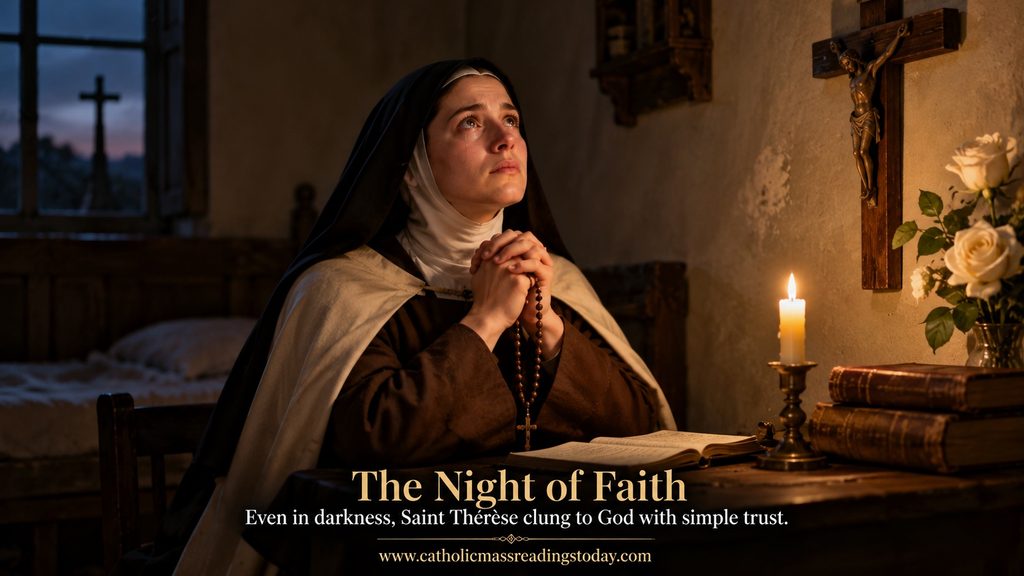
The Night of Faith
The popular image of Saint Therese can sometimes become excessively sweet.
Roses.
Smiles.
Childlike trust.
But the final period of her life was spiritually severe.
Therese experienced what she described as a trial of faith.
At the same time that tuberculosis was destroying her body, she suffered deep interior darkness concerning heaven and eternal life.
She did not stop believing.
But she no longer enjoyed the emotional certainty and spiritual consolation that had marked earlier stages of her life.
She experienced the darkness of those who cannot believe.
This suffering gave her spirituality an unexpected depth.
Her confidence in God was no longer based upon feeling God’s presence.
She trusted when she felt nothing.
She loved when the darkness remained.
She believed when belief became costly.
This is one reason her Little Way should never be confused with an easy spirituality.
The final form of her confidence was forged in suffering.
Tuberculosis and the Final Illness
By 1896, signs of tuberculosis had become unmistakable.
Therese coughed blood, Her strength declined and pain increased. Breathing became difficult as the disease progressed steadily.
Yet even during her illness she continued writing, praying, encouraging others, and speaking of confidence in God’s love.
In June 1897, already seriously ill, she completed further autobiographical material at the request of her prioress.
Her final months were physically brutal.
She suffered from suffocation, weakness, fever, pain, and exhaustion.
But those around her preserved many of her final conversations.
Therese was approaching death without romantic illusions about suffering.
Her body was failing, Her faith was being tested and still, she continued choosing love.
The Death of Saint Therese
Saint Therese died in the Carmel of Lisieux on September 30, 1897, at only twenty-four years of age.
Her final words expressed the very centre of her life: love of God.
The official Sanctuary of Lisieux records her dying with a crucifix in hand, surrounded by her sisters, after a prolonged and painful final illness.
From the perspective of the world, her life might have appeared almost insignificant.
She had lived twenty-four years.
Spent less than a decade in Carmel.
Published nothing herself during her lifetime.
Held no public office.
Travelled nowhere as a missionary.
And yet something extraordinary began almost immediately after her death.
“I Will Spend My Heaven Doing Good on Earth”
Therese had spoken before her death of continuing her mission after entering heaven.
She used the image of scattering roses upon the earth, meaning that she hoped to obtain graces for people through her intercession.
This image became associated permanently with her.
That is why Saint Therese is so often depicted holding roses.
After her death, reports of favours attributed to her intercession spread rapidly.
Pilgrims began visiting her grave.
Her autobiography circulated widely.
Her reputation for holiness grew with extraordinary speed.
The hidden nun became internationally known.
Story of a Soul Changes the World
The publication of Story of a Soul in 1898 was decisive.
The book introduced readers to Therese’s childhood, spiritual development, Carmelite life, Little Way, confidence in divine mercy, and understanding of love at the heart of the Church.
It was translated into numerous languages.
Priests recommended it.
Religious communities read it.
Lay Catholics embraced it.
Missionaries carried her image and writings across continents.
People found in Therese something immediately recognizable: weakness that did not end in discouragement.
Her message was not, “Become impressive.”
It was, “Allow God to love you in your littleness.”
That spoke powerfully to people burdened by their own failures.
It still does.
The Rapid Growth of Devotion to Saint Therese
The Church’s formal recognition of Therese advanced with unusual speed.
Her cause was introduced in 1914.
Pope Benedict XV declared her heroic virtues in 1921.
She was beatified by Pope Pius XI in 1923.
Then, on May 17, 1925, Pope Pius XI canonized her before an enormous crowd in Saint Peter’s Basilica.
Only twenty-eight years had passed since her death.
In 1927, Pius XI proclaimed her Patroness of the Missions, together with Saint Francis Xavier.
In 1944, Pope Pius XII named her one of the patron saints of France.
Her influence continued to expand.
The Basilica of Saint Therese at Lisieux
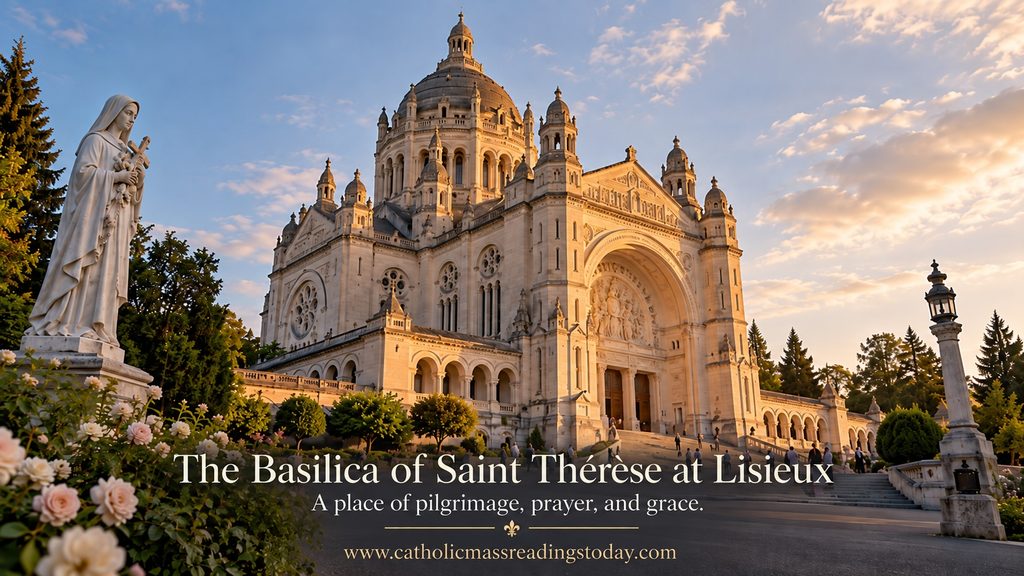
The growing number of pilgrims visiting Lisieux eventually required a major shrine.
The Basilica of Saint Therese was begun in the late 1920s and became one of the great pilgrimage churches of France. The Sanctuary of Lisieux records that the project developed after her canonization, construction began in 1929, and the basilica was later consecrated in 1954.
Today Lisieux remains one of the important Catholic pilgrimage destinations in Europe.
Pilgrims come not because Therese lived an outwardly spectacular life, but because her hidden life became an extraordinary school of trust.
Saint Therese Becomes a Doctor of the Church
One of the greatest recognitions of Saint Therese came a century after her death.
On October 19, 1997, Pope Saint John Paul II proclaimed Saint Therese of the Child Jesus and the Holy Face a Doctor of the Universal Church.
The title Doctor of the Church is reserved for saints whose teaching possesses outstanding value for the universal Church.
Therese had received no advanced academic degree.
She had not attended a theological faculty.
She had not written a systematic theological treatise.
Yet the Church recognized in her what John Paul II called a genuine “science of divine love.”
Her authority came from deep penetration of the Gospel.
She had understood something profoundly Christian: the path to holiness is fundamentally the path of grace, trust, humility, mercy, and love.
Her simplicity was not lack of theology.
It was theology purified to its spiritual centre.
Why Saint Therese Is So Important to the Church
Saint Therese is important because she brought holiness close to ordinary people.
Many believers can become discouraged when reading about saints whose lives appear heroic beyond imitation.
Therese offers another route.
She does not tell us to imitate every circumstance of her Carmelite life.
She teaches us how to live our own circumstances differently.
She turns attention toward intention.
Love transforms the ordinary.
A hidden sacrifice can matter.
A small act of patience can matter.
A difficult person can become an opportunity for charity.
A weakness can become the place where we discover grace.
Our inability does not repel God.
It can become the opening through which we learn to depend upon Him.
The Little Way Is Not Spiritual Laziness
The Little Way is sometimes misunderstood.
It does not mean doing the minimum.
It does not excuse sin.
It does not replace repentance.
It does not teach that effort is unnecessary.
Therese herself practised discipline, sacrifice, obedience, fasting, prayer, forgiveness, and self-denial.
What she rejected was spiritual self-sufficiency.
She understood that even our best efforts cannot manufacture holiness apart from grace.
The Little Way therefore says:
Do what love asks.
Do it faithfully.
Then trust God with the rest.
This is an intensely demanding spirituality because it reaches into the smallest corners of daily life.
It is often easier to make one dramatic sacrifice than to offer hundreds of small sacrifices without recognition.
Therese understood that.
Confidence in God’s Mercy
Perhaps the most important word for understanding Saint Therese is confidence.
Not confidence in herself.
Confidence in God.
Pope Francis returned to this theme in his 2023 Apostolic Exhortation C’est la confiance, issued for the 150th anniversary of her birth. He presented Therese’s trust in God’s merciful love as the heart of her spiritual genius.
This confidence protects the Christian from two opposite errors.
The first is pride: imagining we can save ourselves.
The second is despair: imagining our weakness is greater than God’s mercy.
Therese rejects both.
We cannot save ourselves.
But we do not need to.
Christ has come for the weak.
The proper response is trust.
Saint Therese and People Who Struggle With Failure
This is why Saint Therese speaks so powerfully to people who feel inadequate.
The person who cannot pray as well as others.
The parent exhausted by ordinary responsibilities.
The person repeatedly struggling with the same weakness.
The Christian who feels small in comparison with great saints.
The elderly person whose active life has become restricted.
The sick person unable to do what they once did.
Therese says that holiness remains possible.
You may be small.
But God is not.
Saint Therese and the Missionary Church
Her status as Patroness of the Missions is particularly important for the modern Church.
Mission does not begin with travelling abroad.
It begins with love for souls.
A mother quietly teaching her children to pray participates in mission.
A sick person offering suffering for another participates in mission.
A contemplative nun praying behind monastery walls participates in mission.
A Catholic sharing faith naturally with a friend participates in mission.
Therese teaches that hidden prayer can support visible apostolic work.
Pope John Paul II explicitly highlighted this paradox when he proclaimed her Doctor of the Church: she became a model of missionary commitment despite never leaving her cloister.
Her Love for Sacred Scripture
Saint Therese did not possess the kind of formal biblical training associated with modern theological scholarship.
Yet Scripture shaped her profoundly.
She returned constantly to the Gospels and to Saint Paul’s letters.
The Sanctuary of Lisieux notes that biblical language saturates her writings, and Scripture helped her discover both the Little Way and her vocation to love in the heart of the Church.
She did not read Scripture merely to gather information.
She read it to hear Jesus.
This is another important lesson for Catholics today.
The Bible should not remain only a source for theological argument.
It should become encounter.
Saint Therese and the Eucharist
The Eucharistic life of the Carmel was central to Therese.
She understood Holy Communion as an encounter with the love of Christ.
Her spirituality was never individualistic.
She lived within the sacramental life of the Church.
Prayer, Eucharist, confession, community life, Scripture, and obedience were woven together.
Her trust in God’s mercy therefore belongs fully within Catholic sacramental spirituality.
The Little Way is not spirituality without the Church.
It is spirituality from within the heart of the Church.
Saint Therese and the Blessed Virgin Mary
Therese loved the Blessed Virgin deeply.
But she preferred to contemplate Mary as a mother close to ordinary human life rather than merely as an inaccessible queen.
Her childhood healing through what she called Mary’s smile left a lasting mark on her.
Near the end of her life, she wrote a long poem expressing her love for Mary and her conviction that Mary’s holiness remained truly human and therefore imitable.
Therese’s Marian devotion was tender, but always Christ centred.
Mary leads to Jesus.
Her Parents: Saints Louis and Zélie Martin
Another remarkable chapter in Therese’s legacy concerns her parents.
Louis and Zélie Martin were canonized together by Pope Francis in 2015.
Their canonization brought renewed attention to the family in which Therese’s vocation had been formed. Pope Francis later explicitly recalled their canonization when reflecting on Therese’s legacy.
This matters because Therese did not emerge from nowhere.
Her holiness grew in a home where faith was taken seriously.
Her family knew affection, grief, illness, work, death, misunderstanding, vocation, and sacrifice.
The Martin family shows that holiness can grow in ordinary domestic life.
Why the Church Celebrates Saint Therese on October 1
Saint Therese died on September 30, 1897.
The Church celebrates her liturgical memorial on October 1.
The church identifies October 1 as the annual memorial of Saint Therese of the Child Jesus, Virgin and Doctor of the Church.
The placement is fitting.
September ends with her death.
October begins with her memorial.
It almost symbolizes her own promise that death would not end her mission.
The hidden Carmelite entered eternity, and immediately afterward her influence began spreading throughout the world.
What the Memorial of Saint Therese Means for Catholics Today
The Memorial of Saint Therese of the Child Jesus, Virgin & Doctor of the Church is not meant only to recall a beautiful saint from nineteenth-century France.
It asks us what kind of holiness we are seeking.
Do we imagine holiness mainly as something dramatic?
Do we postpone it because our lives seem too ordinary?
Do we become discouraged by our weaknesses?
Do we think God can use us only after we become stronger?
Therese answers these questions with her life.
Begin where you are.
Give God what you have.
Love the person in front of you.
Offer the small sacrifice.
Do the ordinary duty well.
Ask forgiveness when you fail.
Start again.
Trust mercy.
Her Message to the Modern World
Modern culture often teaches people to prove their worth.
Achieve more.
Become more visible.
Build influence.
Control outcomes.
Create a successful image.
Therese offers a radically different anthropology.
Your value does not begin with achievement.
You are loved before you succeed.
You do not need to become impressive in order to attract God’s attention.
God already sees you.
God already desires you.
Your task is not to become spiritually famous.
Your task is to become available to love.
That message may be even more necessary now than when Therese first wrote it.
A Doctor of the Church for Ordinary People
Saint Therese’s title as Doctor of the Church remains one of the most striking facts about her legacy.
The Church did not declare her a Doctor because she produced volumes of technical theology.
She became a Doctor because she penetrated the Gospel deeply enough to teach the universal Church something essential about God.
Theological greatness is not always complexity.
Sometimes it is clarity.
Therese saw the centre.
God is love.
We are little.
Grace comes first.
Confidence opens the heart.
Love fulfils every vocation.
This is why John Paul II regarded her teaching as possessing genuine doctrinal importance and formally proclaimed her a Doctor of the Universal Church in 1997.
Why Saint Therese Remains So Loved
There is an intimacy in Therese’s spirituality that makes people feel personally addressed.
She does not write from above.
She writes from weakness.
She knows emotional suffering.
Family grief.
Spiritual dryness.
Physical illness.
Frustration with herself.
Difficult relationships.
The desire to do great things while being unable to do them.
Her holiness emerged inside all of this.
That gives hope.
Therese is not loved because her life was easy.
She is loved because she discovered how to trust inside difficulty.
How Catholics Can Celebrate the Memorial of Saint Therese
The most fitting way to celebrate Saint Therese is to practise her Little Way.
Attend Mass where possible.
Read part of the Gospel slowly.
Perform some unnoticed act of kindness.
Forgive someone.
Accept an irritation without complaint.
Pray for missionaries.
Offer a sacrifice for someone who needs grace.
Ask God for the confidence to trust His mercy more deeply.
Read a passage from Story of a Soul.
And above all, do something small with genuine love.
That would be deeply Theresian.
Saint Therese’s Lasting Legacy
Saint Therese lived only twenty-four years.
Yet more than a century after her death, she remains one of the most recognizable Catholic saints in the world.
Her writings continue to be translated.
Her shrine continues to draw pilgrims.
Her intercession is invoked across cultures.
Missionaries claim her as patroness.
Theologians study her.
Families love her.
Religious communities read her.
Young people recognize their struggles in her story.
Suffering people find comfort in her trust.
Pope Francis devoted an entire apostolic exhortation to her spirituality in 2023, evidence that her message remains intensely relevant to the contemporary Church.
Her influence proves something she herself believed deeply:
Love offered to God is never wasted.
A Small Life That Became a Great Light
Saint Therese’s story contains a beautiful paradox.
She wanted to be small.
God made her influence enormous.
She wanted to remain hidden.
The world came to know her.
She never travelled as a missionary.
She became Patroness of the Missions.
She had no formal theological career.
She became a Doctor of the Church.
She died at twenty-four.
Her spiritual voice continues more than a century later.
This is not a contradiction.
It is the logic of the Gospel.
God delights in working through what appears small.
Therese understood that mystery, lived it, and handed it to the Church.
The Heart of Saint Therese’s Message
If everything about Saint Therese had to be reduced to one invitation, it might be this:
Do not wait until you are strong enough to love God.
Love Him in your weakness.
Do not wait until your life becomes extraordinary.
Offer Him the life you have.
Do not become discouraged because you are small.
Let your littleness teach you to trust.
Do not measure holiness by what others can see.
Measure it by love.
The Little Way does not lead away from the great commandment.
It leads directly into it.
Love God.
Love your neighbour.
Trust mercy.
And begin today.
A Prayer Through the Intercession of Saint Therese
Lord Jesus Christ,
You drew Saint Therese of the Child Jesus into the mystery of Your merciful love and taught her to walk the Little Way of confidence, humility, and spiritual childhood.
Through her intercession, teach us to trust You more completely.
When we become discouraged by our weakness, remind us that Your grace is greater than our limitations.
When we desire to do great things, teach us first to love faithfully in the small duties of each day.
Give us humble hearts that seek no recognition, generous hearts that serve without counting the cost, and childlike hearts that rest confidently in the mercy of the Father.
May our homes, our work, our suffering, our relationships, and our hidden sacrifices become places where love is offered to You.
Strengthen missionaries throughout the world, and teach us, like Saint Therese, to carry the missionary heart of the Church through prayer, sacrifice, witness, and charity.
When faith becomes difficult, keep us trusting.
When prayer feels empty, keep us faithful.
When we fall, give us the humility to begin again.
And at the end of our lives, may we come before You not trusting in our own merits, but confidently surrendering ourselves to Your merciful love.
Saint Therese of the Child Jesus and the Holy Face, Virgin and Doctor of the Church, pray for us.
Through Christ our Lord.
Amen.