Celebrated on 5 August
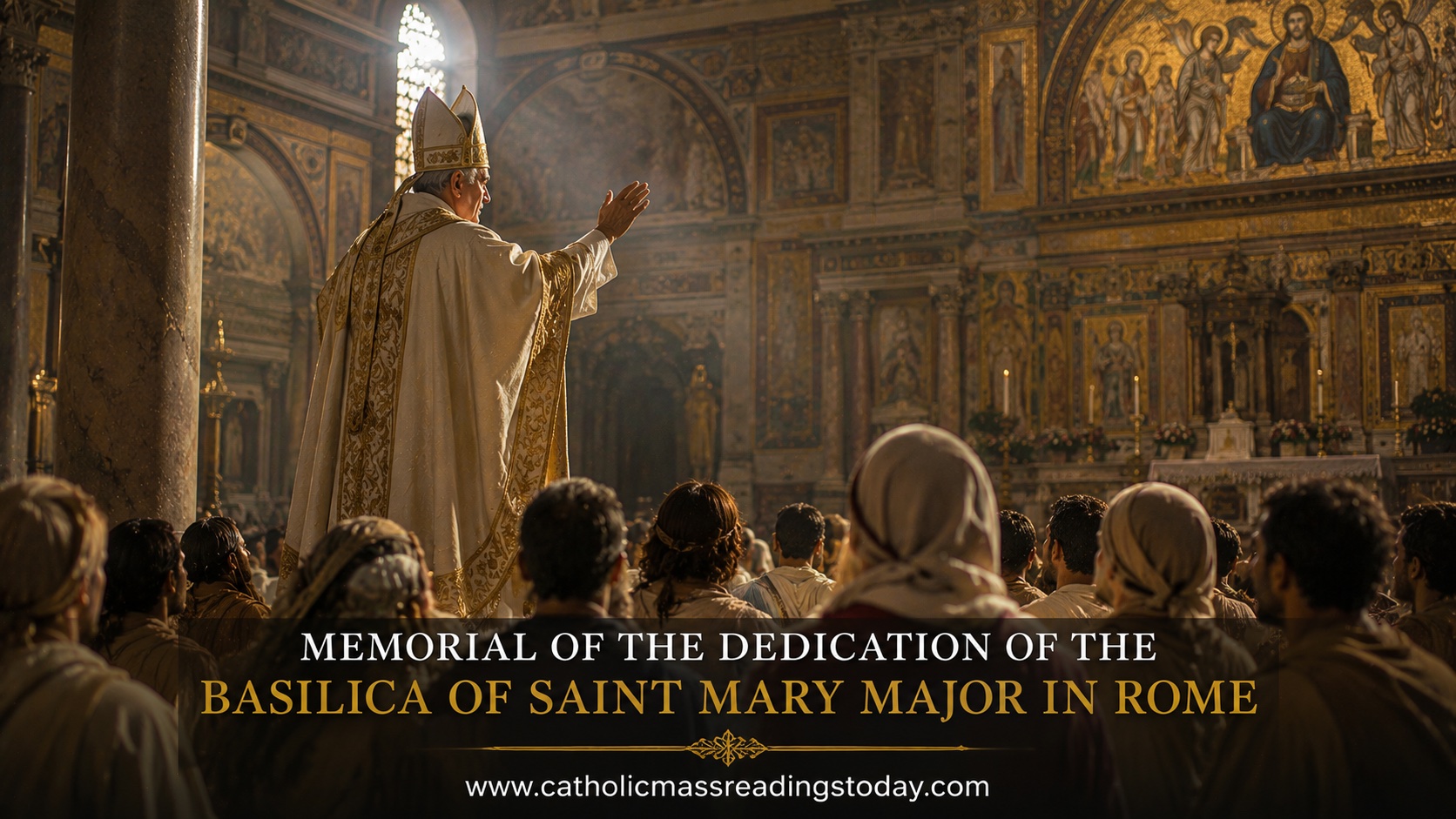
The Memorial of the Dedication of the Basilica of Saint Mary Major in Rome is one of the Church’s most beautiful Marian commemorations. Unlike many memorials that honour the life of a particular saint, this celebration recalls the dedication of the oldest church in the West built in honour of the Blessed Virgin Mary. It is a feast that invites Catholics throughout the world to give thanks not only for a magnificent basilica, but also for Mary’s unique place in God’s plan of salvation.
Every year on 5 August, the Church remembers this sacred basilica, a place where countless pilgrims have knelt in prayer for more than sixteen centuries. It stands as a visible reminder that from the earliest centuries Christians loved and honoured Mary because of her faithful “Yes” to God and because she gave the world Jesus Christ, our Saviour.
Far more than an architectural masterpiece, Saint Mary Major is a living witness to the Church’s faith in the Mother of God.
Understanding This Memorial
It is important to understand that this memorial does not commemorate the life or death of the Blessed Virgin Mary. Instead, it celebrates the dedication of a church built in her honour.
The Blessed Virgin Mary’s principal liturgical celebrations include:
- The Solemnity of Mary, Mother of God (1 January)
- The Annunciation (25 March)
- The Assumption (15 August)
- The Nativity of the Blessed Virgin Mary (8 September)
- The Immaculate Conception (8 December)
The Memorial of the Dedication of Saint Mary Major celebrates something different: the Church’s enduring love for Mary expressed through one of Christianity’s most important shrines.
The Story Behind the Basilica
The origins of Saint Mary Major are surrounded by a tradition cherished by Christians for centuries.
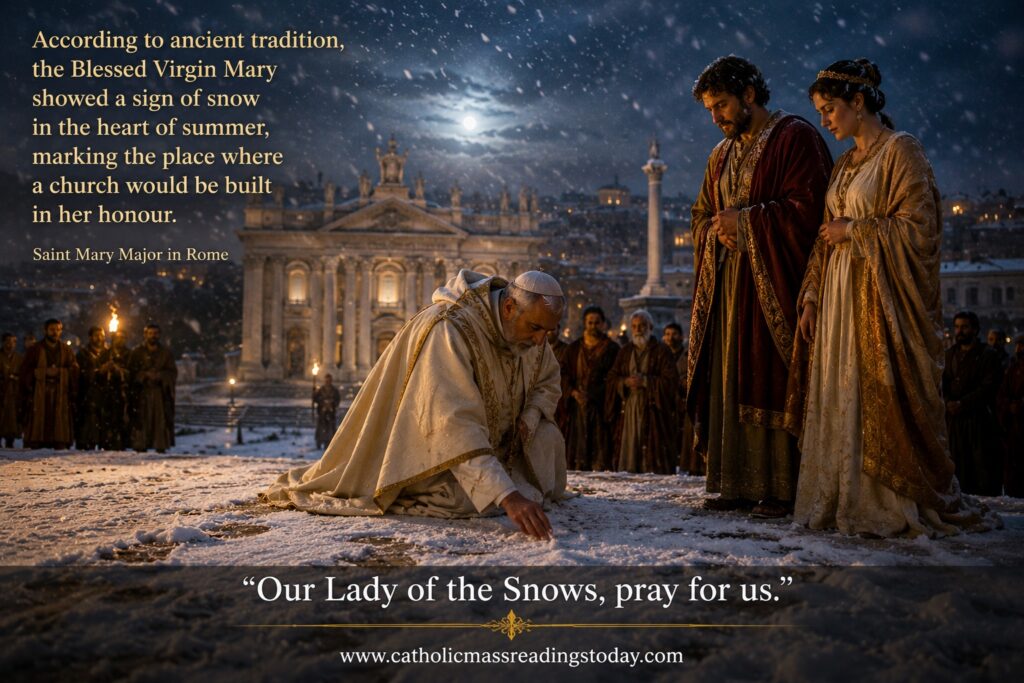
According to ancient tradition, during the fourth century a wealthy Roman nobleman named John and his wife had no children. They prayed earnestly that the Blessed Virgin Mary would show them how they should use their wealth for God’s glory.
On the night of 4 August, both the couple and Pope Liberius reportedly experienced the same extraordinary dream. The Blessed Virgin Mary appeared to them and asked that a church be built in the place where snow would fall the following morning.
Rome, however, was in the middle of summer. On 5 August, an astonishing event is said to have taken place. Snow covered the summit of the Esquiline Hill, one of Rome’s seven hills.
Pope Liberius is said to have traced the outline of the future church in the snow, and construction began shortly afterwards. Because of this beautiful tradition, the basilica became affectionately known as Our Lady of the Snows.
Although historians distinguish this ancient tradition from the later historical construction of the present basilica, the story continues to inspire pilgrims and reminds the faithful that God’s providence often unfolds in unexpected ways.
The Council of Ephesus and the Title “Mother of God”
The history of Saint Mary Major became even more significant after one of the most important moments in Christian history.
In 431 AD, the Council of Ephesus solemnly proclaimed that Mary is truly Theotokos, meaning Mother of God.
This declaration was not primarily about Mary herself. Rather, it defended the truth about Jesus Christ. The Church affirmed that the child born of Mary is one divine Person, the eternal Son of God, possessing both a divine and a human nature. Therefore, Mary can rightly be called the Mother of God because she gave birth to Jesus Christ, who is fully God and fully man.
Following the Council, devotion to Mary flourished throughout the Christian world. Soon afterwards, Pope Sixtus III commissioned the magnificent basilica that still stands today. Much of the present church dates from this fifth-century reconstruction, making it the oldest Marian basilica in the Western world that has retained much of its original structure.
A Treasure of Christian History
For more than sixteen centuries, Saint Mary Major has stood as one of Rome’s greatest treasures.
Pilgrims entering the basilica immediately encounter breathtaking beauty.
The church is renowned for its magnificent fifth-century mosaics depicting scenes from the Old Testament and the infancy of Christ. These mosaics remain among the oldest surviving Christian artworks in Rome and continue to proclaim the Gospel in brilliant colour.
Its soaring nave, richly decorated ceiling, marble columns, and sacred chapels draw the eyes heavenward, reminding visitors that every church is meant to lead hearts toward God.
The Relic of the Holy Crib
One of the basilica’s most treasured possessions is a revered relic traditionally associated with the manger in which the Infant Jesus was laid at Bethlehem.
For centuries, pilgrims have come to venerate this relic, contemplating the mystery of the Incarnation, the moment when the eternal Word became flesh and dwelt among us.
This connection with Bethlehem makes Saint Mary Major a particularly beloved destination during the Christmas season.
A Basilica Loved by Popes
Throughout history, countless popes have had a special devotion to Saint Mary Major. Many have celebrated Mass there on Marian feasts.
Several popes are buried within the basilica, including Pope Honorius III, Pope Nicholas IV, Pope Clement IX, Pope Paul V, and Pope Clement VIII. More recently, it has also become the burial place of Pope Francis, in accordance with his wish to rest near the icon of Mary that he visited so often during his pontificate.
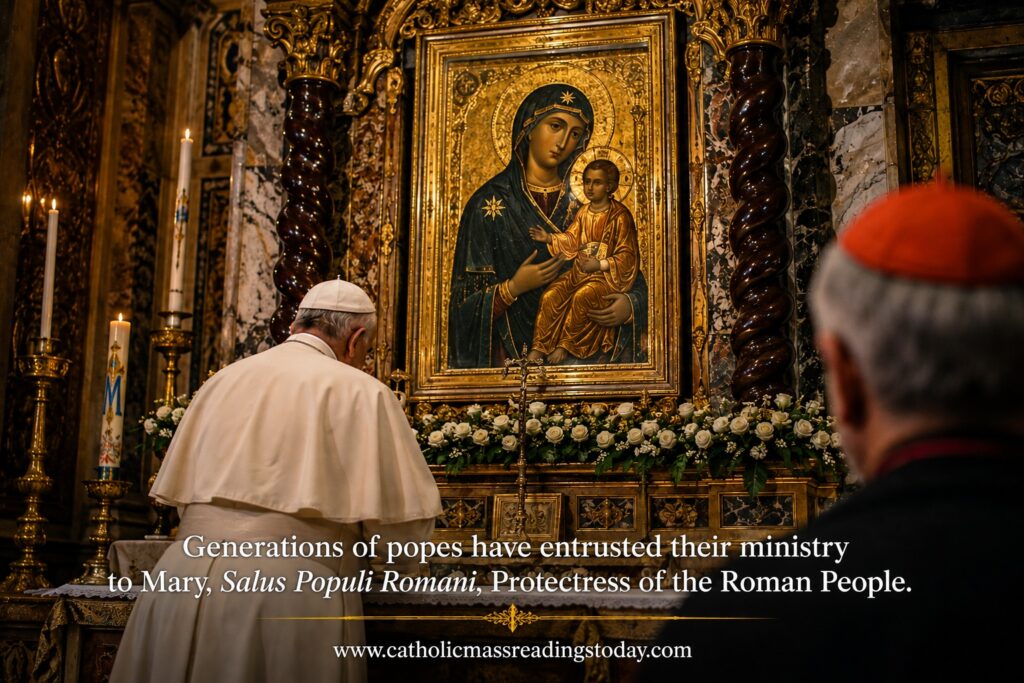
One of the basilica’s greatest treasures is the ancient Marian icon known as Salus Populi Romani (“Protectress of the Roman People”).
For centuries, popes have entrusted their ministries to Our Lady before this sacred image. It became a deeply loved custom of Pope Francis to pray before this icon before and after every Apostolic Journey, asking Mary’s protection over the Church and the peoples he visited.
Why Saint Mary Major Matters Today
Modern pilgrims continue to flock to Saint Mary Major because it speaks to something timeless. It reminds us that God chose an ordinary young woman from Nazareth to become the Mother of the Saviour. Her humility became the doorway through which salvation entered the world.
The basilica also teaches that authentic Marian devotion always leads us to Jesus. Every mosaic, every chapel, every prayer offered there ultimately points to Christ.
Mary never keeps our attention fixed upon herself. She always leads us to her Son. As she once said at Cana:
“Do whatever He tells you.” (John 2:5)
Those words remain the heart of genuine Marian spirituality.
Lessons for Every Catholic
The Memorial of the Dedication of Saint Mary Major offers several important lessons:
1. Honouring Mary Strengthens Our Faith in Christ
Every authentic Marian devotion deepens our relationship with Jesus. To honour His Mother is to appreciate more fully the mystery of the Incarnation.
2. Sacred Places Matter
Churches are more than buildings. They are places where generations gather to celebrate the Eucharist, receive the sacraments, and encounter God’s presence. Saint Mary Major reminds us to cherish our own parish churches and to treat them with reverence.
3. Beauty Can Lead Souls to God
The splendour of Saint Mary Major demonstrates that sacred art and architecture can lift hearts toward heaven. Beauty has long been one of the Church’s most powerful forms of evangelisation.
4. Mary Continues to Accompany the Church
From the Upper Room at Pentecost to the present day, Mary remains close to the pilgrim Church, praying for her children and leading them ever more deeply to Christ.
Pilgrims Through the Centuries
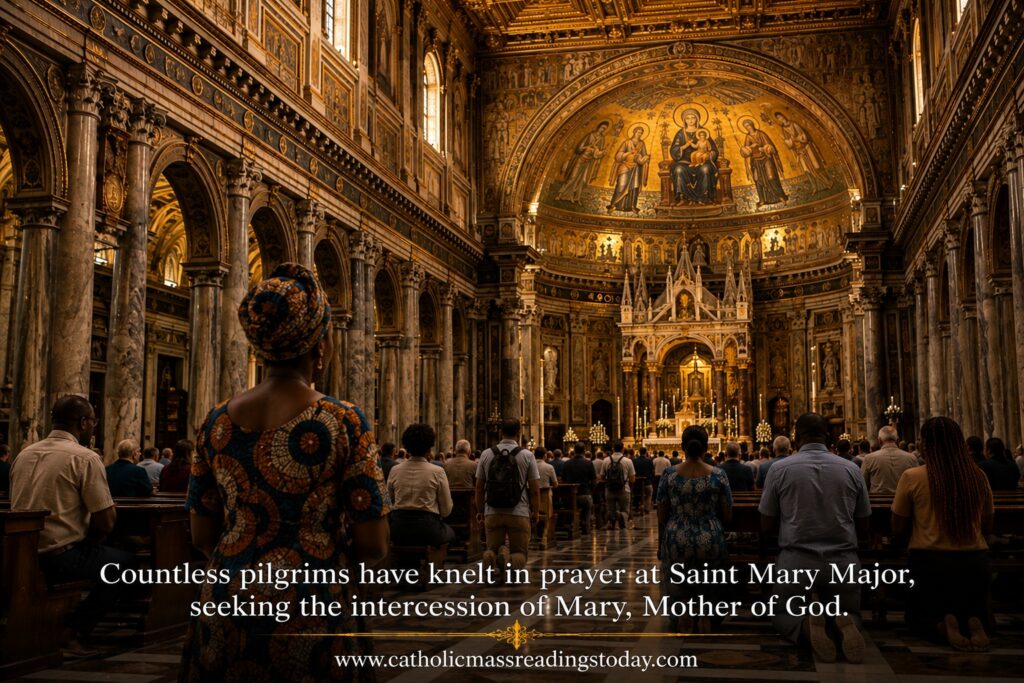
Millions of pilgrims have crossed the threshold of Saint Mary Major. Among them have been saints, missionaries, religious sisters, seminarians, families, and ordinary believers carrying countless intentions in their hearts.
Some came seeking healing, others sought peace whilst many came simply to thank God.
Though separated by centuries and cultures, they have all found themselves united beneath the loving care of the Mother of God.
The Continuing Mission of the Basilica
Today, Saint Mary Major remains an active place of worship. Daily mass is celebrated, the Sacrament of Reconciliation is available and pilgrims continue to pray before the Blessed Sacrament and the revered Marian icon.
Its mission has never changed. It remains a house of prayer where countless people encounter God’s mercy through Christ while asking the intercession of His Blessed Mother.
Living the Message of This Memorial
The Memorial of the Dedication of the Basilica of Saint Mary Major calls every Catholic to imitate Mary’s faith.
- Like her, we are invited to trust God’s plan even when we cannot see the whole path before us.
- Like her, we are called to welcome Christ into our lives and carry Him into the world.
- Like her, we are invited to remain faithful in times of joy and in moments of suffering.
The basilica itself stands as a monument to that faith—a reminder that generations before us believed, hoped, prayed, and found strength in the loving care of the Mother of God.
The Church’s enduring love for the Blessed Virgin Mary
The Memorial of the Dedication of the Basilica of Saint Mary Major in Rome is a celebration of the Church’s enduring love for the Blessed Virgin Mary and her unique role in the mystery of salvation. It recalls the dedication of the oldest Marian basilica in the West, a sanctuary that has welcomed pilgrims for more than sixteen centuries and continues to draw hearts to Christ.
Although this memorial does not commemorate Mary’s earthly life or death, it honours the profound truth that through her humble obedience, God chose to dwell among His people. Every stone of Saint Mary Major proclaims that mystery, and every pilgrim who enters its doors is invited to renew the same trust that filled Mary’s heart.
As we celebrate this memorial, may we entrust ourselves to the maternal care of the Blessed Virgin Mary, asking her to guide us ever more faithfully to her Son, Jesus Christ. May our lives, like hers, become a joyful witness to the Gospel, and may our hearts always remain open to God’s grace, so that we too may proclaim with confidence the greatness of the Lord.
Let us pray
Heavenly Father,
We thank You for the gift of the Blessed Virgin Mary, whom You chose to become the Mother of Your Son and the Mother of the Church. As we remember the Dedication of the Basilica of Saint Mary Major, deepen within us a love for Christ and a filial devotion to His holy Mother.
May the witness of countless pilgrims who have prayed in this sacred place inspire us to seek You with sincere hearts. Teach us, like Mary, to trust Your will without hesitation, to listen attentively to Your Word, and to carry the hope of the Gospel into our homes, our workplaces, and our communities.
Strengthen Your Church throughout the world. Bless our Holy Father, all bishops, priests, deacons, religious, and the faithful. May every church become a place where the lonely find comfort, sinners discover mercy, the weary receive strength, and all people encounter the living presence of Jesus Christ.
Through the loving intercession of Mary, Salus Populi Romani, protect our families, guide those who are searching for You, comfort the sick and the suffering, and grant eternal peace to the faithful departed.
May our hearts always echo the words of Our Lady at Cana: “Do whatever He tells you.” And may our lives become a joyful witness to the faith, hope, and charity that lead us safely to Your heavenly Kingdom.
We ask this through Christ our Lord.
Amen.