The Courageous Witnesses Who Gave Their Lives for Christ
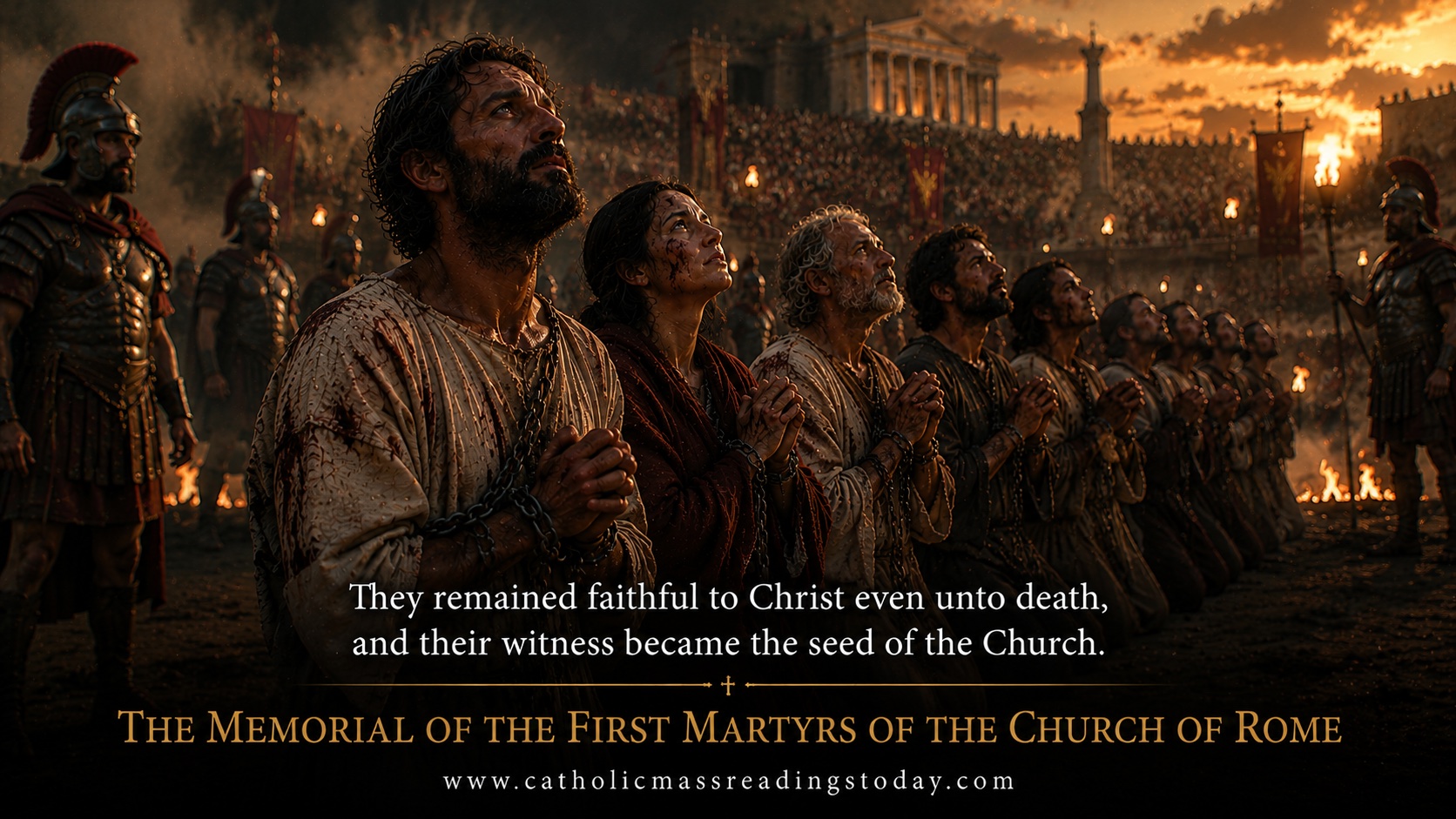
Every year on 30th June, the Catholic Church celebrates The Memorial of the First Martyrs of the Church of Rome, a day dedicated to remembering the countless anonymous Christians who willingly gave their lives rather than deny Jesus Christ during the brutal persecution unleashed by Emperor Nero in the first century.
Unlike many feast days that honor an individual saint, this memorial commemorates an entire community of believers. Most of their names have been lost to history, yet their witness remains forever written in the heart of the Church. They were ordinary men and women, fathers and mothers, young people and elderly believers, merchants, servants, labourers, soldiers, widows, and children who shared one extraordinary conviction: Jesus Christ was worth more than life itself.
These early Christians never sought fame. They left behind no books, no personal memoirs, and in many cases not even their names. What they left behind was something far greater. They handed down an example of unwavering faith that continues to inspire Christians nearly two thousand years later.
The Church remembers them because their sacrifice reminds us that the Gospel was never spread merely through eloquent preaching or political influence. It grew because ordinary believers remained faithful to Christ even when doing so demanded the ultimate sacrifice.
Why Does the Church Celebrate the First Martyrs of Rome?
This memorial is observed immediately after the Solemnity of Saints Peter and Paul.
The placement is deeply meaningful. On 29 June, the Church honors its two great apostolic pillars.
The following day, she remembers the countless faithful who followed their example.
Peter and Paul preached the Gospel and the First Martyrs lived it to the very end.
Together they remind us that the Church is built not only upon apostolic leadership but also upon the courageous witness of ordinary believers whose fidelity strengthened the early Christian community.
Their blood became the seed from which Christianity continued to flourish throughout the Roman Empire.
Rome During the First Century
To appreciate the courage of these martyrs, we must understand the world in which they lived.
Rome was the center of one of history’s greatest empires. Its roads connected distant nations, the army enforced imperial authority. Its culture influenced much of the known world today.
At first, Christians attracted little attention with most Romans viewing them as another Jewish group.
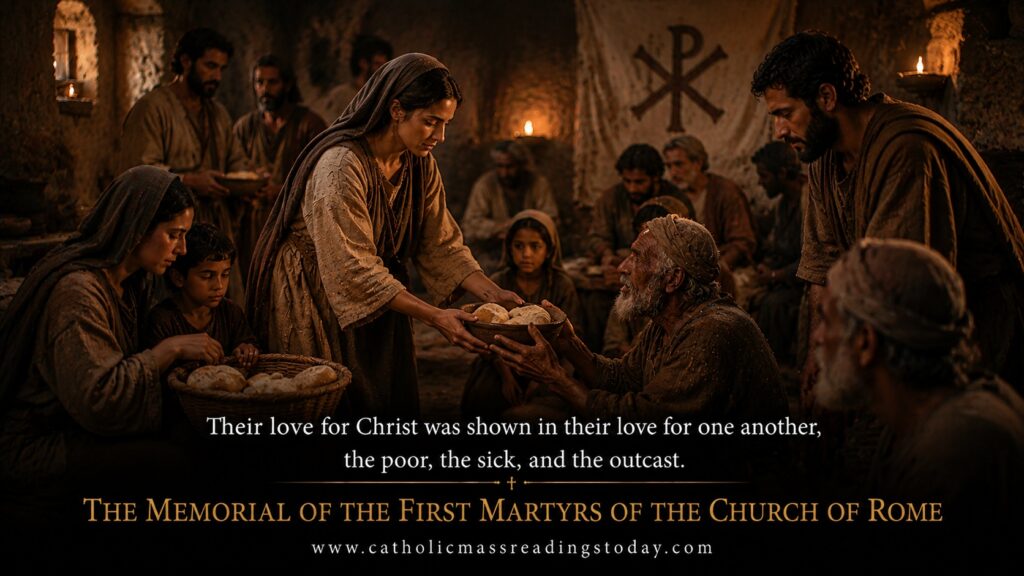
They gathered quietly in homes, prayed together, celebrated the Eucharist, shared their possessions with the poor, cared for widows and orphans, visited prisoners and even welcomed strangers.
These small Christian communities grew steadily, not through force but through love, charity, and the joyful witness of transformed lives.
Yet their refusal to worship the Roman gods or offer sacrifices to the emperor gradually made them objects of suspicion.
The Great Fire of Rome
In July of AD 64, disaster struck the city. A devastating fire swept through Rome. or days, flames consumed homes, temples, marketplaces, and public buildings.
Large sections of the capital were reduced to ashes. Thousands lost their homes and many people lost their lives. Panic spread throughout the empire. Almost immediately, rumors began to circulate regarding the cause of the fire.
Many believed Emperor Nero himself had ordered the destruction in order to rebuild Rome according to his own vision. Whether true or not, public anger rapidly turned toward the emperor.
Seeking someone else to blame, Nero found an easy target.
The Christians.
Nero’s Accusation
The Roman historian Tacitus, who was not a Christian, provides one of history’s earliest accounts of what followed.
According to his writings, Nero falsely accused Christians of starting the fire.
The charge had little evidence, yet it achieved its purpose. Public opinion turned violently against the Christian community.
People who had previously lived quietly among their neighbors suddenly became enemies of the state.
Simply professing faith in Jesus could become a death sentence.
The Beginning of a Terrible Persecution
The persecution that followed shocked many Romans because of its extraordinary cruelty.
Christians were arrested in large numbers, many were imprisoned and others were publicly tortured.
Others were condemned to death in spectacles intended to entertain crowds.
Ancient accounts describe believers being sewn into animal skins and thrown before wild dogs.
Others were attacked by wild beasts in the arenas. Some were crucified.
Still others were covered in pitch, tied to posts, and burned alive at night to illuminate Nero’s imperial gardens.
The cruelty was almost unimaginable and yet despite the suffering, the Christian community did not disappear. Instead, it became stronger.
Who Were These Martyrs?
Unlike Saints Peter and Paul, whose names are known throughout the world, most of these martyrs remain anonymous.
The Church honors them collectively. They came from every part of society. Some had been wealthy and others lived in poverty.
Some were educated yet others could neither read nor write. Many had families who depended on them.
Many were converts from paganism, others had embraced christianity from Jewish backgrounds. What united them was not their social status but their faith in Christ believing that Jesus had conquered death through His Resurrection and it is because of that hope, that they faced suffering with remarkable courage.
Their Daily Lives Before the Persecution
It is easy to imagine martyrs only at the moment of their death, yet before persecution arrived, they lived ordinary lives working to support their families, raising children, preparing their daily meals, visited neighbors, shared the Eucharist in hidden gatherings, helped the sick, collected food for the poor, welcomed travellers, encouraged those struggling in faith.
Their holiness was found first in daily fidelity. When the moment of trial came, they simply remained faithful to the Christ they had loved in ordinary life. Their martyrdom was the culmination of a life already offered to God.
Why They Refused to Deny Christ
Roman authorities often offered Christians a simple choice. Burn incense before the emperor, offer sacrifice to the Roman gods, publicly deny Christ or leave.
Many could have escaped death by performing these outward acts. Yet these First Martyrs of the Church of Rome refused. Why?
Because they understood that Jesus was not merely another religious teacher. He was the risen Lord. To deny Him would have meant denying the One who had conquered sin and death.
Their fidelity was not rooted in stubbornness. It flowed from love. They had encountered Christ.
Nothing, not fear, suffering, imprisonment, or even death could separate them from Him.
Their witness fulfilled the words of Saint Paul:
“Who shall separate us from the love of Christ?”
(Romans 8:35)
The Church Strengthened by Their Witness
Paradoxically, Nero’s persecution achieved the opposite of what he intended. Instead of destroying Christianity, it strengthened it.
Observers saw believers praying for their executioners, families remained united in faith, Martyrs forgave those who condemned them, some sang hymns while facing death.
Such extraordinary courage caused many pagans to ask: “What gives these people such hope?”
The answer was always the same. Jesus Christ.
Their witness became one of the most powerful forms of evangelization in the history of the Church.
The blood of the martyrs truly became, as the early Christian writer Tertullian would later say, “the seed of Christians.”
A Witness That Still Speaks Today
The First Martyrs of the Church of Rome lived nearly two thousand years ago. Their world was very different from ours, yet their testimony continues to challenge modern Christians.
They remind us that authentic faith is more than words spoken on Sunday. It is a relationship with Christ that shapes every decision, every sacrifice, and every act of love.
They never imagined that future generations would honor them, they simply chose to remain faithful and true to their Christian lives following Jesus’ teachings.
That quiet fidelity has echoed across the centuries. Their example invites every believer to ask a simple but searching question:
If Christ gave everything for me, how am I living for Him today?
The Persecution Under Nero, Their Heroic Witness, and the Growth of the Church
The first Christians in Rome never imagined that simply professing the name of Jesus would one day cost them everything.
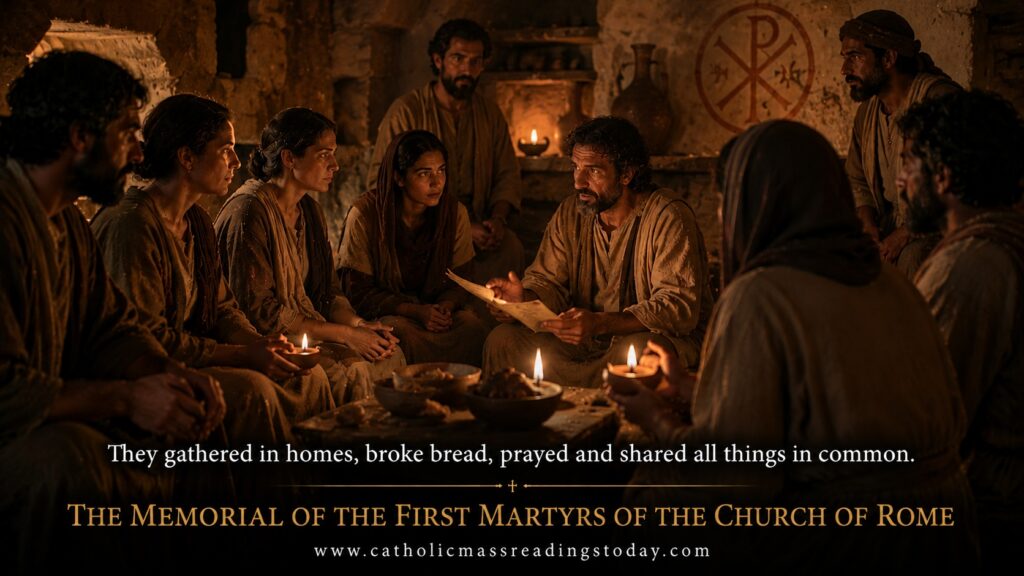
They had gathered quietly in homes to celebrate the Eucharist. They cared for the poor, welcomed strangers, visited prisoners, and lived according to Christ’s commandment to love one another. Their lives were peaceful, yet they stood apart from the culture around them because they refused to worship false gods or acknowledge the emperor as divine.
When Nero blamed them for the Great Fire of Rome, that quiet difference suddenly became a reason for violent persecution.
What followed would become one of the darkest chapters in the history of the Roman Empire—and one of the brightest chapters in the history of Christian faith.
Nero’s Reign of Terror
Emperor Nero ruled Rome from AD 54 to AD 68.
His reign began with promise but gradually descended into fear, cruelty, and instability. Ancient historians describe him as a ruler increasingly consumed by suspicion, vanity, and a desire for absolute power.
After the Great Fire devastated much of Rome, public anger threatened his authority. Rather than face growing accusations against himself, Nero chose a vulnerable community that had little political influence and few defenders.
The Christians became convenient scapegoats with arrests spreading throughout the city.
Believers were questioned, imprisoned, and publicly condemned. Families were torn apart, homes were abandoned.
The simple act of gathering to pray could result in execution, yet the Christian community did not respond with violence instead, they remained faithful to the teachings of Christ.
Unspeakable Cruelty
Ancient writers, especially the Roman historian Tacitus, record the horrifying punishments inflicted upon Christians during Nero’s persecution.
Some believers were crucified others were sewn into the skins of wild animals and thrown before hunting dogs.
Many were forced into the great arenas, where hungry beasts were released against them before cheering crowds. Perhaps the most horrifying punishment occurred in Nero’s imperial gardens.
Christians were covered with pitch, tied to wooden stakes, and set ablaze after sunset. Their burning bodies were used as human torches to illuminate the emperor’s evening festivities.
Even Tacitus, who was not sympathetic toward Christians, described these punishments with deep horror, acknowledging that many Romans began to pity the victims because the cruelty exceeded all measure. The persecution was not merely intended to execute Christians but to humiliate them publicly.
What the authorities intended as disgrace became, in God’s providence, a testimony that has inspired believers for nearly two thousand years.
They Did Not Fight With Weapons
One of the most remarkable aspects of these early martyrs is how they responded to suffering.
They did not organize rebellions nor seek revenge. They did not answer hatred with hatred instead, they imitated Christ.
Many forgave those who condemned them while others prayed aloud while facing execution. Some encouraged fellow prisoners to remain faithful until the end.
Their courage astonished even those who had come to witness their deaths. The strength they displayed did not come from human determination alone it flowed from a profound certainty that Christ had already conquered death through His Resurrection.
For them, martyrdom was not defeat it was the final act of fidelity to the One who had first loved them.
Strengthened by the Eucharist
The courage of the martyrs did not appear suddenly when persecution began it had been formed over time. The Eucharist stood at the center of their lives.
Gathering secretly to celebrate the breaking of the bread, they received the Body and Blood of Christ, drawing strength from the same sacrifice they would soon imitate through the offering of their own lives.
Prayer sustained them and scriptures nourished them. Their love for one another created a community unlike anything the Roman world had seen.
Long before they faced death, they had already learned how to live for Christ. Because they had learned to live for Him, they were able to die for Him.
Families Who Chose Faith
The First Martyrs were not only bishops or priests. Many were ordinary families.
Parents encouraged their children to remain faithful, husbands and wives strengthened one another and young believers stood beside elderly Christians. Masters and servants suffered together.
In Christ, earthly distinctions disappeared, they became one family united by Baptism.
Their witness reminds us that holiness is lived first in ordinary homes before it is tested in extraordinary circumstances. The domestic church became the birthplace of many martyrs.
The Influence of Saints Peter and Paul
The courage of the Roman Christians did not develop in isolation. They had been formed by the preaching of Saints Peter and Paul.
Peter had taught them to remain steadfast in faith despite suffering. Paul had reminded them that nothing could separate them from the love of Christ. Both apostles were eventually martyred during Nero’s reign.
Although their individual deaths are commemorated on the Solemnity of Saints Peter and Paul, the witness of these great apostles profoundly shaped the anonymous believers who followed them.
The First Martyrs became living proof that the apostles’ preaching had taken deep root.
The Gospel was no longer simply proclaimed. It was lived.
Historical Witnesses
Although many individual names have been lost, the Church’s memory of these martyrs rests upon solid historical foundations.
The Roman historian Tacitus provides one of the earliest non Christian accounts of Nero’s persecution.
The writings of Saint Clement of Rome, who served as Bishop of Rome near the end of the first century, also refer to the sufferings endured by Peter, Paul, and many other faithful believers.
Later Christian writers such as Eusebius of Caesarea preserved these traditions, helping future generations understand the immense price paid by the earliest witnesses to Christ.
These historical testimonies remind us that the martyrdoms were not legends invented centuries later. They belong to the earliest history of the Church itself.
Why Their Witness Changed History
From a purely human perspective, Nero appeared victorious. He possessed armies, political authority and public influence. The Christians seemed powerless, yet history tells a different story.
Nero’s empire eventually faded, his palaces crumbled, his statues disappeared but the faith of those humble believers continued to spread across the world.
Within three centuries, Christianity had reached every corner of the Roman Empire, eventually, the empire that once sought to destroy the Church would itself recognize Christianity.
The martyrs had not conquered through force but through love, truth, and unwavering fidelity.
Their lives fulfilled Christ’s own words:
“Blessed are those who are persecuted for righteousness’ sake, for theirs is the kingdom of heaven.”
(Matthew 5:10)
Their Witness Challenges Us Today
Most Catholics today will never face the brutal persecutions endured by the First Martyrs of Rome.
Yet every generation encounters its own trials. Some Christians suffer ridicule because of their faith, others experience discrimination.
Many struggle to remain faithful in cultures where Christian values are increasingly misunderstood or ignored. The First Martyrs remind us that courage is needed in every age.
Faithfulness is not measured only by dramatic acts of heroism, it is shown in daily perseverance, in choosing honesty when dishonesty is easier, forgiveness when resentment seems justified, charity when selfishness is tempting, and hope when discouragement threatens to overwhelm us.
The same Holy Spirit who strengthened those early Christians continues to strengthen the Church today. Their witness reminds us that Christ never abandons those who remain faithful to Him.
The Church Built Upon Witness
The First Martyrs of Rome left behind no monuments bearing their names.
Most have no known feast day of their own and few are mentioned individually in history. Their influence cannot be measured. Their blood became the foundation upon which generations of Christians continued to build.
Every time believers choose Christ over comfort, truth over compromise, or love over hatred, they continue the witness first given by these heroic men and women.
Their lives proclaim one enduring truth:
The Church is strongest when her members remain faithful to Christ, whatever the cost may be.
Their Lasting Legacy and what we learn
The First Martyrs of the Church of Rome may not be remembered individually by name, but together they form one of the greatest testimonies of faith in the history of Christianity. Their witness did not end with their deaths. Instead, it became a light that has continued to guide the Church through every century.
They belonged to the first generation of Christians who learned the faith directly from the Apostles. They had heard the Gospel preached by men such as Saint Peter and Saint Paul, celebrated the Eucharist in hidden gatherings, cared for one another as members of a single family, and remained faithful even when the cost was their own lives.
Their courage proved that the Christian faith was not simply another philosophy or passing movement. It was a living relationship with Jesus Christ, worth every sacrifice.
The Lasting Legacy of the First Martyrs of Rome
The Church has always believed that the blood of the martyrs is a sign of hope rather than defeat.
Although Nero intended to erase Christianity from Rome, his persecution achieved the opposite. The remarkable courage shown by these believers caused many observers to ask what could give ordinary men and women such extraordinary peace in the face of suffering.
The answer was found in the Risen Christ.
As the years passed, more people embraced Christianity, inspired by the unwavering witness of those who had died rather than deny their Lord.
Their legacy continues in every Christian community throughout the world. Every church, every celebration of the Eucharist, every profession of the Creed, and every act of charity bears witness to the faith that these early believers defended with their lives.
Why the Church Continues to Honor Them
The Church remembers the First Martyrs of Rome because their example speaks to every generation. Their memorial is not a celebration of suffering for its own sake. Rather, it is a celebration of faithful love.
These martyrs remind us that Christ’s victory over sin and death gives courage even in life’s darkest moments. They teach us that discipleship is not measured by comfort or popularity but by fidelity.
In honoring them, the Church also acknowledges the countless unnamed Christians throughout history who have quietly lived and died for Christ. Many faithful witnesses are known only to God, yet their lives have strengthened the Church in ways that history can never fully record.
Lessons Every Catholic Can Learn
1. Faith Is Meant to Be Lived
The First Martyrs did not become saints only in the moment of their deaths. They became saints by living faithfully each day.
They prayed.
They worshipped.
They forgave.
They cared for the poor.
They loved one another.
Their daily lives prepared them for their final witness.
Holiness still grows in the same way today.
2. Courage Begins with Small Acts of Faithfulness
Most Christians will never be asked to surrender their lives for Christ.
Yet every day presents opportunities to remain faithful.
Choosing honesty.
Protecting the dignity of others.
Standing for truth.
Forgiving those who have hurt us.
Remaining faithful to prayer.
Participating in the Sacraments.
These quiet acts of fidelity prepare our hearts to trust God in greater trials.
3. Love Is Stronger Than Fear
The Roman authorities hoped fear would silence Christianity.
Instead, love proved stronger.
The martyrs refused to repay hatred with hatred.
Many prayed for those who condemned them.
Others encouraged fellow believers to remain steadfast until the end.
Their witness reminds us that Christian love always possesses greater power than violence.
4. Christ Never Abandons His Church
Throughout history, the Church has endured persecution, division, and countless challenges.
Yet Christ’s promise remains true.
He continues to guide His Church through the Holy Spirit.
The witness of the First Martyrs reminds us that no earthly power can overcome the Kingdom of God.
5. Every Christian Is Called to Be a Witness
Not everyone is called to martyrdom.
Every Christian, however, is called to witness.
Sometimes that witness is public.
Often it is quiet.
A parent teaching children to pray.
A young person choosing integrity.
Someone caring for a lonely neighbor.
A family remaining faithful to Sunday Mass.
These everyday acts continue the same Gospel witness begun by the first believers in Rome.
Catholic Devotions for the Memorial of the First Martyrs of the Church of Rome
Catholics can observe this memorial in many meaningful ways:
- Participate in Holy Mass.
- Pray for Christians who continue to suffer persecution throughout the world.
- Read Acts of the Apostles and the accounts of the early Church.
- Spend time in Eucharistic Adoration, thanking God for the witness of the martyrs.
- Pray the Apostles’ Creed slowly, reflecting upon the faith handed down by the Apostles.
- Perform an act of charity in honor of those who loved Christ by serving others.
- Read the lives of the early martyrs and teach their stories to children.
- Offer prayers for courage to remain faithful in daily life.
These simple practices unite us spiritually with the courage of the early Church.
Frequently Asked Questions
Who were the First Martyrs of the Church of Rome?
They were the early Christians who were executed during Emperor Nero’s persecution following the Great Fire of Rome in AD 64. Most remain anonymous, but together they are honored for their faithful witness to Christ.
Why does the Catholic Church celebrate their memorial?
The Church honors them because they remained faithful to Jesus even under severe persecution. Their witness strengthened the early Christian community and continues to inspire believers today.
Did Saints Peter and Paul die during the same persecution?
According to ancient Christian tradition, both Saints Peter and Paul were martyred during Nero’s persecution, although their individual feast is celebrated separately on the Solemnity of Saints Peter and Paul on 29 June.
Why are their names unknown?
Many records from the first century were lost or never written. The Church remembers them collectively because their shared witness is more important than individual recognition.
What can modern Catholics learn from the First Martyrs?
They teach us perseverance, courage, fidelity, forgiveness, and unwavering trust in Christ. Their lives remind us that authentic discipleship is lived every day, especially during times of difficulty.
Remember a people whose hope was stronger than fear
The Memorial of the First Martyrs of the Church of Rome invites us to remember more than a tragic chapter in history.
It invites us to remember a people whose hope was stronger than fear.
Their names may have faded from earthly memory, but their witness remains alive in the Church they helped strengthen through their sacrifice.
They remind us that Christianity has never been sustained by comfort or worldly success. It has endured because ordinary believers chose extraordinary faithfulness.
As we honor these heroic Christians, may we ask for the same grace that strengthened them.
May we remain faithful when our beliefs are challenged, choose charity over hatred, forgive generously, never be ashamed of the Gospel and above all, may our own lives become quiet but powerful testimonies to the love of Jesus Christ.
Though separated from us by nearly two thousand years, the First Martyrs of Rome still speak to the Church today. Their message is simple, enduring, and filled with hope:
Christ is worth everything.
Let us Pray
In the Name of the Father, and of the Son, and of the Holy Spirit. Amen.
Heavenly Father,
You gave the First Martyrs of the Church of Rome the grace to remain faithful to Your Son even in the face of suffering and death. Their courage was born not of human strength but of complete trust in Your love.
Grant us that same steadfast faith.
When we are tempted to compromise our beliefs, strengthen us.
When we encounter fear or discouragement, fill us with hope.
When we face trials, remind us that Christ has already conquered sin and death.
Teach us to love as the martyrs loved, to forgive as they forgave, and to witness to the Gospel through lives marked by humility, charity, and perseverance.
We pray especially for Christians throughout the world who continue to suffer persecution because of their faith. Protect them, strengthen them, and let their witness bear abundant fruit for Your Church.
May the example of the First Martyrs of Rome inspire us to remain faithful in the ordinary moments of daily life until the day we join all the saints in praising You forever in heaven.
Through Christ our Lord.
Amen.
First Martyrs of the Church of Rome, pray for us.
You are invited to read
The Solemnity of Saints Peter and Paul, Apostles | History, Meaning & Catholic Reflection