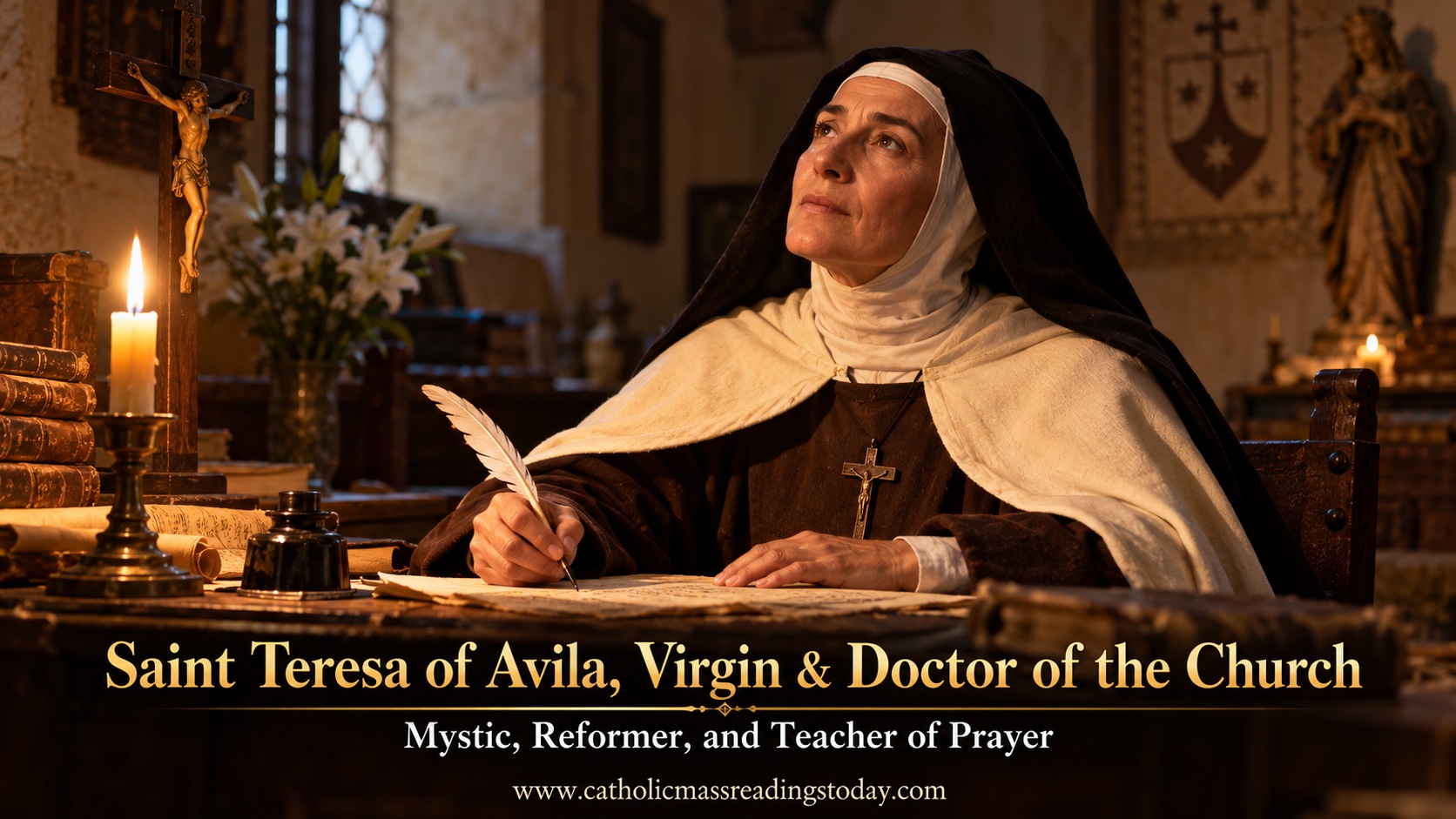
Among the great saints of the Catholic Church, few have left a mark as deep and enduring as Saint Teresa of Avila. Known for her brilliant spiritual writings, her courage in reforming religious life, and her profound union with God, she stands as one of the most remarkable women in Christian history. The Church honors her not only as a saint, but also as a Virgin and Doctor of the Church, titles that reflect both the holiness of her life and the lasting value of her teaching. Her story is not merely the story of a cloistered nun from sixteenth-century Spain. It is the story of a woman who allowed grace to take hold of her life so completely that her witness continues to guide the faithful centuries after her death.
The Early Life of Saint Teresa of Avila
Saint Teresa of Avila was born Teresa Sánchez de Cepeda y Ahumada on March 28, 1515, in Ávila, Spain, a walled city whose strong towers and austere beauty would later shape many of the images found in her spiritual writings. She was born into a large and respectable Catholic family. Her father, Alonso Sánchez de Cepeda, was known as a serious and virtuous man, while her mother, Beatriz de Ahumada, was gentle, devout, and deeply influential in Teresa’s early upbringing.
From childhood, Teresa showed an intense and lively spirit. She was intelligent, imaginative, and strong willed. Like many children of faith, she was fascinated by the stories of the saints and martyrs. She and her brother Rodrigo were so moved by the accounts of those who gave their lives for Christ that, when they were still very young, they once attempted to leave home and travel to the land of the Moors, hoping to die as martyrs for the faith. Their plan ended quickly, but the incident revealed something that would remain true throughout Teresa’s life: she had a heart drawn to great things, and she longed for God with an intensity that would only deepen over time.
When Teresa was still a teenager, her mother died. The loss marked her deeply. In that sorrow, she turned to the Blessed Virgin Mary and, in a simple but sincere act of trust, asked Our Lady to be her mother. That Marian devotion remained with her all her life and became one of the quiet strengths of her spiritual journey.
Youth, Struggle, and the Call to Religious Life
Like many young people, Teresa experienced a period of inner conflict as she grew older. She enjoyed friendships, conversation, and the pleasures of social life. By her own later admission, she was not always as recollected or spiritually disciplined as she should have been. Yet beneath those ordinary human struggles, God was at work.
Her father eventually placed her in an Augustinian convent school for her education. There Teresa encountered religious life more closely, and although she was not immediately certain that it was her path, the seed of vocation began to take root. After some hesitation and inward struggle, she chose to enter the Carmelite Monastery of the Incarnation in Ávila in 1535, despite her father’s initial opposition.
Her entrance into convent life did not instantly make everything easy. Teresa later wrote honestly about the challenges she faced, both physical and spiritual. Not long after entering the convent, she became seriously ill. At one point her condition was so grave that people believed she was near death, and she even lay in a coma for several days. Though she recovered, she suffered from poor health for years afterward.
These early years in religious life were marked by mediocrity rather than spiritual greatness. Teresa fulfilled her duties, but she also struggled with distraction, attachment to certain friendships, and a divided heart. That honesty is one of the reasons her life remains so relatable. She did not begin as a finished saint. She became one through grace, perseverance, repentance, and renewed surrender to God.
The Turning Point of Her Conversion
The decisive turning point in the life of Saint Teresa of Avila came when she was around forty years old. For years she had lived a life that was outwardly respectable but inwardly inconsistent. She prayed, but not always deeply. She desired God, yet she still held back parts of herself.
Everything began to change when she encountered an image of the wounded Christ. Seeing Jesus depicted in His suffering pierced her heart. She realized with fresh clarity the depth of His love and the shallowness of her own response. From that moment, her spiritual life entered a new phase. She gave herself more completely to prayer and became increasingly attentive to the presence of God within her soul.
This conversion was not a brief emotional experience. It became the beginning of a profound and lasting transformation. Teresa grew in detachment, humility, and love. She discovered that prayer was not merely the recitation of words but an intimate friendship with Christ. One of her best known insights would later capture this beautifully: prayer, she said, is nothing else than “an intimate sharing between friends; it means taking time frequently to be alone with Him who we know loves us.”
From this deepened life of prayer came extraordinary mystical experiences. Teresa spoke of visions, locutions, and moments of intense union with God. One of the most famous is the transverberation, in which she described an angel piercing her heart with a fiery spear, leaving her overwhelmed by the love of God. Artists later depicted this event, and it became one of the best-known images associated with her life. Yet Teresa herself was always careful to insist that such extraordinary experiences were not the essence of holiness. What mattered most was growth in love, humility, obedience, and faithful service.
Saint Teresa and the Reform of Carmel
As Teresa matured in holiness, she became increasingly convinced that religious life needed renewal. The Carmelite convent she had entered was large and, in some respects, relaxed in discipline. Teresa came to believe that a return to greater simplicity, poverty, enclosure, and prayer was necessary if Carmel was to live its vocation fully.
This conviction was not welcomed by everyone. Reform rarely is. Yet Teresa possessed a rare combination of contemplative depth and practical strength. She was a woman of prayer, but she was also courageous, organized, and remarkably determined. In 1562, despite opposition and hardship, she founded the Convent of Saint Joseph in Ávila, the first house of what became the Discalced Carmelites. The term “discalced,” meaning “shoeless” or “barefoot,” symbolized a life of greater poverty and austerity.
This first foundation was only the beginning. Over the years Teresa travelled extensively across Spain, often in difficult and exhausting conditions, establishing new convents and encouraging renewal. Her reform emphasized small communities, deep prayer, genuine sisterly charity, silence, poverty, and fidelity to the original Carmelite spirit.
One of the greatest gifts Providence gave her during this period was the friendship and support of Saint John of the Cross, another giant of the spiritual life. Together, though in different ways, they helped shape the reform of Carmel for both women and men. Their influence on Christian spirituality would become immense.
The Spiritual Writings of Saint Teresa of Avila
If Saint Teresa of Avila had done nothing more than write, she would still hold an honored place in the history of the Church. Her writings are among the treasures of Catholic spirituality. They are rich in doctrine, practical wisdom, personal experience, and psychological insight. Yet one of the striking features of her work is that it is never cold or abstract. She writes as someone who has walked the path herself.
Among her major works is The Life, an autobiographical account in which she tells the story of her spiritual journey with remarkable openness. In it she describes her struggles, her conversion, her experiences in prayer, and the ways God led her over the years. Another important work is The Way of Perfection, written for the sisters in her reformed convents. There she gives practical guidance on prayer, humility, detachment, and community life, always with warmth and realism.
Perhaps her most celebrated spiritual masterpiece is The Interior Castle. In that work, Teresa compares the soul to a magnificent castle made of crystal, with many dwelling places or “mansions.” At the center of the castle is God Himself. The spiritual life, then, is a journey inward, a movement from distraction and self-centeredness into deeper and deeper union with the Lord. The beauty of this image has endured across centuries because it expresses something profound: that the Christian life is not just moral effort, but an invitation into intimacy with God.
Her letters and lesser writings also reveal her humanity. She could be humorous, sharp, practical, and tender. She was not a remote mystic floating above ordinary life. She was very much grounded in reality, attentive to the details of convent management, interpersonal tensions, travel difficulties, and human weakness. That combination of mystical depth and practical common sense makes her especially beloved.
Her Final Years and Holy Death
Teresa spent the final years of her life continuing the work of reform, writing, guiding souls, and founding convents. She travelled tirelessly, even when her health was poor. Her body often struggled, but her spirit remained strong. Those who knew her recognized in her both authority and kindness, strength and simplicity.
She died on October 4, 1582, in Alba de Tormes, Spain. By a quirk of history, the calendar reform introduced by Pope Gregory XIII took effect immediately after her death, so the following day became October 15, the date on which the Church now celebrates her feast. She died with deep peace, having spent her life in the service of Christ and His Church.
Her final words reflected the center of her soul: she belonged wholly to God. She had once said, “I am yours, Lord; I was born for you; what do you want me to do?” In many ways, that spirit sums up her whole life.
Canonization and the Growth of Her Legacy
The holiness of Saint Teresa of Avila was quickly recognized after her death. She was beatified in 1614 and canonized in 1622 by Pope Gregory XV. Her influence continued to spread, especially through the Carmelite reform and the circulation of her writings.
A particularly significant moment came in 1970, when Pope Saint Paul VI declared her a Doctor of the Church. This was a landmark event, because Teresa became one of the first women ever to receive that title. The title “Doctor of the Church” is given to saints whose teaching is of special importance for the universal Church. In Teresa’s case, it confirmed what generations of believers had already known: her teaching on prayer, the interior life, and union with God is of lasting value for all Christians.
From her own century to the present day, Teresa’s writings have been read by popes, theologians, priests, religious, and lay faithful. She has influenced contemplative spirituality, Catholic teaching on prayer, and the wider understanding of how grace works in the human soul.
Why Saint Teresa of Avila Is Important to the Church
The importance of Saint Teresa of Avila to the Church cannot be overstated. She is important first because she reminds the Church that holiness begins in friendship with Christ. At a time when people can easily reduce religion to habit, activism, or external appearances, Teresa calls us back to the heart of the matter: prayer rooted in love.
She is also important because she shows that reform in the Church does not begin with bitterness or mere criticism. It begins with conversion. Teresa loved the Church deeply, even as she saw the need for renewal. Her reforms were not acts of rebellion but of fidelity. She sought not to break from tradition, but to live it more fully.
Her life is also significant because she proved that contemplative prayer and practical action are not opposed. Teresa could spend long hours in prayer and still manage foundations, correspond with bishops, direct communities, and face opposition with remarkable steadiness. She teaches that union with God does not withdraw us from reality; it gives us the strength to live within it more faithfully.
As a woman recognized as a Doctor of the Church, she also holds a unique place in Catholic history. She stands as a witness to the profound contribution women have made, and continue to make, to the theological and spiritual life of the Church.
Saint Teresa of Avila and Her Relevance Today
The world has changed greatly since the sixteenth century, but Saint Teresa of Avila remains strikingly relevant. Many modern Christians struggle with distraction, interior restlessness, and a fragmented spiritual life. Teresa understood all of that. She knew what it meant to begin weakly, to lose focus, to feel resistance in prayer, and to be called again to greater faithfulness.
In an age of noise, she teaches recollection. In an age of anxiety, she teaches trust. In an age that often prizes appearance over depth, she teaches the reality of the inner life. Her famous words, “Let nothing disturb you, let nothing frighten you,” continue to strengthen countless believers who feel overwhelmed by uncertainty.
She also remains relevant because her teaching on prayer is so practical. She does not write as though prayer were only for the exceptionally gifted. She writes for ordinary believers who must learn patience, perseverance, and trust. She knew that prayer could be difficult, dry, and demanding, but she never doubted that it was worth the effort because God Himself is found there.
The Lasting History of Saint Teresa of Avila to the Present Day
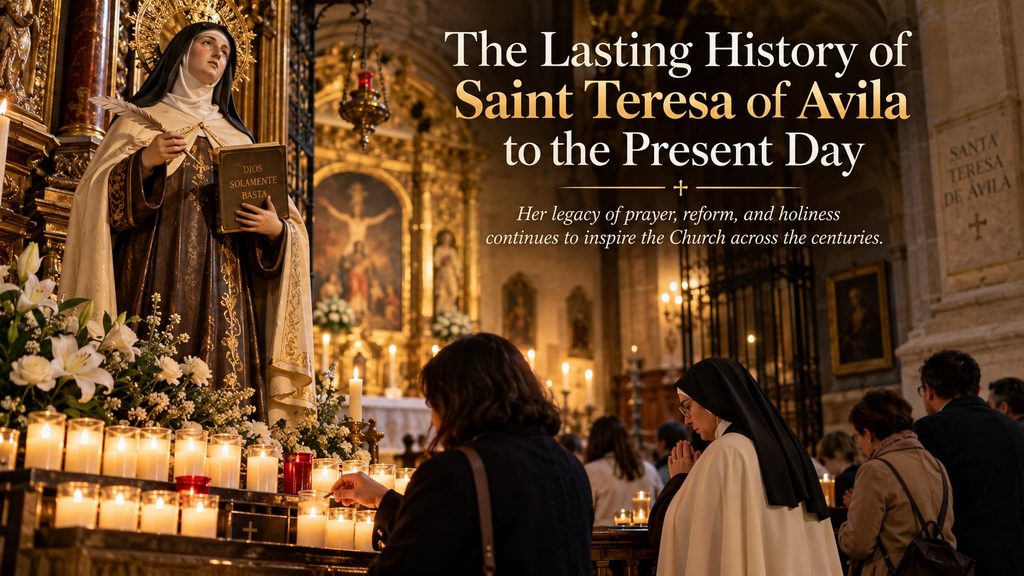
From the day of her death to the present, the history of Saint Teresa of Avila has continued to unfold through the life of the Church. Her reformed Carmelite communities spread across the world, carrying forward her vision of prayer and evangelical simplicity. Her books were translated into many languages and became standard reading in Catholic spirituality. Churches, schools, retreat houses, and religious institutions have been placed under her patronage.
Popes and saints after her time drew from her wisdom. Her influence can be seen in the life of Saint Thérèse of Lisieux, Saint Edith Stein, and many others within the Carmelite tradition. Her feast day on October 15 remains an important celebration in the Church’s liturgical calendar, especially for those devoted to the spiritual life and the contemplative tradition.
Today, pilgrims still visit Ávila and Alba de Tormes to honor her memory. Scholars continue to study her writings. Religious communities continue to live by the ideals she embraced. Lay Catholics continue to discover in her pages a guide who is at once wise, direct, and deeply human. Her history did not end in 1582. It lives on wherever a Christian learns to pray more deeply, trust more fully, and surrender more completely to Christ.
The Witness of Saint Teresa of Avila, Virgin and Doctor of the Church
To call Teresa a Virgin is to recognize the totality of her consecration to God. To call her a Doctor of the Church is to recognize the wisdom God gave her for the good of the whole People of God. But beyond all titles, she remains a saint whose life still speaks with freshness and power.
She teaches that holiness is possible even for those who begin imperfectly. She teaches that prayer is not a luxury but a necessity. She teaches that courage and tenderness can dwell together in one soul. She teaches that reform begins with fidelity. And above all, she teaches that God is not far away. He dwells within, waiting for us to enter more deeply into His friendship.
That is why Saint Teresa of Avila continues to matter. Her life is not merely an inspiring chapter from the past. It is a living invitation to every Christian soul.
Her Legacy
The story of Saint Teresa of Avila, Virgin & Doctor of the Church, is the story of a woman transformed by grace and given to the Church as a guide for every age. From her birth in Ávila in 1515, through her years of struggle, her profound conversion, her reforming zeal, and her holy death in 1582, she lived with a heart increasingly centered on Christ.
Her legacy remains one of the most beautiful in Catholic history. She gave the Church not only her example, but also a treasury of wisdom on prayer and the interior life. She showed that true holiness is not found in outward show, but in deep communion with God. And for that reason, the Church continues to honor her with love and gratitude.
For anyone seeking to understand the life of Saint Teresa of Avila, one truth stands above the rest: she was a woman who met Christ deeply, loved Him greatly, and spent her life helping others draw near to Him.
Prayer to Saint Teresa of Avila
O glorious Saint Teresa of Avila,
faithful bride of Christ and wise teacher of prayer,
you gave your life completely to the service of God
and taught the Church how to seek Him with a sincere and recollected heart.
Pray for us, that we may learn to love prayer,
to trust God in every trial,
and to persevere in faith when the road is difficult.
Help us to seek holiness not in appearances,
but in humility, truth, and deep union with Christ.
Obtain for us the grace to live with courage,
to remain faithful to the Church,
and to desire above all things the friendship of God.
Saint Teresa of Avila,
Virgin and Doctor of the Church,
pray for us.
Amen.