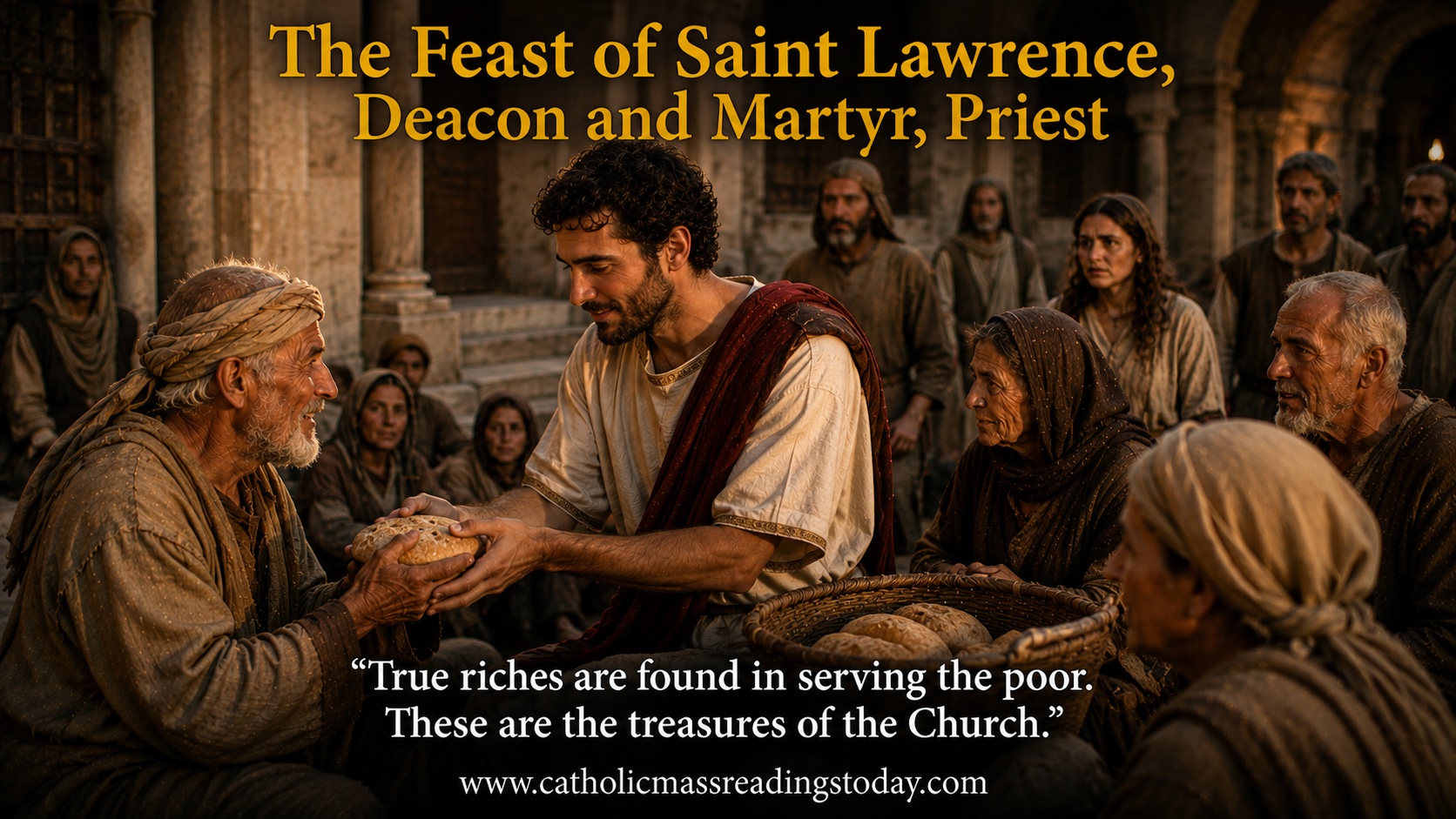
Every year on 10th August, the Catholic Church celebrates The Feast of Saint Lawrence, Deacon and Martyr, one of the most beloved saints of the early Church. His story is one of extraordinary courage, unwavering charity, and complete fidelity to Jesus Christ. Though he lived more than seventeen centuries ago, his witness continues to inspire Christians to place God above every earthly possession and to recognise Christ in the poor, the forgotten, and the suffering.
Saint Lawrence did not become famous because he was a great preacher or a celebrated scholar. Instead, he became one of the Church’s greatest heroes because he faithfully fulfilled the ordinary responsibilities entrusted to him and remained steadfast when those responsibilities demanded the ultimate sacrifice. His life reminds us that holiness is not reserved for extraordinary people. It belongs to those who love Christ faithfully in whatever vocation God has given them.
The Early Life of Saint Lawrence
The exact details surrounding Lawrence’s birth are not known with certainty, but ancient Christian tradition places his birth around the year 225 AD in the Roman province of Hispania, in what is now Spain. Many historians believe he was born in the region of Huesca, while others suggest nearby Valencia. Regardless of the exact location, it is widely accepted that Lawrence grew up in a Christian family during an era when following Christ could cost a person everything.
As a young man, Lawrence displayed remarkable intelligence, humility, and a sincere love for God. His faith was not simply inherited from his family; it became the centre of his own life. Those who knew him recognised not only his devotion but also his compassion toward others, particularly the poor and those who had no one to care for them.
It was during his youth that Lawrence met Sixtus, a respected priest known for his holiness and wisdom. A deep friendship developed between the two men, founded upon their shared love for Christ and the Church. When Sixtus was later chosen to become Pope Sixtus II, he invited Lawrence to accompany him to Rome.
For Lawrence, this invitation marked the beginning of a mission that would define his life.
Serving the Church in Rome
Rome in the third century was both the centre of the Roman Empire and the heart of the growing Christian Church. Christianity was spreading rapidly despite repeated waves of persecution. Believers gathered quietly in homes, celebrated the Eucharist in secret, and cared for one another with remarkable generosity.
Recognising Lawrence’s gifts, Pope Sixtus II ordained him as one of the seven deacons of Rome.
The role of a deacon was one of profound importance. Lawrence assisted in the celebration of the sacred liturgy, proclaimed the Gospel, distributed Holy Communion, and helped oversee many practical needs of the Christian community. Most importantly, he became responsible for administering the Church’s charitable works.
The offerings brought by Christians were never viewed as wealth to be accumulated. They were entrusted to the Church so that widows, orphans, prisoners, the sick, and the poor would be cared for. Lawrence managed these resources with exceptional honesty and generosity.
- He knew many of the poor by name.
- He visited the imprisoned.
- He comforted the sick.
- He welcomed strangers.
- He ensured that no Christian family was forgotten.
To Lawrence, every act of charity was an encounter with Christ Himself.
The Persecution Under Emperor Valerian
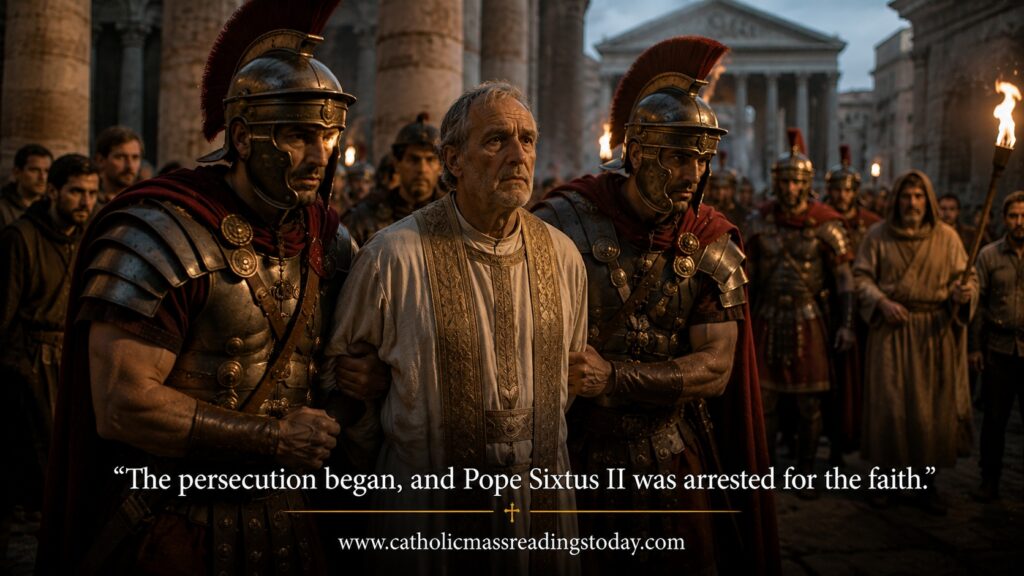
The peaceful service of Lawrence was interrupted when Emperor Valerian launched one of the fiercest persecutions against Christians in 258 AD.
Unlike previous persecutions that targeted ordinary believers indiscriminately, Valerian focused first on Church leaders. Bishops, priests, and deacons were arrested and executed in an attempt to weaken the growing Christian community.
Pope Sixtus II was among the first to be arrested.
As the Holy Father was being led away to his execution, Lawrence followed him with tears in his eyes. Ancient tradition records Lawrence crying out:
“Father, where are you going without your deacon?”
Pope Sixtus is said to have replied with words that became prophetic:
“I am not leaving you, my son. In three days you shall follow me.”
Those words remained in Lawrence’s heart. He knew that his own martyrdom was near.
The Treasures of the Church
After Pope Sixtus II was executed, Roman authorities turned their attention to Lawrence.
The prefect of Rome believed the Church possessed enormous wealth hidden somewhere within the city. Lawrence, being responsible for the Church’s finances, was ordered to surrender all its treasures to the Empire.
Rather than refusing immediately, Lawrence requested three days to gather everything.
The request was granted. During those three days, Lawrence did something extraordinary.
Instead of collecting gold and silver, he distributed the Church’s remaining resources to the poor.
He ensured that widows received assistance, the hungry families were fed, the sick received care and the prisoners were helped.
Every available possession was placed into the hands of those who needed it most.
When the appointed day arrived, Lawrence appeared before the Roman prefect accompanied not by wealthy officials or expensive possessions, but by the poor, the blind, the crippled, the elderly, widows, and orphans whom the Church had lovingly served. Standing before the governor, Lawrence declared:
“These are the treasures of the Church.”
Those words have echoed throughout Christian history.
Lawrence understood that the true wealth of the Church has never been found in buildings, precious metals, or earthly riches.
Its greatest treasure has always been the people redeemed by Christ, especially the poor in whom Jesus Himself is present.
The Martyrdom of Saint Lawrence
The Roman governor was enraged. Feeling mocked and humiliated, he ordered Lawrence to suffer one of the most painful executions recorded in Christian history.
Ancient tradition tells us that Lawrence was tied to a large iron gridiron suspended over burning coals. Rather than renouncing Christ, he remained calm. His faith remained unshaken.
Even in the midst of unbearable suffering, Lawrence continued to trust completely in God.
One of the most famous traditions associated with his martyrdom tells that, after enduring the flames for some time, he courageously said to his executioners:
“Turn me over; I am done on this side.”
Whether these exact words were spoken cannot be historically verified, but the tradition beautifully reflects the remarkable peace and courage with which Christians believed Lawrence faced his death. His serenity was not born from extraordinary physical strength but from complete confidence that Christ had already conquered death.
On 10 August 258 AD, Lawrence surrendered his life to the Lord. He was only about 33 years old.
Why Saint Lawrence Matters Today
Saint Lawrence’s witness remains remarkably relevant.
In an age often fascinated by wealth, status, and personal success, Lawrence reminds us that greatness in God’s Kingdom is measured differently.
He teaches us that generosity is never a loss. That caring for the poor is not optional but essential.
That every Christian is called to become a faithful steward of God’s gifts.
His life also reminds us that courage is often found in quiet faithfulness. Lawrence did not seek recognition or fame. He simply fulfilled the mission God had entrusted to him with integrity, humility, and love.
When persecution came, he remained faithful because he had already spent years learning to serve Christ in ordinary acts of charity.
The Church continues to honour him as the patron saint of deacons, librarians, archivists, cooks, and many charitable institutions throughout the world.
Countless churches, schools, hospitals, and ministries bear his name as living reminders that authentic Christian leadership is always rooted in humble service.
The Enduring Legacy of Saint Lawrence
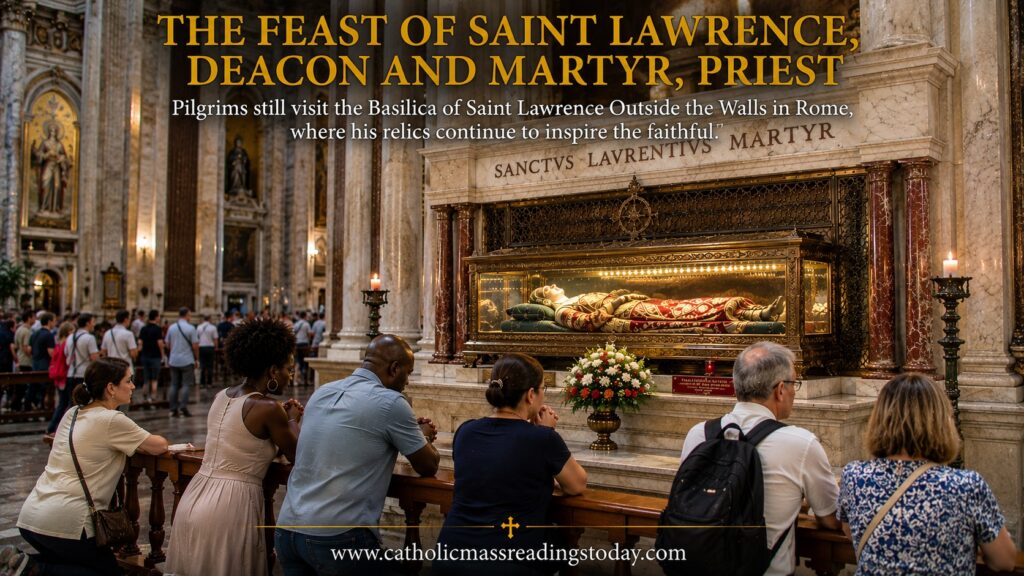
More than seventeen centuries have passed since Lawrence gave his life for Christ, yet his witness continues to illuminate the Church.
Pilgrims still visit the Basilica of Saint Lawrence Outside the Walls in Rome, where his relics are venerated. His name is also remembered in the Roman Canon of the Mass, placing him among the great saints whose lives have shaped the faith of generations.
But Lawrence’s greatest legacy is not found in monuments or ancient churches.
It is found wherever Christians choose generosity over selfishness.
- Whenever food is shared with the hungry…
- Whenever a family opens its home to someone in need…
- Whenever a deacon faithfully serves God’s people…
- Whenever believers give quietly without seeking praise…
- Whenever the poor are treated with dignity because they bear the image of Christ…
The spirit of Saint Lawrence lives on. His life reminds us that the Church’s greatest treasures are not stored in vaults or museums. They are found in every person loved by God.
May his example inspire us to become generous disciples who serve Christ with joyful hearts, trusting that no act of charity offered in His name is ever forgotten.
Let us Pray
Heavenly Father,
You filled Saint Lawrence with unwavering faith, joyful charity, and remarkable courage in the face of suffering. Through his example, teach us to recognise Christ in the poor, to serve Your people with generous hearts, and to value the treasures of heaven above the riches of this world.
Grant us the grace to be faithful in both ordinary duties and difficult trials. May we never be afraid to stand for the truth of the Gospel, but always respond with humility, compassion, and steadfast hope.
Through the intercession of Saint Lawrence, strengthen deacons, priests, and all who dedicate their lives to the service of Your Church. Inspire us to become cheerful givers, willing servants, and joyful witnesses to Your love in our families, our parishes, and our communities.
May our lives, like his, bear lasting fruit for Your glory and lead many hearts closer to Christ.
We ask this through our Lord Jesus Christ, Your Son, who lives and reigns with You in the unity of the Holy Spirit, God, for ever and ever.
Amen.