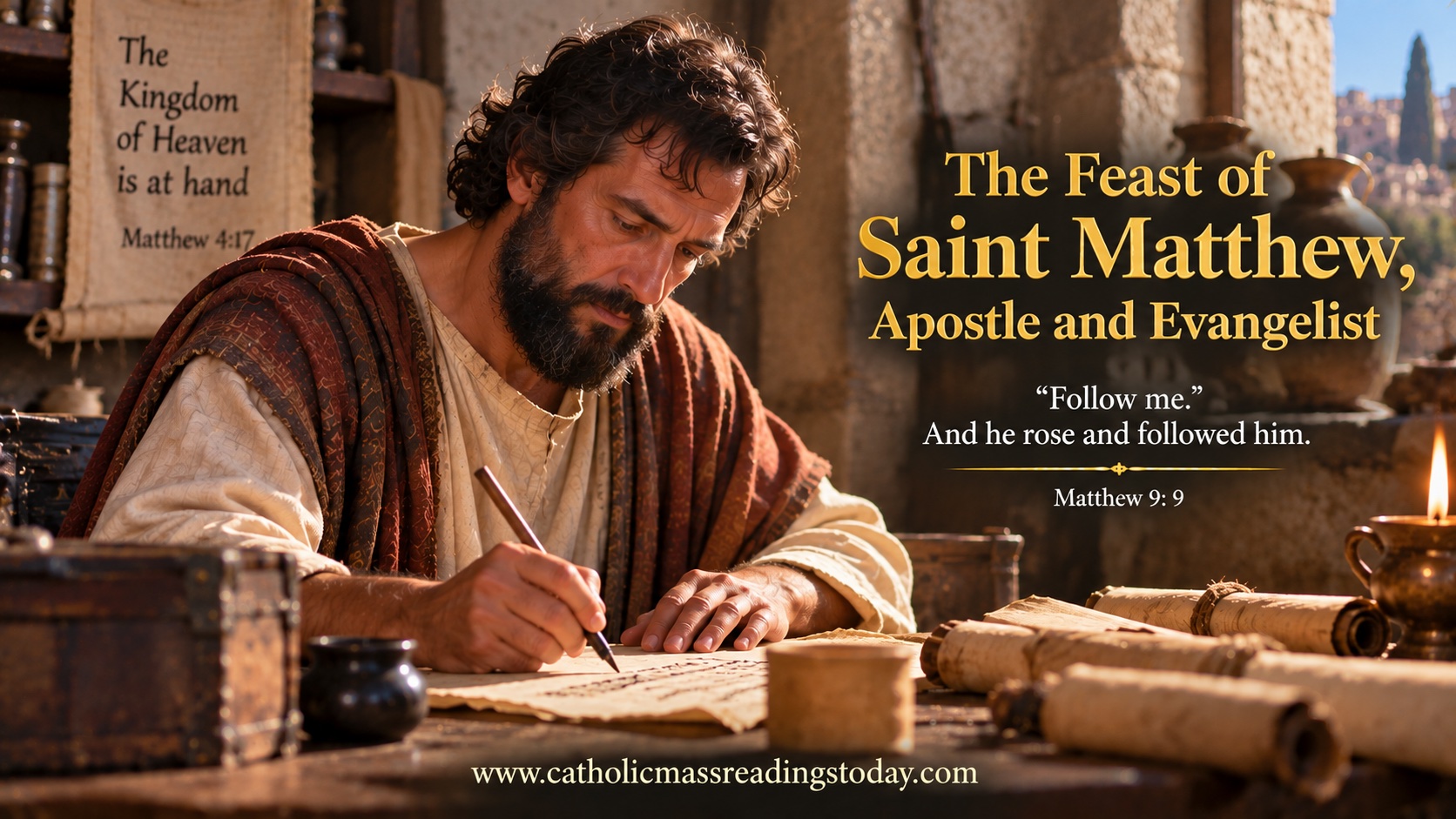
Every year on September 21, the Catholic Church celebrates the Feast of Saint Matthew, Apostle and Evangelist, one of the Twelve chosen by Jesus Christ and the saint traditionally associated with the Gospel according to Matthew. In 2026, the Vatican liturgical calendar marks September 21 specifically as the Feast of Saint Matthew, Apostle and Evangelist, with Matthew 9:9 – 13, the account of his calling as the Gospel proclaimed at Mass.
Few stories among the Apostles reveal the transforming power of grace as simply and beautifully as Matthew’s. His story begins not in a synagogue, not beside a fishing boat, and not with a man already admired for holiness. It begins at a tax office.
There Matthew sat, surrounded by the business of his old life, until Jesus passed by and spoke two words that changed everything:
“Follow me.”
Matthew rose and followed Him.
Behind that brief sentence lies the extraordinary story celebrated by the Church today: the story of a man whom society could easily have written off, but whom Christ chose to become an Apostle, a witness to the Gospel and a saint.
Saint Matthew Before He Met Jesus
The New Testament gives us relatively few biographical details about Matthew. Pope Benedict XVI observed that the historical information concerning him is “scarce and fragmentary,” meaning that any responsible account of Saint Matthew must distinguish what Sacred Scripture actually tells us from traditions that developed later.
Matthew appears consistently among the Twelve Apostles in the New Testament. The Gospel bearing his name identifies him strikingly as “Matthew the tax collector” in the list of the Twelve. Mark and Luke describe the tax collector whom Jesus called as Levi, and Christian tradition has identified this figure with Matthew.
His occupation matters enormously for understanding his story.
Matthew was a tax collector, or publican. Tax collectors worked within the Roman taxation system, and among the Jewish population they could be regarded with profound suspicion and contempt. They were associated with the occupying imperial power and were commonly grouped in the Gospels with “sinners.” Pope Francis, reflecting on Matthew’s calling, noted that people around him tended to see the label – publican – whereas Jesus saw the person.
That difference lies at the heart of Matthew’s story.
Others could look at him and see his profession.
Jesus looked at him and saw a disciple.
Others could see what Matthew had been.
Christ saw what grace could make of him.
The Day Jesus Passed the Tax Office
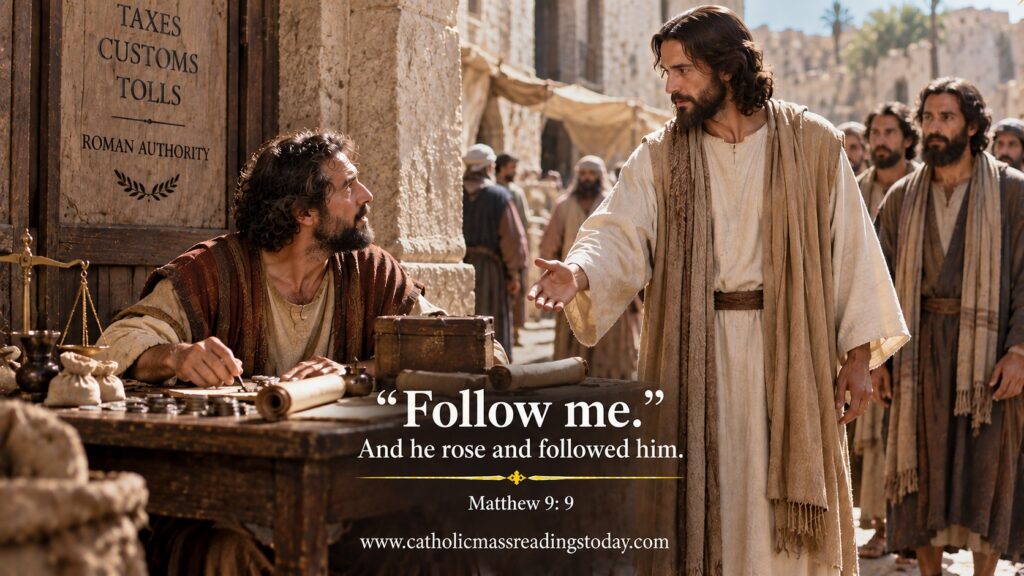
The decisive moment is preserved with remarkable simplicity in Matthew 9:9. Jesus sees Matthew sitting at the tax office and tells him:
“Follow me.”
Then comes the response:
“And he rose and followed him.”
There is no long conversation recorded. Matthew does not ask Jesus for time to consider the offer. The Gospel does not describe negotiations over what he will keep or what following Christ will cost him.
Jesus calls.
Matthew rises.
Matthew follows.
Benedict XVI pointed out something particularly significant in this response: getting up required Matthew to abandon a lucrative source of income. The Pope saw in this an indication that Matthew understood immediately that attachment to something incompatible with following Jesus could not be allowed to stand between him and Christ.
The tax office therefore becomes much more than the setting of Matthew’s vocation. It becomes an image of conversion.
Every Christian has, in some sense, a place from which Christ calls him or her to rise. It may be a particular sin, an attachment, resentment, fear, ambition, pride or simply a way of living in which God has gradually been pushed to the edges.
Matthew’s response shows what discipleship looks like when the call of Christ becomes more important than what we are being asked to leave behind.
Jesus Did Not See Matthew Only as a Sinner
One of the most beautiful aspects of this feast is the way Jesus looks at Matthew.
Pope Francis drew attention to the opening words of the account: Jesus “saw a man.” While others knew Matthew primarily by the social category attached to him—the tax collector—Christ looked beyond the label and encountered the human person.
This does not mean Jesus ignored Matthew’s moral condition. Christian mercy is never the denial of sin.
Rather, Jesus refused to believe that Matthew’s sin was the whole truth about Matthew.
There is an important distinction here.
The world can imprison a person inside his past. God calls the sinner out of it.
Christ does not tell us that our sins are insignificant. He tells us that through repentance and grace they do not have to determine what we become.
Matthew’s life is therefore a powerful witness to Christian hope. A human being can be known for one thing and, through the grace of God, become something entirely different.
The tax collector became an Apostle.
The man sitting behind the money table became a preacher of the Kingdom.
The one associated with public sinners became a saint celebrated throughout the universal Church.
A Table Filled With Tax Collectors and Sinners
Matthew’s response to Jesus did not end when he walked away from the tax office.
The Gospel immediately takes us to a meal.
Jesus is at table, and many tax collectors and sinners are there with Him and His disciples. The sight scandalizes the Pharisees, who ask:
“Why does your teacher eat with tax collectors and sinners?”
Jesus answers with words that reveal the very purpose of His saving mission:
“Those who are well have no need of a physician, but those who are sick.”
And then:
“I desire mercy, and not sacrifice. For I came not to call the righteous, but sinners.”
Benedict XVI described this episode as bringing us to the heart of Sacred Scripture: Christ draws near to sinners because they need the healing mercy that He has come to bring.
This scene also tells us something beautiful about Matthew.
The man who has encountered Christ begins bringing others into His presence.
Those gathered around that table were precisely the people religious society might have preferred to keep at a distance. Yet Matthew’s house becomes a place where they encounter Jesus.
His conversion begins to become missionary.
That pattern continues throughout authentic Christian discipleship. We receive Christ, and eventually we begin wanting others to encounter Him too.
“I Desire Mercy, and Not Sacrifice”
The words spoken by Jesus in Matthew’s house remain one of the great lessons associated with this feast.
“I desire mercy, and not sacrifice.”
Jesus is quoting the prophet Hosea. He is not rejecting genuine worship or sacrifice. Rather, He exposes the contradiction of performing religious observances while possessing a heart that has forgotten mercy.
Matthew himself stands as living evidence of what mercy can accomplish.
Had Jesus treated him only according to his reputation, Matthew’s story might have ended at the tax office.
Mercy opened another future.
For Catholics, this has profound implications. We cannot celebrate God’s mercy toward Saint Matthew while quietly believing that certain people around us are beyond redemption. Nor can we rejoice in the forgiveness we ourselves receive, especially through the Sacrament of Reconciliation, while permanently defining another human being by the worst chapter of his or her life.
Mercy does not call evil good. It does something far greater.
It believes that through repentance and grace, the sinner can become a saint.
Matthew Becomes One of the Twelve
After his calling, Matthew belongs to the group that stands at the foundation of the apostolic Church. His name appears in the lists of the Twelve in Matthew, Mark and Luke, and again among the Apostles gathered after the Ascension in the Acts of the Apostles.
Think of the extraordinary distance between those two moments.
Once he sat collecting taxes.
Later he stood among the Apostles of Jesus Christ.
He heard Christ teach. He witnessed His ministry. He belonged to the community that passed through the bewilderment and sorrow of the Passion and into the proclamation of the Resurrection.
The Feast of Saint Matthew therefore celebrates more than one man’s conversion. It celebrates apostleship: being called by Christ and then sent by Christ.
This connection is especially clear in the liturgy of the feast. The First Reading for September 21, 2026, from Ephesians 4:1 – 7, 11 – 13, speaks of Christ giving different gifts to His Church, apostles, prophets, evangelists, pastors and teachers, for ministry and for building up the Body of Christ.
Matthew’s vocation belongs precisely within this mystery. Christ does not merely rescue us from something. He calls us for something.
Grace forgives, but grace also sends.
Saint Matthew the Evangelist
The Church venerates Matthew not only as an Apostle but also as an Evangelist, and Christian tradition associates him with the Gospel according to Matthew.
The Gospel bearing his name occupies the first position among the four canonical Gospels in the New Testament. Its pages repeatedly show Jesus as the fulfilment of God’s promises and illuminate the continuity between the Old Testament and the life, teaching, death and Resurrection of Christ.
Its opening genealogy traces the ancestry of Jesus through Israel’s history. Throughout the Gospel, the reader repeatedly encounters the fulfilment of Scripture. Jesus appears as the Messiah, the Son of David, Emmanuel God with us and the authoritative teacher who brings God’s saving plan to fulfilment.
The Gospel contains some of Christianity’s most treasured passages: the visit of the Magi, the Sermon on the Mount, the Beatitudes, the Lord’s Prayer, numerous parables of the Kingdom, Peter’s confession of faith, Christ’s teaching about the Church, the Passion and Resurrection, and finally the Great Commission.
It ends with the risen Christ sending His disciples to make disciples of all nations, baptizing them and teaching them to observe all He commanded.
The man once seated at a tax office is thus remembered by the Church in connection with a Gospel that has carried the words of Christ across nations and centuries.
The Symbol of Saint Matthew
Christian art traditionally represents the four Evangelists using four figures associated with the visions found in Ezekiel and Revelation.
Saint Matthew is traditionally represented by a winged man or angelic human figure. Catholic tradition associates this symbol with the way Matthew’s Gospel begins—with the human genealogy of Jesus Christ.
Matthew is also frequently depicted with a Gospel book or manuscript, emphasizing his role as Evangelist. Other artistic representations connect him with money, coins or a tax table, recalling the life from which Christ called him.
Perhaps no artistic representation of his vocation is more famous than Caravaggio’s The Calling of Saint Matthew, preserved in the Church of San Luigi dei Francesi in Rome. Benedict XVI himself referred to this celebrated painting while reflecting upon Matthew’s calling.
Its enduring power comes from the same mystery found in the Gospel itself: Christ enters an ordinary human setting, points toward a man immersed in his former life, and calls him into something entirely new.
What Happened to Saint Matthew After Pentecost?
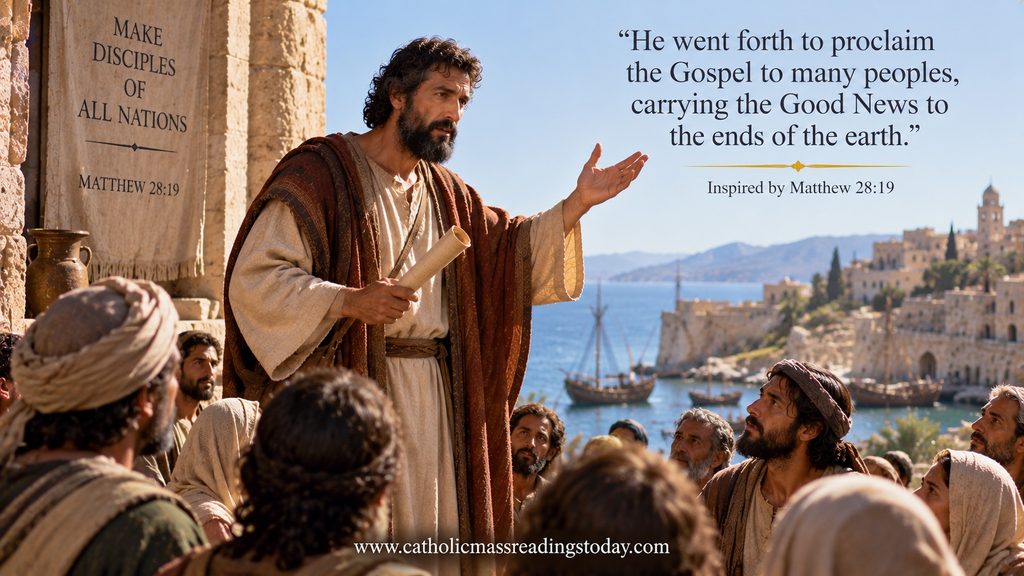
The New Testament does not give us a detailed account of Matthew’s later missionary journeys or his death. Traditions developed associating his preaching with various regions beyond Judea. Accounts differ considerably regarding exactly where he preached and how his earthly life ended.
Some traditions remember him as a martyr, while other accounts describe a different manner of death. Because the historical evidence is not sufficiently clear to reconstruct these events with certainty, it is better not to present one later tradition as though it were an undisputed biblical biography. Catholic sources themselves acknowledge that relatively little is known with certainty about Matthew beyond the Gospel witness.
What the Church does know with confidence is enough to explain why his memory has endured: Matthew belonged to the Twelve and became a witness to Christ whose apostolic legacy remains embedded in the life of the Church.
Why the Church Celebrates Saint Matthew on September 21
The Roman Catholic Church celebrates Saint Matthew, Apostle and Evangelist, on September 21, and the day has the liturgical rank of a Feast.
The Mass draws our attention directly to Matthew’s vocation.
The Gospel is Matthew 9:9 – 13 the call from the tax office and the meal with sinners. The Communion Antiphon recalls Christ’s declaration that He came to call sinners, while the liturgical prayer asks that the faithful, strengthened by Matthew’s example and intercession, may remain firm in following Christ.
The Church therefore does not remember Matthew merely because he belonged to an important group two thousand years ago.
She places his story before us because his vocation remains a mirror for every Christian vocation.
- Christ still passes by.
- Christ still sees people whom others have labelled.
- Christ still calls sinners.
- Christ still asks men and women to rise.
And the invitation remains:
“Follow me.”
Saint Matthew and the Meaning of Christian Vocation
The Feast of Saint Matthew teaches us something essential about vocation: God does not call only people who appear perfectly prepared.
Matthew was not standing in the Temple waiting for a religious commission. He was sitting at his place of work.
His vocation entered the middle of ordinary life.
This should give great hope to anyone wondering whether God can still do something meaningful with his or her life.
The Lord can call someone from an office, a workshop, a classroom, a hospital ward, a kitchen, a marketplace or a home. He can call the young and the old. He can call someone who has walked faithfully with Him for decades and someone who has only just returned after years away.
The important question is not whether our past has been perfect.
It is whether our hearts are willing to respond when Christ says, “Follow me.”
From Receiving Mercy to Becoming a Witness
Matthew’s story also teaches that receiving mercy carries a responsibility.
Christ’s mercy is never sterile. It creates disciples.
The man who received the invitation of Jesus eventually became associated with proclaiming Jesus to others. That movement, from being found by Christ to helping others find Christ, is at the heart of evangelization.
Not everyone is called to preach publicly. Not everyone will become a missionary in another country. But every baptized Catholic has received a life that can bear witness to the Gospel.
Parents evangelize when they teach their children to pray and allow faith to shape family life. Workers evangelize when integrity survives where dishonesty would be easier. Young people evangelize when they refuse to be ashamed of Christ. Christians evangelize when mercy appears where resentment would be expected, when forgiveness interrupts hatred, and when someone quietly chooses what is right because he or she belongs to Jesus.
Matthew reminds us that evangelization begins with encounter.
Before Matthew could proclaim Christ, he first had to hear Christ call him.
The Patron Saint of Those Who Work With Money
Because of his former profession as a tax collector, Saint Matthew has traditionally been invoked as a patron of people whose occupations involve money and financial records, including accountants, bankers, bookkeepers and tax collectors.
There is something fitting about this patronage.
Matthew’s life reminds Christians working in finance, business and commerce that discipleship does not remain outside the workplace. Money is not evil in itself, but our relationship with it must come under the lordship of Christ.
Integrity, justice, honesty, generosity and concern for the human person are not optional additions to Christian professional life. They belong to the vocation of the baptized.
Matthew left the tax table when Christ called him, but his story continues to challenge everyone who sits at a modern equivalent of that table: What place does Christ occupy in the way I earn, use and understand what has been entrusted to me?
What Saint Matthew Teaches the Church Today
Perhaps the most enduring lesson of the Feast of Saint Matthew, Apostle & Evangelist is that God sees more in a human being than the world sees.
The crowd saw a tax collector.
Jesus saw Matthew.
The religious critics saw a sinner.
Jesus saw a man capable of becoming an Apostle.
Matthew himself may have seen the security of his present life.
Christ saw the mission ahead of him.
This is how grace works.
God meets us truthfully where we are, but He loves us too much to leave us there.
Pope Benedict XVI, reflecting on Matthew, emphasized that his conversion shows that we must never lose confidence that anyone can respond to the call of Christ. No one should be considered permanently excluded from God’s friendship while life remains and the possibility of conversion is still open.
That is a message worth hearing in every generation.
There are people whom society has written off.
There are people whose mistakes have followed them for years.
There are Catholics who believe they have been away from the Church too long to return.
There are men and women carrying sins they imagine God could never forgive.
And there are ordinary people who assume holiness is something meant for somebody else.
Saint Matthew stands before all of them.
His life says: Christ still calls.
“Follow Me” The Invitation That Continues
The beauty of Matthew’s vocation lies partly in how little Jesus says.
There is no complicated formula.
“Follow me.”
Those words contain the whole Christian life.
To follow Jesus means allowing Him to lead where we would not necessarily have chosen to go. It means permitting His teaching to correct us, His mercy to heal us, His commandments to shape us and His Cross to teach us how to love.
Following Christ does not mean that everything becomes easy. The Apostles themselves discovered that discipleship leads through sacrifice.
But Matthew discovered something greater than the security he left behind.
He discovered Christ.
And once Christ becomes the treasure, the old tax table can no longer have the final claim upon the heart.
Celebrating the Feast of Saint Matthew, Apostle & Evangelist
As the Church celebrates the Feast of Saint Matthew, Apostle & Evangelist, we are invited to do more than admire a saint from the distant past.
We are invited to hear his story personally.
Perhaps there is something from which Christ is asking us to rise.
Perhaps there is someone we have reduced to his or her past, just as Matthew was reduced to the label of “tax collector.”
Perhaps we have forgotten how much mercy we ourselves have received.
Perhaps God is calling us to use our gifts more courageously in the service of the Gospel.
Or perhaps, after years of hesitation, we simply need to hear those words again:
“Follow me.”
Matthew rose.
And because he rose, his life became part of the story of the Gospel.
May his feast remind us that holiness does not begin when we finally become impressive enough for God.
It begins when Christ calls, and, trusting His mercy, we rise and follow Him.
Prayer to Saint Matthew, Apostle and Evangelist
O glorious Saint Matthew,
Apostle and Evangelist,
you heard the voice of Jesus calling you from the tax office,
and you rose without delay to follow Him.
Pray for us, that we may recognize the voice of Christ
when He calls us away from sin, fear and attachment
and invites us into deeper friendship with Him.
You who experienced the mercy of the Divine Physician,
help us never to despair of God’s forgiveness
and never to judge another person as beyond the reach of His grace.
Teach us to use faithfully the gifts entrusted to us,
to serve the Church with humility,
to proclaim the Gospel by our words and our lives,
and to remain steadfast in following Christ.
Saint Matthew, Apostle and Evangelist,
pray for us,
that having followed Jesus faithfully on earth,
we may one day rejoice with you in His presence forever.
Through Christ our Lord.
Amen.