Every year on October 7, the Catholic Church celebrates the Memorial of Our Lady of the Rosary, a feast that draws the faithful back to one of the Church’s most beloved forms of prayer. The Rosary is familiar enough to fit into the palm of a hand, simple enough to be prayed by a child, and yet deep enough to accompany a Christian through an entire lifetime.
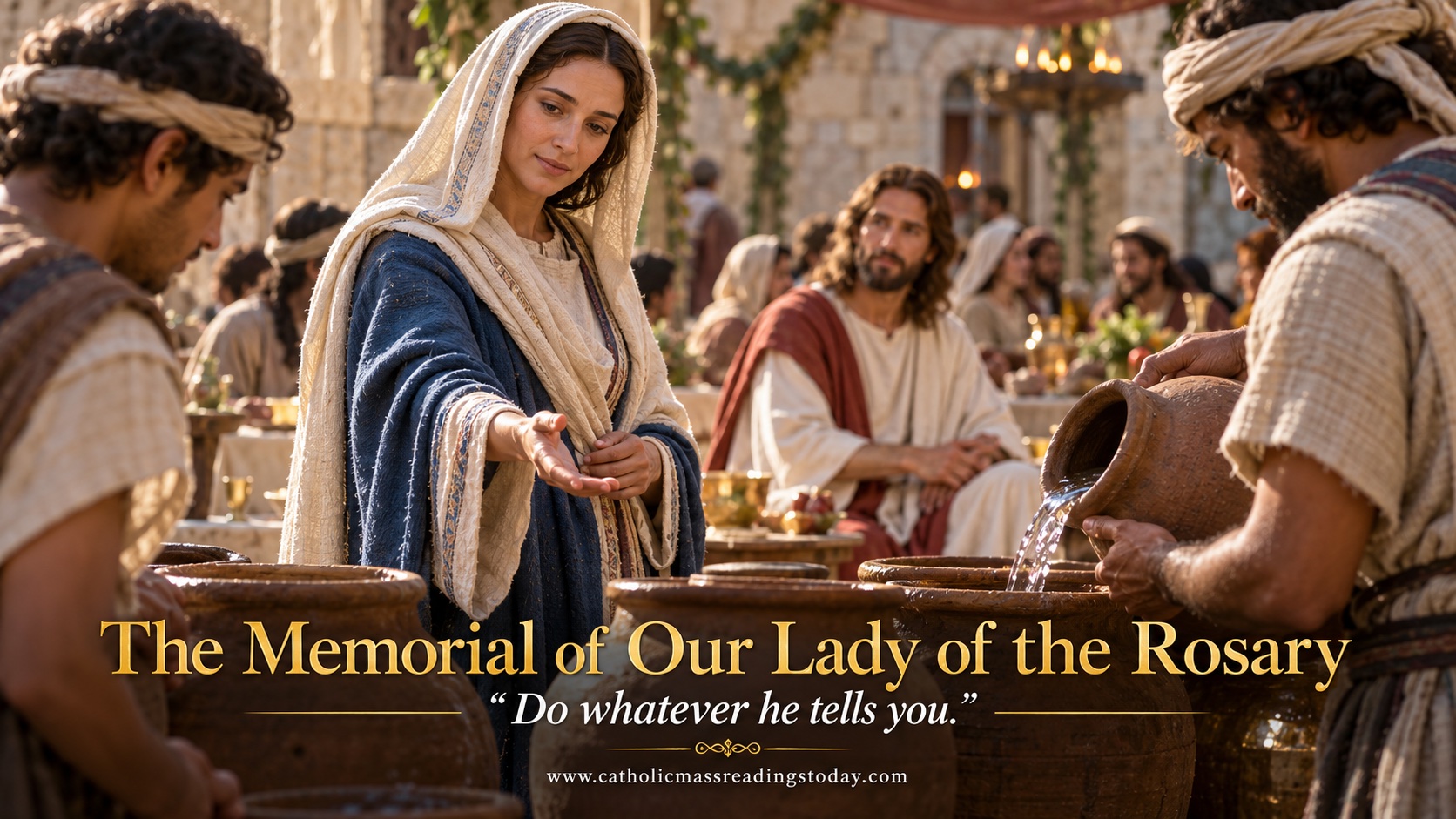
At its heart, devotion to Our Lady of the Rosary is not simply about repeating prayers. It is about learning to look at Jesus through the eyes of His Mother. The mysteries of the Rosary lead us through the great events of the Gospel: the Incarnation, the public ministry of Christ, His Passion and Death, His Resurrection and glory. Mary never keeps the attention on herself. As she did at the wedding feast in Cana, Galilee when she said, “Do whatever he tells you,” she continues to lead believers toward her Son.
Pope Benedict XVI once described the Rosary precisely in this Christ centered way, explaining that it is a means by which the faithful contemplate Jesus and learn to love and follow Him more faithfully.
The Memorial of Our Lady of the Rosary therefore invites Catholics not only to hold the beads in their hands, but to allow the mysteries of Christ to enter their minds, memories, choices, families and daily lives.
The Meaning of the Title Our Lady of the Rosary
The title Our Lady of the Rosary honors the Blessed Virgin Mary in her unique relationship to this form of prayer. Catholics do not pray the Rosary because Mary replaces Jesus or because she is worshipped. Worship belongs to God alone.
Rather, Catholics ask Mary to pray with and for them because she is the Mother of Jesus and the first and most faithful disciple of her Son.
Each Hail Mary contains the name of Jesus at its center. Each mystery directs attention toward an event in His life. Even when the prayer repeats the words “Holy Mary, Mother of God, pray for us sinners,” its purpose is ultimately to bring the believer closer to Christ.
Saint John Paul II called the Rosary a prayer that is both simple and profound, and taught that through it Christians sit, in a spiritual sense, “at the school of Mary” while contemplating Christ.
This explains why generations of Catholics have turned to the Rosary during moments of joy, uncertainty, grief, persecution, family difficulty and war. It gives the hands something to hold while giving the heart a path toward God.
The Rosary Developed Through Centuries of Christian Prayer
The Rosary as Catholics know it today did not suddenly appear in its complete form. It developed gradually within the prayer life of the Church.
In earlier centuries, monks and clergy prayed the 150 Psalms as part of the Church’s liturgical prayer. Many ordinary Christians, however, could not read the Psalms or did not possess books. Forms of repeated prayer therefore developed in which the faithful prayed groups of Our Fathers or Hail Marys, sometimes using beads or cords to keep count.
Over time, these prayers increasingly became connected with meditation on events in the lives of Jesus and Mary. The practice of praying 150 Hail Marys developed alongside the tradition of the 150 Psalms, and eventually groups of mysteries from the life of Christ became associated with the prayers.
The Dominican tradition has a particularly strong association with the Rosary. For centuries Catholic devotion has linked Saint Dominic with the spread of Marian prayer, and sacred art often portrays Our Lady handing the Rosary to Saint Dominic. Historically, however, the Rosary developed over a longer period rather than being created in its complete present form at a single moment.
That distinction does not lessen the Dominican contribution. The Dominican family played an enormous role in preaching, organizing and popularizing the Rosary throughout Europe, helping it become a prayer of ordinary Catholic households as well as religious communities.
Saint Pius V and the Rosary
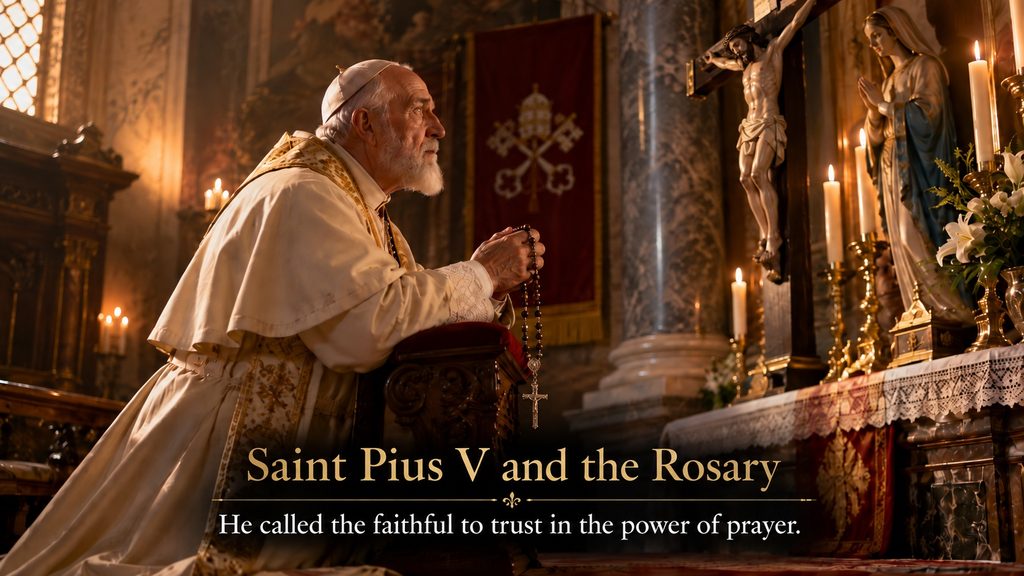
A decisive moment in the history of the Rosary came during the pontificate of Pope Saint Pius V, a Dominican who served as pope from 1566 until 1572.
Saint Pius V strongly promoted the Rosary and helped establish its traditional structure. His pontificate also coincided with the event that would forever connect October 7 with Our Lady of the Rosary: the Battle of Lepanto.
By the middle of the sixteenth century, conflict between European Christian powers and the Ottoman Empire had intensified throughout the Mediterranean. In 1570, Ottoman forces attacked Cyprus, increasing fears of further expansion westward. Saint Pius V worked to bring Catholic powers together in what became known as the Holy League, whose principal naval forces came from Spain, Venice and the Papal States.
At the same time, the Pope urged Christians to pray.
The Rosary became central to that appeal.
The Battle of Lepanto and October 7, 1571
On October 7, 1571, the fleets of the Holy League and the Ottoman Empire met near Lepanto in the Gulf of Patras, off western Greece.
It became one of the most famous naval battles of the sixteenth century.
While sailors fought at sea, Catholics far from the battlefield were praying. Rosary confraternities took part in public prayer in Rome, and Saint Pius V had urged the faithful to ask for the Blessed Virgin Mary’s intercession. Historical Catholic accounts associate these prayers deeply with the Christian victory that followed.
The battle was costly and brutal, but the Holy League emerged victorious.
For Saint Pius V and countless Catholics, the victory was not simply a military achievement. It became a moment of profound thanksgiving to God, with particular gratitude for the intercession of the Blessed Virgin Mary.
The Church’s remembrance of October 7 grew from this historical setting.
Saint Pius V established a celebration associated with the victory under the title Our Lady of Victory. His successor, Pope Gregory XIII, developed the observance further and connected it explicitly with the Holy Rosary.
What began as thanksgiving for a particular moment in history gradually became something much larger: an annual reminder of the spiritual power of prayer and of the Christian’s need to entrust every struggle to God.
From Our Lady of Victory to Our Lady of the Rosary
The feast continued to develop after Lepanto.
In 1573, Pope Gregory XIII established the observance of the Holy Rosary in churches where there was an altar dedicated to the Rosary, traditionally celebrated on the first Sunday of October.
Its observance continued spreading.
Following another Christian victory over Ottoman forces at Petrovaradin in 1716, Pope Clement XI extended the celebration of the Rosary to the universal Church.
Later, Pope Saint Pius X restored the celebration to the date of October 7, linking the liturgical memorial directly with the anniversary of Lepanto.
The feast that Catholics celebrate today therefore carries centuries of history within it. Yet the Church does not celebrate October 7 merely to commemorate a naval battle.
The deeper message is that Christians are never self sufficient.
There are moments when human strength reaches its limits. There are battles in families, societies and individual hearts that cannot be overcome by determination alone. The Memorial of Our Lady of the Rosary reminds the faithful to turn again to prayer, trusting that history ultimately belongs to God.
Why the Rosary Is a Gospel Prayer
Anyone encountering the Rosary for the first time may notice immediately that it is repetitive.
The same prayers return again and again.
Yet repetition in the Rosary is not meant to empty the mind. It is intended to quiet the mind enough for contemplation.
The words of the Our Father and Hail Mary become something like a gentle rhythm beneath meditation on the life of Christ.
The Annunciation recalls the moment when the Word became flesh.
The Visitation reveals Christ already bringing joy through Mary’s presence.
The Nativity brings the believer before the manger.
The Baptism of the Lord points toward Christ’s public mission.
The Transfiguration reveals His glory.
The Institution of the Eucharist draws the heart toward the mystery of His enduring sacramental presence.
The Sorrowful Mysteries bring us into Gethsemane, the scourging, the crowning with thorns and finally Calvary.
The Glorious Mysteries lead from the empty tomb toward the Resurrection, Ascension, Pentecost and the ultimate hope of heaven.
The Rosary is therefore deeply biblical in its structure and purpose.
Its destination is Christ.
Saint John Paul II described it as a contemplative prayer capable of leading Christians more deeply into the mysteries of the Gospel, while also becoming a powerful prayer of intercession for the needs of the world.
Mary Never Leads Us Away From Christ
One of the clearest ways to understand Marian devotion is to look at Mary’s own words in the Gospel.
At the wedding feast of Cana, after recognizing the need of the newly married couple, Mary turns to the servants and says:
“Do whatever he tells you.”
Those words could almost serve as a summary of authentic Marian spirituality.
Mary does not say, “Look at me.”
She points toward Jesus.
The Rosary follows exactly that pattern.
Mary accompanies us through the mysteries of her Son so that we can listen to Him more closely, understand His life more deeply and follow Him more faithfully.
This is why devotion to Our Lady of the Rosary is never meant to stop with Mary. She leads us toward Bethlehem, Nazareth, Galilee, Jerusalem, Calvary and the empty tomb.
She leads us to Christ.
Our Lady of the Rosary and the Message of Fatima
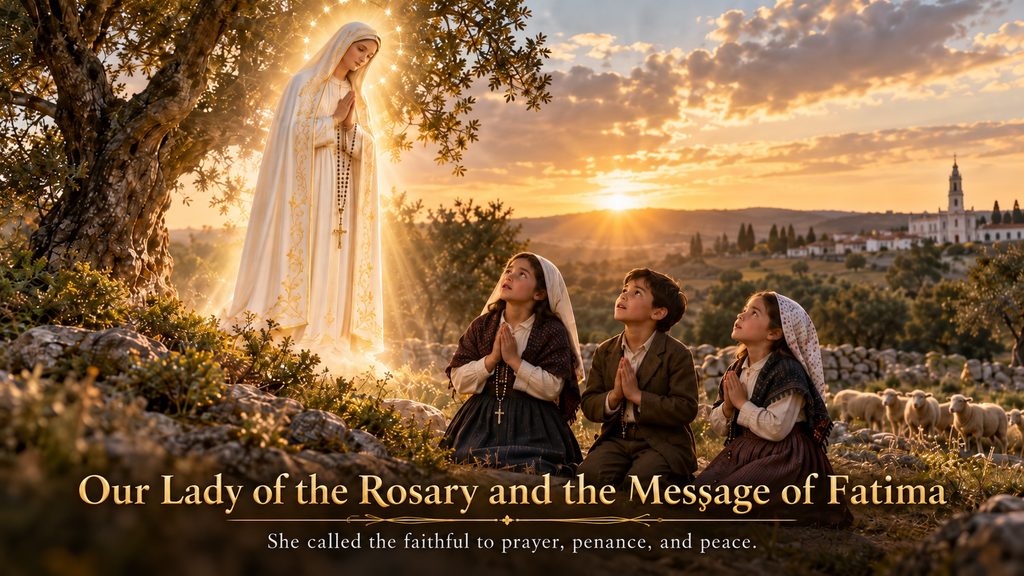
The twentieth century gave the title Our Lady of the Rosary renewed prominence through the apparitions associated with Fatima, Portugal, in 1917.
According to the Fatima tradition recognized by the Church, the Blessed Virgin repeatedly encouraged the three shepherd children, Lucia dos Santos and Saints Francisco and Jacinta Marto, to pray the Rosary for peace and for the conversion of sinners.
Pope Benedict XVI later recalled that Mary identified herself at Fatima as Our Lady of the Rosary and urged the children to pray the Rosary daily, particularly for peace amid the devastation of war.
The connection is striking.
The feast had emerged centuries earlier from a moment of war and prayer. At Fatima, the Rosary again appeared as a prayer offered amid violence and uncertainty.
But the Church’s message is not that the Rosary is a magical formula capable of forcing events to occur according to our wishes.
Christian prayer always rests upon God’s will.
The Rosary forms the believer in trust, repentance, perseverance and peace. It trains the heart to remain close to Christ, especially when circumstances seem beyond human control.
The Rosary and the Christian Family
The Rosary has also occupied a special place within Catholic family life.
For generations, families have gathered in living rooms, kitchens, chapels and bedrooms to pray it together. Children often learn their first prayers while sitting beside parents or grandparents with rosary beads in their hands.
Pope Leo XIII strongly encouraged this devotion and repeatedly called Catholics to pray the Rosary, especially during October. In 1883 he ordered special Rosary devotions throughout the Church during the month, helping establish October’s enduring association with the Holy Rosary.
He also saw the Rosary as particularly suited to family life because its mysteries continually return Christians to the Holy Family and the virtues seen in the home of Nazareth.
That lesson may be even more relevant today.
Modern family life is surrounded by noise. Phones demand attention. Work follows people home. Social media rarely sleeps. Families can share the same room and yet spend very little time truly present to one another.
The Rosary creates a different kind of space.
For twenty or thirty minutes, the family stops.
The television is silent.
Phones can be placed aside.
Parents and children pray together.
Even when young children become restless, even when someone loses track of the mystery, something important is happening: the household is deliberately making room for God.
Such moments may appear small, but faith is often handed from one generation to the next through precisely these ordinary acts.
The Rosary in Times of Suffering
There is another reason the Rosary has endured across centuries: it can be prayed when people have very few words left.
Someone sitting beside a hospital bed may struggle to compose a long prayer.
A grieving mother may not know what to say.
A frightened family awaiting news may find concentration difficult.
A person struggling with anxiety may discover that spontaneous prayer feels impossible.
The Rosary gives words when our own words fail.
The fingers move from bead to bead.
The familiar prayers continue.
The mysteries place suffering beside the suffering of Christ.
Sometimes the person praying feels consolation. Sometimes nothing changes emotionally. But prayer continues.
And that perseverance matters.
The Rosary teaches that faith is not simply a feeling. It is also the decision to remain with God when we cannot see what He is doing.
The Rosary Is Not an Escape From the World
True devotion never encourages Christians to hide from responsibility.
The person who spends time contemplating Christ should gradually begin to resemble Christ.
If we meditate on the Visitation, we should become more willing to serve.
If we contemplate the Nativity, we should become more attentive to the poor and vulnerable.
If we contemplate Christ forgiving His enemies, we should examine the grudges we refuse to release.
If we contemplate the Crucifixion, we should become more willing to carry our own crosses with faith.
If we contemplate the Resurrection, despair should never have the final word in our lives.
Prayer sends us back into the world differently.
This is one reason Saint John Paul II described the Rosary as particularly relevant to the work of evangelization in the modern world.
The Rosary does not remove Christians from reality.
It teaches them how to face reality with Christ.
Our Lady of the Rosary and the Search for Peace
The history of this memorial inevitably brings us back to the question of peace.
The Rosary became associated with October 7 because people prayed during war. Fatima’s message again connected the Rosary with prayer for peace. Popes across generations have urged Catholics to take up the Rosary whenever humanity finds itself threatened by division, conflict or fear.
That message remains painfully relevant.
Our world continues to experience war, displacement, hatred, persecution, broken families and political division. Technology has advanced enormously, but the human heart remains vulnerable to the same pride, resentment and desire for domination that have wounded humanity throughout history.
Peace therefore requires more than treaties.
It begins with conversion.
The person who asks God for peace must also ask whether peace exists within his or her own heart.
The family praying for peace among nations must also learn forgiveness at home.
The Christian who condemns hatred in society must refuse to nourish hatred toward a neighbor.
The Rosary brings these contradictions before Christ.
Decade after decade, it asks the believer to become the kind of person through whom God’s peace can enter the world.
What Our Lady of the Rosary Teaches Us Today
The Memorial of Our Lady of the Rosary arrives every October with a quiet but demanding invitation.
Take up the beads again.
Not because every prayer will immediately feel profound.
Not because every problem will suddenly disappear.
Not because the Rosary is a guarantee of an easy life.
Pray because Christ is worth contemplating.
Pray because our families need grace.
Pray because sinners need mercy.
Pray because the Church needs holiness.
Pray because our world needs peace.
Pray because we ourselves need conversion.
Some Catholics may have prayed the Rosary faithfully for decades. Others may have allowed the devotion to disappear from their lives. Some may know only a few prayers and feel uncertain about beginning.
The invitation remains the same.
Begin where you are.
One decade prayed attentively can be more fruitful than an entire Rosary hurried without thought.
A family can begin with one mystery in the evening.
A commuter can pray during a journey.
Someone unable to sleep can place the beads beside the bed.
Parents can teach children one prayer at a time.
The Rosary belongs not only in churches and monasteries but also in cars, kitchens, hospitals, airports, prisons, schools and ordinary homes.
Its simplicity is one of its greatest strengths.
A School of Mary, a Journey With Christ
The deepest significance of the Memorial of Our Lady of the Rosary is ultimately not found at Lepanto, important though that history remains.
It is found in the Christian heart learning to stay with Jesus.
The Rosary begins again and again with familiar words because Christian conversion also begins again and again.
We return to the mysteries.
We return to the Gospel.
We return to Christ.
And beside us stands Mary, the woman who said yes to God at Nazareth, carried Jesus within her, gave Him to the world, followed Him through His public ministry, stood near His Cross and prayed with the disciples as the Church awaited the Holy Spirit.
When Catholics honor her as Our Lady of the Rosary, they are asking her to do what she has always done: help the disciples of her Son remain close to Him.
This October 7, the Church invites us to rediscover the Rosary not merely as an inherited Catholic custom, but as a living school of prayer.
The beads may be small.
The prayers may be familiar.
But the mysteries into which they lead us contain the whole drama of salvation.
And every time we pray them with faith, we allow Mary to take us once more by the hand and lead us toward Jesus.
Prayer to Our Lady of the Rosary
O Blessed Virgin Mary,
Our Lady of the Rosary,
Mother of Jesus and Mother of the Church,
we come before you with confidence and love.
Teach us to contemplate the face of your Son
with the same faith with which you welcomed Him,
the same tenderness with which you cared for Him,
and the same courage with which you stood beside His Cross.
When our hearts are troubled, lead us to Jesus.
When our families are divided, obtain for us the grace of reconciliation.
When we are tempted to lose hope, remind us that God remains faithful.
When sin separates us from Him, lead us back to repentance and mercy.
Our Lady of the Rosary,
pray for our families,
pray for the Church,
pray for those who suffer,
pray for sinners,
and pray for peace throughout the world.
Help us to pray the Holy Rosary with attention and love,
so that while meditating upon the mysteries of Christ,
we may learn to follow Him more faithfully each day.
May every Hail Mary draw us nearer to your Son,
every mystery deepen our faith,
and every Rosary make our hearts more like His.
Mary, Queen of the Most Holy Rosary,
pray for us now and at the hour of our death.
Amen.