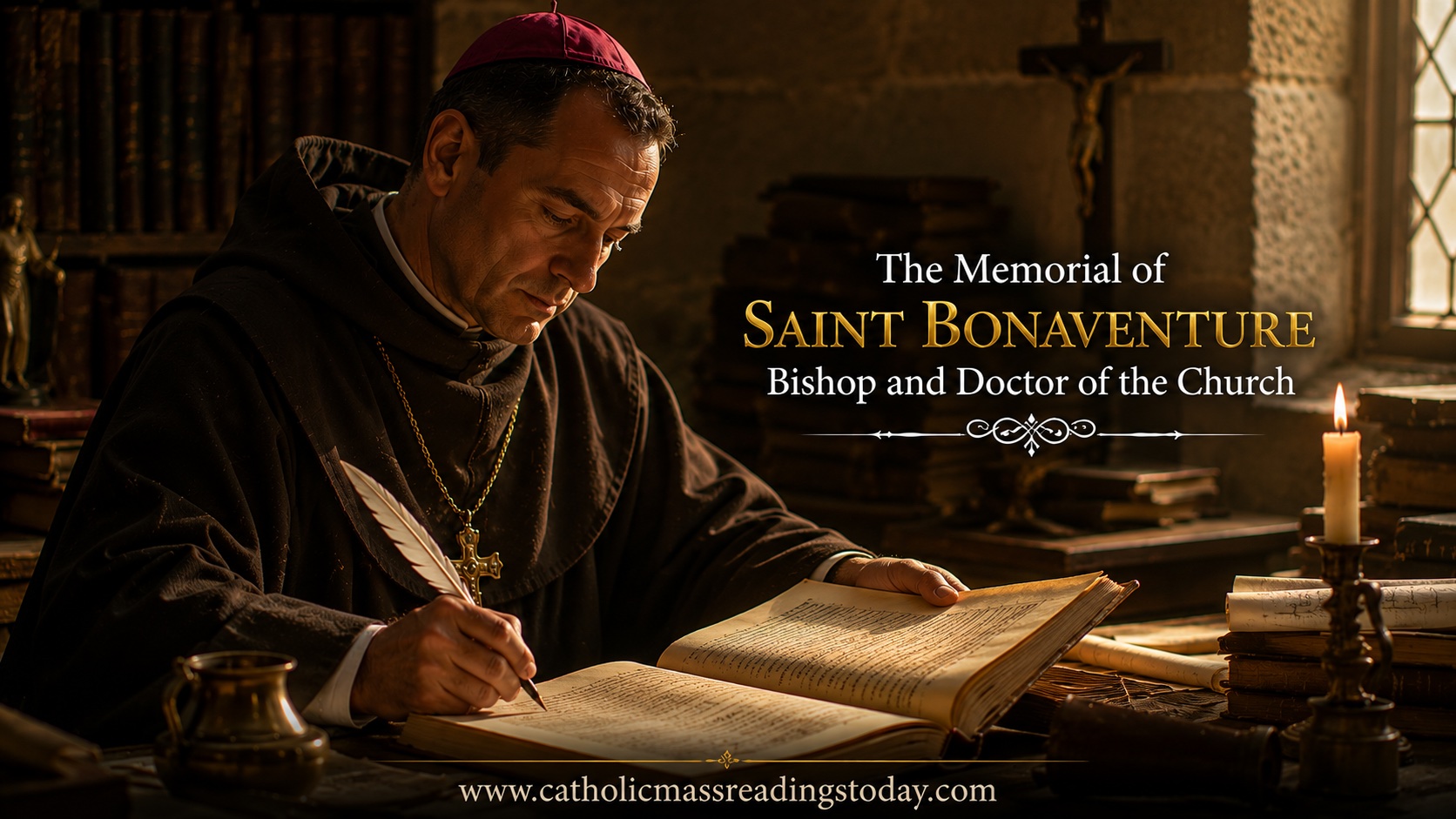
Feast Day: July 15
Saint Bonaventure stands among the greatest minds and holiest pastors the Catholic Church has ever known. Remembered as a brilliant theologian, humble Franciscan, wise bishop, and Doctor of the Church, he united intellectual excellence with profound holiness. His writings continue to guide Christians toward a deeper knowledge and love of God, reminding believers that true wisdom is born not merely from study but from prayer, humility, and a living relationship with Jesus Christ.
The Memorial of Saint Bonaventure, Bishop and Doctor of the Church, celebrated each year on 15 July, invites Catholics to reflect on the harmony between faith and reason, learning and holiness, leadership and humility. His life demonstrates that genuine greatness is found not in worldly recognition but in faithful service to God and His people.
Who Was Saint Bonaventure?
Saint Bonaventure was born around 1217 in the small Italian town of Bagnoregio, near Viterbo, during a period of remarkable spiritual renewal in the Church. His baptismal name was Giovanni di Fidanza (John of Fidanza).
His parents were devout Christians who nurtured him in the faith from an early age. According to a cherished tradition, Bonaventure became seriously ill as a young child. Believing he was close to death, his mother sought the prayers of Saint Francis of Assisi, who had founded the Franciscan Order only a few years earlier.
The child recovered unexpectedly.
His family always believed this healing came through the intercession of Saint Francis. Tradition holds that when Francis saw the child after his recovery, he joyfully exclaimed:
“O buona ventura!”
meaning,
“O good fortune!” or “What a blessed future!”
From that joyful greeting came the name by which history remembers him, Bonaventure.
Whether every detail of the story can be historically verified or not, one thing is certain: Bonaventure would grow into one of the greatest sons of the Franciscan Order.
His Education and Calling
Gifted with exceptional intelligence, Bonaventure travelled to Paris, then the intellectual heart of Europe, to pursue higher studies at the famous University of Paris.
There he encountered the newly established Order of Friars Minor, founded by Saint Francis of Assisi.
The simplicity of Franciscan life deeply attracted him.
Instead of seeking prestige or worldly advancement, Bonaventure entered the Franciscan Order around 1243, embracing a life of poverty, fraternity, prayer, and service.
His teachers quickly recognised his extraordinary mind.
Among those who greatly influenced him was the renowned theologian Alexander of Hales, under whom Bonaventure developed both academically and spiritually.
His studies were never separated from prayer. He believed theology was not merely an intellectual exercise but a path leading the soul closer to God.
He would later write that no one truly understands divine things unless the heart is inflamed with love.
This conviction would shape every aspect of his life and teaching.
A Brilliant Theologian
After completing his studies, Bonaventure became one of the leading professors of theology at the University of Paris.
His lectures attracted students from across Europe.
Unlike many scholars of his time who delighted primarily in debate, Bonaventure sought to help people encounter Christ personally.
He possessed the rare ability to explain profound mysteries of the faith with clarity while always pointing listeners toward prayer and holiness.
His theology combined intellectual depth with spiritual warmth.
He believed:
- Knowledge should lead to love.
- Learning should deepen humility.
- Theology should inspire worship.
- Every truth ultimately leads to Christ.
Because of this balanced approach, he became one of the Church’s most respected theologians.
His influence remains visible in Catholic theology even today.
Minister General of the Franciscan Order
In 1257, Bonaventure was elected Minister General of the Franciscan Order.
The Franciscans were growing rapidly throughout Europe, but rapid growth had also brought disagreements.
Some members wanted an extremely strict interpretation of Saint Francis’ rule.
Others favoured a more practical approach that would allow the Order to continue its expanding ministry.
The disagreements threatened to divide the Franciscans.
Bonaventure’s wisdom proved invaluable.
Rather than taking sides harshly, he patiently listened, encouraged dialogue, and guided the Order back toward unity.
He reminded the friars that fidelity to Saint Francis required both evangelical poverty and fraternal charity.
His leadership preserved the unity of the Franciscan family during one of its most difficult periods.
Because of this achievement, he is often called the “Second Founder of the Franciscan Order.”
Preserving the Legacy of Saint Francis
One of Bonaventure’s greatest contributions was writing the official biography of Saint Francis of Assisi, known as the Legenda Maior.
Many stories about Saint Francis were circulating throughout Europe.
Some were accurate.
Others contained exaggerations or conflicting details.
Bonaventure carefully gathered reliable sources and produced a biography that faithfully preserved the spirit and teachings of Saint Francis.
For centuries, this became the principal account of the saint’s life.
Through this work, Bonaventure ensured that future generations would understand not merely the remarkable events of Francis’ life but the profound spirituality that inspired them.
For Bonaventure, Francis was not simply a historical figure but a living example of complete conformity to Jesus Christ.
His Spiritual Writings
Saint Bonaventure authored numerous theological and spiritual works that continue to nourish the Church.
Among his most famous writings are:
- The Journey of the Mind into God (Itinerarium Mentis in Deum)
- The Tree of Life
- The Breviloquium
- Commentary on the Sentences
- Life of Saint Francis
These works invite readers beyond intellectual understanding into personal communion with God.
He taught that creation itself reflects God’s beauty.
Nature, Scripture, the sacraments, prayer, and charity all become pathways leading the human soul toward its Creator.
Unlike purely academic theology, Bonaventure’s writings always end in contemplation.
His goal was never simply to teach people about God.
His desire was to help them encounter Him.
Bishop, Cardinal, Doctor of the Church, and His Lasting Legacy
A Humble Servant Called to Greater Responsibility
Saint Bonaventure never sought positions of honour. His greatest desire was simply to serve Christ faithfully as a Franciscan friar. Yet God had prepared him for an even greater mission within the Church.
In 1273, Pope Gregory X appointed Bonaventure Cardinal Bishop of Albano, one of the most important dioceses surrounding Rome. It is said that when the papal messengers arrived carrying the cardinal’s red hat, Bonaventure was washing dishes in the monastery. Rather than interrupt his work, he politely asked them to hang the hat on a nearby tree until he had finished.
Whether preserved exactly or embellished over the centuries, the story beautifully reflects the humility that characterised his life. Titles and honours never distracted him from the simple service of God.
To Bonaventure, greatness was measured not by rank but by holiness.
Helping Heal the Church
The Church of the thirteenth century faced many challenges. Political tensions frequently affected ecclesiastical life, divisions threatened Christian unity, and reform was urgently needed in many places.
Recognising Bonaventure’s wisdom, Pope Gregory X entrusted him with one of the most significant responsibilities of his time.
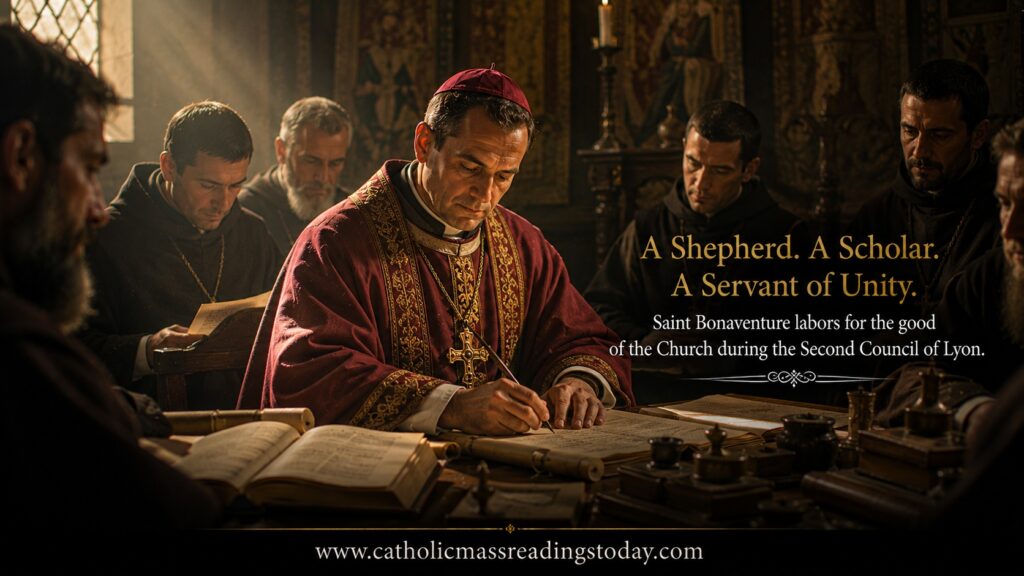
He played a leading role in preparing for the Second Council of Lyon, which opened in 1274.
The Council addressed several pressing concerns:
- restoring unity between the Eastern and Western Churches,
- reforming Church life,
- strengthening missionary work,
- promoting peace among Christian rulers,
- encouraging greater holiness within the clergy.
Bonaventure worked tirelessly before and during the Council to build understanding rather than deepen divisions. His calm temperament, theological brilliance, and deep spirituality made him a trusted adviser to the Pope and respected by bishops throughout Christendom.
He believed that truth and charity must always walk together.
Even when disagreements arose, he encouraged patient dialogue, mutual respect, and sincere prayer.
His example continues to offer valuable lessons for the Church today.
His Death
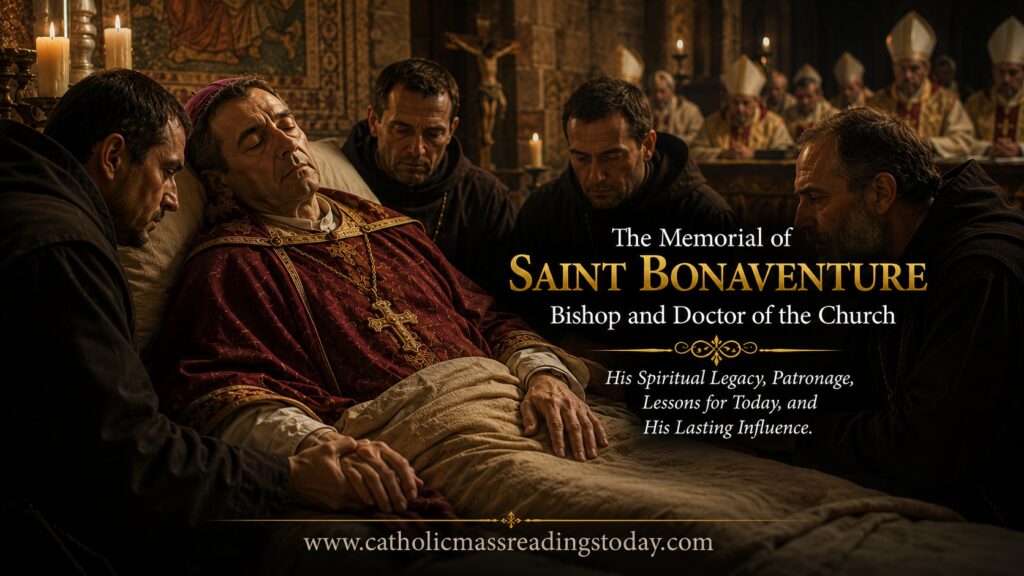
While serving the Church at the Second Council of Lyon, Saint Bonaventure became seriously ill.
Despite his failing strength, he continued carrying out his responsibilities until he could do so no longer.
He died peacefully on 15 July 1274, during the Council itself.
He was about fifty-six years old.
His death deeply saddened Pope Gregory X, the bishops attending the Council, and the Franciscan Order. They recognised that the Church had lost not only one of its greatest theologians but also one of its wisest pastors.
His funeral was attended by many Church leaders who mourned a man whose life had been marked by humility, learning, holiness, and unwavering fidelity to Christ.
Unlike many saints who died as martyrs, Bonaventure gave his life through tireless service. His was a daily martyrdom of charity, study, prayer, leadership, and complete dedication to the mission entrusted to him.
Canonisation and Doctor of the Church
Saint Bonaventure’s reputation for holiness spread rapidly after his death.
His writings continued to shape Catholic theology, while his example inspired generations of Franciscans and countless other Christians.
In 1482, Pope Sixtus IV formally canonised him as a saint.
Only a few years later, in 1588, Pope Sixtus V declared him a Doctor of the Church, recognising the enduring importance of his theological teaching.
This title is reserved for saints whose doctrine has profoundly enriched the faith of the universal Church.
Bonaventure became known as the “Seraphic Doctor.”
The title reflects both the brilliance of his theological insights and the burning love for God that filled his heart.
His writings are remarkable because they never separate truth from holiness.
He reminds us that theology is not simply about acquiring knowledge—it is about allowing knowledge to become love.
Why Saint Bonaventure Matters Today
Although more than seven centuries have passed since Bonaventure walked the earth, his message remains strikingly relevant.
We live in a world overflowing with information but often lacking wisdom.
Knowledge has never been more accessible, yet genuine peace and spiritual depth remain elusive for many.
Saint Bonaventure reminds us that wisdom begins with humility.
He teaches that faith and reason are not enemies. On the contrary, reason reaches its highest purpose when illuminated by faith, and faith is strengthened when it is thoughtfully understood.
His life speaks powerfully to:
- students seeking truth,
- teachers entrusted with forming minds,
- priests preaching the Gospel,
- theologians studying the mysteries of faith,
- parents educating their children,
- religious striving for holiness,
- and every Christian longing to know Christ more deeply.
He encourages us never to be satisfied with merely knowing about God.
Instead, he invites us to know God personally through prayer, Scripture, the sacraments, and a life of charity.
His Lasting Influence on Catholic Spirituality
Saint Bonaventure believed every part of creation reflects something of God’s beauty.
He encouraged Christians to contemplate nature, not simply to admire its beauty, but to discover within it the fingerprints of the Creator.
He also emphasised:
- deep devotion to the Passion of Christ,
- love for the Eucharist,
- fidelity to the Blessed Virgin Mary,
- simplicity of life,
- humility before God,
- and joyful service of neighbour.
These themes continue to shape Franciscan spirituality throughout the world.
Many religious communities, seminaries, universities, and schools bear his name today as a testimony to his enduring influence.
His writings continue to be studied not only by theologians but by anyone seeking a richer spiritual life.
Lessons We Can Learn from Saint Bonaventure
The life of Saint Bonaventure offers practical lessons for every Christian:
- True wisdom always leads us closer to God.
- Humility is greater than worldly success.
- Leadership should always be exercised with charity.
- Prayer must remain the foundation of every decision.
- Learning becomes fruitful when it inspires holiness.
- Unity is preserved through patience, humility, and love.
- Every Christian is called to grow continually in both faith and understanding.
Perhaps his greatest lesson is this:
The closer we draw to Christ, the more we realise that holiness is not about becoming important, it is about becoming faithful.
His life beautifully demonstrates that intellectual brilliance reaches its fullest purpose only when it is placed at the service of God and His people.
His Spiritual Legacy, Patronage, Lasting Influence, and Prayer
The Spiritual Legacy of Saint Bonaventure
Saint Bonaventure left behind far more than books and theological writings. He left the Church a way of seeing the world through the eyes of faith. He believed that every part of creation speaks of God’s goodness and that every sincere search for truth ultimately leads to Christ.
His spirituality was deeply Christ-centred. He encouraged Christians not only to study Jesus but to imitate Him, to become people of humility, mercy, sacrifice, and joyful service. For Bonaventure, the Christian life was not simply about avoiding sin; it was about allowing the love of Christ to transform every thought, every decision, and every relationship.
He often described the spiritual journey as a pilgrimage. Each day offers another opportunity to grow in holiness, to trust God more completely, and to become more like Jesus. That journey begins with prayer, is strengthened by the sacraments, and reaches its fullness in loving God and neighbour.
One of his best-known convictions is beautifully expressed in these words:
“No one comes to wisdom except through grace, justice, knowledge, and humility.”
This simple truth continues to challenge every generation. Wisdom is not measured by how much we know but by how faithfully we live what God has revealed.
Saint Bonaventure’s Love for Christ Crucified
The Cross occupied the centre of Bonaventure’s spiritual life.
He believed that anyone who wished to understand God’s love needed only to look at Christ crucified. There, God revealed both His justice and His infinite mercy.
Rather than viewing the Cross as a sign of defeat, Bonaventure saw it as the throne from which Christ conquered sin and death.
This devotion shaped his preaching, his writing, and his personal prayer.
He encouraged Christians to spend time contemplating the Passion of Christ because it teaches:
- the depth of God’s love,
- the seriousness of sin,
- the beauty of forgiveness,
- and the hope of eternal life.
For Bonaventure, every Christian is invited to carry the Cross not with fear but with confidence, knowing that it always leads toward the Resurrection.
Devotion to the Blessed Virgin Mary
Like many Franciscan saints, Bonaventure had a deep love for the Blessed Virgin Mary.
He frequently wrote about Mary’s humility, obedience, and complete openness to God’s will.
He saw her as the perfect disciple, the one who listened to God’s Word, treasured it in her heart, and lived it faithfully.
He encouraged Christians to seek Mary’s intercession and to imitate her trust in God’s providence.
For Bonaventure, devotion to Mary never distracted from Christ. Instead, it always led more deeply to Him.
Patronage and Influence
Although Saint Bonaventure is especially honoured within the Franciscan family, his influence extends far beyond it.
He is widely regarded as the:
- Patron of Franciscan theologians.
- Patron of those engaged in theological study.
- Spiritual guide for teachers and students of theology.
- Model for bishops, scholars, and Christian educators.
Many Catholic universities, seminaries, schools, libraries, and theological institutes throughout the world proudly bear his name.
His works continue to be studied by seminarians, priests, religious, and lay faithful seeking a deeper understanding of the Catholic faith.
Why the Church Continues to Honour Him
The Church celebrates The Memorial of Saint Bonaventure, Bishop and Doctor of the Church not simply because he possessed extraordinary intelligence, but because he placed every gift he had at the service of God.
His life reminds us that:
- Holiness is greater than fame.
- Humility is greater than recognition.
- Love is greater than knowledge.
- Prayer is the foundation of true wisdom.
In an age that often prizes achievement above character, Saint Bonaventure points us back to what truly matters: allowing Christ to shape our minds, our hearts, and our lives.
His witness assures us that faith and reason belong together. The more we genuinely seek truth, the more we discover the face of Christ.
What Saint Bonaventure Can Teach Us Today
Every Christian can learn something from Saint Bonaventure’s remarkable life.
He teaches us:
- to pray before making important decisions;
- to seek understanding without becoming proud;
- to place service before ambition;
- to defend unity within the Church;
- to remain faithful even when responsibilities become difficult;
- to remember that every talent has been entrusted to us for God’s glory rather than our own.
Perhaps the greatest lesson he leaves us is that learning should always make us more humble.
Knowledge that does not lead to love becomes empty.
Faith that is not lived becomes weak.
But when knowledge and love meet in Christ, they become wisdom.
Celebrating His Memorial Today
Catholics throughout the world honour Saint Bonaventure on 15 July through:
- participation in the Holy Mass;
- reading his spiritual writings;
- praying for theologians, teachers, bishops, and students;
- asking his intercession for wisdom and humility;
- spending time in Eucharistic Adoration;
- reading Sacred Scripture prayerfully;
- performing works of charity in imitation of his generous heart.
His memorial encourages every believer to grow not only in understanding but also in holiness.
A Prayer Through the Intercession of Saint Bonaventure
In the Name of the Father, and of the Son, and of the Holy Spirit. Amen.
Heavenly Father,
You raised up Saint Bonaventure to be a faithful shepherd, a brilliant teacher, and a humble servant of Your Church.
Through his example, teach us to seek wisdom that is rooted in prayer and strengthened by charity. Keep us from the pride that trusts only in human knowledge, and fill our hearts instead with the humility that opens us to Your truth.
Grant us the grace to love Your Son more deeply each day. May His Gospel shape our thoughts, our words, and our actions, so that everything we do may give glory to You.
Through the intercession of Saint Bonaventure, bless theologians, teachers, bishops, priests, religious, students, and all who dedicate themselves to sharing the treasures of the Catholic faith. Help them to teach with fidelity, compassion, and courage.
Strengthen Your Church in unity and peace. May we never grow weary in our pursuit of holiness, but continue to walk faithfully toward the eternal joy You have prepared for those who love You.
Saint Bonaventure, faithful servant of Christ and wise Doctor of the Church,
Pray for us.
We ask this through Christ our Lord.
Amen.
Saint Bonaventure at a Glance
- Feast Day: 15 July
- Born: Around 1217, Bagnoregio, Italy
- Baptismal Name: Giovanni di Fidanza
- Religious Order: Order of Friars Minor (Franciscans)
- Roles: Franciscan Friar, Theologian, Minister General, Cardinal Bishop of Albano
- Died: 15 July 1274, during the Second Council of Lyon, France
- Canonised: 1482 by Pope Sixtus IV
- Declared Doctor of the Church: 1588 by Pope Sixtus V
- Title: The Seraphic Doctor
- Remembered For: His profound theology, deep spirituality, humble leadership, and preservation of the Franciscan charism.
Saint Bonaventure’s life remains a timeless reminder that the greatest wisdom is found not in worldly acclaim but in knowing, loving, and faithfully following Jesus Christ.