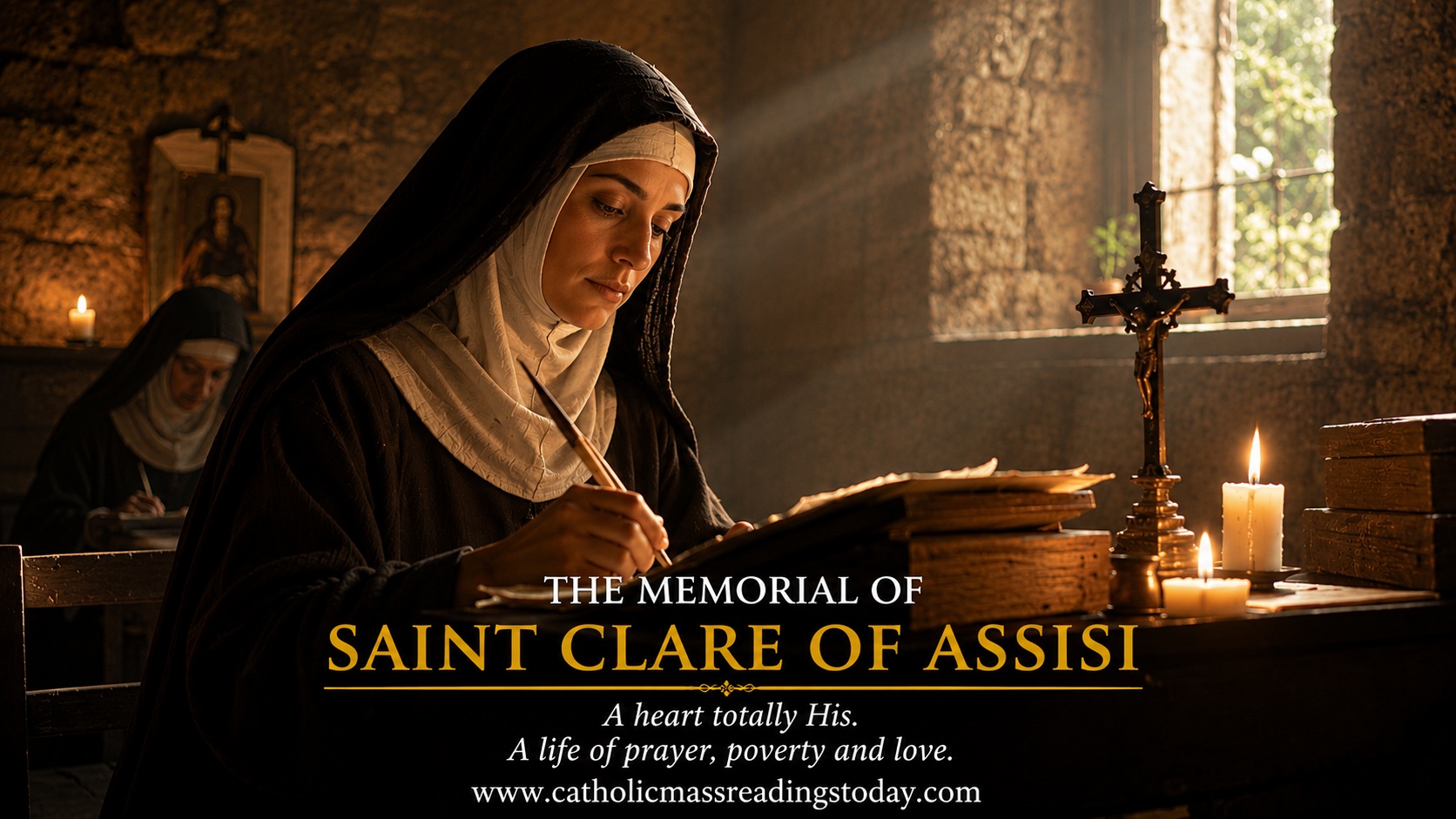
Each year on 11th August, the Catholic Church celebrates The Memorial of Saint Clare of Assisi, one of the most remarkable women in Christian history. Her life was a radiant testimony to the transforming power of the Gospel. Born into privilege yet drawn to radical poverty, admired for her noble birth yet remembered for her humility, Saint Clare left behind the comforts of wealth to embrace a life entirely devoted to Jesus Christ.
Her story cannot be told without mentioning Saint Francis of Assisi, whose witness awakened in her the desire to follow Christ with complete freedom. Yet Clare was never simply “the follower of Francis.” She became a saint of extraordinary courage, a spiritual mother to generations of religious women, and a contemplative whose faith strengthened the Church during one of its most challenging periods.
More than eight centuries after her death, her quiet life of prayer continues to speak powerfully to a world that often mistakes success for greatness. Saint Clare reminds us that true strength is found in surrendering everything to God.
A Noble Beginning in Assisi
Clare was born around 1193 or 1194 in the beautiful hill town of Assisi in central Italy. She belonged to the influential Offreduccio family, one of the noble families of the region. Her father, Favarone di Offreduccio, was a wealthy knight, while her mother, Ortolana, was known for her deep faith and charitable works. Ortolana herself would later become a religious after Clare entered convent life and is honoured as Blessed Ortolana by the Church.
From childhood, Clare experienced a life that many could only dream of. Her family’s home was filled with comfort, fine clothing, servants, and every opportunity that wealth could provide. Yet even as a young girl, these outward privileges failed to satisfy the deepest longing of her heart.
While other noble children delighted in luxury, Clare found joy in prayer. She quietly gave food to the poor, often sacrificing her own meals so that those in need would not go hungry. She was known for her kindness, modesty, and compassion long before she ever considered religious life.
Her parents naturally expected that she would one day marry into another noble family. Such a marriage would strengthen political alliances and increase the family’s influence. But God was preparing Clare for a very different future.
Hearing the Voice of God
Around the time Clare reached her late teens, a young man from Assisi had begun attracting attention throughout the town.
His name was Francis, the son of a wealthy merchant who had abandoned his inheritance after experiencing a profound conversion. Instead of pursuing wealth and honour, Francis chose a life of poverty, preaching repentance, serving lepers, rebuilding abandoned churches, and joyfully proclaiming the Gospel.
Many dismissed him as foolish, others were deeply moved. Clare was among those whose hearts were transformed by his witness. She secretly listened to Francis preach and soon recognised that the Gospel he proclaimed was exactly the life she desired. She sought him out privately, asking for guidance in discerning God’s will.
Francis did not encourage Clare to imitate him superficially. Rather, he helped her discover the unique vocation God had prepared for her.
Through prayer, Clare came to understand that Christ Himself was inviting her to leave everything behind.
Leaving Everything for Christ

On Palm Sunday in 1212, Clare attended Mass with her family in the Cathedral of Assisi. Tradition recalls that when she hesitated to approach the sanctuary with the others, the bishop himself descended the steps to place the blessed palm branch into her hands. Many later saw this as a sign that God was already leading her toward a special mission.
That same night, Clare quietly slipped out of her family’s home while everyone slept.
She walked through the darkness to the small chapel of Portiuncula, where Francis and his brothers were waiting.
There, before the altar, Clare laid aside her noble garments. Francis cut her long hair, a visible sign that she had left her former life behind and clothed her in a simple penitential habit.
Her decision shocked Assisi. Her family quickly attempted to bring her home by force. Some relatives even travelled to the convent where she had taken refuge and tried physically to remove her.
Clare refused. Holding tightly to the altar, she declared that she belonged to Christ alone. Her courage astonished everyone. She had exchanged earthly security for the freedom of belonging entirely to God.
The Birth of the Poor Ladies
Francis first placed Clare in a Benedictine convent before eventually moving her to the small Church of San Damiano, just outside Assisi.
There began one of the most influential communities in the history of the Church.
Women inspired by Clare’s example soon joined her. Among the first was her younger sister, Agnes, who also left the family’s wealth despite fierce opposition from relatives.
Other noble women followed. Together they became known as the Poor Ladies, the community that would later become the Order of Saint Clare, commonly called the Poor Clares.
Unlike many religious communities of the time, Clare insisted upon complete dependence on Divine Providence.
The sisters owned no personal property and the community itself possessed no wealth. They worked with their hands, prayed faithfully, cared for one another, and trusted that God would provide for their daily needs. This “Privilege of Poverty” became the defining characteristic of Clare’s vocation.
While many Church authorities admired her holiness, some believed her strict poverty was impractical. Several popes encouraged her to soften the Rule by allowing property ownership.
Clare respectfully declined. She believed Christ had called her to absolute poverty, and she remained faithful to that calling until the end of her life.
A Woman of Prayer and Quiet Strength
Although Clare rarely travelled beyond the convent walls, her influence reached far beyond Assisi. Her days revolved around the Eucharist, the Divine Office, manual work, silence, and prayer.
Visitors frequently spoke of the profound peace that surrounded San Damiano. Many sought her counsel, Bishops consulted her, Priests admired her wisdom and ordinary people came simply to ask for prayers. Clare understood that hidden prayer could transform the world just as surely as public preaching. She believed that every sister’s first responsibility was to gaze upon Christ, allowing His love to reshape every aspect of her life.
Her letters to Saint Agnes of Prague, one of the great spiritual treasures of medieval Christianity, reveal the depth of her contemplation. Again and again she encouraged Agnes to fix her eyes upon Christ, especially upon His humility and His poverty.
For Clare, the mystery of Christ crucified was not an idea to be admired but a life to be embraced.
Defending Assisi Through Faith
One of the most famous moments in Clare’s life occurred during the conflicts that swept through central Italy.
Around 1240, soldiers threatened the convent of San Damiano. Clare was seriously ill and physically weak, yet when danger approached, she asked that the Blessed Sacrament be brought before her.
Holding the Eucharist before the attackers, she prayed with complete confidence in God’s protection. According to longstanding tradition, the invaders retreated without attacking the convent.
Whether every detail of the event can be historically verified, the Church has long preserved this tradition because it beautifully reflects Clare’s unwavering trust in the Real Presence of Christ in the Eucharist.
Her courage did not come from military strength. It came from faith.
Her Final Years
Years of fasting, illness, and physical suffering gradually weakened Clare.
For almost three decades she endured poor health, yet she never allowed suffering to diminish her joy or her concern for others. Even from her sickbed she continued guiding her sisters with wisdom and tenderness.
One of her greatest achievements came only shortly before her death. After years of perseverance, Pope Innocent IV finally approved the Rule that Clare herself had written for her community.
She became the first woman in the history of the Church known to compose a Rule for a religious order that received papal approval. For Clare, this approval was a great consolation. The way of life she had defended for decades would continue after her death.
The Death of Saint Clare
On 11 August 1253, surrounded by her sisters at San Damiano, Clare peacefully surrendered her soul to God.
She was about sixty years old. Those present recalled the serenity with which she prepared for eternity.
Tradition tells us that Pope Innocent IV himself came to celebrate her funeral, recognising the extraordinary holiness of the woman whose hidden life had become a light for the entire Church.
Only two years later, in 1255, Pope Alexander IV formally declared her a saint.
Such rapid canonisation reflected the widespread conviction that Clare had lived a life of heroic virtue.
Why Saint Clare Still Matters Today
Saint Clare’s witness remains remarkably relevant.
In a culture that often measures success by wealth, possessions, and public recognition, she reminds us that lasting joy comes from placing Christ at the centre of our lives.
She teaches that prayer is never wasted, silence can be deeply fruitful, generosity begins with trusting God’s providence and that holiness grows through ordinary acts of fidelity performed with extraordinary love.
Her example continues through thousands of Poor Clare monasteries across the world, where contemplative sisters dedicate their lives to prayer for the Church and for the salvation of souls.
In 1958, Pope Pius XII declared Saint Clare the Patron Saint of Television, inspired by the tradition that, during her final illness, she was miraculously able to see and hear the Christmas Mass being celebrated from her bed when she was too weak to attend in person. Today many also invoke her as a heavenly patron of modern communications and media.
The Enduring Legacy of Saint Clare of Assisi
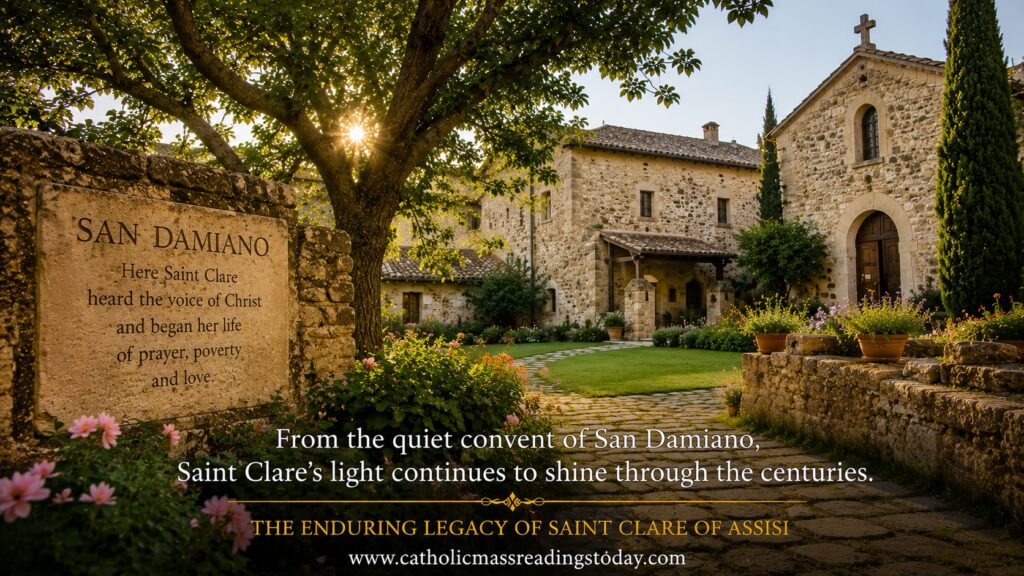
The quiet convent of San Damiano became the birthplace of a movement that has endured for more than eight centuries, yet Clare’s greatest legacy is not found in buildings, monasteries, or even the Rule she wrote.
- It is found wherever Christians choose simplicity over excess…
- Whenever someone spends time before the Blessed Sacrament in silent prayer…
- Whenever wealth is used generously to lift up those in need…
- Whenever a religious sister faithfully offers her hidden life for the good of the Church…
- Whenever a believer chooses trust over anxiety because God’s providence is enough…
The spirit of Saint Clare continues to shine.
She teaches us that a heart completely surrendered to Christ becomes a light that no darkness can overcome.
Let us Pray
Heavenly Father,
You filled Saint Clare of Assisi with a burning love for Christ, a deep devotion to the Holy Eucharist, and an unshakable trust in Your providence. Through her prayers and example, teach us to seek the treasures of heaven rather than the passing riches of this world.
Grant us hearts that are humble, generous, and faithful. May we learn to embrace simplicity with joy, to persevere in prayer with confidence, and to place our lives completely in Your loving hands.
Strengthen all those who have dedicated themselves to the consecrated life, especially the Poor Clares, that they may continue to be living witnesses of the Gospel through prayer, poverty, and charity.
Through the intercession of Saint Clare, help us to remain steadfast in times of trial, to honour You with sincere hearts, and to reflect the light of Christ wherever we are called to serve.
We ask this through our Lord Jesus Christ, Your Son, who lives and reigns with You in the unity of the Holy Spirit, God, for ever and ever.
Amen.