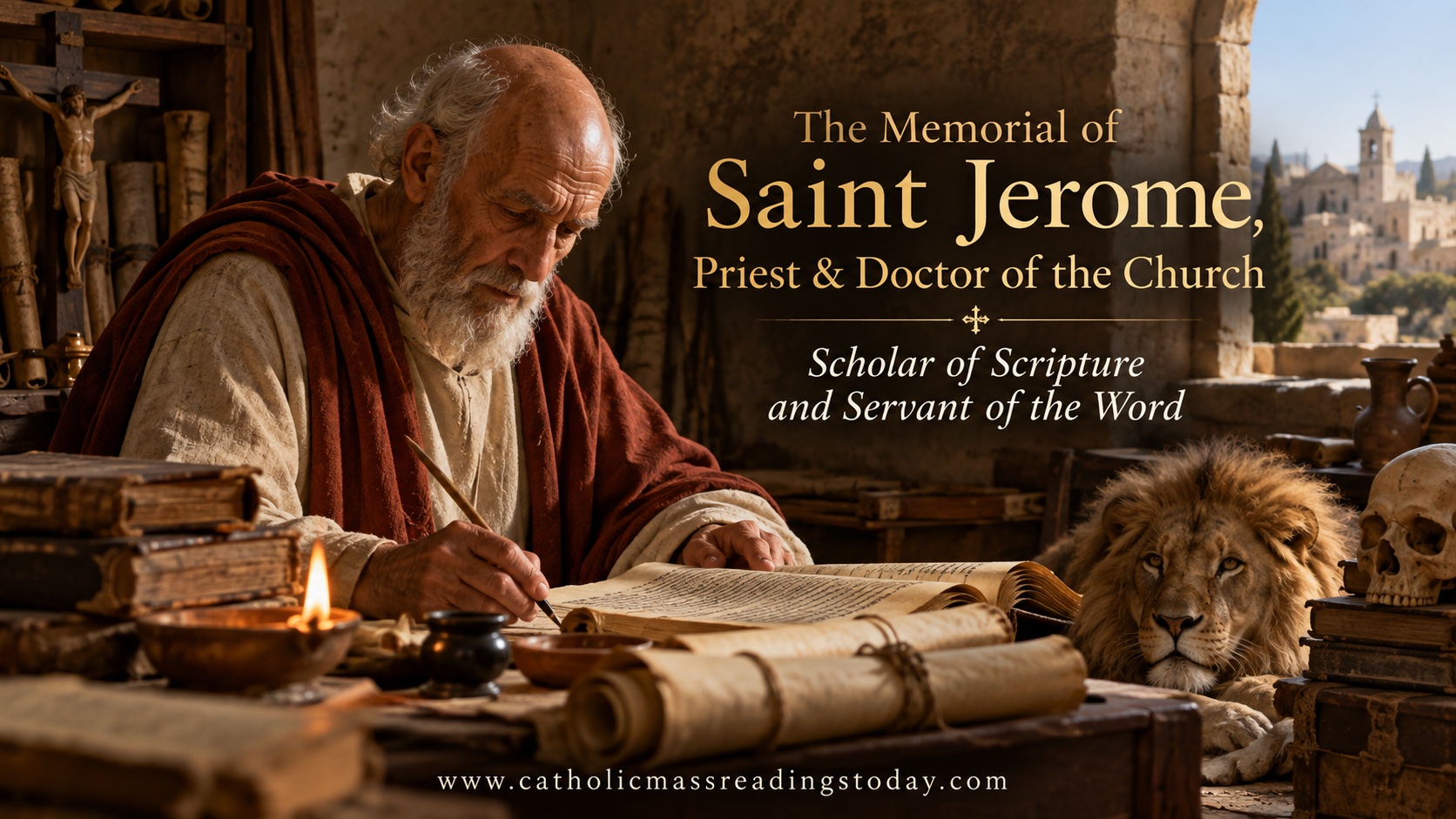
Every year on September 30, the Catholic Church celebrates the Memorial of Saint Jerome, Priest & Doctor of the Church, one of Christianity’s greatest biblical scholars and one of the most influential figures in the history of the Western Church. His life stretched from the closing decades of the Roman Empire into an age of enormous political, cultural, and religious change, yet the work for which he is remembered remains remarkably relevant: Jerome wanted Christians to know the Word of God, understand it accurately, and allow it to shape the way they lived.
Saint Jerome was not a quiet scholar detached from the struggles of ordinary life. He was brilliant, demanding, passionate, sometimes argumentative, deeply ascetical, and intensely devoted to Scripture. He travelled across much of the Roman world, studied languages that few Western Christians of his generation understood, lived as a hermit, served a pope, guided communities of Christian women in the study of Scripture, defended Catholic teaching, established himself near the birthplace of Christ in Bethlehem, and spent decades translating and explaining the Bible.
By the time of his death in Bethlehem on September 30, 420, Saint Jerome had given the Church a legacy that would influence biblical study, theology, prayer, preaching, education, art, and Christian culture for more than sixteen centuries. Pope Francis described him as one of the great figures of the ancient Church and emphasized that his lifelong devotion to Scripture made him a bridge between East and West.
The story of Saint Jerome is therefore not merely the biography of an extraordinary scholar. It is the story of a man whose restless search for truth eventually became a lifelong encounter with Jesus Christ through the written Word of God.
The Birth and Early Life of Saint Jerome
Saint Jerome was born around the middle of the fourth century, probably about 345 – 347, in Stridon, a settlement located on the borderlands of Dalmatia and Pannonia in the Roman Empire, in a region associated today with Croatia and Slovenia. He was born into a Christian family and received the kind of education available to a family able to provide serious intellectual formation for a gifted son.
Jerome grew up at a time when Christianity had emerged from the centuries of persecution that marked the early Church, but the Roman world remained deeply shaped by classical pagan culture. Christianity was spreading rapidly, theological disputes were intense, and the Church was working to articulate the faith clearly across languages and cultures.
As a young man Jerome was sent to Rome to complete his education. There he studied grammar, rhetoric, philosophy, and the great Latin authors whose language and style fascinated him. He became particularly devoted to the classical literature of Rome and acquired an extraordinary command of Latin.
Rome also exposed Jerome to the attractions of worldly life. Benedict XVI, reflecting upon Jerome’s youth, noted that the young scholar was drawn for a time toward the lifestyle surrounding him, even though his interest in Christianity ultimately prevailed. He received Baptism as a young adult, probably during his years in Rome.
The future saint had already developed what would become one of the defining characteristics of his life: an almost relentless desire to learn.
Books fascinated him. Language fascinated him. Arguments fascinated him. He possessed an intellectual hunger that could easily have carried him toward a prestigious secular career.
Instead, that hunger gradually became directed toward God.
From Classical Scholar to Servant of Christ
After his studies in Rome, Jerome travelled through parts of the Roman Empire, including Gaul. At Trier, one of the great imperial cities of the period, he encountered the growing influence of Eastern Christian monasticism. The lives of monks who had withdrawn from worldly ambitions to seek God through prayer, fasting, Scripture, and disciplined community life impressed him deeply.
Jerome later spent time in Aquileia, where he associated with a circle of Christians devoted to prayer and the ascetical life. Yet his spiritual journey was far from complete.
Around 374 he travelled east and eventually withdrew into the desert of Chalcis, near Antioch in Syria. There he attempted a demanding life of solitude and asceticism.
The desert became a place of spiritual purification, but it also became a classroom.
Jerome studied Greek more deeply and began the extraordinarily difficult task of learning Hebrew. He copied manuscripts, read Christian writers, prayed, fasted, and wrestled with the competing attractions of classical literature and Sacred Scripture.
One episode from this period became famous in Jerome’s own account of his life.
During a serious illness he experienced a vivid dream in which he seemed to stand before the judgment seat of God. Asked who he was, Jerome answered that he was a Christian. The Judge challenged him because of his passionate attachment to Cicero and the Latin classics.
The experience deeply affected him.
Pope Francis later described this episode as a decisive moment that helped redirect Jerome’s extraordinary intellectual gifts toward Christ and the service of the Word of God.
Jerome did not suddenly cease to be a scholar of culture. Instead, something more important happened: scholarship itself became a vocation.
His intelligence would no longer be used simply to admire beautiful language.
It would be placed at the service of divine revelation.
Saint Jerome Learns the Languages of Scripture
One of the most remarkable aspects of Saint Jerome’s life was his determination to approach the Bible through its original languages.
This was far from easy.
Greek was widely used among educated Christians, particularly in the eastern Mediterranean, but Hebrew was much less familiar to Latin speaking Christian scholars. Jerome nevertheless understood that serious study of the Old Testament required going as close as possible to the Hebrew text.
He persisted despite frustration.
Pope Francis recalled Jerome describing how he sometimes despaired and gave up, only to begin again because of his determination to learn.
That persistence would eventually transform Western Christianity.
His linguistic work reminds us that Saint Jerome’s reverence for Scripture was never superficial. He did not believe that loving the Bible meant avoiding difficult questions about words, manuscripts, translations, history, or interpretation.
For Jerome, careful study was itself an act of reverence.
If Scripture was truly the Word of God entrusted to the Church, then every effort should be made to understand it faithfully.
Ordination to the Priesthood and the Eastern Church
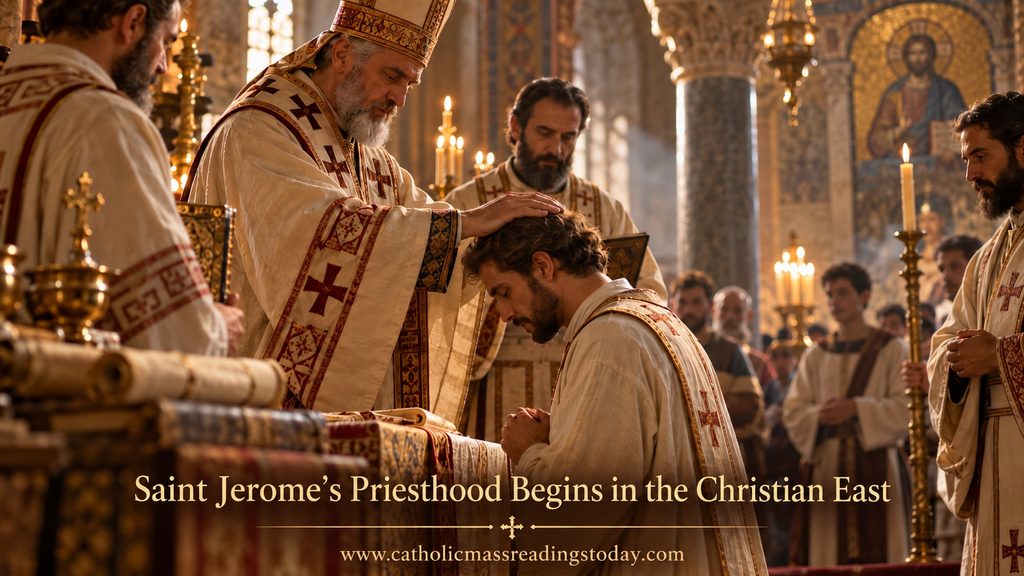
Jerome eventually returned to Antioch, where he was ordained a priest. His vocation, however, would not primarily take the form of ordinary parish ministry. His gifts increasingly drew him toward Scripture, scholarship, theological controversy, teaching, and ascetical life.
Around 379 he travelled to Constantinople, where he came into contact with Saint Gregory of Nazianzus, one of the great theologians of the Eastern Church. Jerome continued his biblical and theological studies and translated important Greek Christian works into Latin.
These years were crucial.
Jerome was becoming something uncommon in the Latin West: a Christian scholar deeply familiar with both the Latin intellectual tradition and the theological riches of Greek Christianity.
Later he would add serious knowledge of Hebrew.
This combination helped make him a bridge between different worlds.
He could bring the scholarship of the Christian East into conversation with the Latin-speaking Church.
Saint Jerome Returns to Rome
In 382 Jerome returned to Rome.
There he entered one of the most important periods of his life.
Pope Damasus I recognized Jerome’s unusual abilities and brought him into close service as a secretary and adviser. More importantly for the future of Christianity, Pope Damasus encouraged Jerome to work on the Latin biblical texts then circulating in the Western Church.
At the time, Christians in the Latin-speaking world possessed several translations of biblical books. Differences between manuscripts and translations could create confusion.
Jerome began by revising the Latin text of the Gospels against reliable Greek manuscripts. His work gradually grew into something much larger.
It would consume decades of his life.
The Women Who Studied Scripture With Saint Jerome
Jerome’s Roman years are also important for another reason.
A group of devout Christian women from Roman aristocratic families gathered around him to study Scripture seriously and pursue a more radical Christian life. Among them were Marcella, Paula, Eustochium, Lea, Asella, and others.
Jerome became their teacher and spiritual adviser.
These women were not merely passive listeners. Several studied Greek and Hebrew so that they could understand Scripture more deeply. Benedict XVI specifically noted their desire for a methodical approach to biblical study.
Saint Paula in particular would become one of the most important companions in Jerome’s later work.
Their collaboration also reminds us that early Christian biblical scholarship was not limited exclusively to clerics. These women devoted substantial intellectual and spiritual energy to understanding the Bible and living the Gospel.
Jerome respected their seriousness and corresponded extensively with members of this circle.
Conflict and Departure From Rome
Saint Jerome’s personality was powerful, but it was not always easy.
He could be direct, sarcastic, combative, and severe in controversy. His criticism of moral complacency and his defence of ascetical Christianity gained him admirers, but also enemies.
When Pope Damasus died in 384, Jerome lost an important protector.
The atmosphere in Rome became increasingly hostile, and Jerome eventually left the city in 385. Benedict XVI notes that after leaving Rome he travelled first to the Holy Land and then to Egypt, where Christian monasticism had reached extraordinary development.
What might have looked like a setback became the beginning of Jerome’s most productive period.
His road eventually led him to Bethlehem.
Saint Jerome Comes to Bethlehem
In 386 Jerome settled permanently in Bethlehem.
The location was profoundly significant.
He would spend the remainder of his life near the place where Christians venerated the birth of Jesus Christ.
With the support of Saint Paula, monastic communities for men and women were established, together with facilities for pilgrims visiting the Holy Land. Jerome lived and worked there for more than three decades.
Bethlehem became his home, monastery, classroom, library, and centre of biblical scholarship.
There Jerome prayed, studied, he argued, taught, translated and there, beside the memory of the Word made flesh, Jerome devoted himself to the written Word of God.
There was something fitting about it.
The scholar who spent his life searching the words of Scripture settled near the place where, according to the Gospel, the eternal Word entered human history as a child.
Saint Jerome and the Latin Bible
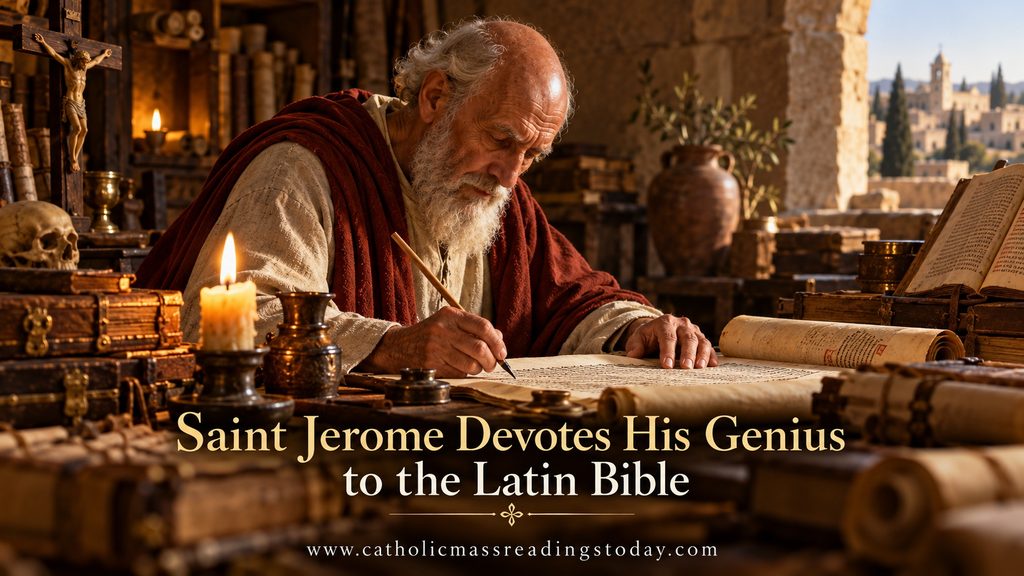
Saint Jerome’s greatest historical achievement was his work on the Latin Bible.
His project was not completed in a single moment, nor should it be imagined as though Jerome simply translated one modern style Bible from beginning to end.
The process was far more complicated.
He revised earlier Latin translations of the Gospels by consulting Greek manuscripts. For much of the Old Testament, he eventually made translations directly from Hebrew, a decision that required enormous linguistic labour and sometimes provoked controversy.
Over time, Jerome’s work became a central foundation of what came to be known as the Latin Vulgate.
The term “Vulgate” refers to the Latin Bible that became widely used in Western Christianity. Its textual history is complex and includes material not all personally translated by Jerome, but his work stands at its centre.
Pope Francis emphasized that Jerome’s translation and interpretation of Scripture became a major cultural achievement as well as an ecclesial one, helping shape Western Christianity for centuries.
It is difficult to exaggerate the influence of this work.
For generations of Christians in Western Europe, the Bible they heard proclaimed, studied, copied, preached, prayed, illustrated, and quoted was the Latin biblical tradition profoundly shaped by Saint Jerome.
His work entered monasteries, cathedrals, universities, theological writings, liturgy, art, music, and literature.
Few scholars in history have influenced the spiritual vocabulary of an entire civilization so deeply.
“Ignorance of Scripture Is Ignorance of Christ”
Perhaps no statement captures Saint Jerome better than the famous phrase associated with him:
“Ignorance of the Scriptures is ignorance of Christ.”
Benedict XVI highlighted this teaching and noted that the Second Vatican Council itself later cited Jerome’s words in Dei Verbum, its Dogmatic Constitution on Divine Revelation.
For Jerome, the Bible was never merely an academic object.
- He studied grammar because he wanted to understand Christ.
- He learned languages because he wanted to understand Christ.
- He examined manuscripts because he wanted to understand Christ.
- He wrote commentaries because he wanted other Christians to understand Christ.
This is an important distinction.
Saint Jerome did not worship a book.
He loved Scripture because Scripture brings us to the living Lord.
The written Word leads us toward the Word made flesh.
That is why his famous statement remains so powerful for Catholics today.
If we claim to love Jesus but rarely listen to His Word, something essential is missing from our spiritual lives.
Saint Jerome the Biblical Commentator
Translation was only one part of Jerome’s enormous literary output.
He also wrote commentaries on biblical books, theological works, historical writings, biographies, polemical works, and hundreds of letters.
His letters are especially valuable because they reveal the human Jerome.
They show his friendships, impatience, affection, anger, humour, scholarship, spiritual counsel, grief, and concern for the Church.
Jerome could be exceptionally harsh toward theological opponents. Even admirers have never needed to pretend otherwise.
Benedict XVI referred frankly to Jerome’s difficult and hot-tempered character while also emphasizing how completely he devoted himself to Scripture.
This makes Saint Jerome strangely encouraging.
Holiness did not erase his personality overnight.
Grace worked through a real human being with genuine gifts and genuine faults.
His life shows that sainthood is not the absence of temperament.
It is the long conversion of everything we are toward God.
Saint Jerome and the Defence of Catholic Faith
Jerome lived during one of Christianity’s great theological ages.
Questions about Christ, grace, asceticism, virginity, monasticism, Scripture, Church authority, and Christian life were being debated intensely.
Jerome entered many of these controversies with enormous energy.
Sometimes his language was excessive. Yet behind the sharpness lay a deep conviction that Christian truth mattered.
For him, theology was not intellectual entertainment.
What Christians believed affected how Christians lived.
He therefore defended what he understood to be the Catholic faith against teachings he regarded as false or dangerous.
His correspondence connected him with many leading Christians of his age, including Saint Augustine of Hippo.
Their exchanges were not always peaceful.
Two great minds could disagree vigorously.
Yet their correspondence became part of the extraordinary intellectual heritage of the early Church.
Jerome, Paula, and Eustochium in Bethlehem
Saint Paula followed Jerome to the East together with her daughter Eustochium.
Their generosity made possible important monastic foundations at Bethlehem.
Benedict XVI records that they established monasteries as well as a hospice for pilgrims, inspired in part by the Gospel memory that Mary and Joseph had found no room when they came to Bethlehem.
Jerome’s life there therefore combined scholarship with community.
He was not simply sitting alone surrounded by manuscripts.
- He taught students.
- He guided monks.
- He corresponded with Christians across the empire.
- He received pilgrims.
- He participated in theological controversies.
- He produced biblical commentaries.
And he continued refining his translations.
The physical setting of Bethlehem also influenced his reading of Scripture.
He was studying the Bible in the landscapes of biblical history.
For Jerome, geography, language, history, and theology belonged together.
The Last Years of Saint Jerome
Jerome lived to an advanced age by the standards of the ancient world.
His later years were not peaceful.
The Roman Empire was undergoing enormous upheaval. In 410 Rome itself was sacked by the Visigoths, an event that shocked Christians throughout the Mediterranean world.
Jerome had spent important years of his life in Rome and knew many people there.
News of its devastation affected him profoundly.
The Christian communities around Bethlehem also experienced insecurity and violence. Jerome knew grief personally as many of his closest companions died, including Paula years before him.
Age weakened him.
His eyesight and physical strength declined.
Yet he continued working.
Even late in life, the old scholar remained devoted to Scripture.
The Death of Saint Jerome
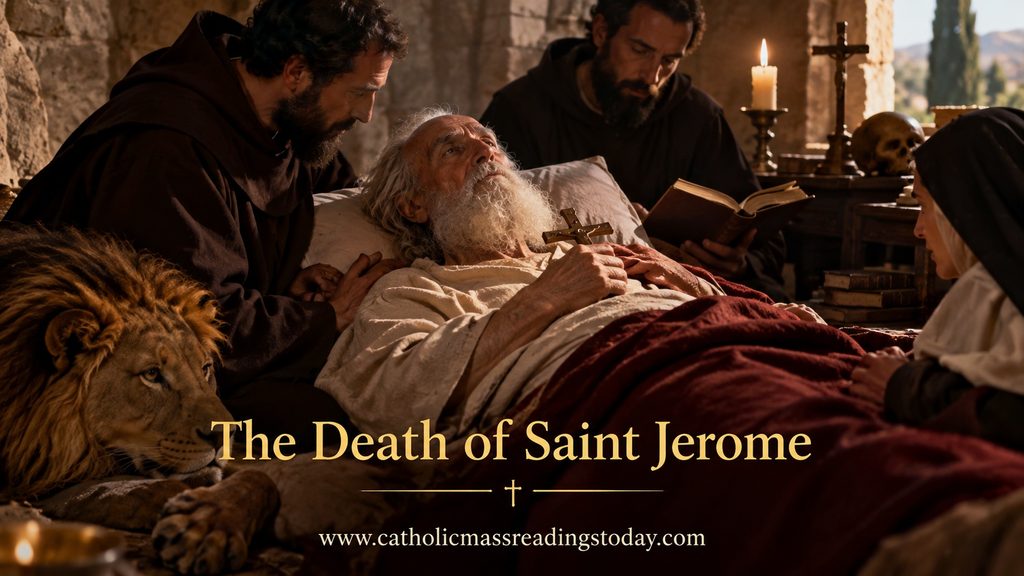
Saint Jerome died in Bethlehem on September 30, 420, in the community he had founded near the Grotto of the Nativity. Pope Francis specifically commemorated the sixteen-hundredth anniversary of Jerome’s death in 2020 with the Apostolic Letter Scripturae Sacrae Affectus, emphasizing again Jerome’s lifelong love for Sacred Scripture.
His death brought to an end a remarkable earthly pilgrimage that had taken him from Stridon to Rome, Trier, Aquileia, Antioch, the Syrian desert, Constantinople, Egypt, Jerusalem, and finally Bethlehem.
But his influence had only begun.
The man who had spent much of his life working in the quiet of a monastic cell would speak to generations he could never have imagined.
How Saint Jerome Became a Doctor of the Church
The Catholic Church honours Saint Jerome as a Priest and Doctor of the Church.
The title “Doctor of the Church” is reserved for saints whose teaching has made an especially important contribution to the understanding and transmission of the Christian faith.
Jerome’s place among the great Latin Doctors rests particularly upon his biblical scholarship.
Pope Benedict XV described him in the strongest terms as an outstanding teacher of Scripture, while later popes have repeatedly returned to Jerome when encouraging Catholics to read, study, and love the Bible.
Christian artistic tradition commonly places Jerome alongside Saints Augustine, Ambrose, and Gregory the Great as one of the great Doctors of the Western Church. Pope Francis recalled precisely this tradition when commemorating Jerome in 2020.
Jerome therefore occupies a distinctive place among the Doctors of the Church.
Augustine is remembered for profound theological reflection on grace, the human heart, and the mystery of God.
Gregory the Great became renowned for pastoral leadership.
Ambrose for preaching, theology, and ecclesial leadership.
Jerome stands uniquely as the great biblical scholar of the Latin Church.
Why Saint Jerome Remains Important to the Catholic Church
The importance of Saint Jerome cannot be reduced to the Vulgate, extraordinary though that achievement was.
His deeper contribution is the conviction that the Church must continually return to Scripture.
He reminds theologians that serious faith requires serious study.
He reminds scholars that learning must remain humble before God.
He reminds priests and preachers that the Word they proclaim deserves careful preparation.
He reminds ordinary Catholics that Scripture is not reserved for specialists.
And he reminds the whole Church that knowing Christ requires listening to God’s Word.
The Second Vatican Council placed renewed emphasis on Sacred Scripture in the life of the Church, encouraging the faithful to have ready access to the Bible and calling theology to remain nourished by Scripture.
In that sense, Jerome sounds remarkably contemporary.
He would understand immediately the Church’s desire that Catholics encounter the Bible more deeply.
Saint Jerome and Catholic Bible Translation Today
Modern Catholic biblical scholarship possesses tools Saint Jerome could never have imagined.
Ancient manuscripts have been discovered.
Archaeology has transformed knowledge of biblical cultures.
Hebrew and Greek scholarship has developed enormously.
Textual criticism allows scholars to compare manuscript traditions with extraordinary precision.
Modern Catholic translations are therefore not simply copies of Jerome’s Latin Bible.
Yet none of this diminishes his significance.
Quite the opposite.
Jerome’s willingness to go back to ancient languages, compare texts carefully, and examine Scripture historically makes him a spiritual ancestor of serious Catholic biblical scholarship.
His methods belonged to his own age, but his fundamental instinct remains sound:
Do the hard work necessary to understand the sacred text faithfully.
The Memorial of Saint Jerome in the Church
The Catholic Church celebrates the Memorial of Saint Jerome, Priest & Doctor of the Church, on September 30, the anniversary of his death. This date is fitting.
Christian tradition often regards the day of a saint’s death as the saint’s dies natalis the “birthday” into eternal life.
The memorial therefore does not simply look backward toward a famous historical figure.
It celebrates what God accomplished through Jerome and asks what his witness means for Christians now.
What Saint Jerome Teaches Catholics About Reading the Bible
Saint Jerome would likely be puzzled by Christians who possess several Bibles yet rarely open one.
For most of Christian history, books were expensive, copying manuscripts required tremendous labour, and access to Scripture could not be taken for granted.
Today many Catholics can carry the entire Bible on a phone. Even here now , we have the Catholic Online Bible, so the difficulty is no longer access. It is attention.
We live surrounded by words, notifications, headlines, messages, videos, and opinions.
Saint Jerome asks us to rediscover a different kind of reading.
- Slow reading.
- Prayerful reading.
- Reading that listens.
Reading that asks not merely, “What does this passage say?” but, “Lord, what are You saying to me through Your Word?”
Jerome’s life tells us that Scripture deserves time.
Study and Prayer Must Remain Together
There is another important lesson in the life of Saint Jerome.
Academic study and prayer do not have to be enemies.
Jerome prayed intensely, but he also studied grammar.
He practised asceticism, but he also compared manuscripts.
He sought holiness, but he also learned languages.
For him, using the intellect well could become an act of service to God.
This matters today, particularly when faith and reason are sometimes wrongly presented as opponents.
The Catholic intellectual tradition insists that truth cannot ultimately contradict truth.
Jerome lived that conviction centuries before it was expressed in modern terminology.
His study became prayerful because it was directed toward God.
His prayer became intellectually serious because he wanted to understand what God had revealed.
Saint Jerome Was Brilliant but Not Perfect
A truthful account of Saint Jerome should not turn him into a flawless marble statue.
His temper could be severe, his disputes could become personal with words against opponents may have been seen as being harsh at times.
His friendships sometimes fractured under controversy, thought this does not diminish his sainthood. It makes his story more recognizably human.
Saints are not people who never needed conversion. They are people who kept allowing grace to work.
Jerome’s intellectual pride, strong personality, and sharp tongue existed alongside extraordinary discipline, prayer, repentance, generosity, scholarship, and devotion to Christ.
The Church honours the whole story.
What the Memorial of Saint Jerome Asks of Us Today
The Memorial of Saint Jerome, Priest & Doctor of the Church invites Catholics to examine their relationship with the Word of God.
- Do we actually read Scripture?
- Do we listen attentively when it is proclaimed at Mass?
- Do we allow difficult passages to challenge us?
- Do we seek trustworthy Catholic explanations when we do not understand something?
- Do we allow the Bible to correct our opinions, or do we only look for verses that confirm what we already think?
Jerome’s life would resist a comfortable Christianity that listens to Scripture without being changed by it.
The Word of God called him from ambition toward asceticism, from classical prestige toward biblical service, from intellectual curiosity toward discipleship.
The same Word continues to call us.
Saint Jerome and the Eucharistic Life of the Church
There is also an important connection between Jerome’s love of Scripture and Catholic worship.
At every Mass, the Church receives Christ through both the proclamation of the Word and the Eucharistic sacrifice.
The Liturgy of the Word prepares the faithful for the Liturgy of the Eucharist.
Catholics therefore cannot treat Scripture as optional to sacramental life.
The Christ proclaimed in the Gospel is the same Christ received sacramentally.
Jerome’s devotion to Scripture helps restore this unity.
To listen to the Gospel attentively is already to prepare the heart for communion with Christ.
Why Saint Jerome Matters in the Digital Age
Saint Jerome lived in a world where manuscripts were copied by hand.
We live in a world where billions of words appear on screens every day.
Yet his message may be more necessary now than ever.
Information is abundant.
Wisdom is not.
Reading is constant.
Reflection is often rare.
People consume enormous quantities of content while struggling to remain still long enough to hear God.
Saint Jerome’s life challenges this pattern.
He asks us to go deeper.
Not every voice deserves equal attention.
Not every argument deserves our heart.
Not every trend deserves our time.
The Christian must learn again to sit with the Word of God.
A Saint for Priests, Scholars, Translators, Students, and Readers of Scripture
Saint Jerome has long been associated with scholars, translators, librarians, students, and those who work with Scripture.
That association is understandable.
But his witness belongs to everyone.
- A parent reading the Gospel before bed can learn from Jerome.
- A young person trying to understand faith can learn from Jerome.
- A priest preparing a homily can learn from Jerome.
- A Bible scholar working with ancient manuscripts can learn from Jerome.
- A Catholic who has never seriously read Scripture before can begin with Jerome’s encouragement.
The essential invitation is the same:
Know the Scriptures so that you may know Christ.
The Lasting Legacy of Saint Jerome
More than sixteen centuries after his death, the legacy of Saint Jerome continues.
- His Latin biblical work shaped Christian civilization.
- His commentaries influenced theologians.
- His letters preserve the intellectual and spiritual struggles of the ancient Church.
- His insistence upon careful biblical scholarship helped establish standards of serious Christian interpretation.
His ascetical life inspired generations.
His famous words about ignorance of Scripture and ignorance of Christ continue to challenge Catholics around the world.
Pope Benedict XV devoted an entire encyclical, Spiritus Paraclitus, to Saint Jerome in 1920, describing him as an outstanding teacher of Scripture. A century later, Pope Francis marked the sixteen-hundredth anniversary of Jerome’s death with Scripturae Sacrae Affectus, once again presenting him to the Church as a witness to profound love for the Bible.
Very few saints have received such sustained attention from the Church across so many centuries.
There is a reason.
Jerome’s central concern never becomes outdated.
Christians need the Word of God.
From Stridon to Bethlehem: A Life Given to the Word
When Jerome was born in Stridon, no one could have known what his restless intelligence would become.
- The young student fascinated by Cicero became a scholar fascinated by Scripture.
- The ambitious Roman student became a desert ascetic.
- The lover of elegant Latin became a student struggling through Hebrew.
- The traveller became a monk of Bethlehem.
- The controversial writer became a Doctor of the Church.
And the man who spent countless nights surrounded by manuscripts became one of history’s greatest servants of the Bible.
His life was not simple, his personality was not simple, his age was not simple, but through all of it one desire gradually became dominant:
to know Christ through His Word and to help others do the same.
That is why the Memorial of Saint Jerome, Priest & Doctor of the Church remains so important.
It reminds us that Sacred Scripture is not merely something Christianity inherited from the past.
It is God’s Word entrusted to the Church and proclaimed anew to every generation.
Celebrating the Memorial of Saint Jerome Today
The most fitting way to honour Saint Jerome is therefore not simply to admire his scholarship.
It is to open the Bible.
Read the Gospel slowly.
Listen carefully to the readings at Mass.
Choose a biblical book and remain with it long enough to understand its message.
Ask the Holy Spirit for wisdom. Use reliable Catholic commentary when questions arise.
Allow Scripture to challenge habits, heal wounds, expose sin, strengthen hope, and deepen prayer.
Saint Jerome spent his life making the Word of God more accessible to others.
The best tribute we can offer is to receive that Word with seriousness.
A Prayer Through the Intercession of Saint Jerome
Lord God,
You gave Saint Jerome an enduring love for Sacred Scripture and the grace to dedicate his life to studying, translating, explaining, and defending Your Word.
Through his intercession, give us a deeper hunger for the Scriptures. Teach us to approach Your Word with humility, reverence, patience, and faith.
May we never be satisfied merely to know about Christ, but come to know Him more deeply through the Gospel.
Give wisdom to those who translate and teach Sacred Scripture, fidelity to those who proclaim it, and attentive hearts to all who hear it.
May Your Word correct us when we wander, strengthen us when we grow weak, comfort us in sorrow, and lead us always closer to Jesus Christ, Your Son.
Saint Jerome, Priest and Doctor of the Church, pray for us.
Through Christ our Lord.
Amen.