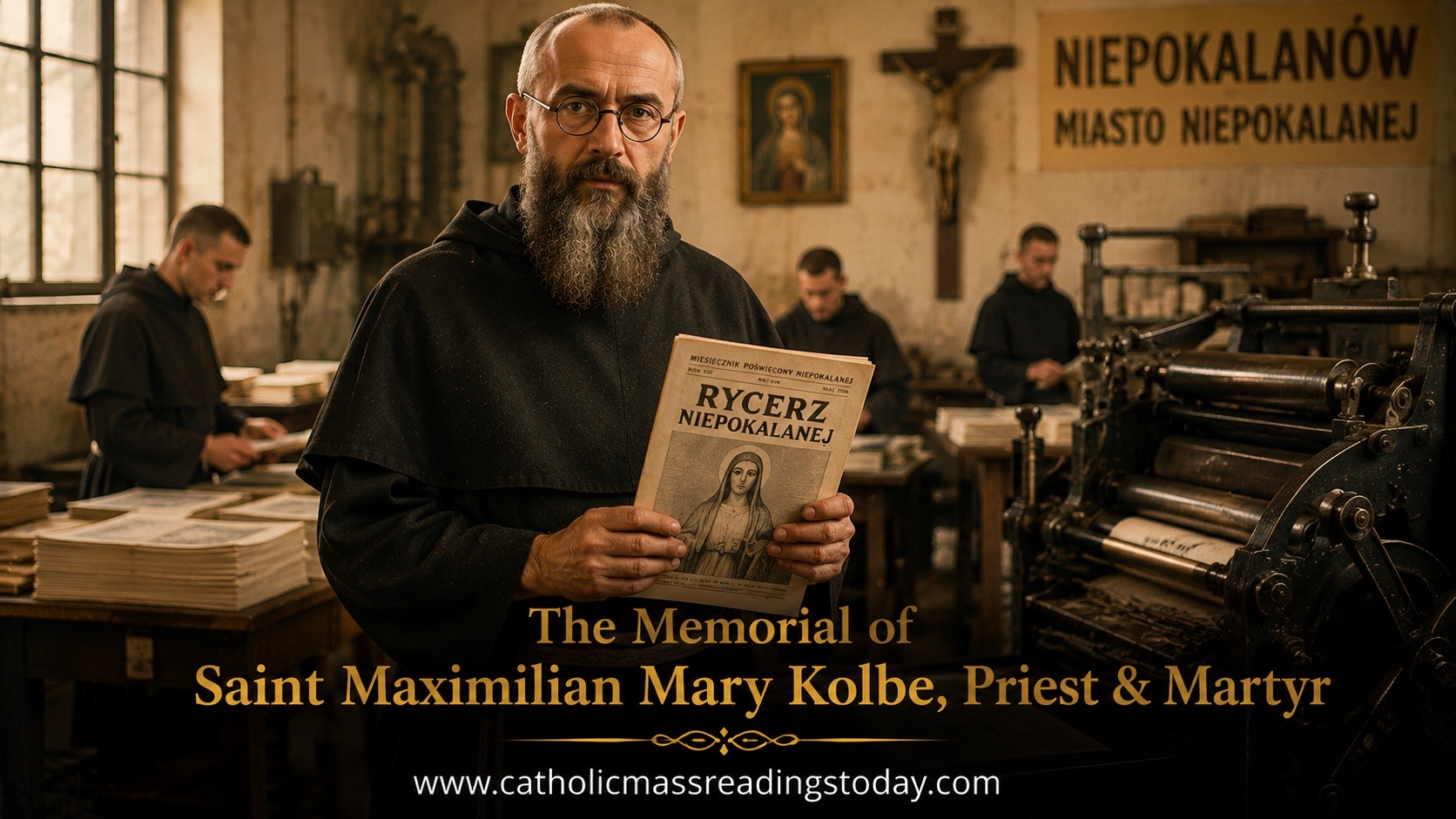
Every year on 14 August, the Catholic Church celebrates The Memorial of Saint Maximilian Mary Kolbe, Priest & Martyr, a saint whose life stands as one of the most extraordinary witnesses to Christian love in modern history. He is remembered not simply because he died during one of humanity’s darkest chapters, but because he chose to die in place of another man. In doing so, he transformed a place of unimaginable hatred into a testimony of Christ’s love.
Saint Maximilian Kolbe’s story is one of courage, missionary zeal, profound devotion to the Blessed Virgin Mary, and unwavering faith. His life demonstrates that holiness is not reserved for peaceful times. Rather, it shines most brightly when darkness seems strongest. Even in the horrors of a Nazi concentration camp, his charity reflected the words of Christ: “Greater love has no man than this, that a man lay down his life for his friends” (John 15:13).
A Child with an Extraordinary Calling
Saint Maximilian Mary Kolbe was born Raymond Kolbe on 8 January 1894 in the small town of Zduńska Wola, in what is now Poland. His parents, Julius and Maria Kolbe, were devout Catholics who worked hard to raise their children in the faith despite difficult political circumstances. Poland at the time was partitioned among foreign powers, and the Catholic faith remained a source of strength and national identity.
As a young boy, Raymond was energetic, intelligent, and sometimes mischievous. One day, after receiving a stern correction from his mother, she asked him what would become of him if he continued on the same path. The question remained in his heart long after the conversation ended.
Soon afterwards, while praying before an image of the Blessed Virgin Mary in the parish church, Raymond experienced a profound spiritual vision that would shape the rest of his life. He later recounted that the Virgin Mary appeared to him holding two crowns. One was white, symbolising purity; the other was red, symbolising martyrdom. She asked whether he was willing to accept them.
Without hesitation, the young Raymond answered that he would accept both. That moment became the compass by which he lived the rest of his life.
Entering Religious Life
At the age of thirteen, Raymond and his older brother Francis entered the Conventual Franciscan Minor Seminary in Lwów. When he entered religious life, he received the name Maximilian, and later added Mary to honour the Blessed Virgin, whose protection and guidance remained central to his spirituality.
His superiors quickly recognised his exceptional intelligence. He was sent to Rome to continue his studies, where he earned doctorates in philosophy and theology. Despite his academic brilliance, Maximilian never sought personal recognition. His greatest desire was to bring souls to Christ through the loving intercession of Mary.
A Knight of the Immaculata
While studying in Rome, Maximilian witnessed growing hostility toward the Church. Anti Catholic demonstrations and increasing attacks on Christian belief convinced him that the Church needed a peaceful yet powerful spiritual response.
In 1917, he founded the Militia Immaculatae (The Militia of the Immaculate). Its purpose was simple yet profound: to lead every soul to Jesus through total consecration to the Blessed Virgin Mary. Members were encouraged to pray, evangelise, distribute Catholic literature, and offer sacrifices for the conversion of sinners.
Saint Maximilian believed that authentic devotion to Mary always leads directly to Christ. He often said that Mary never keeps anyone for herself but always brings them closer to her Son. His vision soon spread far beyond Poland.
Using Modern Media to Proclaim the Gospel
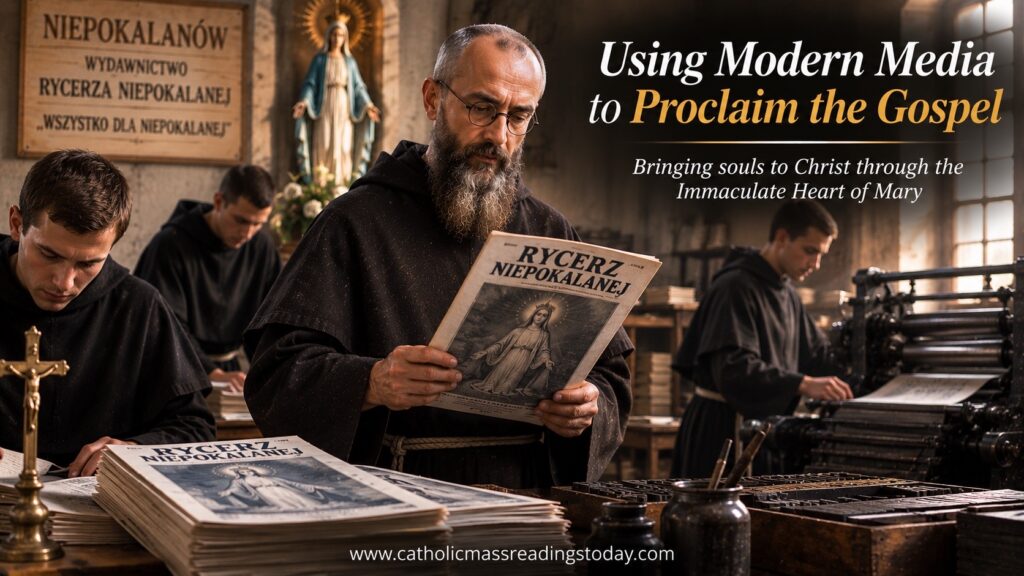
After his ordination in 1918, Father Maximilian realised that the Church should not fear modern technology but rather use it to proclaim the Gospel. He began publishing a magazine called Knight of the Immaculata (Rycerz Niepokalanej). Its circulation grew rapidly until it became one of the largest Catholic publications in Europe.
To support this growing apostolate, he established Niepokalanów, the “City of the Immaculate,” near Warsaw. What began as a small Franciscan monastery became one of the largest religious communities in the world. The friars operated modern printing presses, publishing houses, workshops, and communications facilities that reached millions of readers.
Saint Maximilian believed every available means should be used to spread Christ’s message. Long before the digital age, he recognised the evangelising power of newspapers, magazines, radio, and emerging technologies. His vision continues to inspire Catholic media apostolates around the world today.
Missionary to Japan
His missionary spirit soon led him beyond Europe.nIn 1930, despite poor health and almost no financial resources, he travelled to Japan. Many believed the mission would fail. Instead, he established another monastery called Mugenzai no Sono (“Garden of the Immaculate”) near Nagasaki. Remarkably, he chose a location on the side of a mountain that many considered unsuitable.
Years later, when the atomic bomb devastated Nagasaki in 1945, the monastery survived largely intact because of its protected position. To many, this became a striking reminder of God’s providence.
Father Maximilian also undertook missionary work in India and dreamed of bringing the Gospel to every continent.
The Second World War
When Nazi Germany invaded Poland in 1939, Niepokalanów became a refuge for thousands of displaced people. Among those sheltered were approximately 2,000 Jews, whom the friars protected despite enormous personal risk.
Father Maximilian refused every opportunity to abandon his community. Instead, he remained with those entrusted to his care. His writings continued to proclaim forgiveness, hope, and faith rather than hatred or revenge.
Eventually, the Gestapo arrested him. After a brief imprisonment, he was released and yet he continued helping refugees.
On 17 February 1941, he was arrested again. This time he was sent to the infamous Auschwitz concentration camp. There he became prisoner 16670.
Bringing Christ into Auschwitz
Life inside Auschwitz was almost beyond imagination. Starvation, forced labour, disease, humiliation, and constant brutality filled each day. Even there, Father Maximilian quietly continued his priestly ministry.
- He encouraged fellow prisoners.
- He shared his meagre food.
- He heard confessions whenever possible.
- He comforted the dying.
Those who survived later recalled that his presence brought peace where fear ruled. He reminded prisoners that hatred could never have the final word. Even inside the concentration camp, he remained completely free in spirit because his life belonged entirely to Christ.
The Supreme Act of Love
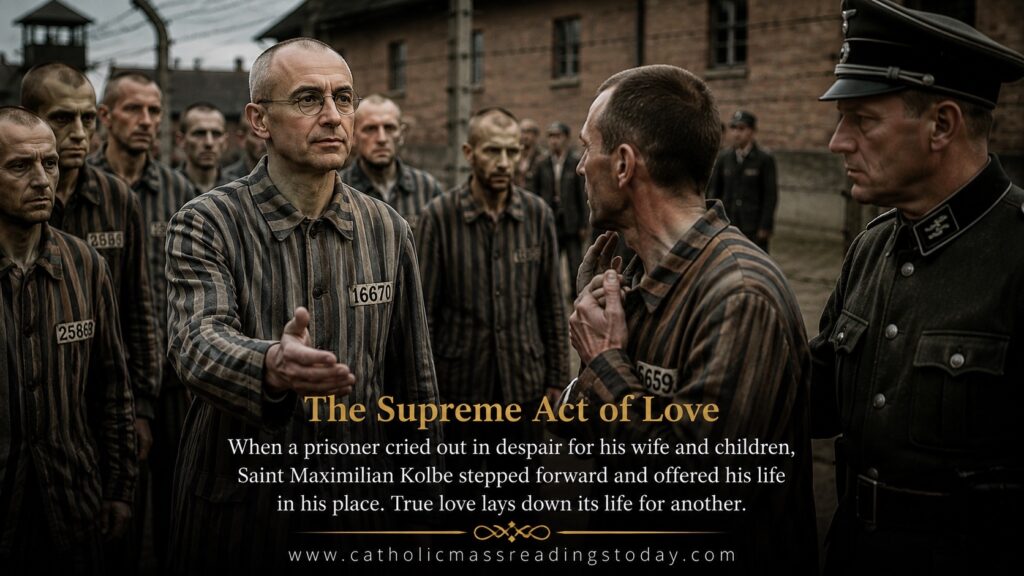
In July 1941, a prisoner escaped. As punishment, the camp commander selected ten men to die by starvation. One of those chosen was Franciszek Gajowniczek, a husband and father.
When he cried out in despair for his wife and children, Father Maximilian stepped forward. In an astonishing act that stunned everyone present, he calmly asked permission to take the condemned man’s place. The Nazi officer accepted.
Saint Maximilian willingly entered the starvation bunker. Inside, witnesses later testified that the bunker became a place of prayer rather than despair. The condemned men prayed together.
They sang hymns. Father Maximilian encouraged them until one by one they died. After two weeks, he was the last survivor.
On 14 August 1941, the vigil of the Assumption of the Blessed Virgin Mary, the guards ended his life with a lethal injection of carbolic acid.
He calmly extended his arm. He died exactly as he had lived, with complete trust in God.
Franciszek Gajowniczek survived the war. For the rest of his long life, he travelled throughout the world telling people about the priest who had died so that he might live.
Beatification and Canonisation
Pope Paul VI beatified Father Maximilian in 1971. On 10 October 1982, Pope Saint John Paul II canonised him before thousands gathered in Saint Peter’s Square.
During the canonisation, the Pope declared him not simply a martyr of hatred but the “Martyr of Charity.”
It was a title unlike any other. His death was freely chosen out of love for another human being, perfectly reflecting Christ’s sacrifice on the Cross.
His Lasting Legacy
Today, Saint Maximilian Mary Kolbe is remembered as one of the greatest witnesses of Christian charity in modern history. He is the patron saint of journalists, broadcasters, radio operators, prisoners, political prisoners, families struggling with addiction, and the pro life movement.
Yet his greatest legacy cannot be measured by patronages or institutions. It is found in the lesson he leaves every Christian.
- Love is stronger than hatred.
- Mercy is stronger than violence.
- Faith is stronger than fear.
In an age marked by conflict, division, and uncertainty, Saint Maximilian reminds us that holiness is lived through daily fidelity, courageous charity, and complete confidence in Christ.
His life teaches us that true greatness is not found in power or recognition, but in selfless love that seeks the good of another before itself.
His witness continues to inspire countless believers to defend human dignity, proclaim the Gospel boldly, embrace devotion to the Blessed Virgin Mary, and serve others with generous hearts.
The darkness of Auschwitz sought to extinguish hope, instead, through the sacrifice of one humble Franciscan priest, the light of Christ shone more brightly than ever.
More than eighty years later, the world still remembers prisoner 16670, not because of the number placed upon him, but because of the love that no prison, no hatred, and no evil could ever overcome.
Let us Pray
Heavenly Father,
You filled Saint Maximilian Mary Kolbe with an unwavering love for Christ, a deep devotion to the Blessed Virgin Mary, and the courage to lay down his life for another.
Through his prayers, grant us generous hearts that are ready to serve, forgive, and love without counting the cost. Help us to remain faithful to the Gospel in times of trial and to become witnesses of hope wherever You place us.
Strengthen all who suffer persecution, comfort those who feel abandoned, and inspire us to defend the dignity of every human life with compassion and courage.
May the example of Saint Maximilian teach us that true freedom is found in self giving love, and may we one day share with him the joy of Your eternal Kingdom.
Through Christ our Lord.
Amen.