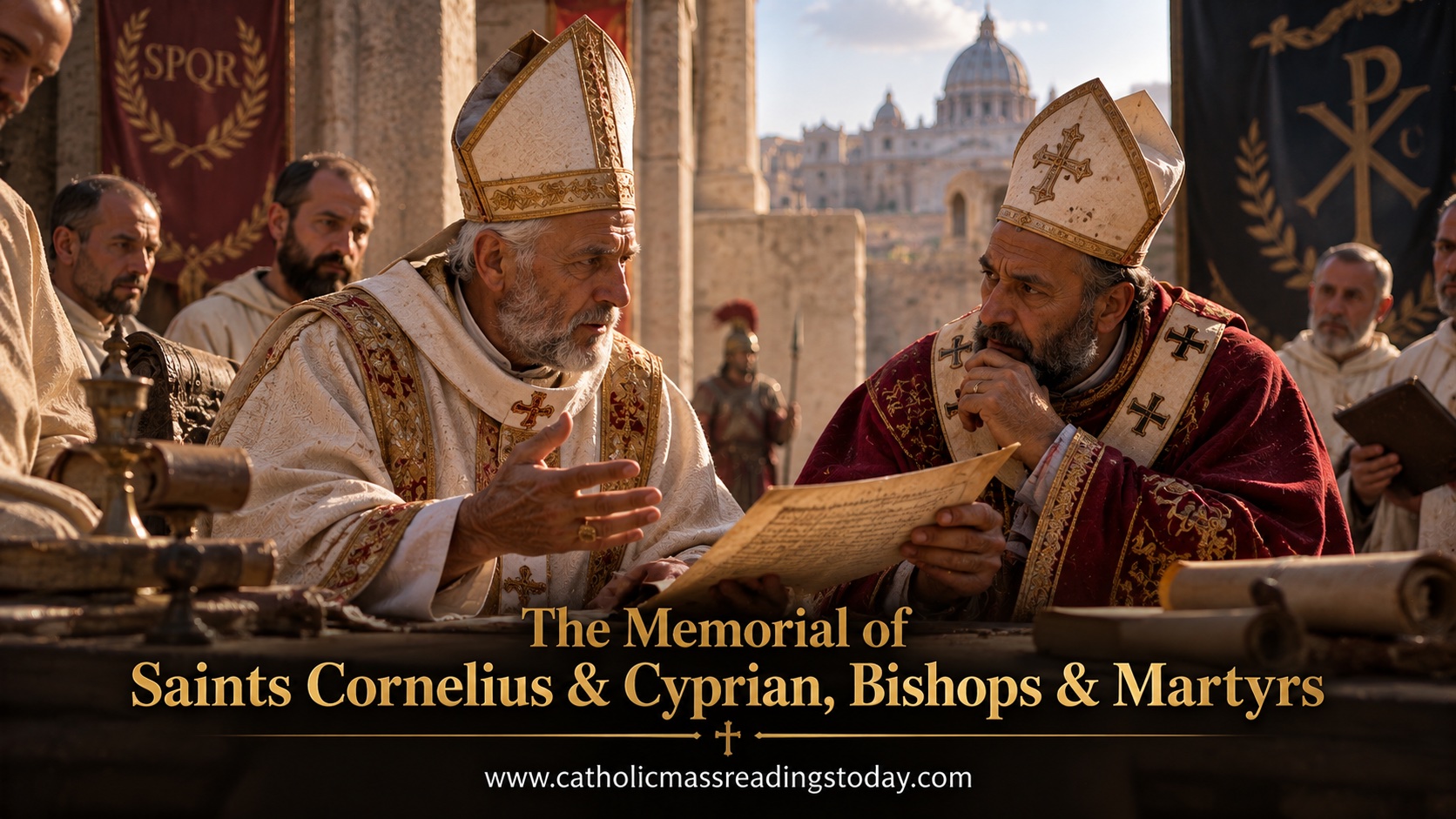
Every year on 16 September, the Catholic Church pauses to remember two remarkable shepherds whose lives became inseparably linked, even though they ministered hundreds of miles apart. One was the Bishop of Rome, entrusted with guiding the universal Church during one of its darkest hours. The other was the brilliant Bishop of Carthage, whose writings would shape Christian thought for centuries. Together they stood as defenders of unity, guardians of mercy, and fearless witnesses to Christ in the face of persecution.
The Memorial of Saints Cornelius and Cyprian is far more than the remembrance of two martyrs who lived in the third century. It is a celebration of friendship rooted in Christ, of courageous leadership during times of confusion, and of a Church that chose mercy over despair without compromising the truth of the Gospel. Their names are remembered together because history itself united them in a common mission: preserving the unity of Christ’s Church when powerful forces sought to tear it apart. Their witness continues to inspire Catholics today, reminding us that fidelity to Christ often requires courage, patience, humility, and an unwavering trust in God’s providence.
A Church Living Under Constant Threat
To understand the greatness of Saints Cornelius and Cyprian, we must first step into the world in which they lived.
The third century was one of the most difficult periods in the history of the early Church. Christianity had spread throughout the Roman Empire, reaching cities, villages, ports, and distant provinces. Although the Gospel continued to attract converts from every class of society, Christians remained a small minority. Their refusal to worship the Roman gods or offer sacrifice to the emperor often brought suspicion upon them. To many Roman officials, Christians appeared to be enemies of the state simply because they acknowledged Jesus Christ alone as Lord.
Periods of relative peace were frequently interrupted by violent persecutions. Churches were destroyed, sacred books confiscated, bishops imprisoned, and countless believers were forced to choose between denying Christ or facing imprisonment, torture, exile, or death. Families were separated, communities scattered, and fear became an almost constant companion for many Christians.
One of the most severe persecutions came under Emperor Decius in AD 249. For the first time, the imperial government required citizens throughout the empire to offer sacrifice to the traditional Roman gods and obtain official certificates proving they had complied. Those who refused faced severe punishment. Some Christians courageously accepted martyrdom. Others endured torture with heroic perseverance. Still others, frightened by the threat of death or anxious to protect their families, gave in to fear and performed the required sacrifices. These believers later became known as the lapsi—the “lapsed” Christians.
When the persecution subsided, a painful question confronted the Church: Could those who had denied Christ be welcomed back if they sincerely repented? The answer would test not only the wisdom of Church leaders but also their understanding of God’s mercy.
Into this troubled moment stepped two extraordinary bishops whom God had prepared in very different ways.
Cornelius: The Humble Shepherd Called to Rome
Very little is known about the early life of Cornelius. Like many Christians of the third century, much of his personal history has been lost to time. Ancient tradition suggests that he came from Rome itself and may have belonged to the respected Cornelii family, although historians cannot confirm this with certainty. What is known is that, long before becoming Pope, he had already earned a reputation for kindness, prudence, humility, and steadfast faith.
After Pope Fabian was martyred during the Decian persecution in AD 250, it proved impossible to elect a successor for more than fourteen months. The danger was simply too great. The Bishop of Rome had become an obvious target for the authorities, and gathering bishops together to elect a new pope could itself invite arrest and execution. During this difficult period, the Church in Rome was governed collectively by its priests while Christians prayed that God would provide a shepherd at the proper time.
When conditions briefly improved in AD 251, the clergy and faithful finally gathered to elect a new Bishop of Rome. Their choice fell upon Cornelius. His election was not the result of political ambition or personal influence. Contemporary witnesses, including Saint Cyprian himself, described his election as one supported by the clergy, the faithful, and the guidance of divine providence.
Cornelius accepted the responsibility knowing full well that it might cost him his life.
His papacy began under the shadow of persecution, but even greater challenges soon emerged from within the Church itself.
A Different Journey Begins in Carthage
Across the Mediterranean Sea, in the thriving North African city of Carthage, another remarkable story was unfolding.
Unlike many early saints who were raised in Christian homes, Thascius Caecilius Cyprian was born around AD 210 into a wealthy pagan family. His parents provided him with an exceptional education, and he became one of the finest rhetoricians of his generation. As a teacher, lawyer, and public speaker, Cyprian enjoyed wealth, influence, and every opportunity for success within Roman society.
Yet beneath these achievements remained an emptiness that success alone could not satisfy.
During his years as an educator and advocate, Cyprian encountered Christians whose quiet faith and unwavering charity stirred something deep within his heart. Their courage during persecution, their care for the poor, and their confidence in Christ presented a way of life unlike anything he had previously known.
Around AD 246, after careful reflection and study, Cyprian embraced the Christian faith. His conversion was not merely an intellectual decision. It transformed every aspect of his life. He later described Baptism as the moment when a heavenly light entered his soul and everything that had once seemed impossible became possible through the grace of God. The old ambitions that had defined his earlier years gave way to a profound desire to follow Christ wholeheartedly.
His generosity quickly became evident. Cyprian sold much of his property and distributed generous assistance to the poor. Those who had once admired him for his eloquence now saw something even more remarkable, humility born of conversion.
His gifts did not remain hidden for long.
Only a short time after his Baptism, Cyprian was ordained a priest. Soon afterwards, despite his own hesitation, the faithful of Carthage chose him to become their bishop. Many recognised that the eloquence he had once used in the courts of law was now entirely devoted to preaching the Gospel of Jesus Christ.
His election was welcomed by many but also opposed by a small group who questioned how someone so recently converted could become bishop so quickly. Cyprian responded not by defending himself, but by dedicating himself completely to his flock. His holiness, wisdom, and pastoral care gradually silenced many critics.
He would soon discover that leading the Church meant carrying not only its joys but also its deepest wounds.
Two Shepherds, One Heart
Although Cornelius served in Rome and Cyprian ministered hundreds of miles away in Carthage, Providence would draw these two bishops into one of the most important friendships in early Christian history.
Neither sought personal influence. Neither desired conflict. Both loved Christ above all else.
Both understood that the Church could survive persecution from emperors more easily than division from within.
It would not be long before that conviction would be tested more severely than either man could have imagined.
The Wound Within the Church
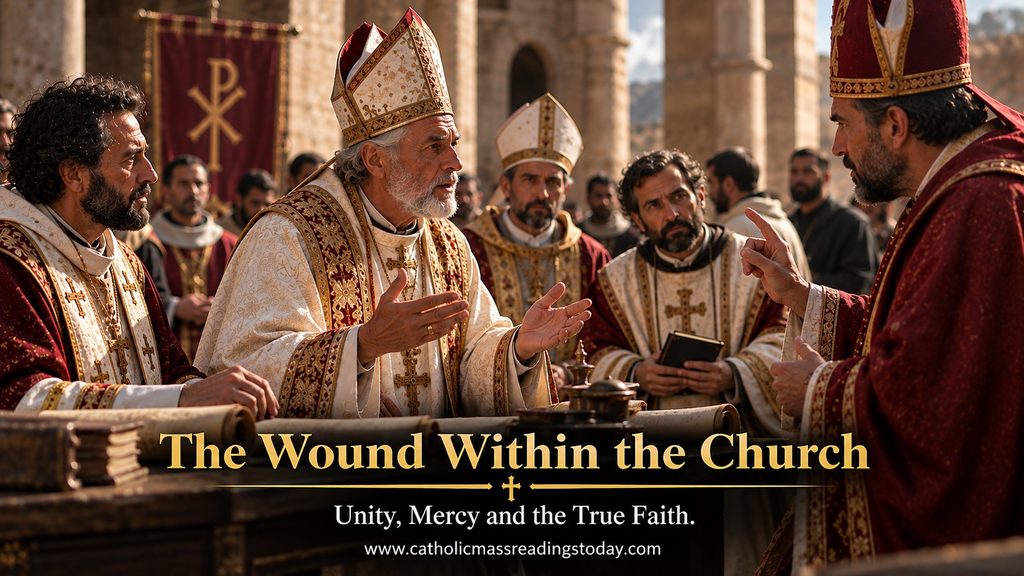
The fiercest dangers facing the early Church did not always come from Roman soldiers or imperial decrees. Sometimes they arose from disagreements among Christians themselves. Such was the crisis that confronted Pope Cornelius and Bishop Cyprian after the Decian persecution had finally begun to ease.
When many of the faithful who had abandoned the faith under threat of death sought to return to the Church, emotions ran high. Those who had endured imprisonment, torture, or the loss of loved ones found it difficult to accept those who had offered sacrifice to pagan gods in order to save themselves. Others argued that no matter how sincere their repentance might be, the grave sin of apostasy could never be forgiven by the Church.
Standing at the centre of this controversy was a Roman priest named Novatian. Learned, disciplined, and respected by many, he insisted that Christians who had denied Christ during persecution should never again be admitted to full communion with the Church. In his view, such sins could be left only to the judgment of God.
Cornelius understood the seriousness of apostasy. He never minimized the pain caused by those who had abandoned the faith. Yet he also remembered the words and actions of Jesus Himself. The Lord had forgiven Peter after his threefold denial. He had welcomed sinners who returned with repentant hearts. He had entrusted to His Apostles the authority to forgive sins in His name.
For Cornelius, the Church could never become a community reserved only for the flawless. She was called to be a place where sinners, after sincere repentance and appropriate penance, could once again encounter the mercy of Christ.
Saint Cyprian immediately recognised both the wisdom and the faithfulness of Cornelius’ position. Though separated by the Mediterranean Sea, the two bishops remained in close communication through letters that revealed not only their theological agreement but also a deep affection and mutual respect. Cyprian defended Cornelius publicly, encouraging the bishops of Africa to remain united with the lawful Bishop of Rome rather than follow those who sought division.
Their correspondence remains one of the great treasures of early Christian history. It shows two pastors concerned less about winning arguments than about preserving communion within the Body of Christ. Their words reflected neither harshness nor weakness, but the delicate balance between justice and mercy that lies at the heart of the Gospel.
The Cost of Defending Unity
The disagreement did not remain a matter of private debate. Novatian allowed himself to be consecrated as a rival bishop of Rome, creating one of the earliest major schisms in the Church’s history. Many Christians, confused by conflicting claims, wondered whom they should follow.
It was a painful moment. The Church, already weakened by persecution from outside, now faced division from within.
Cornelius did not respond with anger or personal attacks. Instead, he sought to strengthen communion among the bishops and patiently explain the Church’s teaching. A synod held in Rome confirmed his election as the legitimate successor of Saint Peter and rejected the schism that Novatian had created. Cyprian wholeheartedly supported these decisions, writing to bishops throughout the Christian world and urging them to remain faithful to the unity established by Christ.
For both men, unity was never simply an administrative necessity. It was a gift entrusted to the Church by the Lord Himself.
Cyprian would later express this conviction in words that continue to echo throughout Catholic teaching: “He cannot have God for his Father who does not have the Church for his Mother.” In these words, he was not placing the Church above Christ, but affirming that Christ chose to gather His people into one visible communion under the shepherds He appointed.
This conviction remains part of the Catholic understanding of the Church today. Unity is not achieved by ignoring the truth, nor by sacrificing charity. It is preserved when believers remain faithful to Christ while treating one another with patience, humility, and mercy.
Shepherds During a Time of Fear
The years that followed brought little peace.
Although the Decian persecution had subsided, Christians continued to live with uncertainty. New outbreaks of violence could begin without warning. Churches remained under suspicion. Bishops were closely watched. The faithful understood that following Christ might still require the ultimate sacrifice.
At the same time, another trial swept through the Roman Empire.
A devastating plague spread across many provinces, bringing fear, suffering, and countless deaths. While many fled infected cities, Christians became known for remaining behind to care for the sick, the dying, and even those who did not share their faith.
Cyprian encouraged the faithful not to give in to fear. He reminded them that Christian hope rests not in earthly security but in the promise of eternal life. He urged believers to show mercy even toward those who persecuted them, caring for pagans and Christians alike with the same compassion that Christ had shown to all.
The witness of these communities astonished many observers. In a society often divided by class and status, Christians cared for the abandoned, buried the dead with dignity, and shared their resources with those in need. Their charity became one of the most convincing testimonies to the truth of the Gospel.
Cornelius, meanwhile, continued strengthening the Church in Rome despite mounting political pressure. His concern extended to widows, orphans, confessors imprisoned for the faith, and clergy scattered by persecution. Ancient records suggest that the Church in Rome had grown significantly during his pontificate, with numerous priests, deacons, subdeacons, acolytes, lectors, and many charitable ministries serving thousands of faithful.
His pastoral heart never ceased beating for those entrusted to his care.
Exile for the Sake of Christ
In AD 253, Emperor Gallus renewed measures against Christian leaders. Cornelius became one of the principal targets.
Rather than provoking violence against the Christian community, he accepted exile to the coastal town of Centumcellae, today known as Civitavecchia.
Exile in the ancient world was often a slow death. It meant separation from one’s flock, uncertainty about the future, harsh living conditions, and constant surveillance.
Yet even in exile, Cornelius remained a shepherd.
Cyprian wrote letters filled with admiration for his brother bishop, praising his courage and encouraging the faithful to remain united around him despite the distance that separated them. These letters reveal not merely professional respect but genuine Christian friendship, strengthened through shared suffering and a common love for Christ.
Far from weakening Cornelius, exile became the final testimony of his fidelity.
He died there around AD 253, having remained faithful to his mission until the end. The Church has long honoured him as a martyr because his death resulted directly from the sufferings he endured for the faith.
His earthly ministry had lasted only a short time.
Its influence would endure for centuries.
The Final Trial of Cyprian
Not long after Cornelius entered eternal life, another storm gathered over the Church.
Emperor Valerian launched a fresh persecution against Christians. This time, bishops were specifically ordered either to renounce their faith or face exile and death.
Cyprian refused to abandon the flock entrusted to him.
Knowing the danger before him, he continued preaching, celebrating the sacraments, encouraging the faithful, and strengthening those preparing to suffer for Christ.
The authorities arrested him and sent him into exile.
Even there, he continued writing letters to encourage Christians throughout North Africa. He reminded them that no earthly suffering could compare with the glory promised by Christ.
The day would soon come when his own faith would be tested in the same way.
The Crown of Martyrdom
After a period of exile, Saint Cyprian was permitted to return to Carthage. He knew, however, that his freedom would be short-lived. The persecution ordered by Emperor Valerian had intensified, and the authorities were determined to silence the leaders of the Church. Cyprian could easily have fled into hiding once more, but he believed that a shepherd should remain close to his flock, especially when danger was greatest.
In the year AD 258, he was arrested and brought before the Roman proconsul, Galerius Maximus. The trial was brief. Cyprian was ordered to offer sacrifice to the Roman gods and abandon the Christian faith. His answer was calm, respectful, and unwavering.
“I am a Christian and a bishop. I know no other gods but the one true God.”
The sentence was pronounced: death by the sword.
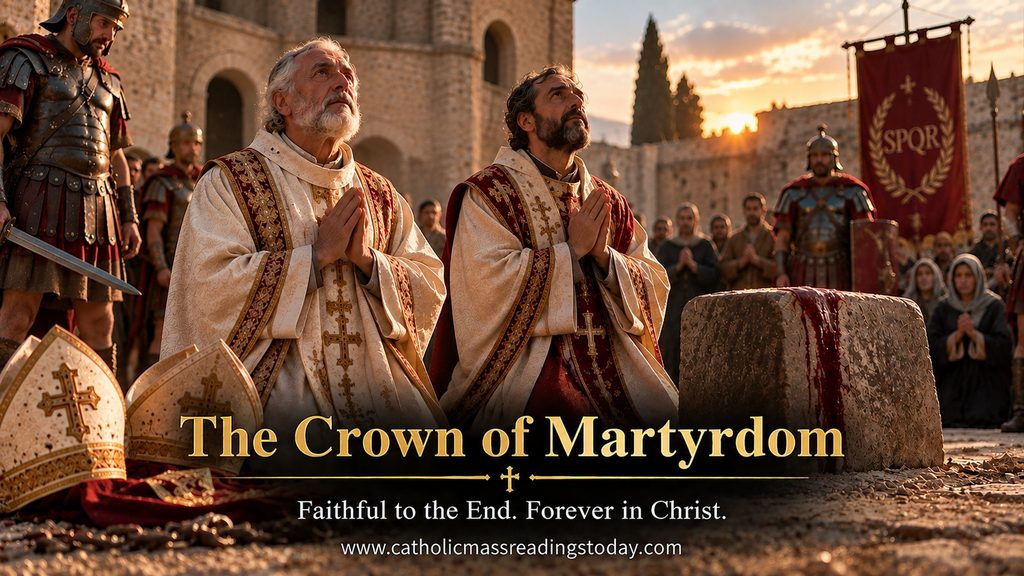
Those who witnessed the execution later recalled the remarkable peace with which Cyprian accepted his fate. He thanked God for the privilege of suffering for Christ. Removing his outer garments, he knelt in prayer. He even gave a gift of gold to the executioner, not out of obligation, but as an expression of Christian charity toward the man who would carry out the sentence. His eyes were gently covered with a linen cloth, and with one stroke of the sword, his earthly pilgrimage came to an end.
The Christians of Carthage reverently gathered his body and buried him with great honour. Their bishop had lived exactly as he had preached—placing his complete trust in Christ until his final breath.
Although Pope Cornelius and Bishop Cyprian died five years apart and in different parts of the Roman Empire, the Church has always remembered them together. Their friendship transcended geography. United in defending the truth, united in preserving the Church’s communion, and united in their willingness to lay down their lives for Christ, they became enduring examples of faithful shepherds who loved the Church more than themselves.
Their Legacy Lives On
History remembers many great leaders, but only a few continue to shape the life of the Church nearly eighteen centuries after their deaths. Saints Cornelius and Cyprian belong among those few.
Saint Cyprian left behind a rich collection of writings that continue to be studied by theologians, seminarians, priests, and historians. His reflections on the unity of the Church, the dignity of the episcopacy, the necessity of charity, and the power of Christian perseverance remain deeply influential. His works helped the early Church navigate questions that still resonate today: How should Christians respond after serious sin? How can truth and mercy coexist? What does authentic unity in the Church look like?
Saint Cornelius, although fewer of his writings survive, left an equally profound legacy through his actions. At a time when some wished to close the doors of the Church to repentant sinners, he chose the path of the Good Shepherd. He upheld both justice and mercy, never treating grave sin lightly, yet never forgetting that Christ came to seek and save the lost. His leadership demonstrated that genuine pastoral care requires both fidelity to truth and compassion for those who sincerely desire conversion.
Their witness reminds us that the Church has always been called to walk this same path. Every generation faces new challenges, new divisions, and new reasons to lose hope. Yet the answer remains unchanged: to remain rooted in Christ, faithful to His Gospel, and united within His Church.
Lessons for Catholics Today
The lives of Saints Cornelius and Cyprian speak powerfully to our own time.
We live in a world where disagreement can quickly become division. Families are fractured by conflict. Communities are polarized. Even within the Church, differing opinions can sometimes overshadow our shared identity as brothers and sisters in Christ. The example of these two saints reminds us that unity is never achieved by abandoning the truth, nor by winning arguments at any cost. True unity grows from humility, charity, forgiveness, and a sincere desire to remain faithful to Christ.
Their lives also teach us about mercy. Both saints understood that every Christian is capable of failure. The lapsi had made painful mistakes under enormous pressure, yet many sincerely repented. Rather than closing the door forever, the Church welcomed them back after genuine repentance and appropriate penance. In doing so, she reflected the heart of Christ Himself, who forgave Peter after his denial and entrusted him once again with the care of His flock.
This lesson remains deeply relevant today. None of us stands before God because of our own perfection. We stand because of His grace. The Church continues to be a place where sinners encounter mercy, receive forgiveness through the Sacrament of Reconciliation, and begin anew.
Their courage also challenges us. Most Christians today are not asked to die for the faith, yet we are called to live for it each day. Fidelity often means remaining honest when dishonesty would be easier, forgiving when resentment feels justified, defending the dignity of every human person, remaining faithful to Sunday Mass, raising children in the faith, and witnessing to Christ even when doing so is unpopular.
Martyrdom takes many forms. Some give their blood. Others quietly give their lives through daily acts of sacrifice, service, and unwavering fidelity.
Both forms are precious in the eyes of God.
Why the Church Celebrates Them Together
The Church’s liturgical calendar contains many individual saints, yet only a handful are commemorated together because their lives became inseparable witnesses to the Gospel. Saints Cornelius and Cyprian belong to that small and distinguished company.
The Roman Canon, the Church’s oldest Eucharistic Prayer still prayed at Mass today, includes both of their names among the great martyrs whose witness strengthened the foundations of Christian faith. Each time that prayer is offered, the Church quietly remembers the Pope who defended mercy and the bishop who defended unity.
Their memorial is therefore more than an historical remembrance.
- It is an invitation.
- It calls bishops to shepherd with courage.
- It calls priests to preach with compassion.
- It calls every Catholic to remain faithful to Christ even when the cost is high.
- It reminds us that unity is a gift worth protecting, mercy is stronger than condemnation, and holiness is achieved one faithful decision at a time.
Nearly eighteen centuries have passed since Cornelius and Cyprian walked the streets of Rome and Carthage. Empires have risen and fallen. Languages have changed. Civilizations have come and gone.
Yet their witness remains astonishingly fresh.
- Whenever the Church chooses reconciliation over resentment…
- Whenever pastors courageously defend both truth and charity…
- Whenever Christians remain faithful despite opposition…
- Whenever believers place the unity of Christ’s Body above personal ambition…
The spirit of Saints Cornelius and Cyprian continues to live within the Church.
May their example inspire us to become courageous disciples in our own generation, people whose faith is unwavering, whose charity is generous, whose hope never fades, and whose hearts remain firmly anchored in Jesus Christ.
Let us Pray
In the name of the Father, and of the Son, and of the Holy Spirit. Amen.
Heavenly Father,
You adorned Saints Cornelius and Cyprian with the grace to shepherd Your people in times of fear, division, and persecution. Through their courageous witness, You showed the world that the unity of the Church is a precious gift and that Your mercy is greater than every repentant sinner’s past.
Grant us, we pray, hearts that seek peace rather than division, humility rather than pride, and truth always united with charity. When we face trials, strengthen us with the same steadfast faith that sustained these holy martyrs. Help us never to be ashamed of the Gospel, but to bear joyful witness to Christ in our homes, our workplaces, our parishes, and our communities.
Bless our Holy Father, all bishops, priests, deacons, religious, and the entire People of God. May the Church throughout the world remain one in faith, one in hope, and one in love, so that all people may come to know the saving power of Jesus Christ.
Through the intercession of Saints Cornelius and Cyprian, obtain for us the grace to persevere faithfully until the end, always trusting in the mercy of God and striving to build up the unity of His Church.
We ask this through Christ our Lord.
Amen.
Saints Cornelius and Cyprian, Bishops and Martyrs, pray for us.