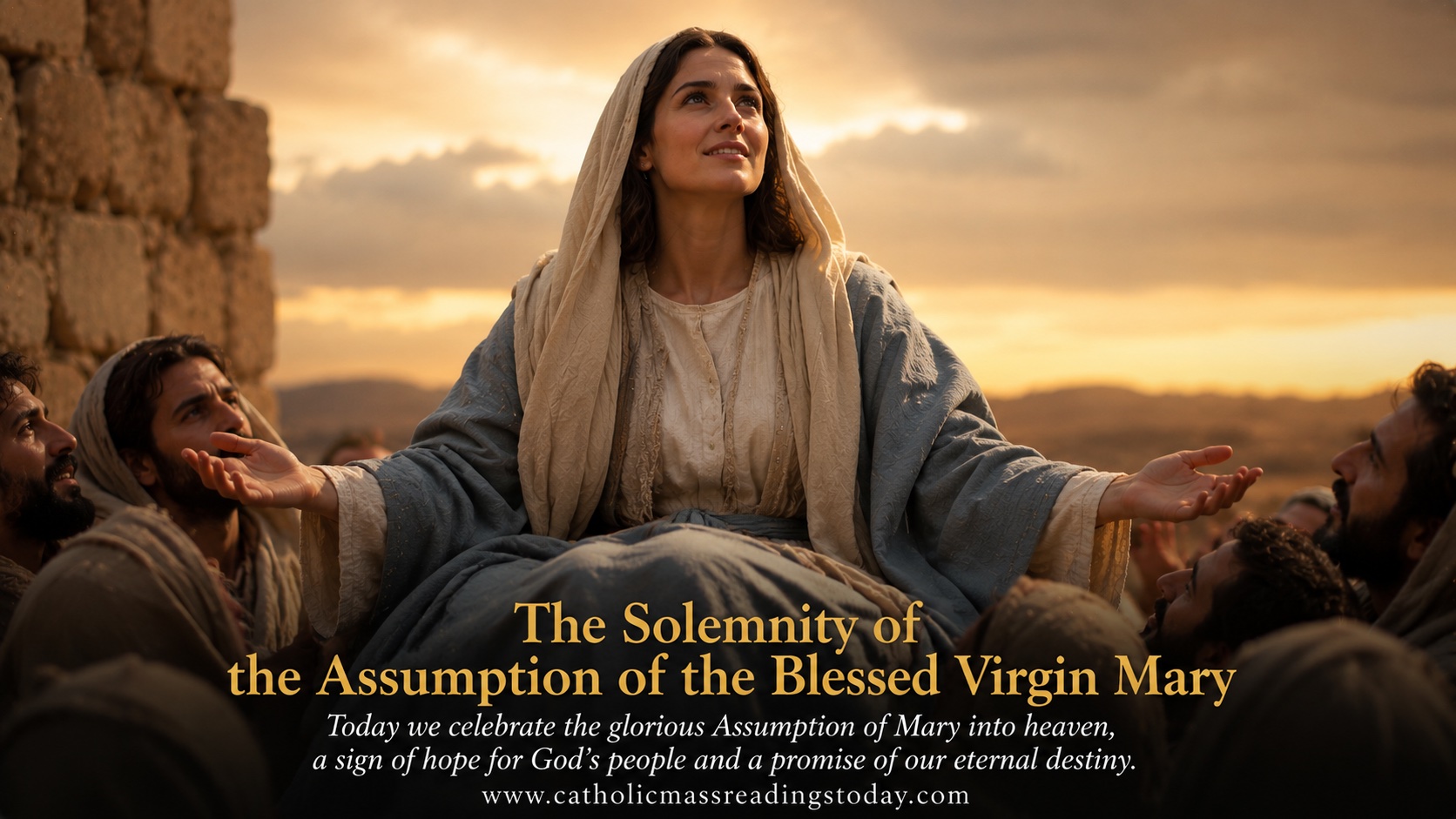
Every year on 15 August, the Catholic Church celebrates The Solemnity of the Assumption of the Blessed Virgin Mary, one of the greatest feasts in the liturgical calendar. It is a day of profound joy and hope, for it proclaims the glorious truth that the Mother of Jesus, having completed her earthly life, was assumed body and soul into heavenly glory by the power of God. The Assumption is not simply a celebration of Mary’s unique privilege; it is also a celebration of the destiny God desires for all who faithfully follow His Son.
For Catholics throughout the world, this solemnity is a reminder that death does not have the final word. In Mary, the Church sees the first and most perfect disciple of Christ receiving the fullness of the resurrection promised to all the faithful. Her Assumption points beyond this life to the eternal Kingdom, where Christ reigns forever and where those who persevere in faith will one day share in His glory.
The story of the Blessed Virgin Mary is unlike any other in human history. From her humble beginnings in Nazareth to her place as Queen of Heaven, every chapter of her life reveals God’s plan of salvation unfolding through a woman who responded to Him with complete trust and unwavering faith.
A Child Prepared by God
Although the New Testament says little about Mary’s early years, the Church has preserved ancient traditions regarding her childhood. Mary was born to Saint Joachim and Saint Anne, a devout Jewish couple who had long prayed for the gift of a child. Their prayers were answered when God blessed them with a daughter who would one day become the Mother of the Messiah.
From her earliest years, Mary grew in holiness, humility, and obedience to God. She was raised in an atmosphere of prayer and faithful observance of the Jewish law. Even as a young girl, she was known for her purity of heart and deep love for the Lord.
The Catholic Church teaches that from the first moment of her conception, Mary was preserved free from Original Sin through the merits of Jesus Christ. This privilege, known as the Immaculate Conception, prepared her to become the worthy dwelling place of the Son of God.
Her life was never separated from God’s plan. Even before she fully understood it, the Lord was preparing her for a mission unlike any ever entrusted to another human being.
The Annunciation
The defining moment of Mary’s earthly life came in the quiet town of Nazareth.
The Angel Gabriel appeared to her with extraordinary words:
“Hail, full of grace, the Lord is with you.”
The angel announced that she had found favour with God and would conceive by the power of the Holy Spirit, giving birth to Jesus, the Son of the Most High.
Mary was troubled by the greeting, not because she doubted God, but because she sought to understand His will. When Gabriel explained God’s plan, she gave the response that changed the course of human history:
“Behold, I am the handmaid of the Lord; let it be done to me according to your word.”
With those words, Mary freely cooperated with God’s plan of salvation. The eternal Word became flesh within her womb, and through her faithful “yes,” the Saviour entered the world.
The Visitation
Immediately after the Annunciation, Mary travelled through the hill country to visit her elderly cousin Elizabeth, who was expecting John the Baptist.
As soon as Mary greeted her, the child in Elizabeth’s womb leapt for joy, and Elizabeth, filled with the Holy Spirit, proclaimed:
“Blessed are you among women, and blessed is the fruit of your womb.”
Mary responded with one of the most beautiful hymns in Scripture, the Magnificat.
“My soul magnifies the Lord, and my spirit rejoices in God my Saviour…”
This hymn continues to be prayed every evening by the Church because it perfectly expresses gratitude, humility, and confidence in God’s faithfulness.
Mary remained with Elizabeth for about three months, serving her quietly before returning home to Nazareth.
The Birth of Jesus
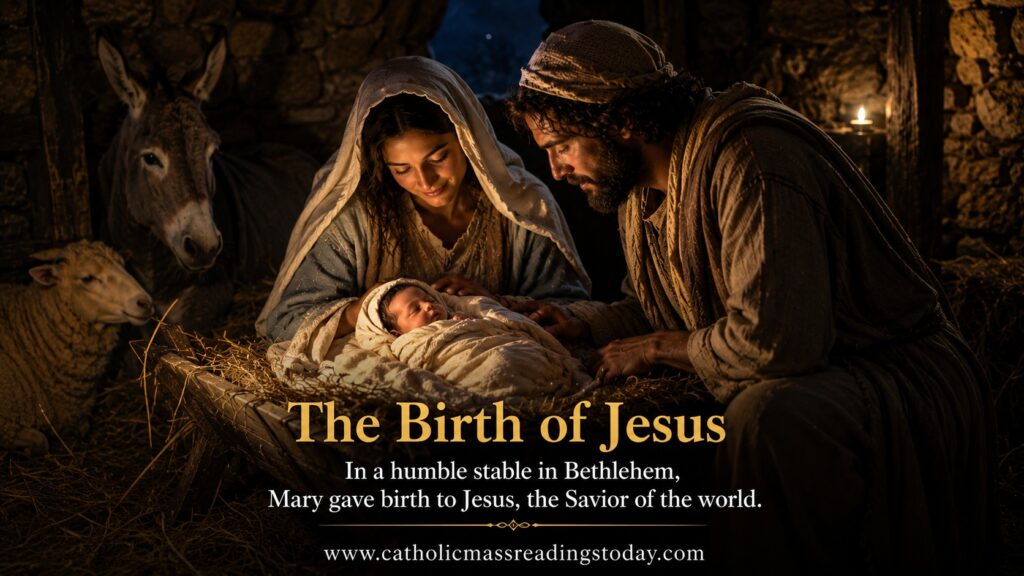
When the decree from Caesar Augustus required Joseph and Mary to travel to Bethlehem, Mary was nearing the time of childbirth. Finding no room at the inn, they sought shelter in a humble stable. There, surrounded by poverty yet filled with heavenly glory, Jesus Christ was born.
Mary became the first person to gaze upon the face of the Redeemer. She welcomed shepherds who came after hearing the angels’ song. Later, the Magi arrived bearing gifts of gold, frankincense, and myrrh.
Throughout these events, Scripture repeatedly tells us that Mary “kept all these things, pondering them in her heart.”
The Hidden Years
After the visit of the Magi, Joseph was warned in a dream to flee into Egypt because King Herod sought to kill the Child. Mary accompanied Joseph on the dangerous journey into exile. After Herod’s death, the Holy Family returned to Nazareth, where Jesus grew in wisdom and stature.
For many years Mary lived an ordinary life, caring for her family, praying, working, and faithfully fulfilling her daily responsibilities. The hidden years of Nazareth remind us that holiness is often found not in extraordinary events but in ordinary faithfulness.
At the Wedding Feast of Cana
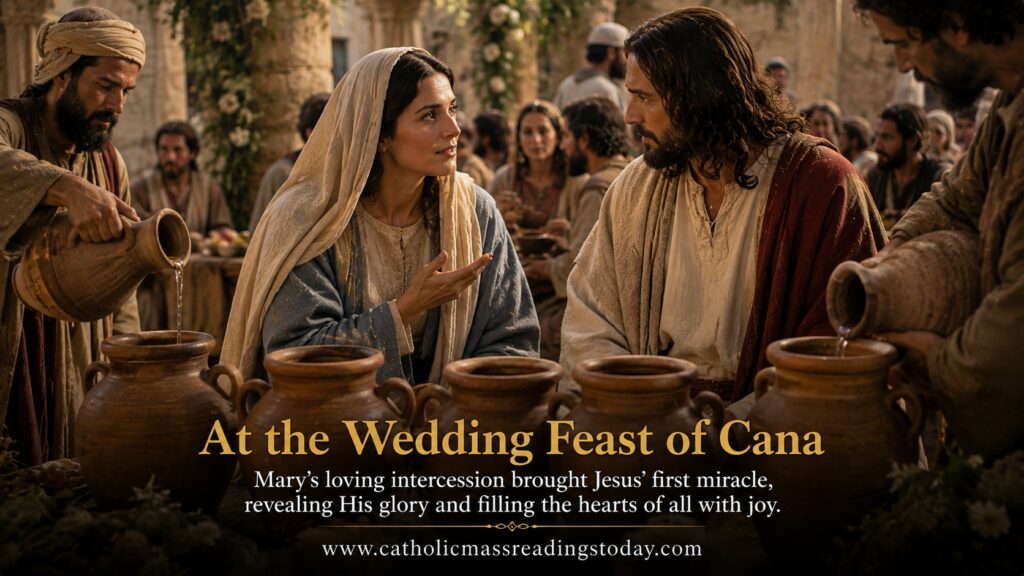
Mary appears again at the beginning of Jesus’ public ministry during the wedding feast at Cana. When the wine ran out, she quietly brought the need to Jesus. Although He replied that His hour had not yet come, Mary confidently instructed the servants:
“Do whatever He tells you.”
These are the last recorded words of Mary in Scripture. They remain her enduring message to every Christian. Through her intercession, Jesus performed His first public miracle, transforming water into wine.
The Church has always seen Cana as a beautiful sign of Mary’s maternal care and powerful intercession.
Standing Beneath the Cross
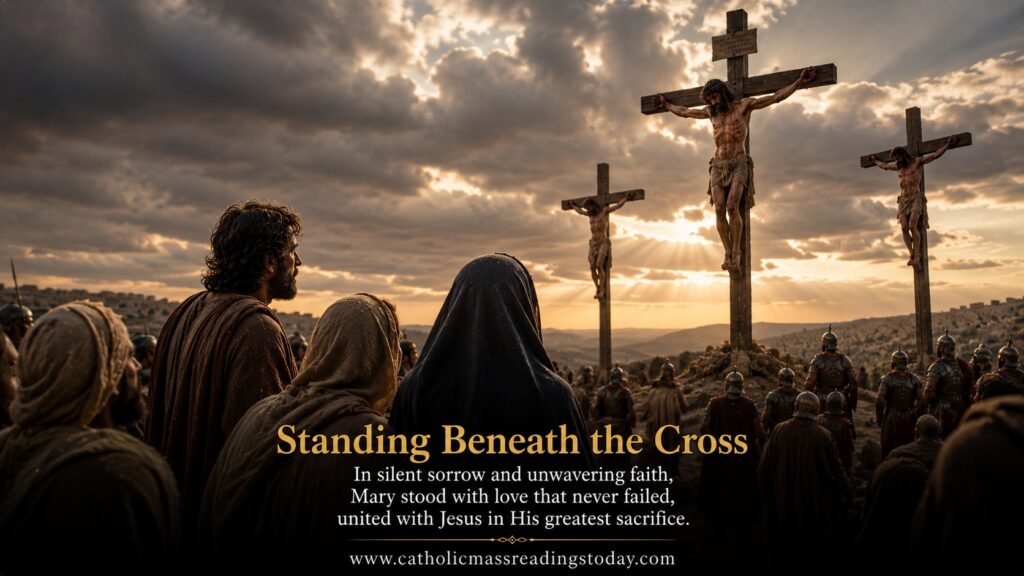
Mary’s deepest sorrow came at Calvary. She stood beneath the Cross as her innocent Son suffered and died. She witnessed His agony without turning away. There Jesus entrusted His beloved disciple to her, saying:
“Behold your mother.”
The Church understands these words as Christ entrusting Mary to all His disciples. From that moment, she became the spiritual Mother of the Church.
Her sorrow was immense, yet her faith never wavered. She remained united to her Son’s sacrifice with complete trust in God’s saving plan.
Witness to the Resurrection and the Early Church
Although the Gospels do not describe an appearance of the risen Christ to His Mother, the Church has long reflected that such a meeting fittingly belongs among the hidden mysteries of Easter.
After the Ascension, Mary remained with the Apostles in Jerusalem. She prayed with them in the Upper Room as they awaited the coming of the Holy Spirit. On the day of Pentecost, the Holy Spirit descended upon the Church, strengthening the Apostles for their mission.
Mary was present at the birth of the Church, just as she had been present at the birth of Christ. Her quiet presence continued to encourage the first Christians as they proclaimed the Gospel throughout the world.
The End of Mary’s Earthly Life
Sacred Scripture does not record the final years of Mary’s earthly life. Ancient Christian tradition, however, consistently teaches that after many years spent caring for the early Church, her earthly pilgrimage came to its completion.
The Church does not define whether Mary died before her Assumption or whether she was taken into heaven without experiencing death. Many ancient Fathers believed she underwent what is traditionally called the Dormition, a peaceful falling asleep in the Lord.
What the Church definitively teaches is that, having completed the course of her earthly life, Mary was assumed body and soul into heavenly glory.
This truth was solemnly proclaimed as a dogma of the Catholic Church by Pope Pius XII on 1 November 1950 in the Apostolic Constitution Munificentissimus Deus.
Her body, which had borne the Son of God, did not experience corruption in the tomb. Instead, by God’s singular grace, she shared fully in the victory of Christ over sin and death.
Why the Assumption Matters
The Assumption is not merely about Mary. It reveals God’s plan for His people. Mary is the first among the redeemed to experience fully what Christ has won through His Resurrection. She is the image of the Church as it will one day be.
Her Assumption gives hope to every Christian who struggles through suffering, illness, and the uncertainty of earthly life. It reminds us that our bodies are destined not for destruction but for resurrection. Mary’s glorification is a promise that faithful disciples will one day share in Christ’s eternal life.
Mary’s Place in the Catholic Church
For more than two thousand years, Catholics have honoured Mary not because she replaces Christ, but because she leads every soul to Him.
She is honoured as:
- Mother of God (Theotokos), because she gave birth to Jesus Christ, true God and true man.
- Mother of the Church, entrusted to all believers by Christ from the Cross.
- Queen of Heaven and Earth, sharing in the glory of her risen Son.
- Our Mother and Intercessor, who continually prays for God’s people.
Every Marian devotion ultimately directs the faithful toward Jesus. Her entire life points beyond herself to her Son.
The Rosary: A School of the Gospel
Among the greatest treasures of Catholic spirituality is the Holy Rosary. More than a repetition of prayers, the Rosary is a meditation on the mysteries of the lives of Jesus and Mary. As the beads pass through our fingers, our hearts are invited to contemplate the Incarnation, the public ministry of Christ, His Passion, Death, Resurrection, and the glory of Heaven. It is often called a “school of prayer” because it teaches us to see the world through the eyes of faith.
The roots of the Rosary reach back to the early centuries of Christianity, when monks prayed all 150 Psalms each day. Many ordinary believers, unable to read, began praying repeated Our Fathers and later Hail Marys, using knotted cords or beads to keep count. Over time, this simple devotion developed into the Rosary we know today.
According to long standing Catholic tradition, in the early thirteenth century the Blessed Virgin Mary encouraged Saint Dominic to promote this prayer as a powerful means of preaching the Gospel and calling sinners to conversion. Through the centuries, saints, popes, and countless faithful have recommended the Rosary as a source of strength, peace, and deeper union with Christ. Saint John Paul II beautifully described it as a prayer that allows us to contemplate the face of Christ with the heart of His Mother.
The Rosary continues to unite families, strengthen parishes, comfort the suffering, and draw countless souls closer to Jesus. Every decade reminds us that Mary’s constant desire is the same as it was at Cana: “Do whatever He tells you.”
The Enduring Legacy of the Blessed Virgin Mary
No woman has influenced history more profoundly than Mary of Nazareth. Her humble obedience opened the way for the coming of the Saviour. Her faithful discipleship continues to inspire billions of Christians throughout the world.
She teaches us that true greatness is found not in power or recognition but in complete trust in God. Her life reminds us that every Christian is called to say “yes” to God’s will, to serve with humility, to persevere in faith, and to hope in the promise of eternal life.
As we celebrate The Solemnity of the Assumption of the Blessed Virgin Mary, we lift our eyes toward Heaven with renewed confidence. Where Mary has gone, the Church hopes to follow.
Her Assumption assures us that God’s promises never fail and that those who remain faithful to Christ will one day share in His everlasting glory.
Prayer
Hail Mary, full of grace, the Lord is with thee. Blessed art thou among women, and blessed is the fruit of thy womb, Jesus. Holy Mary, Mother of God, pray for us sinners, now and at the hour of our death. Amen.
Let us pray
Heavenly Father,
On this glorious Solemnity of the Assumption, we thank You for the gift of the Blessed Virgin Mary, whom You chose to be the Mother of Your Son and whom You have crowned with heavenly glory.
Grant us the grace to imitate her humility, her unwavering faith, and her complete trust in Your holy will. May her example inspire us to say “yes” to Your call each day, to serve others with generous hearts, and to remain steadfast in hope even amid the trials of life.
Through her loving intercession, strengthen our families, protect Your Church, comfort those who suffer, and deepen our love for Jesus Christ. As we pray the Holy Rosary and meditate upon the mysteries of our salvation, draw us ever closer to Your Son, who is our Lord and Saviour.
May the Assumption of the Blessed Virgin Mary remind us that our true home is in Heaven, where You desire all Your faithful children to share in the joy of the Resurrection.
We ask this through Christ our Lord.
Amen.