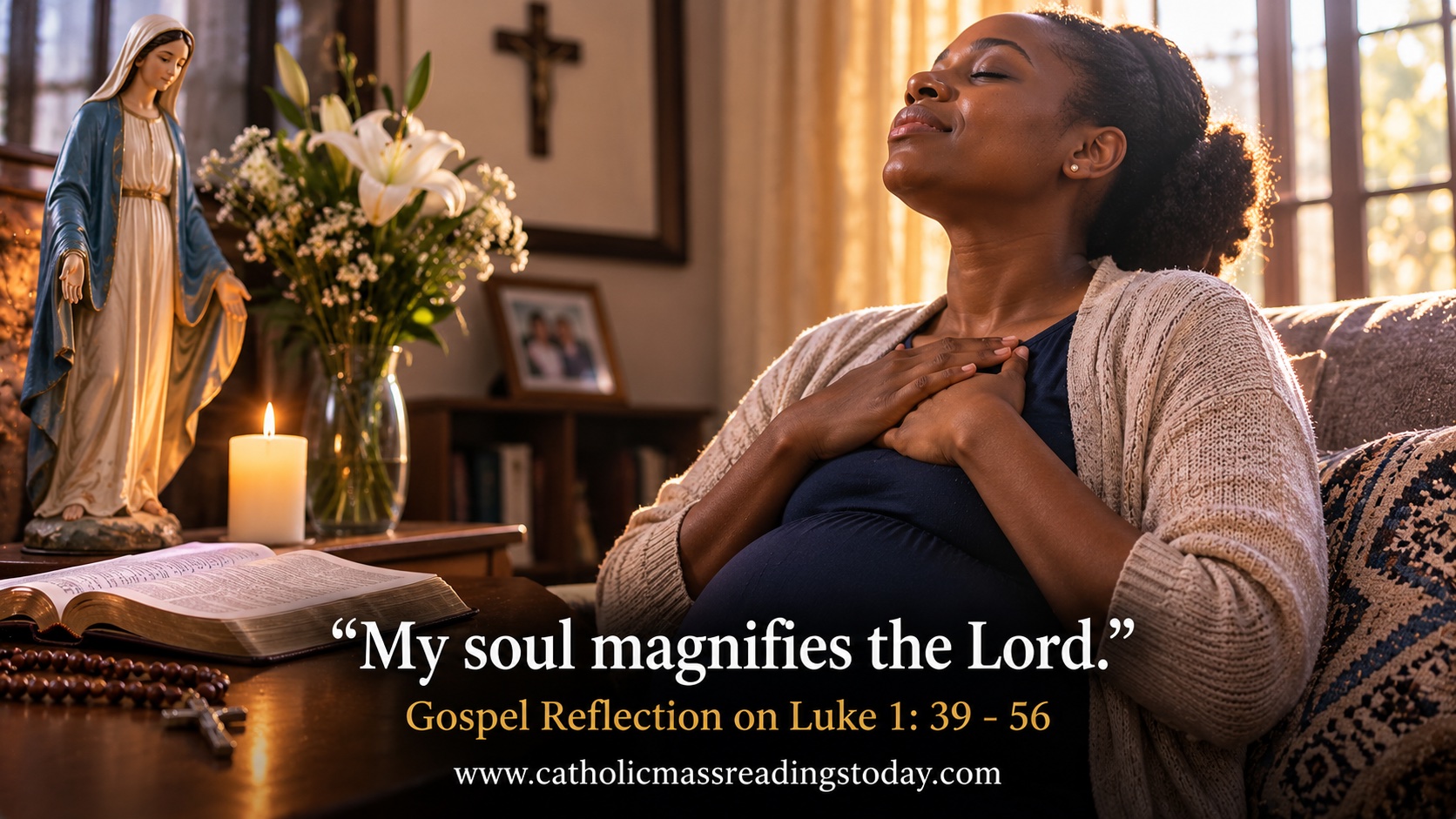
“He who is mighty has done great things for me; he has exalted those of low degree.”
Today’s Gospel draws us into one of the most beautiful moments in all of Sacred Scripture. Mary, having received the message of the Angel, does not remain focused on herself. She immediately sets out “with haste” to visit her cousin Elizabeth. The first steps of the Mother of God after the Annunciation are not toward recognition or comfort, but toward loving service. This simple journey into the hill country reveals the very heart of Christian discipleship. Faith that truly welcomes Christ cannot remain still; it naturally becomes a gift offered to others.
When Mary enters the house of Zechariah, something extraordinary happens. Elizabeth is filled with the Holy Spirit, and the child she carries, John the Baptist, leaps for joy. Before a single miracle has been performed, before Jesus has spoken a word, His presence already brings life, joy, and hope. Wherever Christ is welcomed, hearts begin to change. His presence quietly transforms homes, renews relationships, and fills ordinary moments with the grace of God.
Elizabeth’s greeting is more than a joyful welcome. It is a proclamation of faith inspired by the Holy Spirit. She recognises Mary as “the mother of my Lord,” acknowledging the mystery of the Incarnation hidden within the humble Virgin of Nazareth. She also praises Mary’s faith: “Blessed is she who believed.” Mary is blessed not simply because she was chosen, but because she trusted completely in God’s promise. Her greatness lies in her faithful “yes” to the Lord.
Mary’s response is the magnificent hymn that the Church has prayed every evening for centuries, the Magnificat. It is a song that rises from a heart entirely surrendered to God. Mary does not glorify herself. She magnifies the Lord. She knows that every grace she has received is a gift. Her humility allows God’s greatness to shine without obstruction. This is the secret of true holiness. The closer a soul comes to God, the less it seeks its own glory and the more it desires that Christ may be known and loved.
The words of the Magnificat reveal God’s way of acting throughout history. The Lord raises the humble, strengthens the weak, fills the hungry with good things, and remains faithful to His promises. The values of God’s Kingdom often stand in contrast to the values of the world. Human success is frequently measured by wealth, influence, and power. God looks instead upon humility, trust, generosity, and faithfulness. Those who place their hope in Him discover a richness that no earthly possession can ever provide.
Mary’s song is not merely a memory from the past. It continues to speak to every generation. Whenever we choose service instead of selfishness, forgiveness instead of resentment, or trust instead of fear, the Magnificat is lived once again. Whenever Christians defend the dignity of the poor, comfort those who suffer, encourage the lonely, or share the Gospel with quiet courage, they become instruments through whom God continues to accomplish His great works.
The Visitation also reminds us of the sacred value of every human life. John the Baptist, still hidden within his mother’s womb, recognises the presence of the Saviour and leaps with joy. The Gospel therefore proclaims that life is precious from its very beginning. Every child is known and loved by God before birth, and every human person possesses an inviolable dignity because each is created in His image.
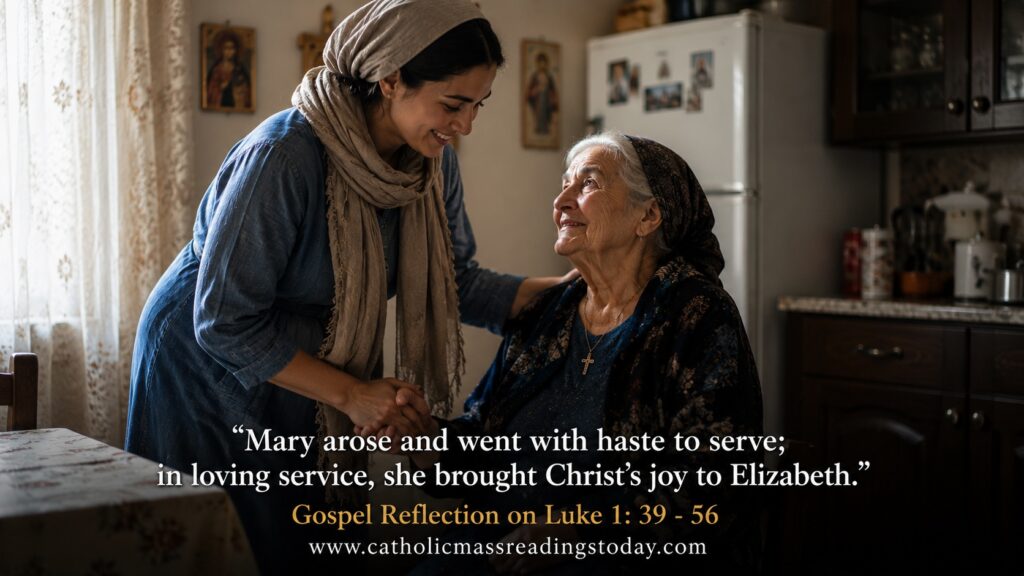
Mary remained with Elizabeth for about three months. She did not come merely to offer congratulations before returning home. She stayed to help, to accompany, and to serve. Love always gives itself generously. It is patient enough to remain present and humble enough to perform unnoticed acts of kindness. In this quiet service, Mary becomes a model for every Christian family, every parish community, and every disciple of Christ.
The Solemnity of the Assumption, celebrated today, gives even deeper meaning to this Gospel. The one who humbled herself before God has now been exalted by Him. Mary’s Assumption into heavenly glory is the fulfilment of the hope proclaimed in the Magnificat. It is also a promise for the whole Church. Where Mary has gone, the faithful are called to follow. Her glory does not distance her from us; rather, it strengthens our hope that Christ’s victory over sin and death will also be shared by all who remain faithful to Him.
As we celebrate this Gospel, let us ask ourselves: Do I carry Christ into the lives of others through my words and actions? Does my heart magnify the Lord, or does it seek its own recognition? Am I willing to serve quietly, trusting that God sees what others may never notice? These questions lead us to the heart of Christian holiness.
May the Blessed Virgin Mary teach us to believe with unwavering faith, to serve with generous love, and to praise God with joyful hearts. Then our lives, like hers, will become living hymns that proclaim not our own greatness, but the greatness of the Lord who continues to do marvellous things for His people.
Let us Pray
Hail, Mary, full of grace,
the Lord is with thee.
Blessed art thou amongst women
and blessed is the fruit of thy womb, Jesus.
Holy Mary, Mother of God,
pray for us sinners,
now and at the hour of our death.
Amen.
Heavenly Father,
You looked with love upon the humility of the Blessed Virgin Mary and accomplished through her the mystery of our salvation. Grant us hearts that are open to Your will and ready to serve with generous love.
Teach us to carry Christ into our homes, our workplaces, and our communities, so that all who meet us may encounter His peace, His mercy, and His joy.
Help us to imitate Mary’s faith, her humility, and her trust in Your promises. May our lives always magnify Your holy name, and may we never grow weary of serving those in need with kindness and compassion.
Through the intercession of the Blessed Virgin Mary, strengthen our hope in the resurrection and lead us safely to the eternal glory You have prepared for all who remain faithful to Your Son.
We ask this through Christ our Lord.
Amen.