“Behold, an Israelite indeed, in whom is no guile!”
There are moments in the Gospel when a person comes before Christ carrying questions, doubts and even prejudices, only to discover that Christ already knows the deepest truth of his heart. The meeting between Jesus and Nathanael is one of those moments.
Philip comes to Nathanael with extraordinary news: “We have found him of whom Moses in the law and also the prophets wrote.” He does not speak merely of another teacher or prophet. Philip believes that the long-awaited promises of God are being fulfilled in Jesus of Nazareth.
Nathanael is not immediately convinced. “Can anything good come out of Nazareth?”
His response is striking because it is so human. Nathanael has already formed an opinion before meeting Jesus. Nazareth was an insignificant place, and the idea that the Messiah could come from there seemed difficult for him to accept.
Philip does not enter into a long argument. He gives an invitation that remains at the heart of Christian evangelization: “Come and see.”
Christian faith ultimately cannot be reduced to arguments about Christ. We are invited to encounter Him.
Jesus Knows Nathanael Before Nathanael Knows Jesus
As Nathanael approaches, Jesus says: “Behold, an Israelite indeed, in whom is no guile!”
Nathanael is astonished. “How do you know me?” Then comes the answer that changes everything:
“Before Philip called you, when you were under the fig tree, I saw you.”
The Gospel does not tell us precisely what Nathanael had been doing beneath that fig tree. Perhaps he had been praying. Perhaps he had been reflecting upon the Scriptures. Perhaps something deeply personal had taken place there.
Whatever happened, Nathanael understands immediately that Jesus knows something about him that an ordinary stranger could not have known.
This is one of the great consolations of today’s Gospel: Christ sees us before we come looking for Him. Before Nathanael took his first step toward Jesus, Jesus had already seen Nathanael. The same is true of us.
There are parts of our lives known to no one else. There are prayers whispered when nobody is listening, sacrifices that receive no recognition, wounds we hide behind ordinary conversation, fears we cannot easily explain and struggles that perhaps even those closest to us do not fully understand.
Christ knows them. There is always an “under the fig tree” in every human life, a place known completely only to God and His knowledge of us is not cold observation. Christ sees in order to call, heal and lead us into communion with Him.
“Rabbi, You Are the Son of God!”
Nathanael’s scepticism disappears with remarkable speed. The man who had just asked whether anything good could come from Nazareth now declares:
“Rabbi, you are the Son of God! You are the King of Israel!”
Something profound has happened within him. Nathanael realizes that he is standing before someone who has seen beyond appearances and reached into the hidden place of his life.
Yet Jesus tells him that this is only the beginning: “You shall see greater things than these.”
Faith is never meant to remain frozen at the moment of our first encounter with God. The Lord continually calls us deeper.
Many Christians can remember moments when God seemed especially near: a prayer unexpectedly answered, a powerful Confession, a moment before the Blessed Sacrament, a Scripture passage that suddenly spoke directly to one’s life, the birth of a child, an unexpected act of mercy, or strength received during suffering.
Such moments are gifts. But Christ does not say, “Remain here.” He says, in effect, there is still more to see. Christian discipleship is a lifelong movement into the mystery of Christ.
“Come and See”
Philip’s role deserves particular attention.
He had discovered Christ, and almost immediately he went looking for Nathanael. That is authentic evangelization. Philip did not possess an elaborate theological argument capable of answering every objection Nathanael might raise. When Nathanael questioned Nazareth, Philip simply said:
“Come and see.”
There is wisdom here for the Church today. Our families, workplaces and communities contain many people who have questions about God. Some have been disappointed by Christians. Others have stopped practising their faith. Some are sceptical of the Church. Others may never have seriously encountered Christ at all.
Not every conversation must become an argument. Sometimes the most powerful Christian witness is an invitation.
- Come to Mass.
- Come with me to Adoration.
- Come and hear the Gospel.
- Come and experience the Sacrament of Reconciliation.
- Come and meet the community.
- Come and see.
But such an invitation becomes credible when others can also see that Christ has changed something in us. Evangelization begins not with clever words but with a life touched by Jesus Christ.
Christ Sees Beyond Our Prejudices
Nathanael’s initial reaction also asks us to examine ourselves. “Can anything good come out of Nazareth?” How easily human beings make similar judgments.
Can anything good come from that neighbourhood? From that family? From that nation? From that person with such a past? From someone who looks, speaks or thinks differently from me?
We can imprison people within our first impressions. God does not.
Throughout salvation history, God repeatedly chooses what the world overlooks. Bethlehem was small. Nazareth was obscure. Fishermen became Apostles. Sinners became saints.
God’s grace frequently appears where human pride would least expect it.
The disciple of Christ must therefore learn to look at another person not merely according to reputation, social standing, wealth, education, nationality or past mistakes, but as someone created in the image of God and capable of being transformed by grace.
“In Whom Is No Guile”
Jesus’ description of Nathanael is also significant. He praises his sincerity.
Nathanael has doubts, but he does not pretend otherwise. He asks what he genuinely thinks. And when the truth stands before him, he is willing to surrender his previous judgment.
There is an important difference between honest questioning and a heart that refuses truth. God is not threatened by our sincere questions. We can come before Him without masks.
We do not need to pretend that our faith is stronger than it is, that our wounds do not hurt, or that we understand mysteries that remain difficult for us.
Christ desires truth in the heart. A sincere person may begin with questions and still arrive at profound faith. Nathanael demonstrates precisely this journey.
“You Will See Heaven Opened”
The Gospel reaches its summit when Jesus declares:
“You will see heaven opened, and the angels of God ascending and descending upon the Son of man.”
These words recall Jacob’s vision of the ladder between heaven and earth. But now something greater is revealed. Christ Himself is the meeting place between heaven and earth. In Him, God has drawn near to humanity.
This truth reaches deeply into Catholic sacramental life. Christianity is not simply humanity trying to climb upward toward a distant God. In Jesus Christ, God has come down to us.
This mystery becomes especially tangible in the Holy Eucharist.
At every Mass, the Church gathers around Christ’s sacrifice. Heaven and earth are mysteriously united in the worship of God. The risen Lord whom Nathanael confessed as the Son of God comes sacramentally among His people under the appearances of bread and wine.
The Christian who approaches the Eucharist therefore approaches not merely a religious symbol, but Christ Himself, Body, Blood, Soul and Divinity.
The invitation “Come and see” ultimately becomes an invitation to come and remain with Him.
What Christ Says to Us Today
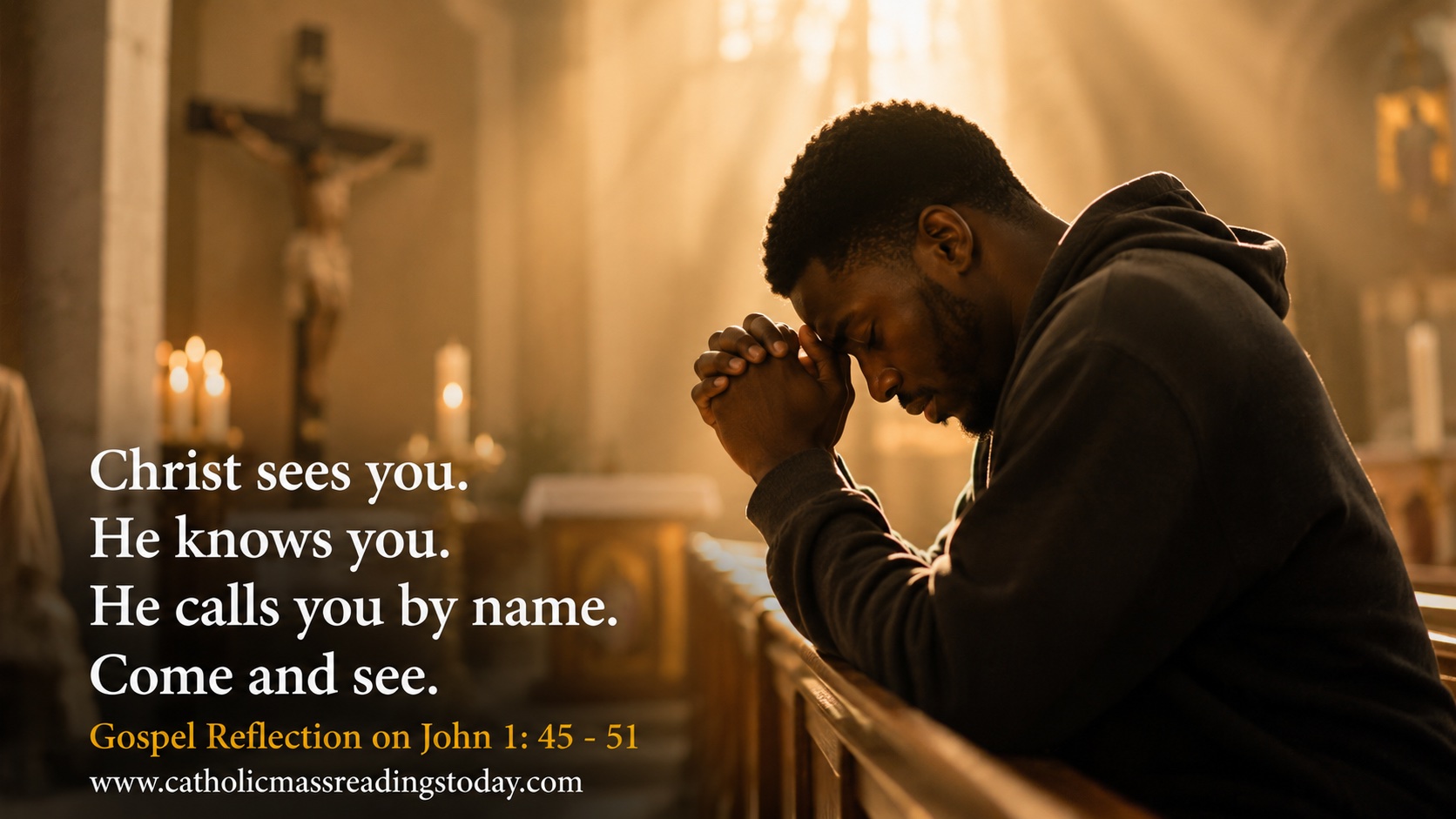
Perhaps today’s Gospel can be heard very personally. Christ sees you. He sees the things nobody applauds, he sees the burdens you carry quietly, he sees your desire to become better, even when you repeatedly struggle with the same weakness, he sees the prayers you think have gone unanswered and he sees the faith that sometimes feels strong and sometimes fragile.
Just as He saw Nathanael beneath the fig tree, Christ sees the hidden places of your life, but He does not merely observe you from afar. He calls you. He asks you to leave behind whatever prevents you from knowing Him more deeply and to discover that the God who knows you completely is also the God who loves you completely.
Nathanael began with:
“Can anything good come out of Nazareth?”
He ended with:
“You are the Son of God!”
Between those two statements stood one encounter with Jesus Christ. That is what grace can do.
Perhaps today, through His Word, Christ is once again saying to each of us:
Come and see. There are still greater things ahead.
Let us Pray
Lord Jesus Christ,
You saw Nathanael beneath the fig tree
before he ever came before You,
and You knew the sincerity hidden within his heart.
Look upon us with the same merciful love.
Free us from prejudice, pride and false judgment.
Give us hearts without deceit,
ready to seek the truth and courageous enough
to follow wherever You lead.
When our faith becomes uncertain,
draw us closer to Yourself.
When we feel unseen or forgotten,
remind us that Your loving gaze has never left us.
Grant us the courage of Philip
to bring others to You,
not merely through our words,
but through lives transformed by Your grace.
Strengthen our faith in Your holy Church,
nourish us through Your Word and the Holy Eucharist,
and teach us to recognize You
as the Son of God and King of our lives.
May we follow You faithfully on earth
until that day when, with the angels and saints,
we behold the glory of heaven opened before us.
You live and reign with God the Father
in the unity of the Holy Spirit,
God, for ever and ever.
Amen.