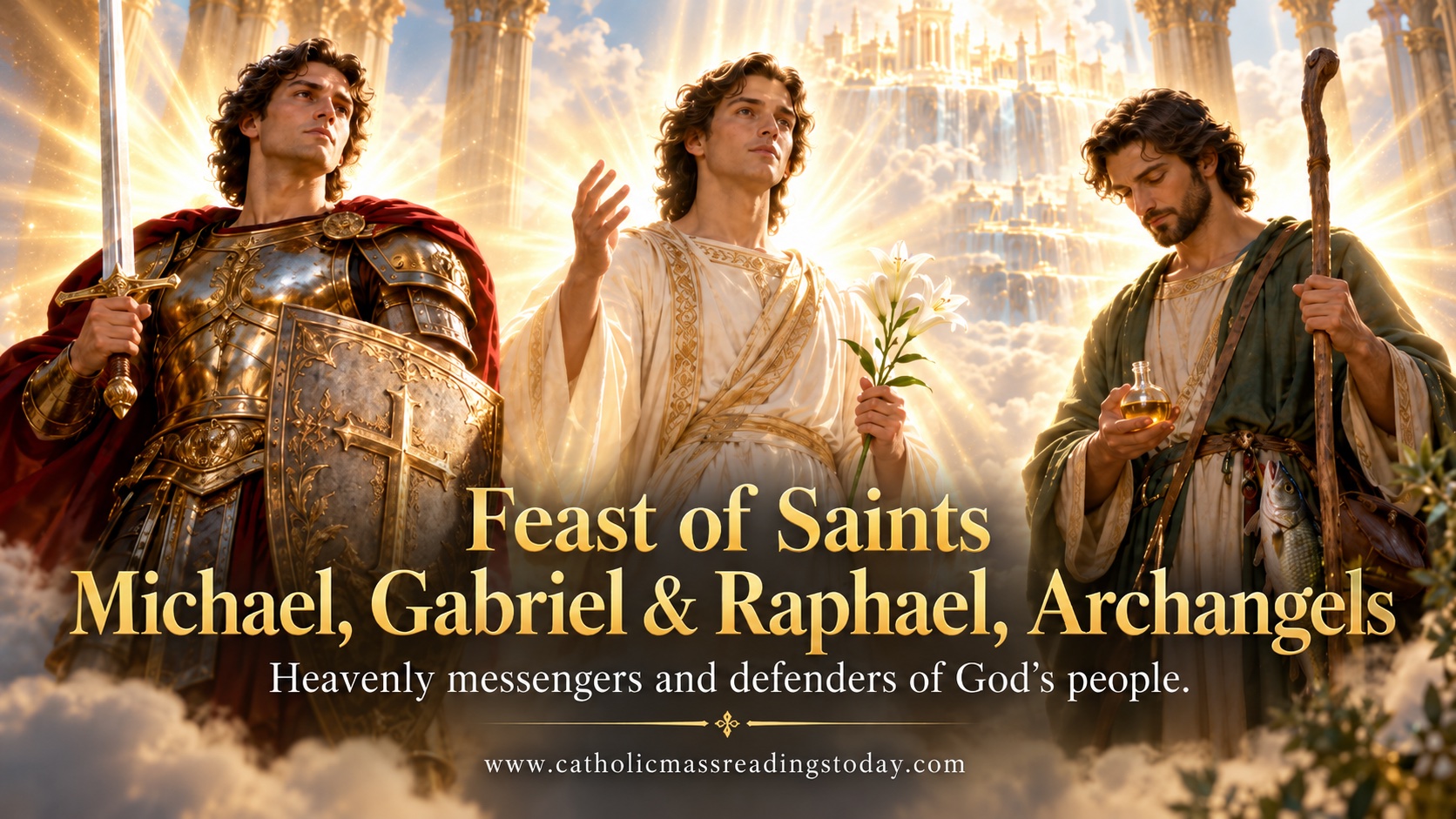
The Catholic Church celebrates the Feast of Saints Michael, Gabriel & Raphael, Archangels on September 29, a day that draws the faithful into the mystery of the heavenly world and reminds us that God’s saving work is not limited to what our eyes can see. The Church’s liturgy for this feast places before us three archangels who appear by name in Sacred Scripture and whose missions reveal something important about the care, protection, guidance, and providence of God. The Vatican’s liturgical calendar marks September 29 specifically as the Feast of Saints Michael, Gabriel, and Raphael, Archangels.
The Feast of Saints Michael, Gabriel & Raphael, Archangels is not simply a celebration of three powerful heavenly beings. It is ultimately a celebration of God Himself, whose glory is reflected in the angels and whose will they carry out with perfect obedience. The Church venerates the angels because their whole existence points beyond themselves to the majesty of God. In Catholic teaching and liturgy, the angels are ministers of God, servants of His saving plan, and companions of the Church in her pilgrimage toward heaven. The Church has always experienced the “mysterious and powerful assistance” of the angels and commemorates Michael, Gabriel, and Raphael together on September 29.
The Meaning of the Feast of Saints Michael, Gabriel & Raphael, Archangels
The word “angel” describes a mission rather than a nature. Angels are spiritual creatures created by God, endowed with intelligence and will, and sent by Him to serve His purposes. Scripture presents them worshipping before the throne of God, carrying divine messages, protecting God’s people, guiding them, and taking part in the great drama of salvation.
Michael, Gabriel, and Raphael each reveal a different aspect of this divine ministry.
Michael appears as the defender against evil. Gabriel comes as the messenger of God’s decisive announcements. Raphael appears as a companion, healer, and guide. When the Church places these three archangels before us on one feast, she gives us a striking picture of God’s providence: He protects, He speaks, He guides, and He heals.
This is why the Feast of Saints Michael, Gabriel & Raphael, Archangels speaks so powerfully to ordinary Christian life. Every believer knows moments of spiritual struggle, moments when direction is needed, moments when God’s word must be heard clearly, and moments when healing is needed. The missions of these archangels remind us that God is not absent from any of these moments.
Saint Michael the Archangel: Defender in the Battle Against Evil
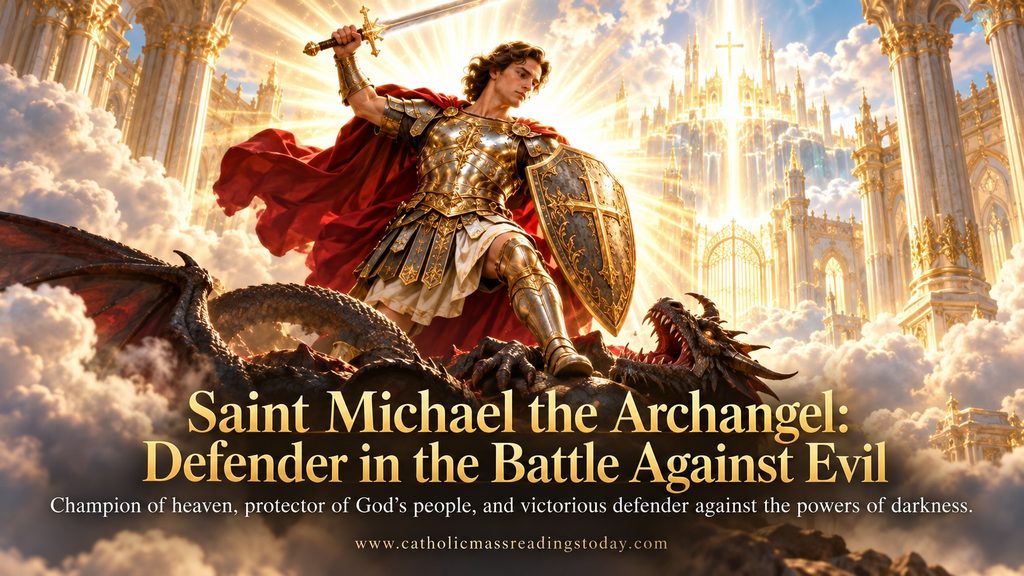
Saint Michael is perhaps the most widely recognised of the three archangels. His name is traditionally understood to mean, “Who is like God?” That question itself becomes a proclamation: no creature can rival the Creator.
The Book of Revelation gives one of the most dramatic biblical descriptions of Michael. A great battle arises in heaven, and Michael and his angels fight against the dragon. The dragon and his angels are defeated and cast down. The imagery is powerful, but the deeper message is even more important: evil is real, but it is not equal to God. It does not have the final word.
This is why Saint Michael has long been invoked as a protector of the Church and of the faithful in spiritual warfare. He is the leader of the heavenly hosts and the church since traditions begun placed him as a defender against evil.
The image of Michael should never tempt us into treating the Christian faith as though it were built upon fear. Quite the opposite. Michael’s witness calls the Church to confidence. The victory belongs to God.
The Christian life includes a real struggle against sin, temptation, deception, discouragement, hatred, pride, and everything that tries to turn the human heart away from God. But the feast reminds us that the Christian does not face this struggle alone.
Michael points us toward the sovereignty of God. His very name seems to ask every power that exalts itself: Who is like God?
The answer is simple.
No one.
Saint Gabriel the Archangel: Messenger of God’s Saving Word
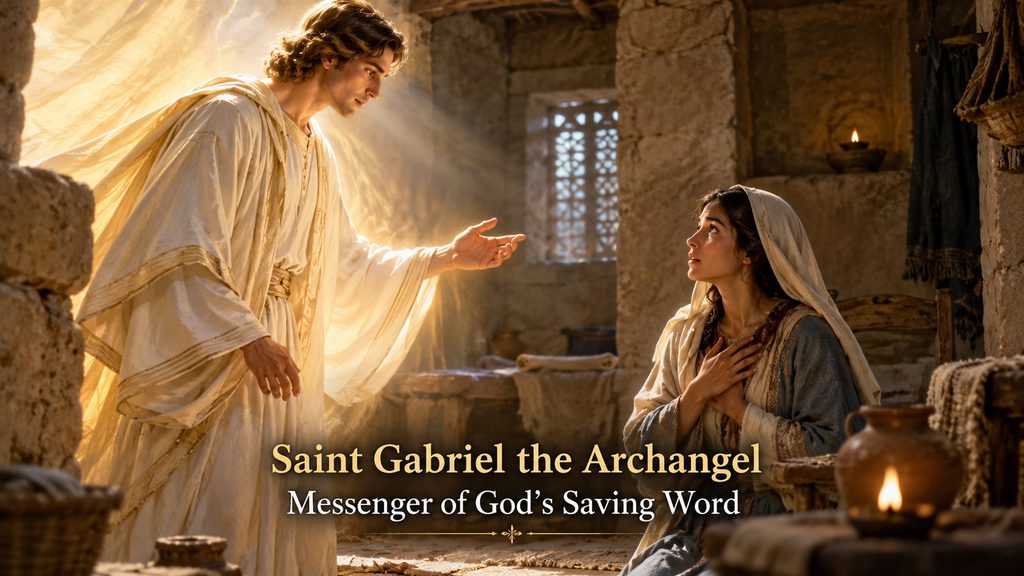
If Michael is closely associated with defence and spiritual battle, Gabriel is remembered above all as the messenger of God’s great announcements.
The name Gabriel is commonly understood as “God is my strength” or “strength of God.” In Scripture, his mission is associated with moments when God’s saving plan is being revealed.
Gabriel appears in the Book of Daniel, helping the prophet understand visions concerning the future. But his most famous mission comes in the Gospel of Luke.
He is sent to the Virgin Mary in Nazareth.
There, in one of the most important moments in salvation history, Gabriel announces that Mary will conceive and bear a Son, and that this Son will be called Jesus.
The Annunciation places Gabriel at the threshold of the Incarnation.
He does not bring an ordinary message, He brings the news that the eternal Son of God will enter human history.
Gabriel’s words to Mary open one of the great turning points of the Gospel: God is coming among His people.
Gabriel also appears earlier in Luke’s Gospel when he announces the birth of John the Baptist to Zechariah.
His mission repeatedly brings divine promise into human uncertainty.
The church identifies Gabriel as the messenger entrusted with announcing God’s will and his name is associated with the strength of God
There is something deeply relevant here for us.
The world is full of voices.
News, opinions, advertisements, social media, arguments, fears, ambitions, and endless information compete constantly for our attention.
Gabriel’s witness asks a quieter question:
Are we listening for the word of God?
God continues to speak through Sacred Scripture, the teaching of the Church, prayer, conscience properly formed, and the ordinary movements of grace in our lives.
The challenge is not only whether God speaks.
It is whether we are willing to hear Him.
Saint Raphael the Archangel: Companion, Guide, and Healer
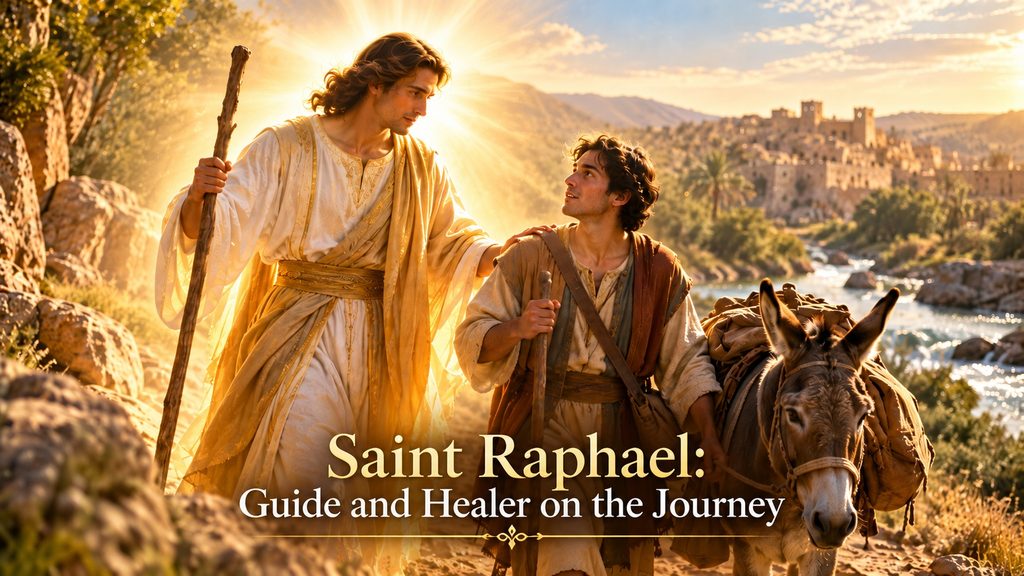
Saint Raphael’s story is told most fully in the Book of Tobit.
His name is traditionally understood to mean “God heals.”
That meaning becomes visible in the role he plays.
Raphael accompanies Tobias, the son of Tobit, on a dangerous journey. He guides him, protects him, and becomes part of the healing God brings to the family.
Tobit had suffered blindness. Sarah had suffered deeply under spiritual oppression and grief. Through the unfolding events of the story, Raphael’s mission becomes an instrument of God’s restoration.
Raphael is the archangel who accompanies Tobias on his journey and the church connects his name with God’s healing action.
Raphael therefore speaks especially powerfully to anyone who feels that life has become a road they cannot walk alone. Some journeys are physical, others are emotional, spiritual, or moral.
There are seasons when we know where we need to go but do not know how we will reach the destination. There are moments when we are carrying wounds that are not visible to anyone else.
Raphael reminds us that God can guide quietly. He can accompany without noise. He can heal through means we do not immediately recognise.
The Book of Tobit shows something profoundly human: God’s care often unfolds through a journey, through relationships, and through acts of trust.
Healing is not always instantaneous, guidance is not always dramatic but God remains present.
Three Archangels, Three Missions, One God
It is easy to speak of Michael, Gabriel, and Raphael as though they represent three separate spiritual themes, but the deeper truth is that their missions all come from the same God.
- Michael protects because God protects.
- Gabriel announces because God speaks.
- Raphael heals because God heals.
The archangels do not draw attention to themselves. Their greatness is found precisely in their obedience. They are servants. This is one of the most important lessons of the feast.
The world often measures greatness by independence, status, influence, visibility, wealth, or power. The angels reveal another kind of greatness, they are great because they belong entirely to God.
They do His will, they stand before Him, they worship snd they serve.
The Church’s liturgy frequently connects the angels with worship. The Church associates herself with the angelic hymn in the liturgy and invokes the assistance of the angels in prayer, Eucharistic worship, protection, and the final passage of the faithful toward heaven.
This gives the Feast of Saints Michael, Gabriel & Raphael, Archangels a deeply Eucharistic meaning, at Mass, the Church does not imagine herself worshipping alone. The earthly liturgy joins the worship of heaven.
When we sing “Holy, Holy, Holy,” the Church understands that our praise is united with that of the angels and saints before God.
The Archangels in the Story of Salvation
The appearances of Michael, Gabriel, and Raphael in Scripture show us that angels are not decorative figures added to biblical stories. They are connected to decisive moments.
Michael appears where evil is confronted, Gabriel appears where God’s saving word is revealed and Raphael appears where God’s guidance and healing are needed.
Their missions remind us that salvation history includes both the visible and invisible creation.
Modern life often encourages us to believe that what cannot be measured physically is somehow less real. The Christian faith does not share that narrow view.
The Creed professes belief in God as Creator of all things visible and invisible, the feast of the archangels brings that truth into focus.
There is more to reality than what we can see.
- There is a spiritual world.
- There are angels.
- There is spiritual struggle.
- There is divine providence.
And above all of it stands God, Creator and Lord.
What Saint Michael Teaches Us About Courage
Saint Michael teaches courage, but Christian courage is not aggression. It is faithfulness.
Michael does not fight for personal glory, He fights because God is God. That distinction matters.
Our own spiritual battles are not won through anger, pride, or domination. They are won through truth, prayer, grace, repentance, humility, fidelity to Christ, and resistance to sin.
The Christian must learn to recognise temptation without becoming obsessed with it.
The goal is not to stare endlessly at evil, the goal is to remain fixed upon God.
Michael’s whole witness points in that direction. When fear rises, return to God.
When temptation comes, return to God, when confusion grows, return to God and when evil appears powerful, remember that it remains a creature and not the Creator.
What Saint Gabriel Teaches Us About Listening
Gabriel teaches us how important it is to receive the word of God.
At the Annunciation, Gabriel delivers the message, but Mary must respond. Her “yes” becomes part of the mystery. That moment reveals an essential pattern of Christian life.
God speaks.
We listen.
God calls.
We respond.
God offers grace.
We cooperate.
Gabriel reminds us that the word of God is not simply information. It demands a response.
There are moments when God’s will may not immediately make sense to us. Mary herself asks how the angel’s announcement will come about.
Faith does not mean never asking questions. It means allowing our questions to remain inside trust.
What Saint Raphael Teaches Us About Trusting the Journey
Raphael’s story teaches patience. Tobias does not know everything at the beginning of his journey, He receives guidance step by step. That is often how Providence works.
We would like God to show us the entire road. Usually, He gives enough light for the next step.
Raphael’s presence in the Book of Tobit reminds us that accompaniment is itself a form of grace.
- Sometimes God helps us through another person.
- Sometimes He brings healing through time.
- Sometimes He opens a path we could not see at the beginning.
- Sometimes we only understand the meaning of a journey after we have completed part of it.
Raphael teaches us not to despise the slow work of God.
Why the Feast Matters to the Church Today
The Feast of Saints Michael, Gabriel & Raphael, Archangels remains especially meaningful in a world marked by fear, violence, misinformation, loneliness, spiritual confusion, and suffering.
- Michael reminds us not to surrender to evil.
- Gabriel reminds us to listen for God’s truth in the middle of endless noise.
- Raphael reminds us that healing and guidance remain possible even when the road ahead is uncertain.
Together, they remind the Church that God has not abandoned His people.
The feast is also a call to humility. Angels are glorious creatures, yet their glory comes from God.
The same is true of us.
Every gift we possess is received, every ability can become service and every strength can become worship.
The feast asks whether our lives are turned toward God as fully as the angels are.
What Is Expected of Us as Catholics
To celebrate this feast well is not simply to admire the archangels. It is to imitate what their missions reveal.
From Michael, we learn fidelity, from Gabriel, attentiveness, from Raphael, trust and from all three, obedience to God.
The feast should lead us to examine our lives.
- Where are we compromising with sin?
- Where are we resisting something God has been trying to say?
- Where have we become impatient with the journey of healing?
- Where do we need courage?
- Where do we need to listen?
- Where do we need to trust?
These are not abstract questions. They touch family life, work, relationships, prayer, morality, suffering, forgiveness, vocation, and every ordinary decision through which holiness is built.
How Catholics Can Celebrate the Feast
The most fitting way to celebrate the Feast of Saints Michael, Gabriel & Raphael, Archangels is to enter deeply into the worship of the Church.
The Mass should stand at the centre where possible.
The readings for the feast draw our attention to the heavenly court, the victory of God, and the mystery of the angels ministering before Him. In the liturgical tradition of the day, passages from Daniel or Revelation and the Gospel of John help the faithful contemplate heaven opened and the angels serving within God’s plan.
Prayer also has an important place.
Catholics may invoke Saint Michael for protection in spiritual struggle, Saint Gabriel for grace to hear and respond to God’s word, and Saint Raphael for guidance and healing.
Yet even these devotions should lead beyond the angels themselves.
Authentic devotion always leads to God. The angels are servants of His glory.
Their mission is not to replace Christ, but to serve His saving work.
The Eucharist, prayer, Scripture, confession, acts of charity, and renewed obedience to God therefore provide the deepest way to honour this feast.
The Archangels and the Life of Prayer
The feast can transform the way we think about prayer. Prayer is not a lonely act performed in an empty universe.
When a Christian prays, he or she stands before the living God.
The Church prays with the angels, the saints worship and Heaven is not silent. This does not mean that we will always feel something extraordinary in prayer. Usually, we will not. But faith reminds us that the invisible reality of worship is greater than what we feel.
A quiet Mass in a small parish church participates in the worship of heaven. A whispered prayer before sleep belongs within the great communion of the Church and a person praying alone during grief is not spiritually alone.
This is one of the quiet gifts of the feast. It expands our vision.
The Angels Always Point Beyond Themselves
One of the safest ways to understand Catholic devotion to angels is to remember that holy angels never compete with God. They point toward Him.
- Michael’s battle proclaims God’s victory.
- Gabriel’s message announces God’s Son.
- Raphael’s healing reveals God’s mercy.
Their mission is entirely God centred. For this reason, devotion to the archangels should deepen our love for Christ.
If devotion becomes detached from Scripture, the sacraments, prayer, and the worship of God, it has lost its proper direction.
The angels themselves would never want to become the centre. Their joy is to serve the Lord.
“Who Is Like God?”
Michael’s name leaves us with one of the most fitting questions for this feast.
Who is like God?
No power.
No ruler.
No fear.
No temptation.
No suffering.
No evil.
Nothing in creation can take the place of the Creator.
Gabriel reminds us that this God has spoken.
Raphael reminds us that this God heals.
Michael reminds us that this God is victorious.
And the Gospel reminds us that in Christ, heaven itself has been opened.
The Feast of Saints Michael, Gabriel & Raphael, Archangels therefore invites us to lift our eyes beyond the visible pressures of daily life and remember the larger reality in which we live.
God reigns, His angels serve Him, His providence surrounds His people, His word continues to speak, His grace continues to heal and His victory remains sure.
A Feast of Courage, Listening, Healing, and Hope
As the Church celebrates Saints Michael, Gabriel, and Raphael, Archangels, we are invited to recover a deeper sense of the nearness of God.
When we are afraid, Michael reminds us of divine victory, when we are uncertain, Gabriel reminds us to listen, when we are wounded or lost, Raphael reminds us that God still guides and heals, but all three ultimately bring us to the same place.
They bring us back to God. That is the heart of this feast. The archangels are glorious because they belong completely to Him.
Their lives, their missions, and their worship are entirely directed toward His will.
May this feast teach us to live the same way: with courage when evil confronts us, with attentiveness when God speaks, with trust when the road is uncertain, and with hearts ready to say yes to the Lord.
Let Us Pray
Saint Michael the Archangel, defend us in battle.
Saint Gabriel the Archangel, help us to hear and receive the word of God.
Saint Raphael the Archangel, guide and accompany us on the road of healing.
Saints Michael, Gabriel & Raphael, Archangels, pray for us.
Amen.