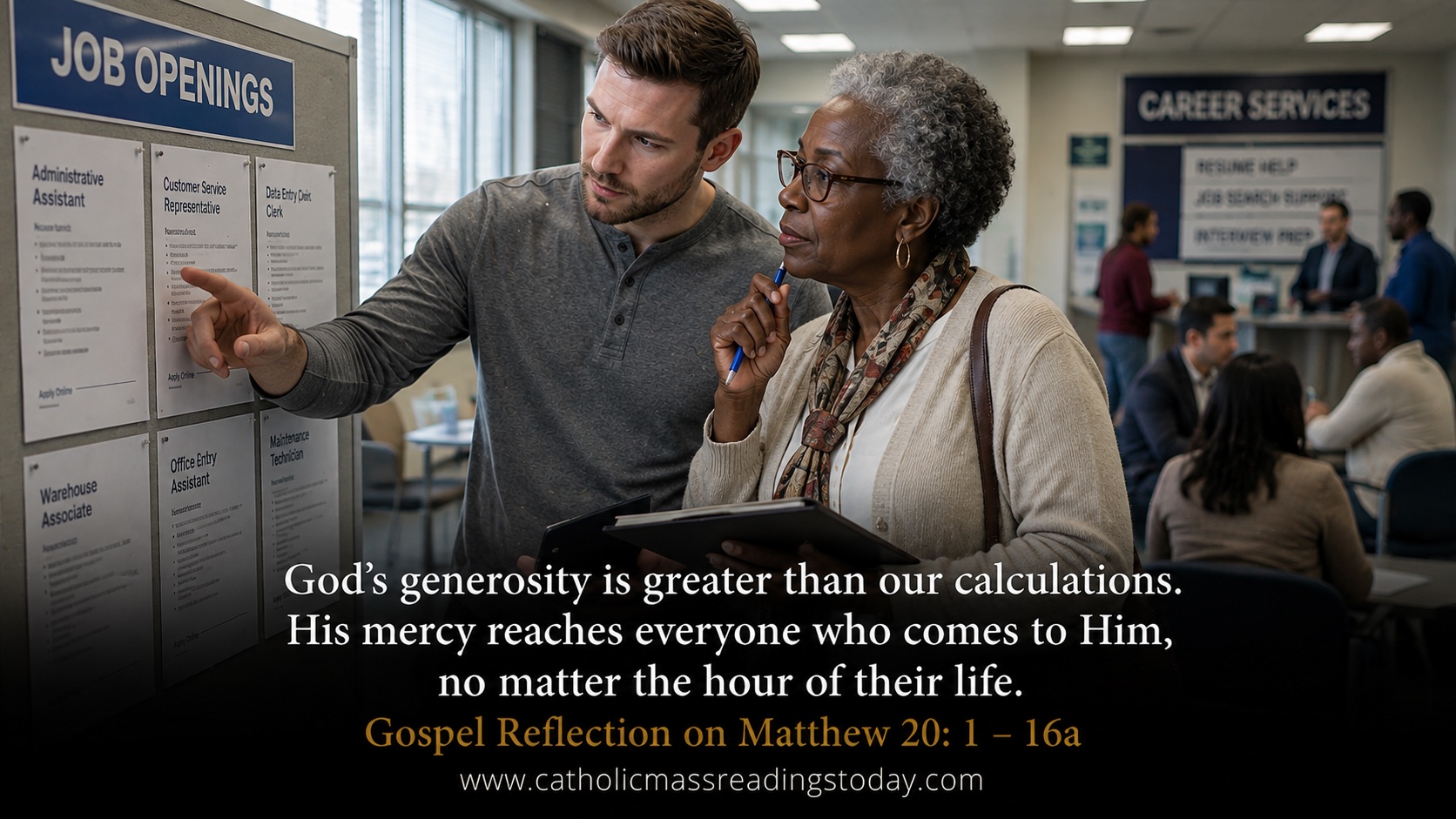
“Do You Begrudge My Generosity?”
There is something about today’s Gospel that can make even a faithful Christian uncomfortable. If we listen to the parable only with our ordinary understanding of fairness, the complaint of the labourers who worked from early morning seems reasonable. They endured the heat of the day, worked for many hours, and watched men who had barely begun receive exactly the same wage.
Yet Jesus is not teaching His disciples how employers should calculate wages. He is revealing something much deeper about the Kingdom of Heaven. At the heart of this parable is a truth we can spend an entire lifetime learning: God is more generous than we are, and His mercy cannot be measured according to our calculations.
The householder goes out early in the morning looking for labourers for his vineyard. But what is particularly striking is that he does not stop looking. He returns at the third hour, the sixth hour, the ninth hour and finally the eleventh hour, when very little of the working day remains.
This repeated going out tells us something beautiful about God.
God never grows tired of seeking His children.
Some people encounter Christ very early in life. They grow up knowing Him, receiving the Sacraments, learning to pray and trying to remain faithful to Him. Others spend years searching. Some wander far from God through sin, disappointment or indifference. Others may not truly discover Him until the evening of their lives.
Still, the Lord goes out looking for them.
There is something particularly moving about the workers whom the householder finds at the eleventh hour. He asks why they have been standing there all day, and they answer simply, “Because no one has hired us.”
Perhaps by then they had given up hope. They had watched other workers being chosen while they remained behind. Hour after hour passed, and nobody seemed to want them.
Then someone finally came looking for them. This is one of the quiet beauties of the Gospel. God sees those whom others overlook.
He sees the person who feels that life has passed him by. He sees the elderly person who wonders whether anyone still needs her. He sees the man struggling to find work and provide for his family. He sees the woman carrying wounds that nobody around her understands. He sees the sinner who believes too many years have been wasted to begin again.
And to each of them God still says, in effect, “You too, go into my vineyard.”
- No human life becomes worthless because it has reached the eleventh hour.
- No sincere conversion comes too late while there is still time to turn toward God.
When evening comes, however, the parable becomes difficult. The workers are called to receive their wages, beginning with those who arrived last. Each receives a denarius. Those who began early therefore expect something more, but they too receive the amount originally promised.
Their disappointment quickly becomes resentment.
They do not complain because the landowner has failed to keep his word. He has given them exactly what was agreed. They complain because he has been generous to somebody else.
And then comes the question that exposes what is happening within their hearts:
“Do you begrudge my generosity?”
It is a question worth staying in our minds for sometime… There are times when we are perfectly content with God’s goodness until we see how generously He has treated someone else.
We may thank God for our blessings and then become troubled when another person’s blessings appear greater. We may quietly wonder why someone else received the opportunity we wanted, why another family seems more fortunate, why someone who made serious mistakes has been given another chance, or why a person who came to faith much later appears to experience such abundant grace.
Comparison has a way of turning blessings into grievances. Instead of seeing what God has placed in our own hands, we begin counting what He has placed in someone else’s. The problem is not God’s generosity. The problem is that envy can make another person’s blessing feel like something that has been taken away from us. But God’s grace does not work that way.
God does not need to love you less in order to love another person more. His mercy toward the sinner does not reduce the mercy available to the saint. His generosity toward someone who arrives at the eleventh hour takes nothing away from the person who has served faithfully since morning.
The Kingdom of God is not governed by scarcity. There is enough mercy in the heart of God for everyone who comes to Him. The denarius in the parable therefore points us toward something greater than an ordinary day’s wage. It helps us understand the gift of salvation and eternal life.
None of us can purchase eternal life. None of us can stand before God and claim that Heaven is something He owes us because we prayed more prayers, attended more Masses or served Him for more years than somebody else.
The Catholic faith certainly teaches that our response to grace matters. We are called to repentance, obedience, charity, holiness and perseverance. We must cooperate freely with the grace God gives us. Our actions have real moral significance.
Yet the beginning of everything is still grace.
- God loved us first.
- God called us first.
- God opened the vineyard.
- God came looking for the labourers.
Even our ability to respond to Him is sustained by His grace.
The Christian therefore does not approach eternal life with the attitude of a worker presenting an invoice to God. We come before Him as sons and daughters who know that everything we have ultimately comes from His goodness.
We see a striking example of this at Calvary.
The repentant thief crucified beside Jesus had no lifetime of Christian service to offer. He could not come down from the cross, repair the damage of his past and spend decades performing good works. The evening of his earthly life had arrived.
All he could do was turn toward Christ. And Christ received him.
That does not make a lifetime of faithfulness meaningless. Quite the opposite. A person who has known Christ from childhood has already received an extraordinary gift: a lifetime spent in the vineyard.
This is where the complaint of the first labourers becomes especially revealing. They speak of having borne “the burden of the day and the scorching heat.” They have begun to see their time in the vineyard only as a burden.
The same danger can enter our spiritual lives.
Someone may have attended Mass for decades and begin to regard it merely as an obligation. Prayer may become something to finish rather than an encounter with God. Service may become resentment. Faithfulness may gradually become a list of sacrifices for which we expect God to compensate us.
But perhaps we need to ask ourselves: Was being in the vineyard not already part of the reward?
- To know Christ is a gift.
- To receive His Body and Blood in the Eucharist is a gift.
- To hear the Word of God is a gift.
- To kneel before Him in prayer is a gift.
- To hear the words of absolution in Confession is a gift.
- To know that suffering, sacrifice and even death do not have the final word is an extraordinary gift.
The labourer who arrived early had something the man hired at the eleventh hour never had: he spent the whole day in the vineyard. Likewise, the Christian who has walked with Christ for many years should not look at the returning sinner and say, “Why should he receive what I receive?”
We should instead be able to say, “Thanks be to God that I have known the Lord all these years, and thanks be to God that my brothers and sisters have finally come home.”
This parable therefore has an important message for the Church. Our churches must always have room for people arriving at the eleventh hour.
There must be room for the person returning to Mass after twenty years. Room for the sinner who is ashamed of his past. Room for the young person who has questions. Room for the wounded person who does not yet know where he belongs. Room for the person standing quietly at the back of the church wondering whether God could possibly want him there.
The Church is not a private gathering of people who arrived first. She is the household of God, continually calling men and women into communion with Christ. When someone returns to God, therefore, our response should not be suspicion or resentment.
It should be joy. Heaven rejoices over the sinner who repents. The Church on earth should learn to rejoice with Heaven. Jesus concludes the parable with the mysterious words, “So the last will be first, and the first last.”
The world is constantly arranging people according to importance. It places enormous value on wealth, influence, appearance, achievement, education and power. But God sees differently.
He sees the mother quietly sacrificing for her children when nobody applauds her. He sees the father working faithfully to provide for his family. He sees the elderly woman praying her Rosary for children and grandchildren who may never know how often she has carried them before God. He sees the person who forgives a terrible wrong because Christ commanded forgiveness. He sees the poor person who shares the little he has with someone who has even less.
Much of what is great in the eyes of God happens without an audience. And much of what appears great before the world will eventually disappear. This is why today’s Gospel should leave us not with anxiety, but with profound gratitude.
- If we have been in God’s vineyard for many years, let us be grateful that He called us early.
- If we have only recently returned, let us be grateful that He came looking for us again.
- If we have wandered far away, let us remember that the day is not yet over.
The Lord is still going out into the marketplace.
- He is still calling.
- He is still forgiving.
- He is still searching for those who believe nobody wants them.
And perhaps the question Christ places before us today is very simple:
When we see God’s mercy poured generously upon another person, will we complain or will we recognise the heart of the Father and rejoice?
May we never begrudge God’s generosity. May we become generous because He is generous, merciful because He is merciful, and joyful whenever another soul discovers the way home.
For when the evening finally comes and our own work is finished, none of us will stand before God boasting about what we deserve. We will stand before Him hoping in His mercy and we will discover that everything was grace.
Let us Pray
O God, whose mercy is without measure
and whose generosity surpasses all that we deserve,
give us hearts that are humble and grateful.
Free us from envy when others are blessed,
from pride when we have served You faithfully,
and from resentment when Your mercy reaches those
whom we think undeserving.
Teach us to rejoice when the lost return,
to welcome those who come to You late,
and to remember that we too live each day
only by Your grace.
Keep us faithful in Your vineyard.
Strengthen us beneath the heat of the day,
seek us when we wander,
and when the evening of our earthly life comes,
receive us into the joy of Your Kingdom.
Through Christ our Lord.
Amen.