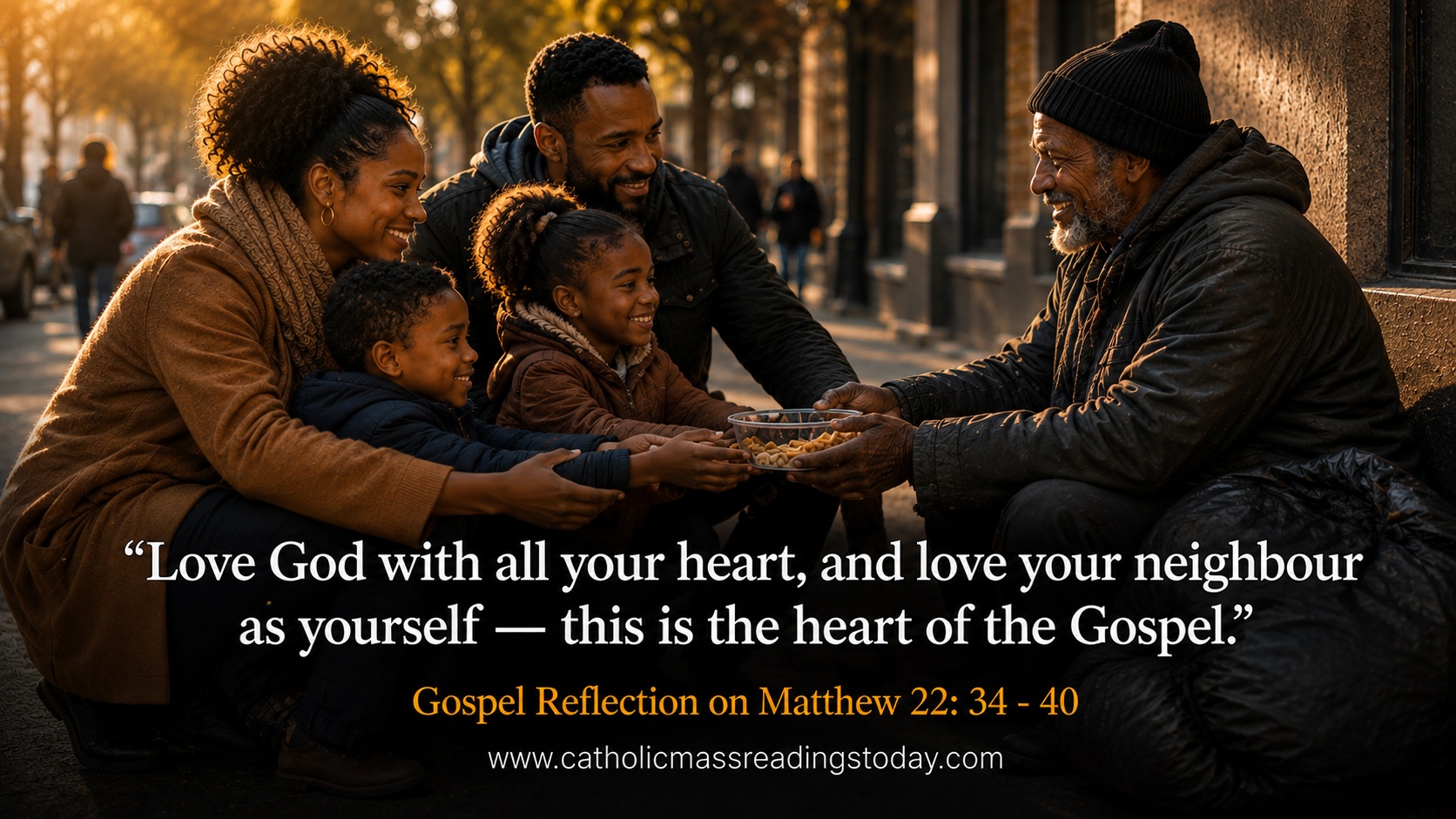
“You shall love the Lord your God, your neighbour as yourself.”
In today’s Gospel, a lawyer approaches Jesus with what appears to be a question about the Law: “Teacher, which is the great commandment in the law?” Yet Saint Matthew tells us that the question was intended to test Him.
Jesus does not become drawn into an argument. Instead, He takes His listeners directly to the heart of the covenant:
“You shall love the Lord your God with all your heart, and with all your soul, and with all your mind.”
Then He immediately adds:
“You shall love your neighbour as yourself.”
In these two commandments, Jesus gives us something far greater than a summary of religious rules. He reveals what the Christian life is meant to become: a life completely turned toward God and, because it belongs to God, opened in love toward every human person.
To Love God With the Whole of Our Life
Jesus does not ask us to give God one part of ourselves.
He says all your heart, all your soul and all your mind.
God cannot simply occupy a small corner of our lives reserved for Sunday Mass, morning prayers or moments of difficulty. If He is truly Lord, then our relationship with Him must reach into our homes, marriages, families, workplaces, friendships, decisions, ambitions and use of our possessions.
To love God with the whole heart is to desire Him above everything that competes for His place within us. It means choosing His will even when another path appears easier.
This does not mean that we will always experience strong religious feelings. Love is deeper than emotion. There will be days when prayer feels consoling and days when it feels difficult. There will be moments when God’s presence seems near and others when we walk largely by faith.
Yet we continue to love.
We go to Mass. We receive the Sacraments worthily. We pray. We listen to Sacred Scripture. We repent when we sin. We seek God’s will and begin again when we fail.
This persevering fidelity is itself an expression of love.
Love of God Cannot Be Separated From Love of Neighbour
Jesus could have stopped after giving the first commandment. He does not.
He joins love of neighbour so closely to love of God that the Christian cannot claim one while deliberately rejecting the other.
This is one of the great tests of authentic discipleship.
It is much easier to speak about loving humanity in general than to love the particular person God has placed before us.
Our neighbour may be the person sitting beside us at home. The colleague who irritates us. The elderly person who needs our patience. The poor person whose suffering interrupts our comfort. The stranger whose life is very different from ours. It may even be someone who has wounded us.
Christian love is therefore not merely affection for those who treat us well.
It begins with recognising something sacred in every human person: each has been created in the image and likeness of God.
For this reason, no human being becomes worthless because he is poor, sick, elderly, unborn, imprisoned, displaced, unpopular or unable to repay our kindness. Human dignity is received from God; society does not grant it and cannot take it away.
“As Yourself”
There is also wisdom in the final words of the commandment: “as yourself.”
Christ does not teach hatred or neglect of oneself. Proper Christian love recognises our own dignity as creatures loved and redeemed by God. We care for the life God has entrusted to us while refusing to make ourselves the centre of everything.
The difficulty comes when self-love becomes selfishness.
Our culture can easily teach us to measure life by what we possess, how others perceive us, how successful we become or how much comfort we can secure for ourselves. The Gospel asks a different question:
How much have we learned to love?
At the end of life, possessions will remain behind. Titles will disappear. Applause will grow silent. But the love with which we have responded to God and served one another belongs to eternity.
Love Must Become Something We Do
There is a danger in reducing the word love to sentiment.
The love Christ teaches has hands and feet.
It forgives when resentment would be easier. It feeds the hungry. It visits the lonely. It protects the vulnerable. It speaks truth without cruelty. It remains faithful when commitment becomes costly. It gives without constantly calculating what will be received in return.
Sometimes the greatest acts of Christian love will never be noticed by the world.
- A mother quietly caring for her family.
- A husband remaining faithfully beside his suffering wife.
- Someone giving food to a stranger.
- A person choosing forgiveness after carrying a wound for years.
- A Catholic stopping to pray for someone who has hurt him.
- A neighbour noticing another person’s loneliness and simply sitting down to listen.
These may appear ordinary, but when they are offered to God, they become places where the Gospel is lived.
The Cross Shows Us What These Commandments Mean
If we want to understand today’s Gospel completely, we must eventually look toward the Cross.
There we see perfect love of God and perfect love of neighbour meeting in one Person.
Christ gives Himself entirely to the Father, and at the same time He gives Himself entirely for us.
His arms are stretched outward. He holds nothing back.
This is why Christian love can never be reduced to comfortable words. Jesus loved us at a cost. And He calls His disciples into that same self-giving love—not necessarily through extraordinary acts, but through the countless sacrifices hidden inside ordinary Christian life.
We cannot accomplish this by willpower alone. We need grace and we need Christ.
We need the Holy Spirit to enlarge hearts that naturally become narrow, to soften hearts hardened by disappointment and to teach us to see others as God sees them.
“On These Two Commandments Depend All the Law and the Prophets”
Jesus concludes with an extraordinary declaration:
“On these two commandments depend all the law and the prophets.”
Everything returns to love.
But it must be love according to God, not a love that simply approves whatever we desire, but a love joined to truth, goodness, sacrifice and holiness.
Truth without love can become harsh. Love separated from truth can become empty sentiment. In Christ, truth and love belong together.
So perhaps today’s Gospel asks each of us two very simple questions:
Do I truly love God above everything else?
And:
Can people encounter something of God’s love through the way I treat them?
We may discover that there is still much within us that needs conversion. That should not discourage us. The Lord who commands us to love is also the Lord who gives us the grace to do it.
- Every morning offers another beginning.
- Another opportunity to forgive.
- Another person to serve.
- Another temptation to overcome.
- Another moment to choose God.
And through these seemingly small choices, the two great commandments gradually cease to be words we merely know and become the life we actually live.
Let us Pray
O God,
source of all love and goodness,
teach us to love You
with all our heart,
with all our soul,
and with all our mind.
Fill us with Your Holy Spirit,
that we may recognise Your image
in every person we meet.
Free our hearts from selfishness,
pride, resentment and indifference.
Give us patience with those who trouble us,
compassion for those who suffer,
generosity toward those in need,
and the grace to forgive
as we ourselves have been forgiven.
Lord Jesus Christ,
You loved us even unto the Cross;
teach us to love not only with our words,
but through the offering of our lives.
May everything we think, say and do
begin in Your love
and lead us ever closer to You.
Who live and reign
for ever and ever.
Amen.