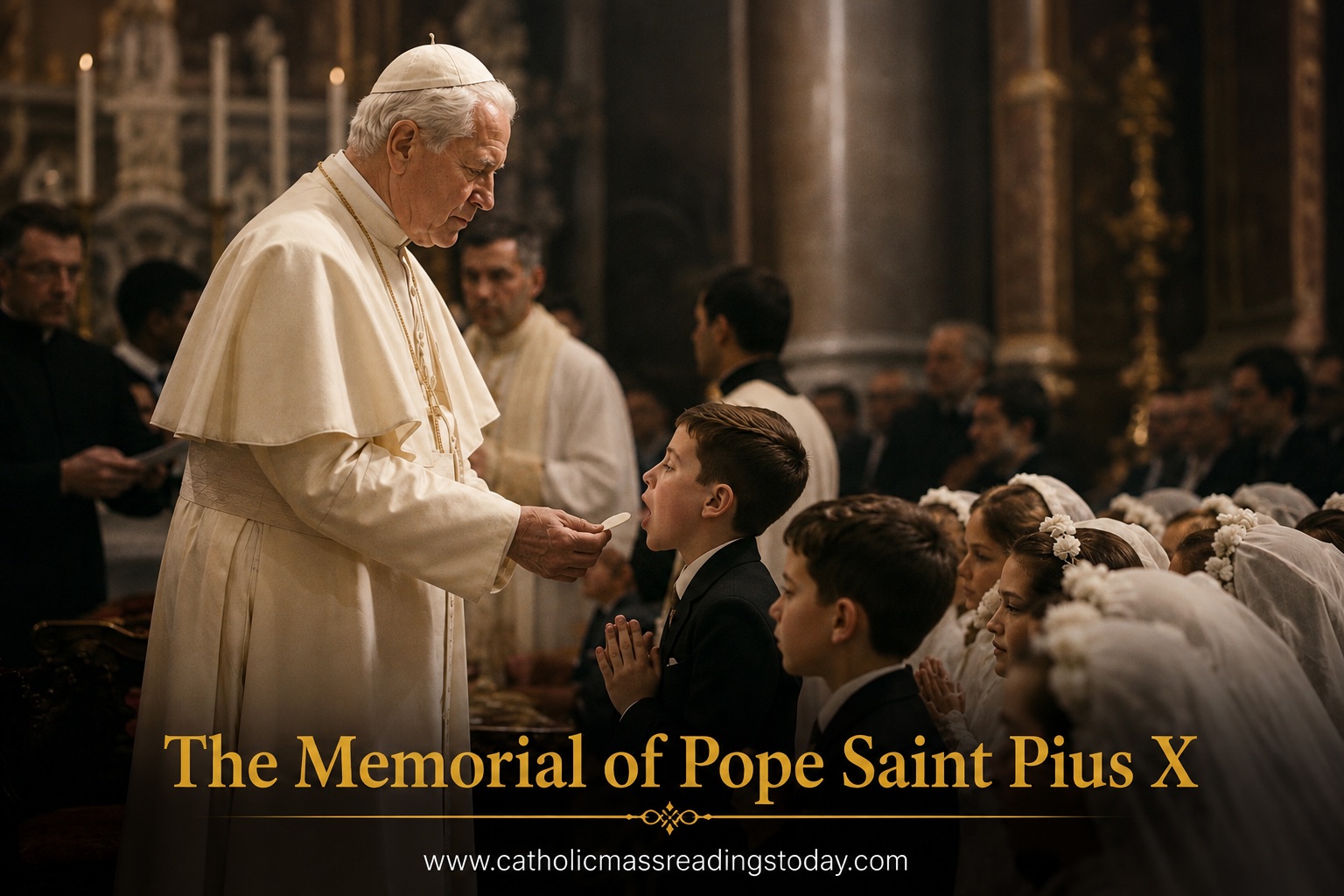
The Memorial of Pope Saint Pius X is celebrated by the Catholic Church on August 21, remembering a humble pastor who rose from an ordinary Italian family to the Chair of Saint Peter and devoted his pontificate to renewing Christian life, defending the Catholic faith and drawing the faithful more deeply into the Holy Eucharist.
Among the popes of the modern era, Saint Pius X occupies a particularly beloved place in Catholic memory. He was not born into wealth, nobility or political influence. He came from a modest family in a small village and spent much of his priesthood close to ordinary people. Yet Providence eventually entrusted to him the pastoral care of the universal Church.
His story is therefore not simply the history of a pope. It is the story of a parish priest at heart who became the 257th Pope of the Catholic Church, carrying into the Vatican a deep concern that Catholics should know their faith, participate reverently in the Sacred Liturgy and, above all, remain close to Jesus Christ in the Eucharist. The Vatican records his pontificate as beginning in August 1903 and ending with his death on August 20, 1914.
Today, as the Church celebrates The Memorial of Pope Saint Pius X, his life offers a powerful reminder that holiness does not depend upon status or privilege. It begins with fidelity to God in the circumstances in which He has placed us.
The Humble Beginnings of Giuseppe Melchiorre Sarto
Before the world knew him as Pope Pius X, he was Giuseppe Melchiorre Sarto.
Giuseppe was born on June 2, 1835, in Riese, in the Diocese of Treviso in northern Italy. Vatican records confirm Riese as his birthplace, and Vatican historical material records that he was ordained a priest in 1858.
His beginnings were far removed from the splendour that people might associate with the papacy.
The Sarto family lived modestly, and young Giuseppe grew up in surroundings where hard work, family life and Catholic faith were woven together. His background remained important throughout his life. Even after receiving increasingly important responsibilities within the Church, he retained the simplicity and pastoral instincts formed during those early years.
His vocation to the priesthood became apparent while he was still young. Education required sacrifice, but Giuseppe persevered, eventually entering seminary and preparing himself for Holy Orders.
In 1858, at the age of twenty-three, Giuseppe Sarto was ordained a priest. The young priest could not have known where his vocation would eventually lead him. There was no obvious path from the small village of Riese to the papal apartments in Rome. There was simply the next duty God had placed before him, and he embraced it.
A Priest Close to His People
The years of Giuseppe Sarto’s priesthood are essential to understanding the pope he would later become. He was not formed primarily as a distant administrator. His early ministry placed him among ordinary Catholics and their everyday struggles. He preached, taught the faith, celebrated the Sacraments and cared for the spiritual needs of the communities entrusted to him.
That pastoral experience never left him. As his responsibilities increased, Sarto became known not merely for intelligence or administrative ability, but for seriousness about the salvation of souls. He understood that the Church’s teaching had to reach ordinary people. Faith could not remain something discussed only by theologians or contained within books. Parents needed to understand it. Children needed to learn it. Parishioners needed to live it.
This concern for teaching the faith would later become one of the defining characteristics of his pontificate. His priestly ministry gradually led to greater responsibilities within the Church, but advancement did not change the fundamental direction of his life. He remained a pastor.
Bishop of Mantua
In 1884, Giuseppe Sarto was appointed Bishop of Mantua.
The appointment placed him in a much larger field of pastoral responsibility. Now he was responsible not simply for a parish but for shepherding a diocese, its priests, religious and lay faithful.
The qualities that had marked his priesthood followed him into the episcopate. He placed great importance on the formation of clergy, faithful Catholic teaching and the spiritual renewal of the people.
For Sarto, reform could never mean merely changing structures. Genuine Catholic renewal had to begin with conversion, holiness and a return to Christ. That conviction would eventually become central to his vision for the whole Church.
Patriarch of Venice and Cardinal
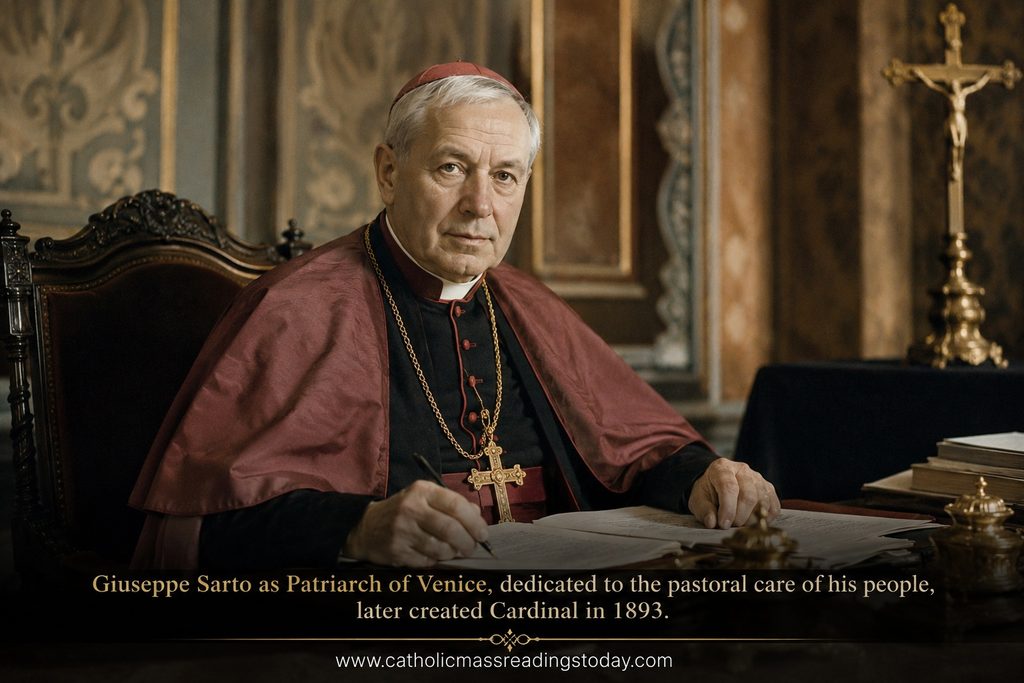
His pastoral abilities did not go unnoticed. In 1893, Giuseppe Sarto was transferred to the Patriarchal See of Venice and was created a cardinal.
The son of a modest family from Riese was now Cardinal Patriarch of one of Italy’s most distinguished Catholic sees, yet his approach remained recognisably pastoral.
He wanted Catholic teaching to shape people’s actual lives. He cared about priests fulfilling their vocation faithfully, about the reverent celebration of worship and about the spiritual condition of ordinary Catholics. Ten years later, everything changed.
The Conclave of 1903
Pope Leo XIII died on July 20, 1903, after a long and influential pontificate. The cardinals gathered in Rome to elect his successor. Giuseppe Cardinal Sarto entered the conclave as Patriarch of Venice.
On August 4, 1903, he was elected pope. Vatican records identify him as the 257th Pope of the Catholic Church. He took the name Pius X.
The responsibility was immense. He was succeeding Leo XIII at a time when Europe and the wider world were experiencing enormous intellectual, political and social changes.
The new pope’s answer was not to retreat from the world, nor simply to accommodate Christianity to every new fashion of thought.
He wanted renewal in Christ. His pontificate would become associated with the motto drawn from Saint Paul:
“To restore all things in Christ.”
Those words capture much of what Pope Pius X attempted to accomplish. He wanted Christ to return to the centre of Christian life.
A Pope of the Holy Eucharist
If there is one aspect of Saint Pius X’s pontificate that continues to touch Catholic families throughout the world, it is his extraordinary concern for the Eucharistic life of the faithful.
At the beginning of the twentieth century, frequent reception of Holy Communion was not the ordinary practice for many Catholics.
Pius X encouraged a recovery of frequent Communion when the faithful were properly disposed. In his own teaching he stressed the ancient Christian practice and encouraged pastors and preachers to urge the faithful toward frequent reception of the Eucharist while preserving proper reverence for the Sacrament.
This was not simply a disciplinary matter. It reflected something fundamental about his understanding of Catholic life.
The Eucharist is not a prize reserved for a spiritual elite. It is Christ Himself given as heavenly nourishment to His people.
The Church continues to teach that the Eucharist is the “heart and summit of the Church’s life,” and she strongly encourages Catholics who are properly disposed to receive Holy Communion frequently. Saint Pius X helped restore this Eucharistic emphasis powerfully to everyday Catholic life.
Pope Saint Pius X and First Holy Communion for Children
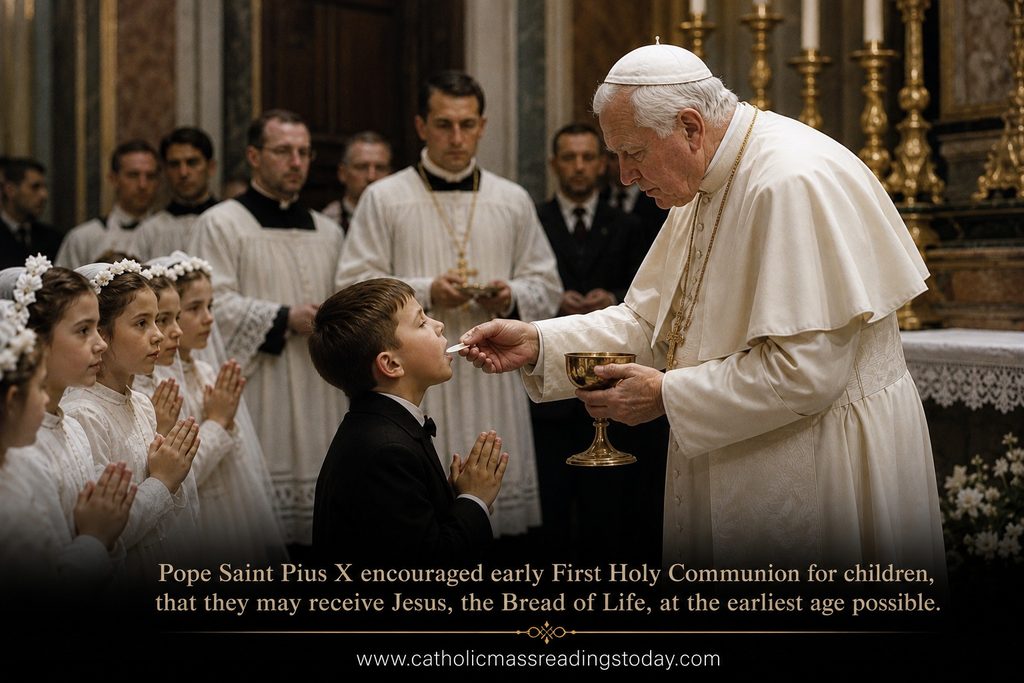
His Eucharistic reforms had a particularly profound effect upon children.
Pius X supported admitting children to Holy Communion once they had reached the use of reason and possessed an understanding appropriate to their age, rather than unnecessarily postponing their First Communion.
The consequences were enormous. Generations of Catholic children throughout the world would approach the altar earlier in life and encounter Jesus in the Blessed Sacrament during their formative years.
Even today, the Church’s canon law states that children who have reached the use of reason should be properly prepared and, after sacramental confession, receive the Eucharist as soon as possible.
For countless Catholic families, this is among the most enduring aspects of Saint Pius X’s legacy.
A child dressed for First Holy Communion today belongs to a living Eucharistic tradition whose modern development was profoundly influenced by this pope.
Teaching Catholics to Know Their Faith
Pius X understood that devotion without formation could easily become shallow. Catholics needed to know what the Church taught and why.
Catechesis therefore became another major concern of his pontificate. He wanted Christian doctrine taught clearly and systematically, particularly to ordinary believers and children.
His concern was intensely pastoral. If Catholics did not understand their faith, how could they defend it? More importantly, how could they live it faithfully?
The Vatican archives preserve his 1912 correspondence concerning approval of a Catechism of Christian Doctrine, evidence of the importance he attached to systematic instruction in the faith.
For Saint Pius X, catechesis was not merely memorising religious information. The truths of the faith were meant to lead people toward Christ and shape the way they lived.
That concern remains remarkably relevant today. In an age when Catholics encounter an enormous mixture of religious claims, social opinions and online information, his insistence that Catholics genuinely know their faith has lost none of its importance.
Renewing the Sacred Liturgy
Pius X also devoted considerable attention to Catholic worship. He sought a renewal of sacred music and liturgical life so that worship would truly serve the glory of God and the sanctification of His people.
He is especially associated with the restoration and promotion of Gregorian chant and with efforts to ensure that sacred music remained genuinely suited to the liturgy. Again, the principle underlying his work was consistent: restore all things in Christ.
The beauty of Catholic worship was not intended as performance. Sacred music, ritual and prayer existed to lead souls toward God. For Pius X, renewal of the Church could never be separated from renewal of her prayer.
Reforming the Administration of the Church
Pius X was deeply pastoral, but this did not prevent him from undertaking substantial administrative reform. His pontificate addressed the organisation of the Roman Curia and began important work toward a systematic codification of the Church’s canon law.
Before the twentieth century, ecclesiastical laws had accumulated across many centuries in numerous collections and sources. Bringing them into a more organised code was an enormous undertaking.
The first complete Code of Canon Law would eventually be promulgated in 1917, after Pius X’s death, during the pontificate of Benedict XV. Nevertheless, the project had been launched under Pius X and formed an important part of his efforts to strengthen the Church’s governance.
Here again we see a characteristic feature of his pontificate. Pius X could be deeply concerned about a child’s First Holy Communion while also addressing the structures governing the universal Church.
For him, both ultimately concerned the same mission: helping the Church lead souls to Christ.
Defending the Catholic Faith
The pontificate of Pius X also unfolded during intense intellectual debate within Catholicism and European society.
One of the major controversies of his reign concerned what came to be called Modernism—a complex collection of approaches that, in his judgment, threatened to undermine essential Catholic teaching concerning revelation, dogma, Scripture and the nature of faith.
Pius X responded forcefully. His pontificate produced major interventions intended to safeguard Catholic doctrine and protect the faithful from theological ideas he believed would dissolve revealed truth into something determined primarily by changing human experience.
His measures remain among the most debated aspects of his pontificate historically, but they cannot be understood properly apart from his conviction that a pope’s responsibility includes guarding the deposit of faith entrusted to the Church.
His opposition to Modernism was therefore not, in his own understanding, resistance to learning or serious scholarship. It arose from his determination that authentic development must remain faithful to the truth received from Christ and handed down through the Church.
A Pope Who Never Forgot the Poor
The white cassock and the grandeur of the Vatican did not erase Giuseppe Sarto’s memory of where he had come from. The simplicity associated with his personal life became one of the qualities for which Catholics remembered him.
He had known modest circumstances. He had spent years among ordinary parishioners. He understood that shepherding the Church was not principally about honour.
It was service. This helps explain why Catholics responded so warmly to him. They saw in Pius X not simply an ecclesiastical ruler, but a spiritual father. His sanctity was found not in separating himself from ordinary people but in giving himself to them.
When Pope Pius XII later reflected on Pius X at the time of his canonization, he presented him precisely in terms of Christ’s command to Peter to feed His flock: a shepherd who loved Christ by feeding Christ’s people with truth, the Eucharist, charity and pastoral care.
The Shadow of War
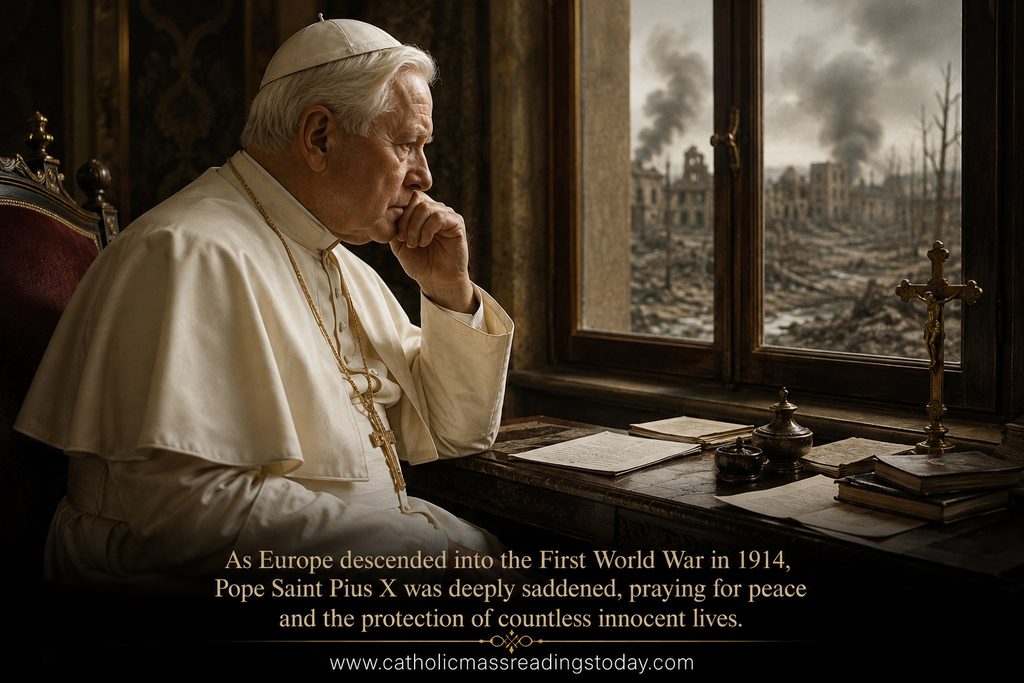
The closing days of Pius X’s life were darkened by events far beyond the walls of the Vatican.
Europe had been moving toward catastrophe. Then, in the summer of 1914, the crisis erupted into the First World War. For a pope whose vocation had been devoted to bringing people to Christ, the sight of Christian nations moving toward mass bloodshed was profoundly painful.
Europe was entering a conflict that would consume millions of lives and transform the political landscape of the continent. Pius X was already in declining health as the crisis intensified.
The burden of the moment weighed heavily upon him, although popular accounts sometimes exaggerate this into the claim that he simply “died of a broken heart.” Historically, it is better to say that he became gravely ill during the opening weeks of the war and died as Europe descended into conflict.
The Death of Pope Saint Pius X
Pope Pius X died in Rome on August 20, 1914. The Vatican records that date as the end of his pontificate. He was seventy nine years old. Eleven years had passed since the reluctant Patriarch of Venice had been chosen to occupy the Chair of Peter.
During those years he had encouraged frequent Holy Communion, promoted earlier First Communion for children, strengthened catechesis, renewed sacred music and liturgical life, defended Catholic doctrine, reformed Church administration and initiated the great work of codifying canon law.
But perhaps his greatest achievement cannot be measured by documents or reforms. He had reminded Catholics that Jesus Christ must remain at the centre of the Church’s life.
The poor boy from Riese had become pope, remained a pastor and the pastor had become a saint.
From Pope Pius X to Saint Pius X
The reputation for holiness surrounding Pius X continued after his death. The Church eventually undertook the careful process of examining his life and cause for sainthood.
Pius X was beatified by Pope Pius XII and then, on May 29, 1954, canonized as a saint. Vatican historical material confirms both his canonization and the date. Only forty years had passed since his death.
The Church was now formally presenting this former village boy, parish priest, bishop, patriarch and pope as an example of Christian holiness for Catholics throughout the world.
His memorial is celebrated on August 21, the day following the anniversary of his death.
Why The Memorial of Pope Saint Pius X Still Matters Today
More than a century after his death, The Memorial of Pope Saint Pius X is not merely an occasion to remember an important figure from Catholic history.
- His life speaks directly to the Church today.
- He reminds priests that pastoral ministry must remain centred upon Christ and the salvation of souls.
- He reminds parents that children are capable of a profound relationship with Jesus and should be formed carefully in the Catholic faith.
- He reminds catechists that teaching doctrine is an act of love.
- He reminds musicians and those involved in the liturgy that sacred worship exists first for the glory of God.
- He reminds theologians that genuine intellectual inquiry and fidelity to revealed truth must belong together.
- He reminds Church leaders that authority is ultimately service.
- And he reminds every Catholic that the Eucharist must never become merely one devotion among many.
Christ is at the centre. This may be the most important lesson Saint Pius X leaves us.
A Church can possess institutions, buildings, schools, programmes and impressive structures. But without Christ at the centre, something essential has been lost.
Pius X spent his pontificate calling the Church back to that centre.
The Eucharistic Legacy of Saint Pius X
Perhaps nowhere is his legacy more visible than at the altar rail and in the Communion procession.
Whenever Catholics approach the Eucharist reverently and properly disposed, we can recognise something of the renewal Pius X worked to encourage.
When a young child receives Jesus in First Holy Communion, his legacy is present.
Whenever a Catholic understands that frequent Communion should lead not to casual familiarity but to deeper holiness, gratitude and conversion, the pastoral vision of Pius X remains alive.
He wanted Catholics close to Jesus, not simply intellectually aware of Him or merely culturally associated with Him but close to Him. Especially in the Blessed Sacrament.
That is why Saint Pius X is remembered with such affection by Catholics devoted to the Holy Eucharist.
What Saint Pius X Teaches Us About Holiness
There is something deeply encouraging about the journey from Giuseppe Sarto of Riese to Pope Saint Pius X. His life tells us that God does extraordinary things through ordinary faithfulness.
Giuseppe did not begin his vocation knowing that he would become pope. He simply responded to the grace given to him.
First as a seminarian, then as a priest, then as a pastor, then as a bishop, then as Patriarch of Venice and finally, as the successor of Saint Peter.
At every stage, the responsibility became greater, but the vocation remained fundamentally the same:
Love Christ. Serve His people. Guard the faith. Lead souls toward heaven.
This is why the Memorial of Pope Saint Pius X belongs not only to historians or clergy.
His example belongs to every Catholic. Most Christians will never hold positions of great authority. Most will live their discipleship in homes, workplaces, schools, parishes and communities largely unnoticed by the world.
But holiness has never depended upon being noticed. It depends upon being faithful.
A Saint for the Church of Today
Our own age is very different from the world of 1903.
Technology has transformed communication. Society has changed dramatically. Catholics now face moral, cultural and intellectual questions that Pius X could never have encountered in their present forms.
Yet the deepest human questions have not changed.
- Who is God?
- What is truth?
- Why are we here?
- What does Christ ask of us?
- How do we pass the faith to our children?
- How do we remain faithful when the surrounding culture moves in another direction?
- And where does the weary human soul find the strength to continue?
Saint Pius X would point us toward Christ. He would point us toward the Gospel.
He would point us toward sound Catholic teaching and, with particular tenderness, he would point us toward the tabernacle.
There is Christ. There is the Bread of Life. There is the One around whom everything in the Church must ultimately be restored.
Prayer for The Memorial of Pope Saint Pius X
O God,
who raised up Pope Saint Pius X
to serve Your Church
with pastoral charity and apostolic courage,
grant that, through his intercession,
we may remain steadfast in the Catholic faith
and grow each day in love for Your Son.
Increase within us a profound reverence
for the Most Holy Eucharist.
Teach us to approach Your altar
with humble and contrite hearts,
and may the Bread of Life strengthen us
to live faithfully according to the Gospel.
Bless our Holy Father,
our bishops, priests and deacons.
Strengthen parents in handing on the faith,
guide those who teach the young,
and draw children ever closer
to the Sacred Heart of Jesus.
Through the intercession of Pope Saint Pius X,
keep Your Church faithful to the truth,
united in charity
and centred always upon Christ.
Through our Lord Jesus Christ, Your Son,
who lives and reigns with You
in the unity of the Holy Spirit,
God, for ever and ever.
Amen.
Pope Saint Pius X, pray for us.