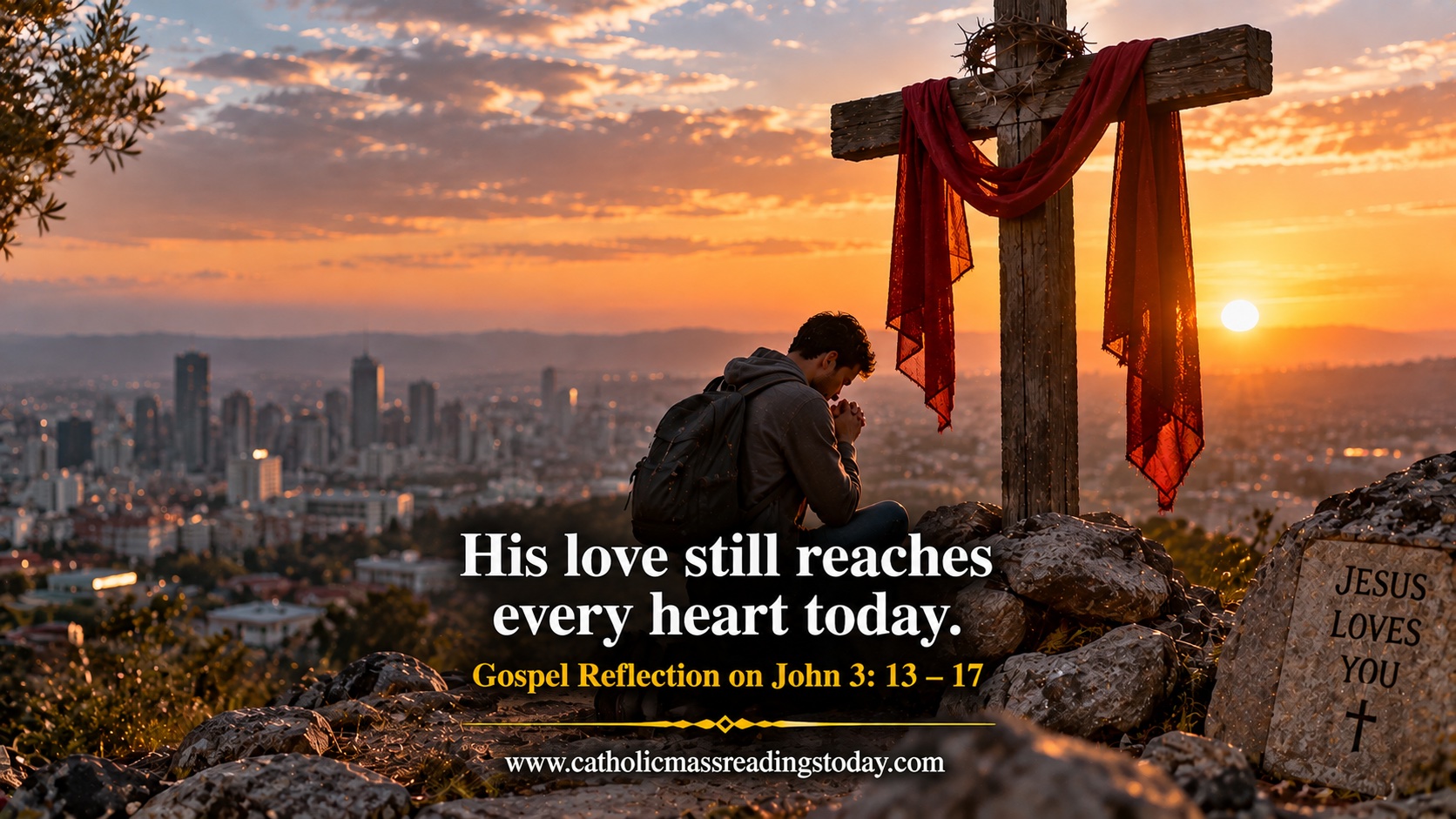
“The Son of Man Must Be Lifted Up”
The Cross Reveals the Heart of God
There are few words in the Gospel more familiar than these: “For God so loved the world that he gave his only-begotten Son.” We may have heard them many times, yet we should never allow their familiarity to lessen their power. At the heart of Christianity is not simply a teaching, a moral code or a religious tradition. At the heart of our faith is an act of love: God gives His Son for us.
Jesus speaks these words to Nicodemus while pointing toward the mystery of the Cross. He tells him that “the Son of man must be lifted up.” What will appear to human eyes as humiliation, suffering and defeat will become the place where the love of God is revealed most completely.
The Cross therefore changes the way we understand God. We do not believe in a God who watches human suffering from a safe distance. In Jesus Christ, God enters our wounded world. He accepts rejection, betrayal, suffering and death. He carries upon Himself the burden of sin so that humanity might be reconciled to the Father.
Look Upon Him and Live
Jesus reminds Nicodemus of what happened to Israel in the wilderness. When the people were afflicted by serpents, Moses lifted up the bronze serpent, and those who looked upon it in obedience and faith were spared. Jesus now reveals that this event pointed toward something greater. The Son of Man Himself will be lifted up, and whoever believes in Him will receive eternal life.
This does not mean that merely looking at a crucifix saves us as though the Cross were a magical object. Christ calls us to faith: to entrust ourselves to Him, to receive the salvation He offers and to allow His grace to change our lives.
This is why the crucifix holds such an important place in Catholic life. We place it in our churches, our homes and sometimes close to our beds. We make the Sign of the Cross over ourselves. We begin and end our prayers in the name of the Father, and of the Son, and of the Holy Spirit. The Cross continually reminds us of the price of our redemption and of the immeasurable love with which we have been loved.
When we look upon Christ crucified, we should hear within our hearts: This is how much God loves you.
“For God So Loved the World”
Notice carefully what Jesus says. God loved the world.
He loved a world wounded by sin. He loved humanity even when humanity turned away from Him. He loved those who would receive His Son and those who would reject Him. The initiative belongs to God. Salvation begins with His love.
This is important because sometimes we imagine that we must first become worthy before approaching God. We may carry shame from our past, wounds that nobody else knows about, or sins that make us afraid to return to Him. Yet the Gospel tells us something very different. Christ came precisely because humanity needed saving.
God does not wait at the end of our conversion and then begin to love us. His love is already there, calling us to conversion.
This does not make sin unimportant. The Cross shows us how serious sin truly is. But at the same time, it shows us something greater: the mercy of God is greater than our sin.
For the Catholic Christian, this becomes especially tangible in the Sacrament of Reconciliation. We come before the Lord carrying what we have done, without excuses and without pretending. We confess our sins, receive absolution and discover again that Christ did not come to abandon the sinner but to restore him to communion with God.
Not to Condemn, but to Save
Perhaps one of the most beautiful lines in today’s Gospel is also one we sometimes overlook: “For God sent the Son into the world, not to condemn the world, but that the world might be saved through him.”
Jesus certainly calls sin by its name. He calls us to repentance. He asks us to leave behind whatever separates us from God. But His purpose is salvation.
This distinction matters greatly in the way Christians live among others. If Christ came seeking the salvation of sinners, then His disciples cannot become people who take pleasure in condemning them. We are called to speak truth, but always with charity. We are called to defend what is good, but never to forget the dignity of the person standing before us.
The Church’s mission is not to point at a wounded world from a distance. She must bring that wounded world to Christ.
And this begins very close to home. It begins in the way we speak to the person who has disappointed us, the patience we show within our families, the mercy we extend to someone who has failed, and the willingness to forgive when pride tells us to hold onto resentment.
A Christian who has stood beneath the Cross should never forget how much mercy he himself has received.
When Our Own Cross Becomes Heavy
There is another reason today’s Gospel speaks so powerfully to us. Every human life eventually encounters a cross.
There are crosses we would never choose: illness, grief, disappointment, financial hardship, loneliness, broken relationships, uncertainty about the future. Faith does not require us to pretend that these things do not hurt. Jesus Himself did not pretend that Calvary was painless.
But the Cross of Christ tells us that suffering does not have to be meaningless.
When our suffering is united with Christ, even the darkest moments of life can become places of grace. We may not immediately understand what God is doing. We may pray and still have questions. Yet we can remain beneath the Cross knowing that the One who suffered for us has not abandoned us in our suffering.
The Christian does not look at the Cross and say that suffering is good. We look at the Cross and proclaim something far more hopeful: God is able to bring redemption even out of suffering.
Calvary was not the end of the story.
The Resurrection followed.
Let the Cross Change the Way We Love
If the Cross reveals how God loves us, then it must also shape the way we love one another.
Christ’s love is not merely sentimental. It gives itself. It forgives. It serves. It remains faithful when love becomes costly.
We cannot kneel before the crucified Lord on Sunday and then deliberately refuse mercy to others throughout the week. The Eucharist we receive draws us into the self-giving love of Christ. Having received His Body and Blood, we are sent back into the world to become witnesses of that love.
Our homes should experience it. Our workplaces should experience it. The lonely, forgotten and wounded should experience it. Even those with whom we disagree should encounter in us something of the patience and dignity with which Christ treats every human person.
The Cross must not remain only upon the wall. It must gradually become visible in the way we live.
God Loved the World Enough to Give Himself
Today’s Gospel ultimately asks us to look again at Jesus.
Not casually. Not simply because we have seen the crucifix thousands of times.
Look at Him again.
The outstretched arms of Christ reveal a love that refuses to abandon humanity. The Cross tells every sinner that forgiveness is possible, every suffering person that God has entered human pain, and every frightened heart that death itself does not have the final word.
“For God so loved the world that he gave his only-begotten Son.”
Perhaps today we need to hear those words personally. God so loved the world—and that world includes you. Christ was lifted up not for an anonymous humanity, but for real people, with real wounds, real sins and real hopes.
May we therefore look upon the Cross with faith, receive the mercy that flows from Christ, and allow that mercy to transform the way we live. For the Cross that once appeared to be the place of defeat has become for us the sign of hope, the instrument of redemption and the unmistakable proclamation that God has not given up on His world.
Let us Pray
Lord Jesus Christ, Son of the living God, You were lifted upon the Cross for the salvation of the world. We adore You and we thank You for the love that led You to give Your life for us.
Strengthen our faith when we are afraid, console us when our crosses become heavy, and draw us back to Your mercy whenever we fall into sin. Keep us close to Your Sacred Heart, that we may never doubt the love revealed for us on Calvary.
Teach us to forgive as You forgive, to serve as You served, and to love with the generous love with which You first loved us. May the mystery of Your holy Cross transform our hearts and lead us, through Your Passion and Resurrection, to the joy of everlasting life.
You who live and reign with God the Father, in the unity of the Holy Spirit, God, for ever and ever.
Amen.