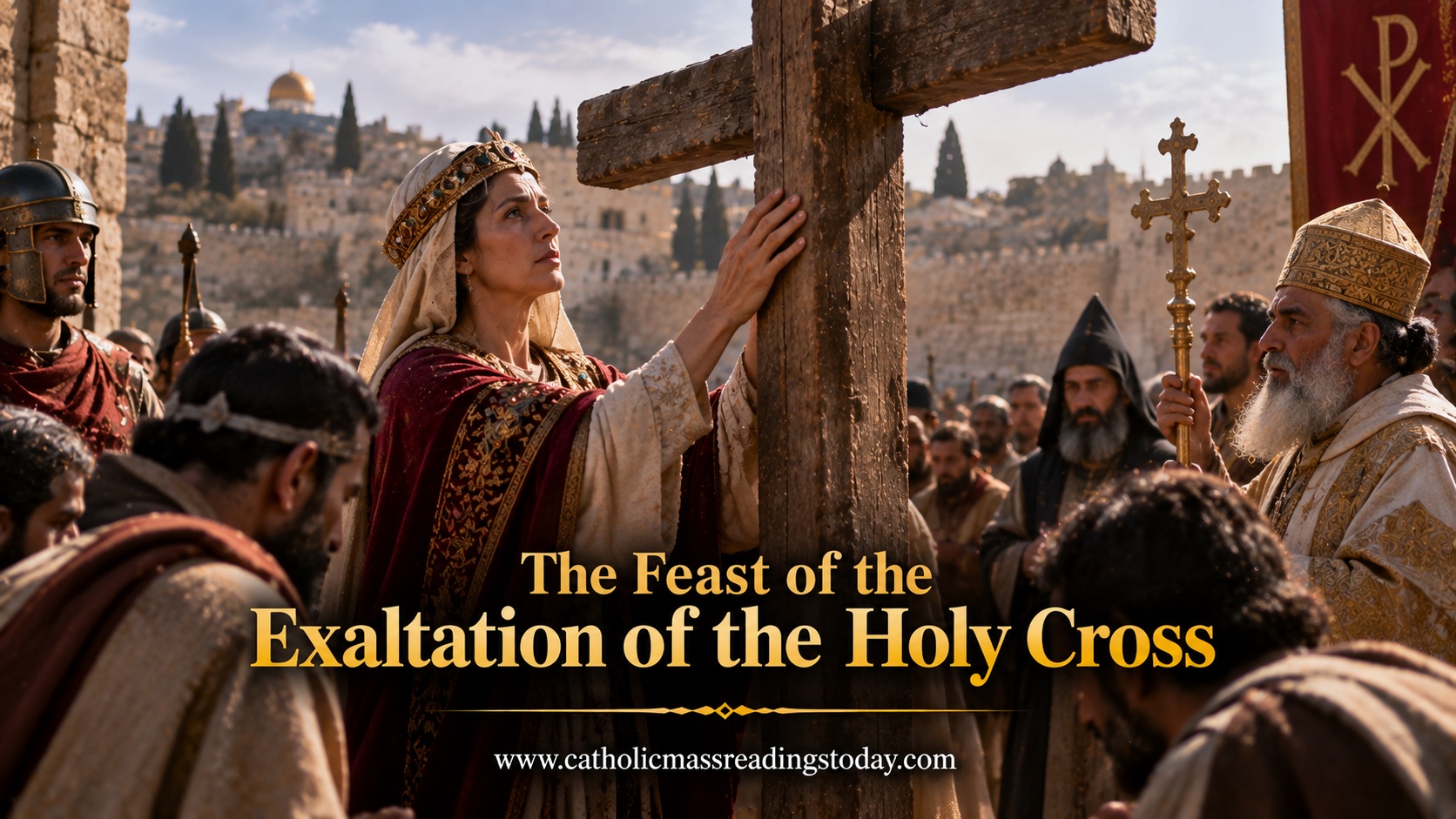
Every year on September 14, the Catholic Church celebrates THE FEAST OF THE EXALTATION OF THE HOLY CROSS, one of the most ancient and profound celebrations centered on the mystery of Christ’s saving death. It is sometimes called the Triumph of the Cross or Holy Cross Day.
At first, the name can sound almost contradictory. Crucifixion was designed by the Roman world to humiliate, torture and destroy. Why, then, would Christians exalt the Cross?
The answer lies at the very heart of Christianity. The Church does not glorify cruelty, suffering or death for their own sake. She exalts the Cross because Jesus Christ transformed an instrument of execution into the instrument of our redemption. What appeared on Calvary to be the defeat of Christ became the place where His perfect obedience and immeasurable love were revealed. It is not the cruelty of the Cross that is exalted, but the love God manifested by accepting death upon it.
The Cross therefore stands before the Christian world not merely as the memory of something terrible that happened nearly two thousand years ago, but as the great sign that God loved humanity enough to give Himself for our salvation.
The Cross Before Christianity
To appreciate The Feast of the Exaltation of the Holy Cross, we must remember what the cross meant before Christ.
Under Roman rule, crucifixion was associated with disgrace and public humiliation. It was meant not only to kill a condemned person but also to make his death a warning to others. There was nothing outwardly glorious about Calvary.
Yet this is precisely where the Christian mystery becomes so striking.
God did not choose a throne of earthly power from which to reveal the fullness of His saving love. The Son of God allowed Himself to be stripped, mocked, rejected and nailed to a Cross. Jesus entered the deepest places of human suffering and death and transformed them from within.
This is why Saint Paul could proclaim that Christ “humbled himself and became obedient unto death, even death on a cross” and that God therefore highly exalted Him.
The Cross is exalted because the One upon it is Christ.
“For God So Loved the World”
The Gospel proclaimed for this feast takes us to Christ’s conversation with Nicodemus in John 3:13–17.
Jesus makes an extraordinary connection between His coming Crucifixion and an event from Israel’s journey through the wilderness. When the Israelites were afflicted by serpents, Moses was commanded to raise up a bronze serpent. Those who looked upon it in faith lived.
Jesus tells Nicodemus:
“And as Moses lifted up the serpent in the wilderness, so must the Son of man be lifted up, that whoever believes in him may have eternal life.”
Then come words that have carried hope into countless hearts across the centuries:
“For God so loved the world that he gave his only-begotten Son.”
This is the key to understanding the feast.
At Calvary we see suffering, but behind that suffering we discover love. We see death, but through that death comes life. We see apparent defeat, yet the Resurrection reveals victory.
The Cross cannot be separated from the Resurrection. Christians do not worship a defeated Christ. The One who was crucified is risen.
The Historical Origins of the Feast
The history of The Feast of the Exaltation of the Holy Cross, takes us back to fourth century Jerusalem, during the reign of the Roman Emperor Constantine.
After centuries in which Christians had periodically suffered persecution, the circumstances of the Church changed dramatically under Constantine. Jerusalem’s holy places associated with the Passion, death and Resurrection of Jesus became the focus of major Christian building projects.
Christian tradition closely associates these events with Saint Helena, Constantine’s mother, who travelled to the Holy Land and became associated with the discovery of the True Cross. Accounts of the precise date differ in later traditions, so it is wise to distinguish the central historical tradition from every later legendary detail. What is clear is that fourth-century Jerusalem developed a solemn veneration of a relic believed to be the Cross of Christ.
This devotion became intimately connected with the great Christian sanctuary built at the places associated with Calvary and Christ’s tomb.
Saint Helena and the Search for the True Cross
Saint Helena occupies an important place in Christian memory.
According to the ancient tradition received by the Church, Helena journeyed to Jerusalem and sponsored efforts connected with identifying and honoring the places of Christ’s Passion. The tradition holds that the Cross of Christ was discovered during excavations associated with Calvary.
The story would become deeply embedded in Christian devotion, art and pilgrimage.
Yet the significance of Helena’s pilgrimage extends beyond archaeology. It reflects something characteristic of Christianity itself: our faith is rooted in real history.
Jesus Christ was not a mythical figure inhabiting an imaginary world. He entered human history. He lived in a particular land, walked real roads, suffered under Pontius Pilate, was crucified and was buried.
Christians therefore treasured the places associated with His earthly life.
The Church of the Holy Sepulchre
Emperor Constantine ordered a magnificent Christian complex to be constructed in Jerusalem at the places associated with Calvary and the tomb of Christ.
The great sanctuary traditionally known today as the Church of the Holy Sepulchre, or Church of the Resurrection, became one of Christianity’s holiest pilgrimage destinations.
The dedication ceremonies took place in September 335. Vatican News records the dedication on September 13, with solemn veneration of the Cross taking place the following day, September 14. Early Jerusalem tradition thus connected the anniversary of the church’s dedication with the public elevation and veneration of the Cross.
This helps explain the word “Exaltation.”
The Cross was literally raised up, presented before the faithful for their veneration.
Generation after generation would continue to raise the Cross before the Christian people, not because Christians worship wood, but because the Cross points unmistakably toward the One who died upon it.
September 14 and the Raising of the Cross
The feast developed first in Jerusalem.
An important witness to early Christian worship in Jerusalem is the pilgrim Egeria, whose account provides valuable evidence about the elaborate liturgical celebrations surrounding the holy places in the late fourth century. The Jerusalem celebration surrounding the dedication and veneration of the Cross became an important part of the city’s liturgical life.
Eventually the feast spread beyond Jerusalem into other parts of the Christian world.
By the end of the seventh century, the September feast was established in Rome as well, although its development in East and West followed somewhat different historical paths.
What began around the holy places of Jerusalem gradually became a celebration for the universal Church.
The Persian Conquest and the Loss of the Cross
Several centuries after Constantine and Helena, another dramatic chapter became associated with the feast.
In 614, the Persian forces of King Khosrow II, also known in older Christian sources as Chosroes II, captured Jerusalem. During the conquest, the revered relic of the True Cross was carried away.
For Christians, the loss was devastating.
The relic associated with the Crucifixion had stood at the center of Jerusalem’s Christian memory and worship. Now it had become part of the spoils of war.
But the story did not end there.
Emperor Heraclius and the Return of the Cross
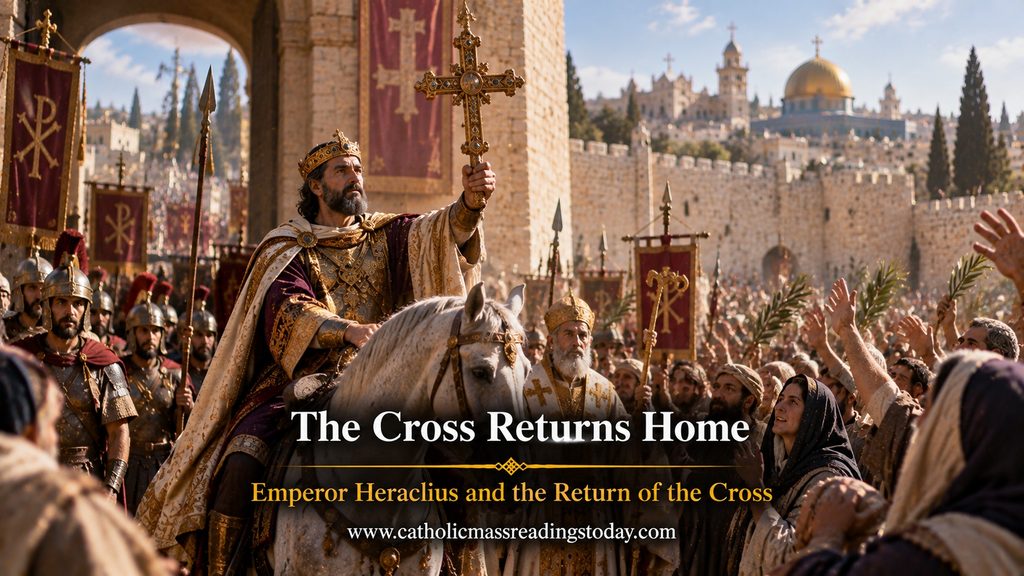
The Byzantine Emperor Heraclius eventually defeated the Persians, and the relic of the Cross was recovered and restored. The traditional Christian account associates its solemn restoration to Jerusalem with 629, though modern historical scholarship discusses some details and chronology surrounding the event. Vatican sources preserve the traditional connection between Heraclius, the recovery of the Cross and its return to Jerusalem.
Over time, this restoration became intertwined with the September celebration.
The feast therefore carried several layers of Christian memory: the discovery of the Cross associated with Saint Helena, the dedication of the Jerusalem sanctuary, the solemn elevation of the Cross before the faithful, and later the recovery of the relic after its capture by the Persians.
Yet all these historical events ultimately point beyond themselves.
The Church’s real concern is not simply where the wood of the Cross travelled, but what happened upon the Cross itself.
What Catholics Mean When We Venerate the Cross
Catholic teaching makes an important distinction here.
We do not worship a piece of wood as though it were God.
Adoration belongs to God alone.
When Catholics venerate the Cross, the honor passes beyond the material object to Jesus Christ, whose saving sacrifice the Cross represents. The Church has long distinguished between the worship owed to God and the legitimate veneration given to sacred images and signs that direct our hearts toward Him.
The Cross is precious because of Christ.
Without Jesus, it would remain an instrument of Roman execution.
Because of Jesus, it has become the universal Christian sign of redemption.
From an Instrument of Death to the Sign of Life
This transformation is one of the most astonishing reversals in history.
Imagine telling someone living under the Roman Empire that one day crosses would stand above churches throughout the world. That Christians would wear crosses around their necks. That families would place crucifixes in their homes. That the dying would hold them. That missionaries would carry them across continents. That believers would trace the Cross upon themselves before prayer.
It would have sounded unimaginable, and yet this is precisely what happened.
The Cross did not become beautiful because crucifixion became beautiful. It became beautiful because Christ’s love transformed its meaning.
What humanity used for death, God used for life.
What was intended for humiliation became the throne from which Christ revealed the depths of divine love.
What appeared to announce defeat became the sign of victory.
Why Catholics Make the Sign of the Cross
The Cross is so central to Catholic life that we trace it upon our bodies almost instinctively.
“In the name of the Father, and of the Son, and of the Holy Spirit.”
This simple gesture contains an extraordinary confession of faith.
We invoke the Most Holy Trinity while tracing upon ourselves the sign through which Christ redeemed us.
- We begin Mass with it.
- We begin and conclude many prayers with it.
- Parents trace it upon their children.
- Priests use it when blessing the faithful.
- Catholics often make it when passing a church, beginning a journey, facing danger or receiving difficult news.
It should never become an empty gesture.
Each Sign of the Cross quietly says: I belong to the Father, the Son and the Holy Spirit. My hope is in Jesus Christ crucified and risen.
The Cross at the Heart of the Mass
The mystery celebrated on THE FEAST OF THE EXALTATION OF THE HOLY CROSS is especially close to the Eucharist.
At every Mass, the Church does not crucify Christ again. Rather, the one sacrifice of Calvary is made sacramentally present. The Eucharistic sacrifice and the sacrifice of the Cross are one sacrifice: the same Christ who offered Himself once for all is present sacramentally.
This is why the crucifix belongs so naturally near the altar.
The Eucharist leads us to Calvary, and Calvary leads us into the mystery of Christ’s self giving love.
The words “This is my Body, which will be given up for you” cannot be separated from the Cross.
The Eucharist teaches us what divine love looks like: love gives itself.
Why the Church Celebrates the Cross Rather Than Hiding It
Modern culture often tries to hide suffering. We prefer images of strength, success, youth and achievement. We naturally want to escape weakness, failure and death.
Christianity does something remarkable. It places a crucified man at the center of its churches.
Not because suffering is desirable, but because Christianity refuses to pretend that suffering does not exist.
The Cross enters hospital rooms.
- It enters funeral homes.
- It enters broken marriages and grieving families.
- It enters prisons, battlefields, refugee camps and homes where someone is wondering how they will survive another difficult day.
The Cross does not give a cheap explanation for suffering. It gives us something greater: God Himself enters it.
As a Catholic explanation of this feast beautifully emphasizes, the Cross does not provide easy answers to pain and misery, but it allows believers to see their lives united with Christ’s.
When a Christian suffers, he does not stand before a God who knows nothing about suffering.
He stands before Jesus Christ crucified.
“Take Up Your Cross and Follow Me”
Jesus never promised His disciples a life without crosses.
He said:
“If any man would come after me, let him deny himself and take up his cross and follow me.”
This does not mean Christians should seek suffering unnecessarily or remain passively in situations of abuse or injustice.
Taking up the Cross means remaining faithful to Christ when faithfulness costs something.
- Sometimes the cross is caring patiently for an aging parent.
- Sometimes it is remaining faithful to marriage through a difficult season.
- Sometimes it is living with illness while refusing to surrender hope.
- Sometimes it is forgiving someone when resentment feels easier.
- Sometimes it is resisting a temptation nobody else knows about.
- Sometimes it is choosing truth when dishonesty would be profitable.
- Sometimes it is simply getting out of bed and continuing to trust God when grief has made life painfully heavy.
These crosses may never appear dramatic to the world.
But when carried with Christ, they can become places where grace quietly transforms us.
The Cross Is Not the End of the Christian Story
There is something essential we must never forget. Christianity does not stop at Good Friday.
There is Easter Sunday.
The Jesus who was crucified is the Jesus who rose from the dead. This is why Catholics can look at the Cross with sorrow and hope at the same time. We remember the terrible reality of Christ’s Passion, but we already know that death could not hold Him.
The Cross and Resurrection belong to one Paschal Mystery. Therefore, when we exalt the Cross, we proclaim that death has been confronted and defeated from within.
The Cross says that suffering is real. The Resurrection says suffering will not have the final word.
The Cross says that death comes to every human life. The empty tomb says death is not our final destiny.
The Cross and the Mercy of God
Today’s Gospel makes this especially clear:
“For God sent the Son into the world, not to condemn the world, but that the world might be saved through him.”
This is the heart of the feast.
The Cross reveals the seriousness of sin, because redemption came at such a price. But it reveals even more powerfully the greatness of God’s mercy.
No sinner should look at the crucifix and conclude, “There is no hope for me.”
The Cross says precisely the opposite. Christ stretched out His arms for sinners.
This is why the Sacrament of Reconciliation is so intimately connected with the mystery of Calvary. When a Catholic kneels in confession and receives absolution, the forgiveness won by Christ’s Passion, death and Resurrection reaches that person’s life sacramentally.
The Cross tells us that mercy has been purchased at an immeasurable price and is offered as an immeasurable gift.
The Cross and the Suffering World of Today
The Feast of the Exaltation of the Holy Cross remains painfully relevant.
Our world continues to know war, violence, persecution, displacement, hunger, disease, loneliness and injustice. Families grieve children. Parents worry about the future. Nations remain divided. People carry private wounds hidden behind ordinary smiles.
The Church does not respond by pretending these realities are insignificant. She raises the Cross, and the Cross says: God has not abandoned humanity.
Christ has entered the darkest place human beings could create and planted there the possibility of redemption.
This is why the Cross remains a sign of hope even in places of tremendous suffering.
- It tells the persecuted Christian that Christ knows rejection.
- It tells the grieving parent that Christ knows tears.
- It tells the betrayed that Christ knows betrayal.
- It tells the lonely that Christ knows abandonment.
- It tells the dying that Christ has passed through death before them.
And because He rose, the Cross tells all of us that darkness does not have the final word.
The Cross Calls Us to Love
We must also be careful not to turn the Cross merely into a comforting symbol.
The Cross demands something from us.
Jesus says:
“Love one another as I have loved you.”
And the Cross shows us exactly what “as I have loved you” means.
Christian love is sacrificial.
- It forgives.
- It serves.
- It remains faithful.
- It sees the dignity of another person even when that person cannot repay us.
If we venerate the Cross in church but refuse mercy at home, we have not yet understood what we are venerating.
If we wear a crucifix but deliberately humiliate others, the symbol around our neck has not yet reached our heart.
If we kneel before Christ crucified while refusing to forgive, we must allow His Cross to challenge us.
The Cross is not merely something to behold. It is a pattern for Christian life.
Why THE FEAST OF THE EXALTATION OF THE HOLY CROSS Matters to the Church
This feast brings us back to what is essential.
Christianity is ultimately not about comfort, cultural identity or personal success. It is about Jesus Christ crucified and risen.
The Church cannot preach herself. She must preach Christ.
She cannot offer the world merely another philosophy. She must announce salvation.
She cannot remove the Cross from Christianity without removing Christianity’s very heart.
That is why September 14 matters.
Once each year, the Church solemnly raises before us the sign we see every day and asks us to look again.
Not casually, not sentimentally, but with faith.
Behold the Cross upon which hung the Savior of the world.
How Catholics Can Observe the Feast
The most fitting way to celebrate THE FEAST OF THE EXALTATION OF THE HOLY CROSS is to participate in Holy Mass where possible and listen carefully to the readings chosen by the Church.
We can also spend time before a crucifix and contemplate what Christ has done for us.
This feast is a good day to examine how deliberately we make the Sign of the Cross. Instead of rushing through it, we can make it slowly and reverently, remembering what those words and that gesture proclaim.
It is also an appropriate day to bring our personal crosses before Christ.
Rather than asking only, “Lord, why is this happening?”, we might also pray, “Lord, remain with me in this. Show me how to carry it with You.”
And perhaps there is another cross waiting for us today: the difficult act of forgiveness, the apology we have delayed, the sacrifice our family needs from us, or the person whose suffering we have been avoiding.
The Cross we venerate must eventually become love expressed through our lives.
The Triumph Hidden on Calvary
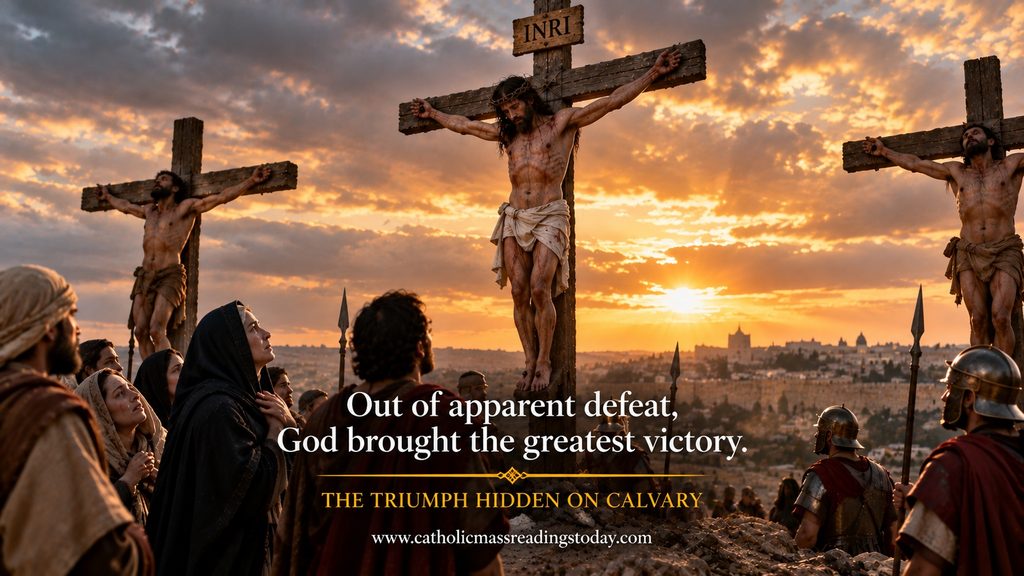
To the soldiers standing beneath Jesus, Calvary probably looked like the end.
To many of the religious authorities who opposed Him, the problem seemed finished.
To the disciples who fled in fear, everything appeared lost.
But heaven saw something else. The Lamb of God was offering Himself and the new covenant was being sealed. Sin was being confronted. Death itself was being invaded by the Author of Life and within days, the stone before the tomb would be rolled away.
This is the great paradox proclaimed by THE FEAST OF THE EXALTATION OF THE HOLY CROSS:
The place that looked like Christ’s defeat became the place of His victory.
“We Adore You, O Christ, and We Bless You”
For centuries Christians have prayed:
“We adore you, O Christ, and we bless you, because by your holy Cross you have redeemed the world.”
That prayer captures the spirit of September 14. Today the Church lifts the Cross high, not to celebrate suffering, but to proclaim Love. Not to glorify death, but to announce Life.
Not to leave humanity at Calvary, but to remind us that the road from Calvary leads to the empty tomb.
So when we see the Cross today—in our churches, in our homes, around our necks or traced upon our bodies—may we never treat it as an ordinary decoration.
- It is the sign of the price with which we were redeemed.
- It is the sign of a God who entered our suffering.
- It is the sign of mercy offered to sinners.
- It is the sign that death has been defeated.
And above all, it is the enduring proclamation that God so loved the world that He gave His only-begotten Son, so that whoever believes in Him should not perish but have eternal life.
On THE FEAST OF THE EXALTATION OF THE HOLY CROSS, the Church raises this sacred sign once more before the world and proclaims with confidence:
Hail, O Cross, our only hope.
Prayer for the Feast of the Exaltation of the Holy Cross
Lord Jesus Christ, Son of the living God, You humbled Yourself and became obedient unto death, even death upon the Cross. We adore You and bless You, for by Your holy Cross You have redeemed the world.
Grant us the grace never to be ashamed of Your Cross nor to treat lightly the price of our salvation. When suffering enters our lives, remain close to us. When sin causes us to fall, lead us back to Your mercy. When fear overwhelms us, help us to remember that the Cross did not end in the tomb, but in the victory of the Resurrection.
Teach us to carry our daily crosses with faith, to forgive as You forgave, to serve as You served, and to love as You loved us. May the sign of Your Cross guard our homes, strengthen our families, console the suffering, give courage to the persecuted, bring peace where there is hatred, and draw every human heart toward the mercy of the Father.
Through the mystery of Your Passion, Cross and glorious Resurrection, lead us at last into the joy of eternal life, where You live and reign with the Father and the Holy Spirit, God, for ever and ever.
“In the name of the Father, and of the Son, and of the Holy Spirit.”
Amen.