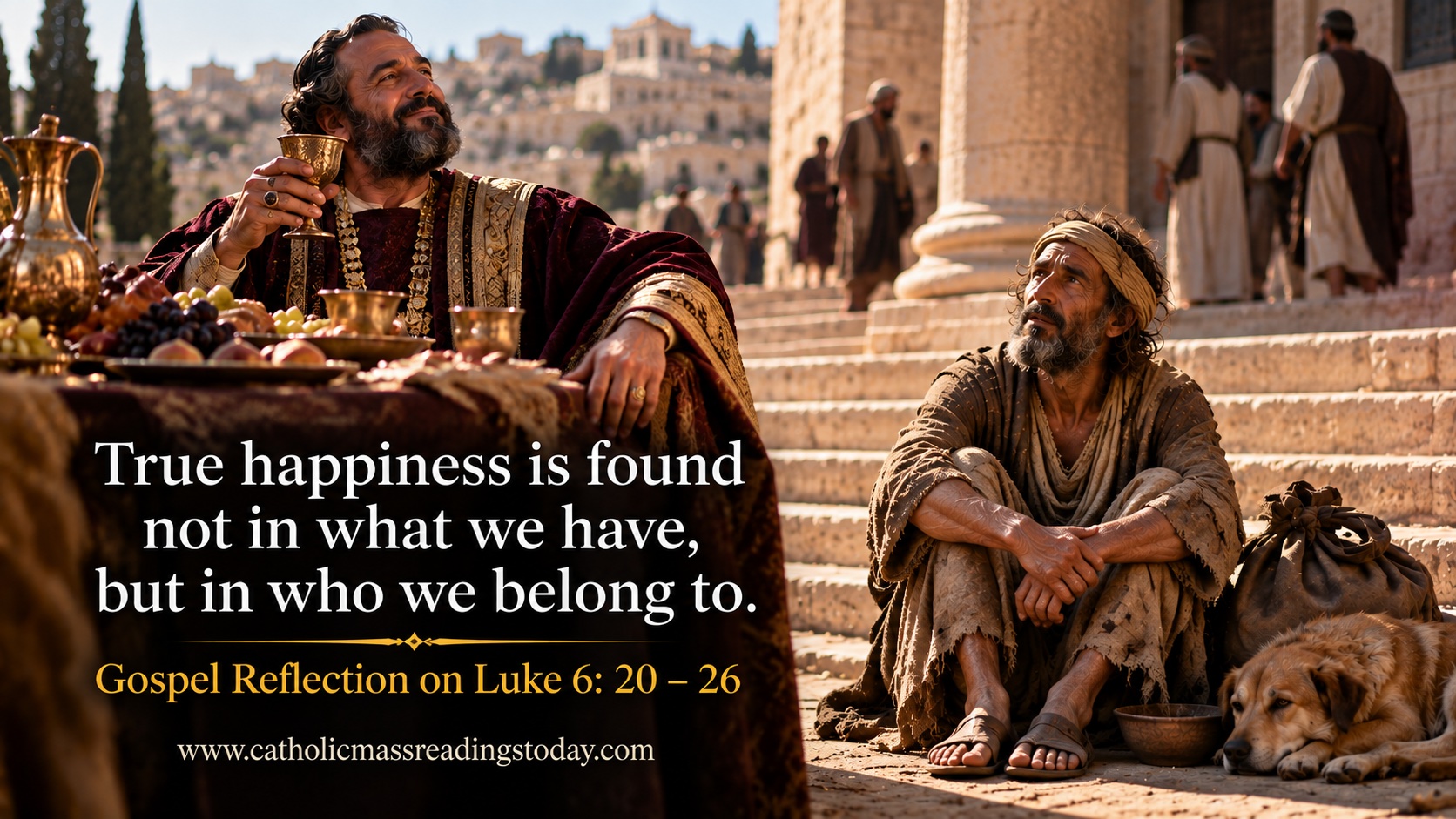
“Blessed Are You Poor”
There are words of Jesus that comfort us immediately, and there are other words that first unsettle us before they reveal their grace. Today’s Gospel does both.
Jesus lifts His eyes toward His disciples and declares, “Blessed are you poor, for yours is the kingdom of God.” He speaks of those who hunger, those who weep and those who are rejected because of Him, and He calls them blessed. Then His words take a more challenging turn: “Woe to you that are rich… Woe to you that are full now… Woe to you that laugh now.”
Christ is overturning the ordinary way the world measures a successful life. We are constantly tempted to believe that the blessed person is the one who has accumulated enough, achieved enough, been admired enough and protected himself from suffering. Jesus asks us to look much deeper. He places before the conscience a question that cannot easily be avoided: Where is your treasure, and upon whom does your heart truly depend?
The Poverty That Makes Room for God
When Jesus says, “Blessed are you poor,” He is not romanticising poverty or suggesting that hunger, deprivation and injustice are good things. The suffering of the poor places a serious responsibility upon the Christian conscience. We cannot claim to love Christ while remaining indifferent to people who lack food, shelter, dignity or the basic necessities of life.
Yet there is also a deeper poverty that the Gospel asks every disciple to embrace. It is the recognition that before God, every one of us is poor. We did not give ourselves life. We cannot forgive our own sins. We cannot conquer death through our own strength. We cannot purchase grace or earn eternal life as though heaven were something we could acquire through human achievement.
Everything ultimately comes from God.
The danger of wealth is not simply possessing things. The greater danger comes when our possessions begin to convince us that we no longer need God. A person may have a full bank account and an empty soul. Another may possess very little and yet carry within the heart a peace that money could never purchase.
Jesus is therefore revealing two very different ways of living. One receives life as a gift and depends upon God; the other attempts to make the things of this world its final security.
Christian poverty of spirit does not necessarily mean possessing nothing. It means refusing to allow anything we possess to take the place that belongs to God alone.
“Blessed Are You That Hunger Now”
Hunger is such a powerful image because hunger cannot easily be ignored. It tells us that something is missing and that we were made to receive something we do not yet possess.
There are many forms of hunger in human life. We hunger to be loved. We hunger for peace within our families. We hunger for healing after wounds that have remained with us for years. We hunger for forgiveness, meaning, friendship and belonging. Beneath many of these desires lies an even deeper hunger: the human heart is searching for the One who created it.
The difficulty is that we sometimes try to satisfy this deepest hunger with things that were never capable of satisfying it. We consume more, buy more, work more, seek more recognition and surround ourselves with distractions, only to discover that something within us remains restless.
Jesus tells those who hunger, “You shall be satisfied.”
This is not a promise that every earthly desire will be granted. It is something far greater. Christ is telling us that the deepest hunger of the human heart has an answer, and that answer is ultimately God Himself.
The good things of this world can bring genuine happiness, and we should receive them gratefully. But no created thing can carry the burden of becoming our god. Only the Creator can satisfy the deepest longing of the creature.
“Blessed Are You That Weep Now”
Perhaps these are among the most tender words in today’s Gospel.
Jesus does not tell us that tears are pleasant. He does not pretend grief does not hurt. He does not ask the bereaved parent, the frightened patient, the abandoned spouse, the lonely elderly person or anyone carrying a hidden sorrow simply to smile and behave as though nothing is wrong.
Instead, He makes an extraordinary promise: “You shall laugh.”
There is the hope of the Resurrection hidden within those words.
Some wounds in this life will not be completely healed in this life. Some questions will remain unanswered. Some people we love will leave this world before we are ready to say goodbye. Christianity does not deny these realities. Our faith gives us something stronger than denial: it gives us hope.
Jesus Himself entered human suffering. He knew betrayal. He knew rejection. He wept. He carried the Cross. He entered the darkness of the tomb.
And then He rose.
Because Christ has risen, sorrow no longer possesses the final word over the human person. The Christian can weep without surrendering to despair because we know that beyond Good Friday stands Easter morning. The final word belongs not to suffering, not to the grave and not to death, but to Jesus Christ, risen from the dead.
When Following Christ Costs Something
Jesus then speaks directly to those who suffer because they belong to Him: “Blessed are you when men hate you, and when they exclude you and revile you… on account of the Son of man!”
Following Christ has never been a promise of universal approval. There will be moments when fidelity to the Gospel places the Christian against the prevailing current. There may be pressure to remain silent about truth, to compromise conscience, to abandon Christian convictions or to measure right and wrong according to whatever happens to be popular at a particular moment.
Jesus does not tell His disciples to seek persecution or deliberately provoke hostility. Neither does He give us permission to become bitter or hateful toward those who disagree with us. The Gospel asks for something much more demanding: faithfulness without hatred, courage without arrogance, conviction without cruelty, and truth spoken with love.
Christ Himself showed us this way. Even from the Cross, He prayed for those who crucified Him.
That is why His words are so striking: “Rejoice in that day, and leap for joy, for behold, your reward is great in heaven.”
Our final judgement does not come from public opinion. Our worth is not determined by applause, social approval or popularity. There may be moments when remaining faithful to Christ costs us friendships, opportunities, comfort or recognition. Yet nothing offered to God through faithful love is ever wasted.
Heaven remembers what the world forgets.
The Warning Hidden in Comfort
Then comes the difficult half of today’s Gospel: “But woe to you that are rich, for you have received your consolation.”
We should not soften these words until they lose their power. Jesus repeatedly warns His disciples about wealth because He knows how easily possessions can begin by serving us and eventually end by possessing us.
Money itself is not evil. Material prosperity is not automatically sinful. Scripture itself presents people of means who remained faithful to God and used what they possessed for good. The real question is what wealth does to the heart and what we choose to do with what God has entrusted to us.
The person who has been blessed materially should therefore hear today’s Gospel not as a condemnation, but as a serious examination of conscience. Do I recognise what I possess as a gift entrusted to me by God? Can I still see the person who has less? Does another person’s suffering disturb my comfort enough to move me toward generosity? If the things upon which I presently depend disappeared tomorrow, would my relationship with God remain?
These questions may make us uncomfortable. Perhaps they are supposed to.
Christ loves us too much to allow temporary comfort to deceive us about what is eternal.
“For You Have Received Your Consolation”
There is something particularly sobering about these words of Jesus.
Imagine reaching the end of life having gained everything we wanted, money, possessions, comfort, influence, admiration and success only to discover that we had spent our years pursuing things we could not carry beyond the grave.
There is nothing wrong with enjoying the good gifts God gives us. A family celebration, friendship, laughter, a comfortable home, meaningful work, financial stability and the ability to provide for those we love can all be received with sincere gratitude.
The danger begins when the gift replaces the Giver.
Jesus is therefore asking us something much deeper than, “What do you have?” He is asking, “What has your heart?”
That is a question worth carrying into prayer.
Perhaps we have become so comfortable that prayer has slowly disappeared from our lives. Perhaps success has made us less conscious of our dependence upon God. Perhaps we have become very concerned about protecting what belongs to us and increasingly unable to notice the needs of others. Perhaps we seek the praise of people more eagerly than the approval of God.
The Gospel does not expose these things in order to condemn us. Christ reveals what is within the heart because He desires to free the heart.
Living for What Does Not Pass Away
The Beatitudes invite us to live with eternity before our eyes. This does not mean withdrawing from the world or treating earthly life as unimportant. Christians are called to work, build families, educate children, serve society, care for creation, defend human dignity, seek justice and contribute to the common good precisely because this world matters to God.
But this world is not our final home.
Everything we possess will eventually pass into someone else’s hands. Titles disappear. Achievements become memories. The applause of others grows silent. Even our bodies eventually return to the earth.
What remains is what we have become before God.
At the end of our earthly pilgrimage, what will matter is whether we learned to love, whether we forgave, whether our prosperity made us generous or selfish, whether suffering drew us toward Christ or hardened our hearts, whether we recognised Jesus in those who needed us, and whether the blessings God placed into our hands became blessings for others.
This is why today’s Gospel cannot simply be directed toward “the rich” somewhere else. Every disciple must hear it personally. Every one of us can become attached to something. Every one of us can place too much confidence in comfort, possessions, reputation or human approval.
And every one of us needs the freedom that only Christ can give.
“Yours Is the Kingdom of God”
There is something beautiful that can easily be missed in the first Beatitude. Jesus says to the poor, “Yours is the kingdom of God.”
He does not merely say, “Yours will be.”
He says, “Yours is.”
The Kingdom begins wherever Christ is welcomed and allowed to reign. Even amid hardship, the person who belongs to Jesus already possesses a treasure that circumstances cannot take away.
This is the freedom Christ desires for His disciples: that we may possess the things of this world without being possessed by them, receive blessings without worshipping them, experience sorrow without surrendering hope, face criticism without abandoning truth, enjoy success without forgetting God, and endure suffering without believing ourselves abandoned.
Ultimately, whether we possess much or little, the Christian heart must gradually learn to say: Christ is enough.
Today Jesus lifts His eyes toward His disciples once again, and we are among those disciples now. His words invite us to examine where we have placed our security. If our hands have become too full of temporary things to receive the Kingdom, He invites us to loosen our grip. If our hearts are wounded, hungry or grieving, He tells us not to despair. If following Him has become costly, He asks us to lift our eyes toward heaven.
The things of this world will pass away. Wealth will pass. Suffering will pass. Human praise will pass. Even the tears we shed today will pass.
But Christ remains.
And the person who has found Christ has discovered a treasure that neither suffering, poverty, rejection nor even death can take away.
Let us Pray
Lord Jesus Christ, You proclaimed blessed those who are poor, those who hunger, those who weep and those who remain faithful to You in times of rejection. Free our hearts from everything that prevents us from belonging completely to You.
When You bless us with abundance, make us generous toward those in need. When we experience hardship, keep us from losing hope. When we weep, remind us of the joy of Your Resurrection. When following You costs us something, give us courage to remain faithful.
Protect us from placing our security in wealth, comfort, success or human praise. Teach us to seek first the Kingdom of God and to recognise that every good thing we possess comes from Your loving hand.
Give us hearts that are poor in spirit, rich in mercy, steadfast in faith and filled with hope in the life to come. May we use the blessings of this world wisely, serve our brothers and sisters generously, and one day rejoice with You in the Kingdom that never passes away.
Through Christ our Lord.
Amen.