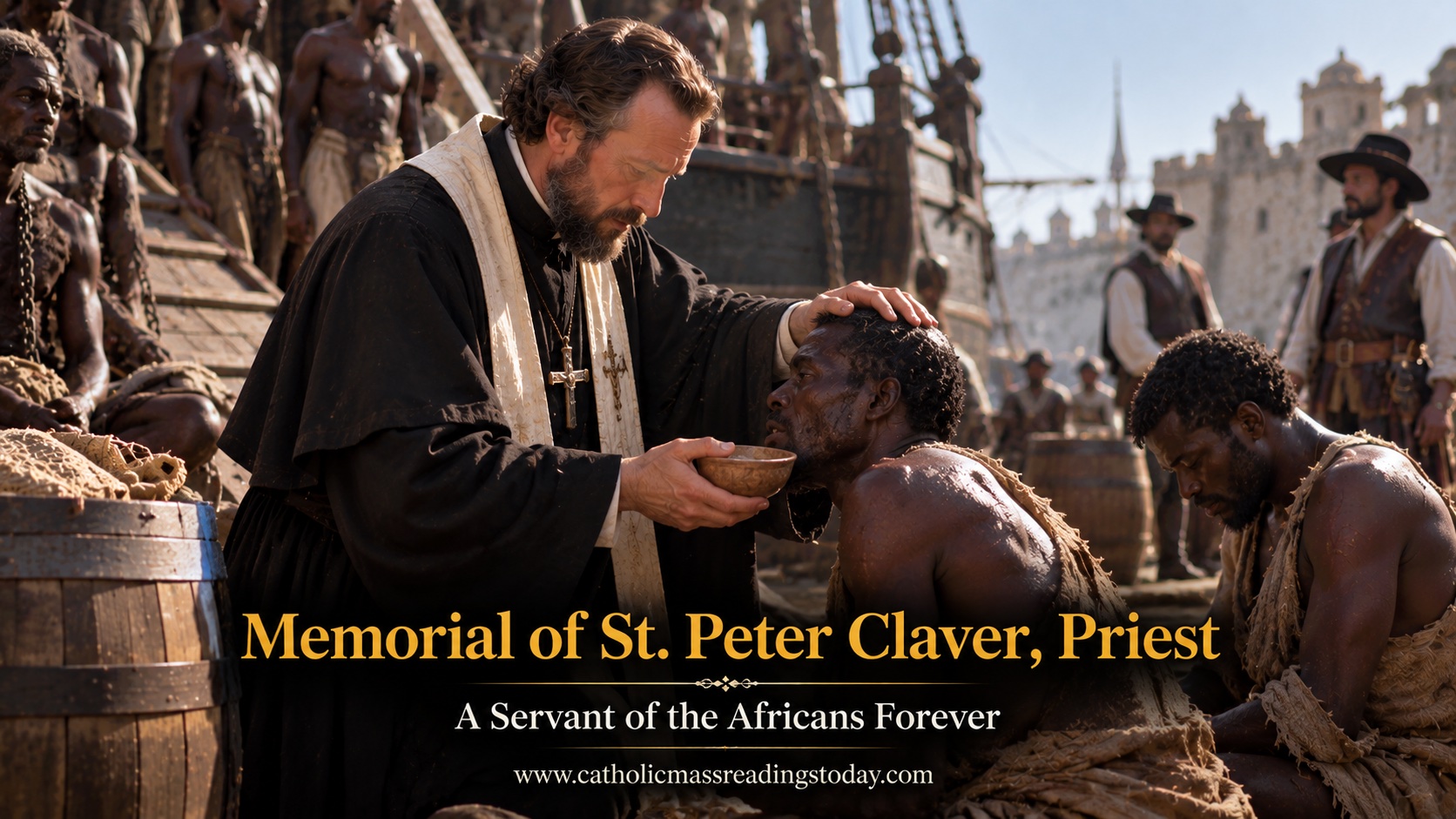
Every year on September 9, the Catholic Church celebrates the Memorial of St. Peter Claver, Priest, remembering a Spanish Jesuit missionary who dedicated almost four decades of his life to serving enslaved Africans arriving at Cartagena in present-day Colombia.
The story of St. Peter Claver takes us into one of the darkest chapters of human history. Men, women and children were torn from their homes in Africa, transported across the Atlantic under horrifying conditions and sold as property. Many died during the journey. Those who survived often arrived sick, wounded, hungry, frightened and separated forever from their families.
Into this world stepped a priest who chose to go where suffering was greatest.
Peter Claver could not dismantle the entire institution of slavery by himself, but he refused to accept the terrible lie upon which slavery depended: that one human being could somehow possess less dignity than another. He went aboard the slave ships, entered places others avoided, tended wounds, brought food and water, instructed people in the faith, administered the Sacraments and defended the dignity of people whom society had reduced to merchandise.
He eventually expressed his vocation in words that became inseparable from his name: “Petrus Claver, Aethiopum servus in perpetuum” Peter Claver, servant of the Africans forever.
The Memorial of St. Peter Claver, Priest, therefore, is much more than the remembrance of an extraordinary missionary. His life confronts every generation of Christians with a deeply personal question: When the dignity of another human being is being denied, where will the disciple of Christ stand?
The Early Life of St. Peter Claver
Peter Claver was born in Verdú, Catalonia, Spain, in 1580. Some older accounts give 1581 as his birth year, which explains why that date is still sometimes associated with him. He grew up in a farming family and, from the circumstances of his childhood, there was little to suggest that this young Spaniard would one day become one of the best-known missionaries in the Americas.
His vocation developed gradually. As a young man, Peter studied in Barcelona, where he encountered the Society of Jesus, the religious order founded by St. Ignatius of Loyola. The Jesuits were still a relatively young religious community, but they had already become known for education, missionary work and their willingness to serve the Church wherever the need was greatest.
Peter entered the Society of Jesus in 1602.
During his Jesuit formation, he was sent to the college of Montesión on the island of Majorca. There he encountered a man whose influence would profoundly shape the direction of his life: St. Alphonsus Rodríguez.
Alphonsus was not a celebrated preacher or famous theologian. He served humbly as the porter of the Jesuit college. Yet behind his ordinary daily duties was an extraordinary interior life of prayer and union with God. The elderly religious brother recognised something in the young Peter and encouraged him to consider offering his life to the missions in the New World.
Peter listened.
That seemingly simple decision would eventually carry him across the Atlantic and into a ministry that would consume the remainder of his life.
Leaving Spain for the Missions
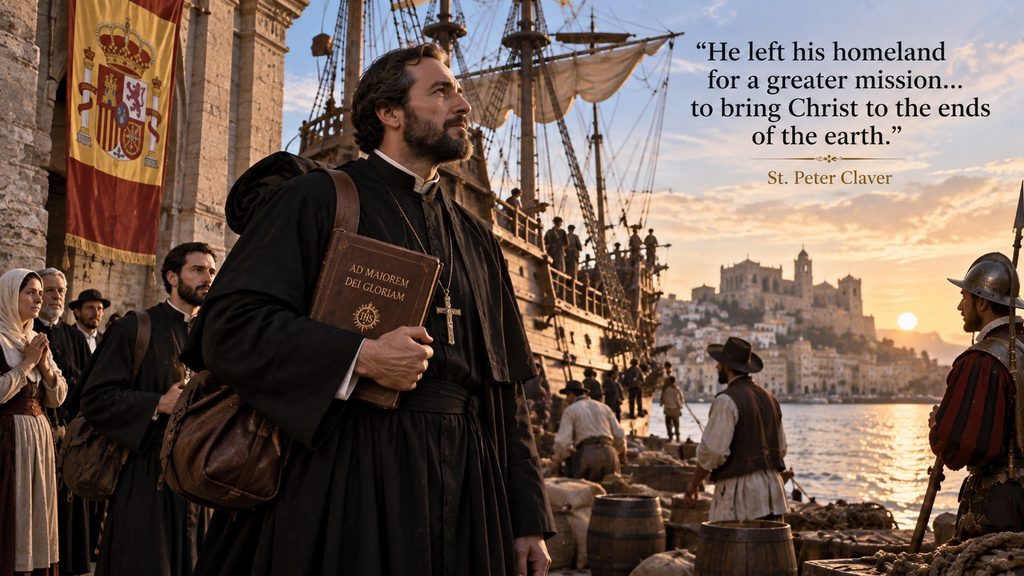
In 1610, Peter Claver left Spain for the New Kingdom of Granada in South America, part of present-day Colombia. For a young European in the seventeenth century, this was no ordinary journey. Crossing the Atlantic meant leaving his homeland, family, language and familiar culture, with little expectation that he would ever return permanently to the world he had known.
Claver understood missionary life as a complete gift of himself.
After continuing his theological formation, he eventually came to Cartagena, where he was ordained a priest in 1616. Cartagena would become the great geographical centre of his priesthood and the place where his understanding of Christian service would be tested in circumstances of extraordinary human suffering.
Cartagena was prosperous, strategically important and commercially active. Yet behind its wealth was an immense human tragedy.
Cartagena and the Horror of the Slave Trade
During the seventeenth century, Cartagena was one of the principal ports through which enslaved Africans entered Spanish America. The transatlantic slave trade had developed into a vast commercial system in which human beings were captured, purchased, transported and sold.
Africans were forced aboard ships and carried across the Atlantic in appalling conditions. They were packed into confined spaces, exposed to disease, hunger and violence, and deprived of almost every freedom. Many never survived the crossing.
Those who reached Cartagena could arrive physically exhausted, malnourished, wounded and terrified. Many did not understand the European languages spoken around them. Families had been separated. Freedom had been stolen. People created in the image and likeness of God were being assigned prices and sold as property.
Peter Claver encountered this reality through the work of another Jesuit priest, Father Alonso de Sandoval, who had already devoted himself to ministry among enslaved Africans. Claver eventually embraced this mission as his own and carried it forward with extraordinary perseverance.
He would spend decades standing at the point where commercial prosperity and terrible human suffering met.
He Went to Meet the Slave Ships
One of the most revealing things about St. Peter Claver’s priesthood is that he did not simply wait for suffering people to come to him.
He went to them.
Claver learned when ships carrying enslaved Africans were approaching Cartagena. When they arrived, he made his way toward the harbour, carrying whatever supplies he could obtain. He brought food, water, medicine and other necessities and boarded the vessels to reach those who had survived the Atlantic crossing.
The conditions he encountered were horrifying. People were sick, wounded and frightened. Some were dying. Others were too weak to stand. Many could not understand a word Claver spoke, while he could not understand their languages.
Yet there was one language that required no translation.
Mercy.
Claver understood that before he could speak convincingly about the love of Jesus Christ, the people before him needed to experience something of that love through his actions. He therefore began not with lengthy explanations but with practical compassion. He gave water to the thirsty, food to the hungry and care to the sick. He tried to reassure those who were frightened and to restore some measure of dignity to people who had endured the degrading experience of being treated as cargo.
His missionary method carried a profound Christian truth: the Gospel must become visible before our words about it can become credible.
A Gospel Proclaimed With His Hands
One surviving account from Peter Claver himself gives us a remarkable glimpse into his ministry. Describing his work among newly arrived enslaved Africans, he explained that he and his companions first addressed their needs not primarily through words, but through their hands and practical assistance.
This reveals something essential about the spirituality of St. Peter Claver.
A hungry person needed food before a theological explanation. A sick person needed treatment. A terrified person needed reassurance. Someone who had been treated as an object needed to encounter another human being willing to look into his eyes and recognise a brother.
Only then could deeper instruction begin.
Peter Claver therefore embodied something profoundly Catholic: the inseparability of evangelization and charity. The Church cares for the body because the human body possesses God-given dignity, and she cares for the soul because every human person is called to eternal communion with God.
Christ commands His disciples to proclaim the Gospel to all nations, but the same Christ also teaches that whatever we do for the least of His brothers and sisters, we do for Him.
Peter Claver tried to live these two truths as one vocation.
A Priest Among the Enslaved
Once the immediate needs of the newly arrived Africans had been addressed, Claver began the difficult work of catechesis and sacramental ministry.
Language remained a major obstacle, so he worked with interpreters who could communicate in different African languages. He also used pictures and other visual aids to teach the essential truths of the Christian faith. He spoke about Jesus Christ, His death and Resurrection, God’s mercy, Baptism and the Christian life.
His ministry did not simply end once someone had been baptized. Claver continued visiting the enslaved, hearing confessions, providing spiritual instruction, caring for the sick and seeking to protect people from abuse.
Over the course of his ministry, traditional accounts attribute approximately 300,000 baptisms to Peter Claver. The number gives some indication of the extraordinary scale of his work, but numbers alone do not explain his sanctity.
What mattered was the way he tried to encounter people as persons.
Where a commercial system saw a cargo of slaves, Claver tried to see individual human beings.
Where others saw labour to be bought and sold, he saw souls redeemed by Christ.
Where society created divisions according to race, status and wealth, he saw brothers and sisters created by one God.
“Servant of the Africans Forever”
In 1622, when Peter Claver made his solemn profession as a Jesuit, he expressed the meaning of his vocation in a phrase that would define his life: “Petrus Claver, Aethiopum servus in perpetuum.”
The phrase has traditionally been translated as “Peter Claver, slave of the Africans forever,” though “servant of the Africans forever” communicates its spiritual meaning more naturally today.
The historical wording is striking because Claver deliberately reversed the language of the society around him. Others called these African men and women slaves. Claver chose to call himself their servant.
He was not accepting their enslavement as something good. Rather, he was placing himself deliberately at the service of people whose freedom and dignity had been violently taken from them.
The words echoed the Gospel itself. Jesus had taught His disciples that the Son of Man came not to be served, but to serve. Peter Claver took that command with radical seriousness.
He Saw the Image of God Where Society Refused to Look
At the heart of St. Peter Claver’s ministry was a truth that remains central to Catholic teaching: every human being possesses an inviolable dignity because every human being is created in the image and likeness of God.
That dignity does not depend upon race, nationality, wealth, education, physical strength, usefulness or social position. It cannot morally be purchased, sold or removed by another person.
The slave trade denied this truth in one of history’s most brutal ways.
Peter Claver’s life proclaimed it through action.
He entered places others avoided. He washed wounds others refused to touch. He embraced people whom respectable society rejected. He remained close to those who possessed almost no earthly power.
He could not undo everything that had happened to them, but he could make one thing unmistakably clear: before God, they were not property. They were persons. They were His children.
That is what makes his witness so enduring.
St. Peter Claver and the Difficult History of Slavery
When telling the story of Peter Claver today, it is important neither to romanticize the colonial society in which he lived nor to pretend that Christians of the period always confronted slavery as clearly or forcefully as they should have.
Claver lived and ministered within a society whose economy was deeply connected to enslaved labour. He did not succeed in abolishing that system. His work was primarily pastoral and missionary. He relieved suffering, defended enslaved people against mistreatment, catechized them, administered the Sacraments and insisted through his actions upon their humanity.
From our historical distance, we may rightly wish that far more people, including more Christians, had challenged the institution of slavery itself with greater determination.
But that recognition does not diminish Claver’s witness. It makes his example even more challenging.
Thousands of people could see the same ships entering Cartagena. Thousands could witness the same suffering. Yet comparatively few chose to enter that suffering as Peter Claver did.
The most important question, therefore, is not simply why people centuries ago failed to recognise injustice. It is whether we have become comfortable with injustices in our own time because they have become familiar to us.
Every generation has things it learns not to see.
The Christian conscience must resist that blindness.
A Life Sustained by Prayer
It would be easy to read about Peter Claver’s exhausting work and think of him simply as an unusually compassionate humanitarian. That would miss the centre of his life.
His strength came from Jesus Christ.
Prayer sustained his service. The Eucharist, the Sacraments and the spiritual discipline of his Jesuit vocation nourished the life he poured out for others.
This is important because human compassion alone can become exhausted. Anyone who spends long periods close to suffering knows how emotionally and physically demanding such service can become. Enthusiasm fades, strength weakens and the enormity of human suffering can overwhelm us.
Christian charity therefore needs a source deeper than emotion.
For Peter Claver, that source was Christ.
He believed that when he bent down before the sick, Christ was there. When he cared for someone society had rejected, Christ was there. When he listened to the confession of a frightened person, Christ was there.
His service to the enslaved was inseparable from his love for Jesus.
Nearly Forty Years of Faithful Service
Year followed year. Ship followed ship. Thousands of people became tens of thousands, and eventually hundreds of thousands.
Peter Claver remained.
For almost four decades, Cartagena became the place where his vocation was tested and fulfilled. He ministered not only to newly arrived enslaved Africans but also continued visiting those who had already been dispersed throughout the region. He cared for the sick, visited prisoners and sought out people whom society preferred to forget.
There is something deeply moving about the constancy of his service.
We often imagine holiness as one dramatic act of heroism. In reality, much of Peter Claver’s holiness was found in doing the works of mercy again and again. One day he would hear that another ship had arrived and go to meet it. On another day he would visit someone who was ill. Then he would hear confessions, teach the faith, pray, tend another wound and begin again the following morning.
His holiness was built through years of repeated fidelity.
This is an important lesson for ordinary Christian life. Most of us will never be asked to perform one spectacular act that defines our entire existence. We are asked instead to remain faithful in the duties God places before us today, and then to remain faithful again tomorrow.
That was the quiet heroism of Peter Claver.
The Final Years of St. Peter Claver
After decades of exhausting missionary labour, Claver’s health eventually deteriorated. Around 1650, he became seriously ill during an epidemic. Although he survived, he was left physically weakened and largely unable to continue the demanding ministry that had defined his priesthood.
There is something particularly moving about this final chapter of his life.
The man who had spent decades caring for people in their weakness now experienced profound weakness himself. The priest who had carried help to others became dependent upon others. The missionary who had been constantly active was forced into stillness.
Yet his vocation had not ended.
Christian life is not valuable only when we are productive. Our dignity does not disappear when illness prevents us from working. Peter Claver had spent his life giving himself through action; now he was called to give himself through suffering, patience and surrender.
The final years of his life remind us that holiness is not measured simply by how much we accomplish. Sometimes faithfulness means working tirelessly. At other times, faithfulness means allowing ourselves to be carried by God when we no longer possess the strength to carry anything ourselves.
The Death of St. Peter Claver
Peter Claver died in Cartagena on September 9, 1654, after a life almost entirely poured out in missionary service. He was approximately seventy-four years old.
The news that the great servant of the enslaved was dying spread through Cartagena. The man who had spent so many years among people whom society ignored was now himself recognised as someone whose life had profoundly marked the city.
There is a beautiful irony in his story. Peter Claver never sought earthly greatness. He spent his best years among people who possessed little social influence. He entered places that respectable society preferred to avoid. Yet centuries later, his name remains known throughout the Catholic world.
People remember him not because he accumulated wealth, commanded armies or governed nations.
They remember him because he served.
His remains are venerated in Cartagena at the church that bears his name, and the place has become an important destination for pilgrims. Both St. John Paul II and Pope Francis prayed there during their respective visits to Colombia, showing how strongly Claver’s witness continues to speak to the universal Church.
From Missionary Priest to Canonized Saint
The Church eventually formally recognised the holiness that so many people had already associated with Peter Claver.
He was beatified by Pope Pius IX in 1851 and canonized by Pope Leo XIII in 1888. Pope Leo XIII presented him as an outstanding example of Christian charity and apostolic dedication, particularly in relation to the suffering caused by slavery.
His influence continued to grow beyond Colombia and beyond the Society of Jesus. St. Peter Claver became especially associated with missionary work among peoples of African descent and with the Christian defence of human dignity in the face of racism, slavery and exploitation.
The Church celebrates his liturgical memorial on September 9th, the anniversary of his death.
Yet canonization does not place Peter Claver safely in the past. The Church presents saints to us precisely because their lives have something to say to the present.
And Peter Claver has much to say to ours.
Why St. Peter Claver Still Matters Today
The slave ships Peter Claver boarded no longer enter Cartagena as they did in the seventeenth century, but the temptation to treat human beings as commodities has not disappeared.
Human trafficking continues. Forced labour continues. Vulnerable migrants can be exploited because they are frightened or desperate. Women and children are still trafficked for profit. Workers can be treated merely as economic tools. Racism can still lead one person to judge another according to the colour of his skin rather than the content of his character and the dignity given to him by God. Poverty can make people almost invisible to those living in comfort.
This is why St. Peter Claver remains so relevant.
We may never stand on the docks of seventeenth-century Cartagena, but every Christian will eventually encounter someone whom society finds inconvenient, difficult or easy to ignore.
Claver’s life asks whether we will recognise Christ in that person.
He teaches us that Christian charity cannot remain an abstract idea. Love must take flesh in the choices we make, in the people we notice and in the way we treat those who cannot repay us.
The Gospel Must Have Hands
One of the strongest lessons from the life of St. Peter Claver is that Christianity cannot remain only in words.
Peter preached the Gospel, taught the faith, baptized and heard confessions. Yet before many people could understand his words, they understood his actions.
They understood the Gospel when he brought water to someone who was thirsty. They encountered something of Christ when he cared for wounds others would not touch. They experienced Christian love when a priest entered the darkness of a slave ship instead of remaining safely outside it.
That same principle remains true today.
A person may forget many of the words we speak but remember that we visited when everyone else disappeared. A struggling family may remember the assistance offered when they had nowhere else to turn. An elderly person may remember the time someone sat beside them and listened. A frightened migrant may remember the Christian who treated him with dignity. Someone burdened by sin may remember the Catholic who spoke truth without humiliating them.
Faith must become visible.
The Gospel must have hands.
Peter Claver understood that with extraordinary clarity.
The Catholic Understanding of Human Dignity
At the heart of Catholic social teaching is the truth Peter Claver lived so powerfully: human dignity is not granted by society. It comes from God.
This distinction is crucial.
If society were the source of human dignity, society could decide who deserves it. If wealth determined dignity, the poor would possess less. If physical strength or usefulness determined human worth, the sick, elderly, disabled and unborn would become vulnerable whenever others decided they were inconvenient.
Christianity rejects such a vision of the human person.
Human dignity is intrinsic because the human person is created by God, redeemed by Christ and called to eternal life.
This is why racism is incompatible with the Gospel. This is why slavery is an assault upon human dignity. This is why human trafficking is evil and why the exploitation of vulnerable people cannot be accepted by a Christian conscience.
Peter Claver’s life takes these truths out of theological books and places them before our eyes.
What St. Peter Claver Asks of Us Today
The Memorial of St. Peter Claver, Priest should not leave us merely admiring a heroic man who lived centuries ago. It should lead us to examine our own lives.
Claver went toward people others avoided, and his example asks us whether there are people we habitually avoid. He saw dignity where society saw little value, which should make us examine whether there are people whose dignity we have failed to recognise. He crossed barriers of race, language and culture, inviting us to consider whether such barriers still remain within our own hearts. He served people who could offer him almost nothing in return, challenging us to ask whether our generosity sometimes depends too much upon gratitude or recognition.
These are uncomfortable questions, but saints often make us uncomfortable because they show us what the Gospel looks like when someone takes it seriously.
We do not honour St. Peter Claver merely by remembering what he did.
We honour him when his witness changes something in us.
A Saint for a Divided World
Our own age remains deeply divided by race, nationality, wealth, class, migration, politics and culture.
St. Peter Claver points toward another way.
He reminds us that before every label stands a person.
When we hear the word migrant, there is a person behind it. When we speak of the poor, we are speaking about persons. When we discuss prisoners, refugees or victims of trafficking, we must never allow categories and statistics to hide the individual human beings whose lives are involved.
The Christian must learn to see the person first.
This does not mean ignoring difficult questions concerning law, economics, borders or social responsibility. It means insisting that no answer to those questions can ever abandon the sacred dignity of the human beings involved.
Peter Claver’s answer to the divisions of his own world was not an ideology.
His answer was Jesus Christ.
Because he saw Christ in those who suffered, he could not simply walk past them.
The Enduring Legacy of St. Peter Claver
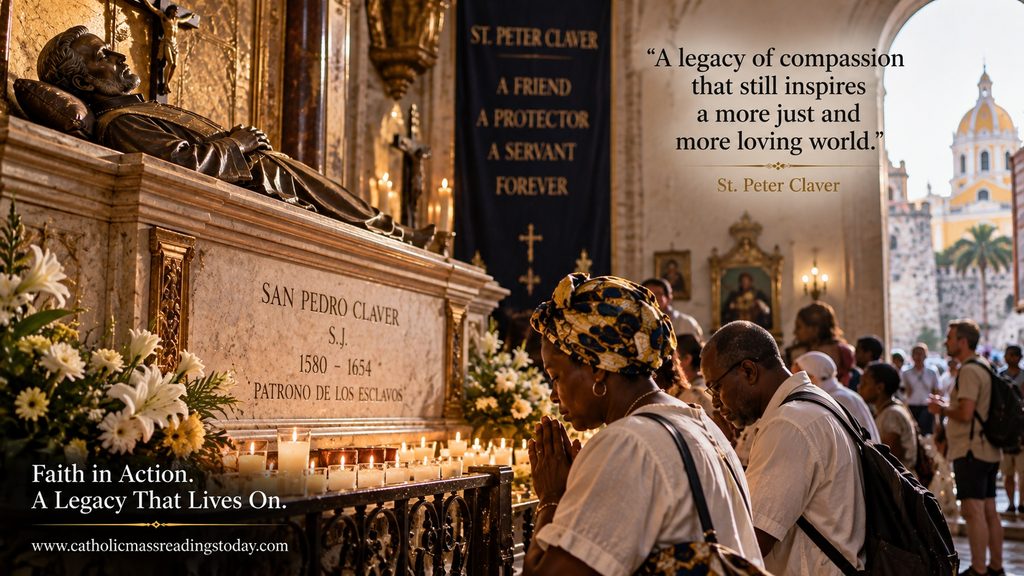
More than three and a half centuries after Peter Claver’s death, pilgrims still travel to Cartagena and pray where his remains are venerated. Popes have knelt there. Missionaries continue to invoke his example. Catholic communities around the world celebrate his memorial every September.
The world in which he lived has disappeared, but the Gospel that formed him has not changed.
Christ still tells us, “Whatever you did for one of these least brothers of mine, you did for me.”
Peter Claver built his life around that truth.
His greatness was not that he managed to correct every injustice of his age. He did not. His greatness was that when terrible injustice became ordinary around him, he refused to allow it to become ordinary within his own heart.
That may be one of his most important messages for us today.
We cannot individually correct every evil in the world. But Christians must never become comfortable with evil simply because everyone around them has learned to live with it. Where dignity is denied, we must defend it. Where people are forgotten, we must remember them. Where suffering is hidden, we must be willing to see it. Where hatred divides people according to race or origin, we must remember that humanity has one Creator and that Christ gave His life for all.
When the world asks what another human being is worth, the Christian answer must always begin with the same truth:
This person bears the image of God.
That conviction took Peter Claver from Spain to Cartagena, from the safety of the Jesuit house to the holds of slave ships, from prayer to service and from service to sanctity.
The Church remembers him because his life showed what can happen when the Gospel reaches not only the mind and the lips, but also the heart and the hands.
Prayer to St. Peter Claver
O God, who made St. Peter Claver a faithful servant of those who had been deprived of freedom and a tireless witness to the dignity of every human person, grant us, through his intercession, the grace to recognise Your image in every brother and sister we encounter.
Give us eyes that notice those whom others overlook, hearts that refuse indifference and hands ready to serve those who suffer. Free us from prejudice, racism and selfishness, and strengthen all who work against human trafficking, forced labour, exploitation and every form of modern slavery.
Teach us, like St. Peter Claver, not merely to speak about love, but to make Your love visible through works of mercy, courage and compassion. May our prayer and participation in the Holy Eucharist draw us ever closer to Jesus Christ, so that strengthened by His grace, we may recognise and serve Him in the poorest, the suffering and the forgotten.
May the example of St. Peter Claver teach us to remain faithful when service becomes difficult, to defend human dignity when others remain silent and to remember always that every person we meet is precious in Your sight.
Through Christ our Lord.
Amen.
St. Peter Claver, pray for us.