“Do You Begrudge My Generosity?”
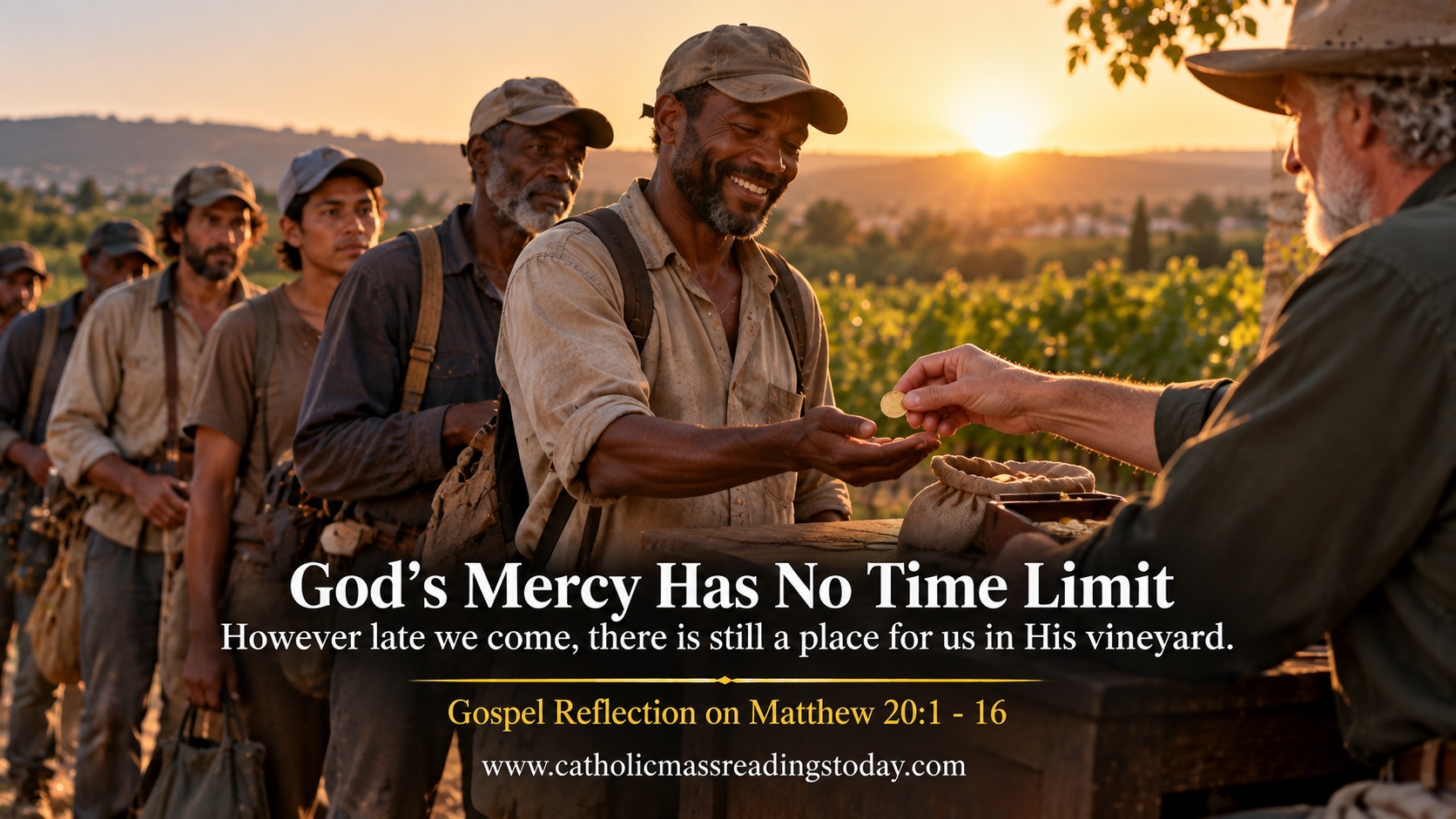
In today’s Gospel, Jesus tells a parable that can make us uncomfortable at first. A landowner goes out early in the morning and hires labourers to work in his vineyard. He returns several times throughout the day and finds more people waiting for work. Some enter the vineyard in the morning, others at midday, and some are called when there is barely an hour of work left.
Then evening comes, and something unexpected happens.
Those who arrived last receive a denarius. When the workers who had been there since morning see this, they naturally expect to receive more. They had endured the long hours, the exhaustion and the scorching heat.
Yet they too receive a denarius.
From a purely human point of view, we can understand why they complained. But Jesus is not primarily giving us a lesson about wages or employment. He is revealing something much deeper about the Kingdom of Heaven and the extraordinary generosity of God.
“Do You Begrudge My Generosity?”
The landowner responds to one of the complaining workers with a question that reaches directly into the human heart:
“Do you begrudge my generosity?”
The worker has not been cheated. He received exactly what had been promised to him. His dissatisfaction begins only when he looks at what someone else has received.
That is where this parable becomes very personal.
Can I rejoice when God is generous to someone else?
It is an uncomfortable question because comparison can enter our spiritual lives almost without our noticing it. We may look at another person’s blessings, opportunities or circumstances and begin wondering why God seems to have given them something that has not been given to us.
We may think, I have been faithful for years. Why has that person received such a blessing?
Or perhaps, I have carried this cross for so long. Why does someone else seem to have an easier road?
We may even be tempted to look at someone who has lived far from God and wonder why that person should receive such abundant mercy after finally turning back to Him.
Quietly, gratitude can become comparison.
When We Begin Looking at What Others Have Received
The first workers were content with the agreement when they entered the vineyard. The denarius was acceptable to them until they discovered what the others had received.
Their problem was not that the landowner had treated them unjustly. Their problem began when they stopped looking at what they had received and started measuring it against the gift given to someone else.
The same can happen to us.
We can become so concerned with another person’s blessings, another person’s gifts, another person’s success or even another person’s experience of God’s mercy that we stop recognizing the grace already present in our own lives.
Comparison has a way of making blessings appear smaller.
The person who constantly looks at what God has given to someone else may eventually lose sight of everything God has already placed in his or her own hands.
Jesus invites us to another way of living. Instead of asking why another person has received so much, we are invited to recognize with gratitude what God has entrusted to us.
The Kingdom of God Is Built Upon Grace
The Kingdom of Heaven is not built upon comparison. It is built upon grace.
This is at the heart of the parable.
God’s mercy is not a salary that we earn by accumulating enough years of service. Salvation is God’s gift, offered through Jesus Christ. Our good works matter deeply, and genuine faith must bear fruit in the way we live, but even our ability to respond faithfully begins with God’s grace.
This is extraordinarily good news because our journeys toward God are not all the same.
Some people encounter Christ very early in life and remain close to Him for many years. Others wander for decades before returning. Some grow up within the life of the Church. Others discover the faith much later. Some carry the consequences of serious mistakes and eventually come before God with little more than repentance and a sincere desire to begin again.
The Gospel tells us that God’s mercy remains greater.
Whenever someone sincerely turns toward Christ, God does not say, You have come too late.
The invitation remains:
“You go into the vineyard too.”
- There is still a place for you.
- There is still grace for you.
- There is still mercy for you.
- There is still a life with Christ waiting to be lived.
It Is Never Too Late to Enter the Vineyard
The labourers hired at the eleventh hour must have spent most of the day wondering whether anyone would choose them.
When the landowner asks why they have been standing idle, their answer is simple: “Because no one has hired us.”
Then comes the invitation they may have thought would never come: “You go into the vineyard too.”
There is tremendous hope in those words.
There are people who may believe that too much of their life has already been wasted. Perhaps they have spent years away from the Church. Perhaps sin has taken them somewhere they never imagined they would go. Perhaps they have repeatedly ignored God’s invitations and now wonder whether they have waited too long.
This Gospel tells them otherwise.
As long as God is calling, there is still time to answer.
The Church knows this mercy intimately in the Sacrament of Reconciliation. The person who returns to God with sincere repentance does not encounter a Father calculating how long he has been absent. He encounters the mercy of Christ, who desires reconciliation and new life.
God’s generosity toward the returning sinner takes nothing away from the faithful disciple. Mercy given to another person does not diminish the mercy available to us.
Grace is not made smaller because God gives it abundantly.
Learning to Rejoice in Another Person’s Mercy
Perhaps one of the clearest signs that God’s grace is transforming our hearts is when we can genuinely rejoice that His mercy has reached someone else.
- When a person returns to the Church after many years, we should rejoice.
- When someone turns away from a sinful life and begins again, we should rejoice.
- When a person we had almost given up on encounters Christ, we should rejoice.
This is the heart of the Gospel.
The Christian response to God’s generosity is not, Why did that person receive mercy?
It is, Thanks be to God that another person has found the way home.
The vineyard belongs to God. The grace belongs to God. The invitation comes from God.
Our task is not to stand in the vineyard measuring how much everyone else has received. Our task is to answer faithfully the invitation given to us.
Being Called Is Already a Grace
There is another truth we can easily miss in this parable. The workers who entered the vineyard early had something the late workers did not have: they had spent the whole day knowing that they belonged there.
Seen through the eyes of faith, walking with Christ for many years is not a burden for which we should demand compensation. It is itself a gift.
- To have known Christ for many years is a grace.
- To have received the Eucharist throughout our lives is a grace.
- To have experienced forgiveness in the Sacrament of Reconciliation is a grace.
- To have heard God’s Word, belonged to His Church and been given opportunities to love and serve Him is already an extraordinary blessing.
The Christian life should therefore not become a calculation of what God owes us because of our faithfulness. We follow Christ because He is worth following. We serve because we love Him. We remain in His vineyard because belonging to Him is itself a gift.
For However Much of the Day Remains
There is something deeply hopeful about the landowner continuing to go out throughout the day.
He keeps looking for people.
Morning passes, and he goes out again.
Midday comes, and he goes out again.
Even when the working day is almost finished, he is still searching.
This is an image of a God who does not easily give up on us.
Perhaps today we are among those who have been in the vineyard for many years. Then Christ asks us to remain faithful without allowing comparison, resentment or spiritual pride to enter our hearts.
Perhaps we feel more like those standing in the marketplace late in the day, wondering whether there is still a place for us.
There is.
The invitation of Christ remains.
Our task is not to calculate how much of the day has already been lost. It is to give God faithfully whatever remains.
Because with God, it is never too late to enter the vineyard.
Let Us Pray
Lord Jesus Christ,
You call each of us into Your vineyard, and You never cease seeking those who are still waiting to be called.
Free our hearts from jealousy, comparison and resentment. Teach us to recognize Your generosity not only in the blessings You have given us, but also in the mercy You show to others.
When we are tempted to measure our faithfulness against someone else’s journey, remind us that everything we possess is already a gift of Your grace.
Give hope to those who believe they have come to You too late. Give courage to those who have spent years far from You, and give perseverance to those who have laboured faithfully for many years.
May we serve You not because we are counting what we will receive, but because we love You, and because being called into Your vineyard is itself a grace.
Make us faithful until the evening comes, and teach us to rejoice whenever another soul discovers the abundance of Your mercy.
Through Christ our Lord.
Amen.