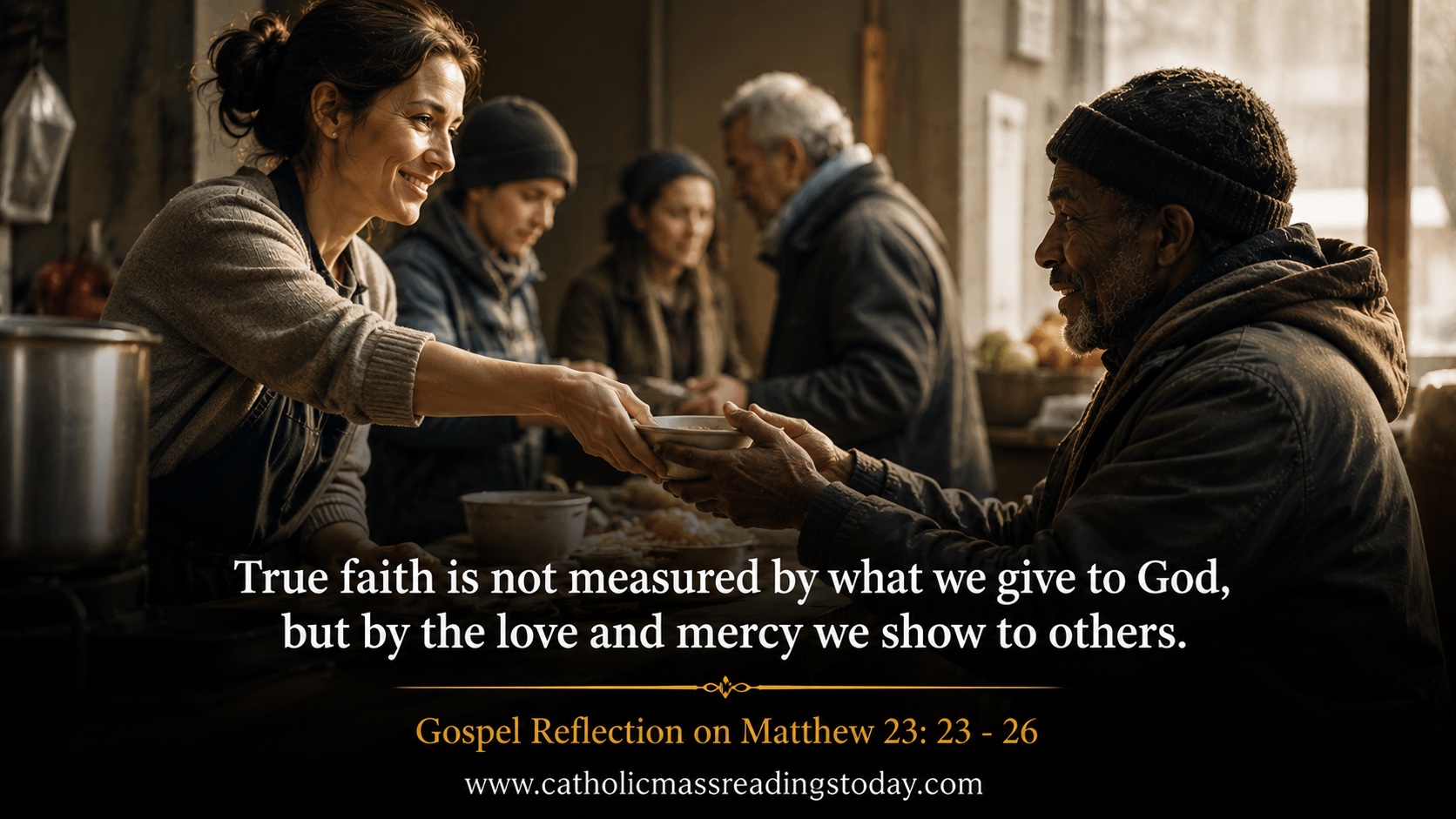
“These you ought to have done, without neglecting the others.”
There are moments in the Gospel when the words of Jesus console the wounded heart. There are other moments when His words disturb us, challenge us and refuse to allow us to remain comfortable with the way we are living. Today’s Gospel belongs to the latter.
Jesus speaks with unusual severity to the scribes and Pharisees. Yet we should not hear His words merely as a condemnation of people who lived two thousand years ago. The Gospel has been preserved for the Church because Christ continues to speak through it. His warning reaches every generation, including our own.
The problem Jesus exposes is not that the scribes and Pharisees cared about religious observance. Their mistake was deeper. They had become so concerned with certain outward requirements that they were neglecting what Christ calls the “weightier matters of the law”: justice, mercy and faith.
They could measure out herbs for tithing with extraordinary care, yet fail to recognize the suffering of the person standing before them.
And here Christ touches something that can easily happen in the life of any believer.
We can know our prayers and still speak harshly to someone in our home. We can attend Mass faithfully and remain unwilling to forgive. We can defend Catholic teaching while failing to show compassion toward the person who is struggling. We can make the Sign of the Cross in public and then conduct our business dishonestly. We can appear deeply religious before others while privately allowing resentment, pride, greed or impurity to take possession of the heart.
Jesus does not tell us that religious practices are unimportant. His words are very precise: “These you ought to have done, without neglecting the others.”
This is important. Christ is not asking us to choose between worship and justice, between prayer and mercy, between fidelity to God’s commandments and compassion toward our neighbour. Authentic Christian life holds them together.
Our worship of God must gradually transform the way we live.
Justice, Mercy and Faith
Jesus places before us three words that deserve serious examination: justice, mercy and faith.
Justice means recognizing that every human person possesses a dignity that comes from God. The poor person, the immigrant, the unborn child, the elderly person, the prisoner, the abandoned child, the person whose opinions differ from ours—all possess a dignity that cannot be taken away because each has been created by God.
Mercy goes even further.
Mercy sees another person’s weakness and refuses to reduce that person to his or her failure. This does not mean pretending that sin does not matter. Christ never treats sin as insignificant. Rather, mercy desires the conversion and restoration of the sinner instead of taking pleasure in condemnation.
This is the mercy we ourselves continually receive from God.
Every time we sincerely approach the Sacrament of Reconciliation, we stand before God with nothing to boast about. We come acknowledging that we have sinned, and yet Christ receives us. He forgives, restores and gives us another beginning.
Having received such mercy, how can we refuse mercy to others?
And then there is faith.
Faith is more than acknowledging that God exists. It is entrusting our lives to Him. It means believing Him when His ways challenge our preferences. It means remaining faithful when prayer seems dry, when suffering makes no sense, when the future is uncertain and when obedience to Christ costs us something.
“First Cleanse the Inside”
Perhaps the most penetrating words in today’s Gospel come when Jesus speaks about the cup and the plate.
The Pharisees were concerned with cleansing the outside, while Christ tells them:
“First cleanse the inside of the cup and of the plate, that the outside also may be clean.”
Here Jesus brings us directly to the human heart. The world is often concerned with appearances. We carefully manage what others see. We present selected parts of our lives to friends, colleagues and increasingly to people on social media. It is possible to construct an impressive public image while carrying tremendous disorder within. But God sees beyond appearances.
- He sees the motives behind our generosity.
- He knows whether our kindness is sincere.
- He knows the resentment hidden behind a smile.
- He knows whether our religious devotion flows from love or from a desire to be admired.
- He knows the battles nobody else knows we are fighting.
And remarkably, Christ does not reveal these things in order to humiliate us. He reveals them because He wants to heal us.
The physician must reach the wound before healing can begin. So must Christ reach the hidden places of the heart.
The Danger of Becoming Comfortable With Our Own Goodness
One of the greatest spiritual dangers is not recognizing that we need conversion. The obvious sinner may eventually cry out, “Lord, have mercy on me.” But the person convinced of his own righteousness may never think to ask.
This was at the heart of Christ’s confrontation with religious hypocrisy. The Pharisees could identify faults in others while becoming increasingly blind to their own.
We should therefore be careful whenever Christianity becomes primarily a means of judging everybody except ourselves. Before asking, “What is wrong with the world?” the disciple of Christ must sometimes have the courage to ask:
- What still needs to change in me?
- Where have I withheld forgiveness?
- Whom have I treated unfairly?
- Where have I chosen convenience instead of truth?
- Have I ignored someone who needed my compassion?
- Have I become more interested in appearing faithful than actually becoming holy?
These are uncomfortable questions. Yet Christianity without conversion becomes little more than an identity we wear. Christ desires something infinitely greater. He desires the transformation of the human person.
Holiness Begins Within
The Catholic faith gives us beautiful outward signs: churches, crucifixes, rosaries, sacred images, vestments, processions, fasting, kneeling, candles and countless devotional practices handed down through generations. These things matter. The Church does not ask us to abandon them.
But every outward expression of faith is meant to lead us toward an inward reality: communion with Jesus Christ.
- The Rosary should lead us closer to Christ through Mary.
- The Eucharist should make our lives increasingly Eucharistic, lives offered in love.
- Confession should produce humility and conversion.
- Fasting should teach us mastery over our desires.
- Prayer should gradually make our hearts resemble the Heart of Christ.
If our religious practices never change the way we treat other people, something essential is missing.
When Christ Looks Into Our Hearts
Today’s Gospel therefore invites us to stand quietly before Jesus without excuses.
Imagine Christ looking into your heart, not with the cold gaze of someone searching for reasons to condemn you, but with the gaze of the One who loved you enough to die for you.
What would He find?
Perhaps generosity alongside pride, faith alongside fear, love alongside resentment, a sincere desire for holiness alongside weaknesses that repeatedly bring us down.
Christ already knows all of it and still He calls us.
This is one of the great consolations of the Christian life. Jesus does not wait until we have perfectly cleansed ourselves before approaching us. We could never accomplish that on our own.
We bring Him the heart as it is and allow grace to begin its work.
Conversion is rarely accomplished in one dramatic moment. Often it happens through countless smaller decisions: choosing patience when anger rises, telling the truth when dishonesty would be easier, forgiving when resentment feels justified, giving when selfishness says to keep, praying when we would rather give up.
Slowly, grace cleanses the inside of the cup and when the inside changes, the outside begins to follow. That is the integrity Christ desires: a life in which the person we appear to be and the person we truly are increasingly become one and the same before God.
Today, therefore, let us not hear Christ’s strong words only as a rebuke. Let us hear within them an invitation.
- An invitation to deeper faith.
- An invitation to justice.
- An invitation to mercy.
- An invitation to allow Jesus into those rooms of the heart that we would rather keep closed.
For holiness is not simply looking righteous before others. Holiness is allowing Christ to make the heart His own.
Let us Prayer
Lord Jesus Christ,
You know the secrets of every heart
and nothing within us is hidden from Your sight.
Cleanse us from pride, hypocrisy and selfishness.
Teach us to seek justice, to practise mercy
and to remain faithful to Your truth.
Purify our hearts before we judge the faults of others.
May our prayers be reflected in the way we live,
our worship in the way we love,
and our faith in the way we treat every person You place before us.
Give us the humility to recognise where we need conversion
and the courage to allow Your grace to change us.
Create in us clean hearts, O Lord,
so that what we profess with our lips
may be witnessed faithfully by our lives.
You live and reign for ever and ever.
Amen.