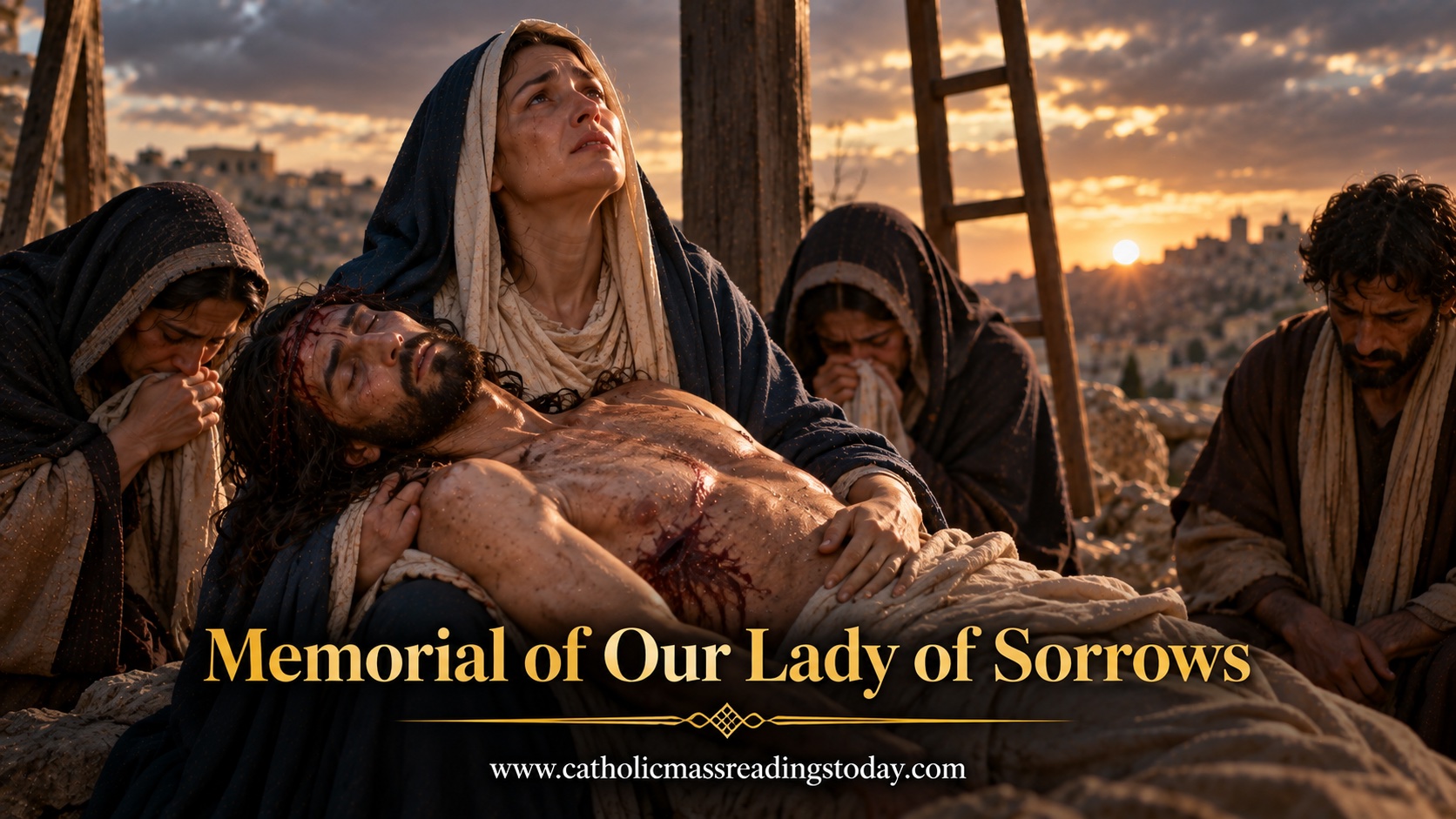
Every year on September 15, the Catholic Church celebrates THE MEMORIAL OF OUR LADY OF SORROWS, a day that draws us into one of the most intimate and painful mysteries in the life of the Blessed Virgin Mary. It comes immediately after the Feast of the Exaltation of the Holy Cross on September 14, and the placement is deeply meaningful. Having spent one day contemplating Jesus Christ upon the Cross, the Church remains at Calvary and turns our attention to the woman standing beneath it: His Mother.
The Memorial of Our Lady of Sorrows is not simply a day for remembering that Mary suffered. It is a celebration of extraordinary faithfulness. Mary knew the joy of carrying the Son of God within her womb, giving birth to Him at Bethlehem and watching Him grow in the quiet home of Nazareth. She also knew fear, uncertainty, separation and, eventually, the almost unimaginable anguish of watching her Son die upon the Cross. Through all of it, she remained faithful to God.
Saint John captures the heart of this memorial in one simple sentence: “Standing by the cross of Jesus were his mother…” Mary could not remove the nails. She could not silence those who mocked Jesus. She could not take His suffering upon herself. But she could remain with Him, and she did.
That faithful presence beneath the Cross has spoken to Christians for centuries. It is why the Church calls her Our Lady of Sorrows.
The Beginning of Mary’s Life and Her Yes to God
Sacred Scripture does not describe Mary’s birth or childhood. The ancient Christian tradition that names her parents as Saints Joachim and Anne comes principally from early extra-biblical writings such as the Protoevangelium of James. The Church preserves the names Joachim and Anne in her liturgical tradition, while not treating every detail of these ancient accounts as historical fact.
What the Gospel reveals clearly is that Mary was a young Jewish woman living in Nazareth and betrothed to Joseph when God entered her life in an extraordinary way. The Angel Gabriel announced that she had found favor with God and would conceive a Son through the power of the Holy Spirit. He would be called Jesus and would be the Son of the Most High.
Mary did not receive a detailed explanation of everything her vocation would eventually require. She was not shown Bethlehem, Egypt, the years of uncertainty, the rejection of Jesus or the hill of Calvary. She was simply invited to trust.
Her answer became one of the most important responses ever spoken by a human being: “Behold, I am the handmaid of the Lord; let it be to me according to your word.”
The story of Our Lady of Sorrows therefore does not begin with sorrow. It begins with a yes.
Mary entrusted herself to God before she knew where that trust would lead. That is important for understanding everything that followed. Her fidelity at Calvary was not a sudden act of courage. It was the mature fruit of a lifetime spent saying yes to God.
The Mother Who Pondered Everything in Her Heart
Mary’s motherhood began with extraordinary joy. She carried Christ within her, visited Elizabeth, sang the Magnificat and eventually gave birth to Jesus at Bethlehem. Yet even the circumstances surrounding His birth revealed that the path ahead would not be easy.
The Son of God entered the world in humility. Soon afterward, Mary and Joseph brought the infant Jesus to the Temple in Jerusalem, in obedience to the Law. There they met Simeon, a righteous man who had been waiting for the consolation of Israel.
Simeon took Jesus into his arms and recognized Him as the salvation God had prepared. Then he turned to Mary and spoke words that must have remained with her for the rest of her life. Jesus would be a sign that would be contradicted, and “a sword will pierce through your own soul also.”
Mary was holding an infant when she heard those words.
She did not yet know how the prophecy would be fulfilled. She could only continue loving her Son and entrusting His future to God. Years later, beneath the Cross, the meaning of Simeon’s prophecy would become painfully clear.
This moment became the first of what Catholic devotion would eventually contemplate as the Seven Sorrows of Mary.
A Mother Forced to Flee with Her Child
The Holy Family soon faced real danger. King Herod sought the life of Jesus, and Joseph was warned in a dream to take the Child and His Mother and flee into Egypt.
Mary therefore knew what it meant to become displaced because violence threatened her family. She knew the uncertainty of leaving home suddenly and entering a foreign land while protecting a vulnerable child.
We can easily make the Flight into Egypt appear peaceful in religious art, but behind the journey was a frightening reality: someone powerful wanted Mary’s Child dead.
This part of her life gives Our Lady of Sorrows a particular closeness to suffering families even today. There are still mothers fleeing war with children in their arms. There are still families forced from their homes by persecution and violence. There are still parents who lie awake wondering whether their children will be safe tomorrow.
Mary knows something of that fear. Her sorrow is therefore not remote from human experience. It enters directly into it.
Searching for Jesus in Jerusalem
Another sorrow came when Jesus was twelve years old.
After travelling to Jerusalem for Passover, Mary and Joseph began their journey home before realizing that Jesus was not among their relatives and companions. They returned anxiously to Jerusalem and searched for Him for three days.
When they finally found Him in the Temple, Mary spoke with the honesty of a frightened mother: “Son, why have you treated us so? Behold, your father and I have been looking for you anxiously.”
Jesus’ answer pointed toward His unique relationship with the Father and the mission for which He had come into the world. Mary did not yet understand everything, but Saint Luke tells us that she kept these things in her heart.
This is one of the most beautiful characteristics of Mary in the Gospel. When she does not understand, she does not walk away from God. She carries the mystery in her heart.
There are times when faith looks exactly like this. We pray and do not understand the answer. We trust God while still carrying questions. We know that He is faithful even when we cannot yet see what He is doing.
Mary teaches us that faith does not require us to understand everything before we trust.
The Hidden Years at Nazareth
Much of Mary’s life was lived far from public attention. The Gospels tell us very little about the long years at Nazareth, and that silence has its own beauty.
The Mother of God lived an ordinary family life.
There were meals to prepare, clothes to wash, prayers to say, neighbors to encounter and the daily responsibilities of a household to fulfill. Mary watched Jesus grow from childhood into adulthood. She knew the sound of His voice in the home long before crowds gathered to hear Him preach.
At some point Joseph disappears from the Gospel narrative. Christian tradition has therefore generally understood that he died before the Passion of Christ, although Scripture does not tell us precisely when.
Eventually Jesus left Nazareth and began His public ministry. Mary would see the extraordinary things surrounding her Son, but she would also become increasingly aware of the opposition against Him. The contradiction Simeon had foretold was becoming visible.
The road from Nazareth was moving toward Jerusalem.
The Mother Who Followed Jesus Toward Calvary
Catholic tradition contemplates Mary’s meeting with Jesus on the road to Calvary as another of her great sorrows. The Gospels do not explicitly describe such an encounter during the carrying of the Cross, so it should be understood as part of the Church’s devotional tradition rather than an event directly narrated in Scripture. It has nevertheless become deeply embedded in Christian meditation, particularly through the Stations of the Cross.
The scene captures something undeniably true about Mary’s place within the Passion: she did not abandon her Son.
The Child she had once carried was now carrying the Cross.
The hands she had held when He was young would soon be nailed to wood. The face she knew better than almost anyone had been struck and wounded.
There are forms of suffering that come not because something happens directly to us, but because something happens to someone we love. A parent would often prefer to suffer personally rather than watch a child suffer.
Mary knew this kind of anguish and still she followed.
Mary Standing Beneath the Cross
Everything in the devotion to Our Lady of Sorrows ultimately brings us to Calvary.
Saint John tells us that Mary stood near the Cross together with other faithful women and the disciple whom Jesus loved. By this point many disciples had fled. Fear had scattered them.
Mary remained.
The Church has contemplated that single fact for centuries.
She stood.
Her standing does not mean that she was somehow untouched by grief. Simeon’s sword was piercing her heart. She stood because love held her there and because grace sustained her.
Before her was the Son she had conceived through the Holy Spirit, carried within her body, given birth to at Bethlehem, protected in Egypt and raised at Nazareth. Now she watched Him die.
There is no need to embellish the scene. The Gospel itself is powerful enough.
And then, amid His own agony, Jesus looked toward His Mother.
Seeing her and the beloved disciple standing nearby, He said to Mary, “Woman, behold, your son!” Then He said to the disciple, “Behold, your mother!”
Saint John immediately adds that from that hour the disciple took Mary into his own home.
The Church has always recognized the immediate human meaning of these words: Jesus was ensuring that His Mother would be cared for. Yet Catholic tradition has also contemplated something deeper. The beloved disciple stands beneath the Cross as a disciple of Christ, and in him the Church sees something of every disciple who will follow Jesus.
From the Cross, Mary receives a new maternal relationship with Christ’s disciples.
This is one of the foundations of the Catholic understanding of Mary’s spiritual motherhood.
When Jesus says, “Behold, your mother,” the Church hears words that continue to echo through the generations.
Mary’s Sorrow Never Replaces the Sacrifice of Christ
Our devotion must always remain firmly rooted in Catholic teaching. Mary is not the Redeemer. Salvation comes through Jesus Christ, whose Passion, death and Resurrection reconcile humanity to the Father.
Everything Mary possesses comes from the grace of God and from her unique relationship with Christ.
Yet among all human beings, Mary’s participation in the events of Christ’s earthly life was unique. She gave Him His human nature. She raised Him. She followed Him. She loved Him as only His Mother could. And when the hour of His sacrifice came, she stood beneath His Cross.
To contemplate Mary’s sorrow therefore does not lead us away from Jesus. Properly understood, it takes us more deeply into His Passion.
Our Lady of Sorrows never says, “Look at me instead of my Son.”
Her entire life says, “Look at Him.”
The Mother Receiving the Body of Her Son
After Jesus died, His body was taken down from the Cross.
Christian devotion has long contemplated Mary receiving the body of her Son. The image has become one of the most recognizable scenes in Christian art, immortalized especially in representations of the Pietà.
There is an almost unbearable contrast between Bethlehem and Calvary.
At Bethlehem, Mary received the living body of the infant Jesus into her arms.
At Calvary, tradition contemplates her receiving His lifeless body.
The hands that once wrapped Him in swaddling clothes now encounter the wounds of His Passion.
The Mother who once watched Him sleep now looks upon the silence of death and yet Christianity refuses to leave Mary there.
Good Friday is real, but it is not the conclusion of the Gospel.
Mary at the Tomb and the Silence Before Easter
The burial of Jesus forms the final traditional sorrow of Mary.
Christ’s body is placed in the tomb, and the stone is rolled into place. His followers depart carrying a grief that must have seemed overwhelming.
Mary knew what it meant to walk away from the tomb of someone she loved.
That alone makes Our Lady of Sorrows profoundly close to anyone who has ever stood beside a grave and wondered how life could continue afterward.
Yet there was something that neither the stone nor the silence could change.
God was still faithful, the promises had not failed.
The darkness of Good Friday and the silence of Holy Saturday were moving toward Easter morning.
The sorrow of Mary is therefore never Christian despair. It is sorrow lived within faith.
She does not teach us that believers never weep. She teaches us that tears and hope can exist within the same faithful heart.
The Seven Sorrows and the Heart of Marian Devotion
Over the centuries, the Church’s meditation on Mary’s suffering became especially associated with seven moments: Simeon’s prophecy, the Flight into Egypt, the loss of the Child Jesus in Jerusalem, Mary’s encounter with Jesus on the way to Calvary, the Crucifixion and death of Christ, the taking down of His body from the Cross, and His burial.
These became known as the Seven Sorrows of Mary.
They should not be treated merely as seven episodes to remember. Together they reveal the unfolding of a single vocation.
Mary said yes at Nazareth and continued saying yes when obedience became costly.
Her faith matured through joy and sorrow, ordinary family life and extraordinary suffering. The young woman who told Gabriel, “Let it be to me according to your word,” became the Mother standing beneath the Cross when obedience to that word demanded almost everything from her.
The Seven Sorrows therefore invite us not simply to pity Mary, but to learn from her.
Mary After Calvary
The Cross was not the end. Jesus Christ rose from the dead.
The Gospels do not describe a private appearance of the risen Christ to His Mother, although Christian spiritual tradition has often lovingly contemplated such a meeting. We should distinguish such devotional reflection from what Scripture explicitly tells us.
What Scripture does tell us is that Mary remained with Christ’s disciples.
After the Ascension, Acts of the Apostles places her in the Upper Room, united in prayer with the apostles as they awaited the coming of the Holy Spirit.
The Mother who stood beneath the Cross therefore appears again at the heart of the praying Church.
She had accompanied Christ through His earthly life. Now she was present among those who would carry His Gospel into the world.
Mary’s vocation had not ended at Calvary. Her maternal presence remained within the life of the Church.
The Completion of Mary’s Earthly Life
Sacred Scripture does not tell us the circumstances surrounding the end of Mary’s earthly life. Ancient Christian traditions associate her final years particularly with Jerusalem, while another longstanding tradition connects her with Ephesus.
The Catholic Church solemnly teaches that when the course of her earthly life was completed, the Blessed Virgin Mary was assumed body and soul into heavenly glory.
The dogmatic definition of the Assumption does not settle the question of whether Mary first underwent bodily death. A very ancient Christian tradition, particularly expressed in the Eastern celebration of the Dormition, holds that she did. The Church’s defined teaching, however, focuses upon the certainty that at the completion of her earthly life Mary was assumed body and soul into heaven.
The woman whose heart was pierced by sorrow now shares in the glory of her risen Son.
This is where the story of Our Lady of Sorrows ultimately leads. Not to permanent mourning but to glory.
The Mother at Calvary becomes for Christians a sign of what God’s grace can accomplish when human beings remain faithful to Him.
How Devotion to Our Lady of Sorrows Grew in the Church
The roots of devotion to Mary’s sorrows lie in Scripture itself. Simeon’s prophecy of the sword and Saint John’s account of Mary beneath the Cross naturally invited Christians to contemplate what the Mother of Jesus experienced during the Passion.
Over the centuries, this meditation developed more formally within Christian spirituality.
A particularly important role was played by the Order of the Servants of Mary, commonly known as the Servites, founded in Florence in the thirteenth century. The Servites developed a profound spirituality centered upon Mary, especially her suffering in union with the Passion of Christ, and helped spread devotion to the Seven Sorrows throughout the Church.
The medieval period also gave the Church one of its most moving meditations upon Mary’s sorrow: the Stabat Mater.
Its opening words place us immediately at Calvary: the sorrowful Mother stands beside the Cross while her Son hangs dying.
The hymn does not invite us merely to observe Mary from a distance. It asks that our own hearts be drawn into contemplation of Christ’s Passion with her. It has inspired generations of Christians and some of the greatest works of sacred music ever composed.
Its spirituality is simple but demanding: stand with Mary beside Jesus.
How September 15 Became the Memorial of Our Lady of Sorrows
The liturgical celebration we now observe on September 15 developed gradually.
Devotion to Mary’s compassion and sorrows had been growing for centuries when various local celebrations began to emerge. The Servites were instrumental in establishing and spreading a feast centered upon the Seven Sorrows.
The observance eventually received wider papal approval, and in 1814 Pope Pius VII extended the September feast to the universal Latin Church. Later, Pope Saint Pius X fixed its celebration on September 15.
The date creates one of the most beautiful pairings in the Roman liturgical calendar.
On September 14, the Church celebrates the Exaltation of the Holy Cross.
On September 15, she celebrates Our Lady of Sorrows.
First we contemplate Christ crucified.
Then we remain at Calvary and contemplate His Mother standing beside Him.
The two celebrations belong naturally together because Mary’s sorrow can only be understood in relation to Christ’s Cross.
Why the Memorial of Our Lady of Sorrows Matters Today
The Memorial of Our Lady of Sorrows remains deeply relevant because suffering has not disappeared from human life.
Behind the doors of our homes, hospitals, workplaces and parishes are people carrying crosses that others may know nothing about.
There are parents frightened for their children. There are husbands and wives watching someone they love become seriously ill. There are families facing financial uncertainty. There are people grieving someone whose voice they desperately wish they could hear once more. There are mothers who have buried children. There are people whose prayers seem to have gone unanswered for years.
Mary does not come into these situations with an easy explanation.
She comes as the Mother who knows what it means to stand beneath a Cross.
Sometimes suffering cannot immediately be solved. Sometimes there is no sentence that can make grief disappear. Sometimes love has nothing left to offer except presence.
Mary teaches us the holiness of remaining.
At Calvary she could not take Jesus’ suffering away, but she would not allow Him to suffer without the presence of His Mother.
There is a lesson here for the whole Church.
We cannot remove every cross from another person’s life, but we can refuse to abandon people while they carry it.
What Our Lady of Sorrows Asks of Us
Authentic devotion to Our Lady of Sorrows should change the way we live.
It is not enough to admire Mary’s faithfulness while walking away from people who are suffering around us. If we stand spiritually with Mary at Calvary, we should begin to recognize the Calvaries hidden within ordinary life.
There may be someone in our family who needs patience rather than criticism. Someone grieving may need us simply to sit beside them. An elderly person may need a visit. A frightened parent may need someone to listen. A person carrying a private burden may need to know that somebody is praying for them.
Mary’s example also challenges our understanding of faith. She was full of grace, yet her life was not free from suffering. This matters enormously.
We sometimes assume that if we pray faithfully and try to live close to God, everything should work out according to our expectations. Then suffering comes, and we wonder whether God has abandoned us.
Mary tells us otherwise. There may be moments when the road of faith itself passes through Calvary.
The question then becomes not simply, “Why has this happened to me?” but also, “Lord, how can I remain faithful to You here?”
Mary shows us how.
How Catholics Can Celebrate the Memorial of Our Lady of Sorrows
The most fitting celebration of this memorial begins with Christ. Where possible, Catholics can participate in Holy Mass and listen carefully to the Scriptures chosen by the Church. The Gospel places us beneath the Cross with Mary and the beloved disciple and allows us to hear once again the words of Jesus: “Behold, your mother.”
The day is also particularly suited to quiet prayer before a crucifix.
The Rosary can be prayed slowly, especially while contemplating the Sorrowful Mysteries. Catholics may also pray the Chaplet of the Seven Sorrows, meditate upon the Seven Sorrows themselves or pray the Stabat Mater.
But devotion should eventually become action.
A beautiful way to honor Our Lady of Sorrows is to seek out someone carrying a cross and remain with them.
- Visit the sick.
- Comfort the grieving.
- Remember someone who has recently lost a loved one.
- Pray for mothers who are suffering for their children.
- Call the person who has become isolated.
- Offer practical help to a family passing through hardship.
Not because these acts earn Mary’s favor, but because they imitate the love she showed at Calvary.
Our devotion becomes most credible when it makes us more compassionate.
Our Lady of Sorrows Is Ultimately a Mother of Hope
If we see only Mary’s tears, we have not yet understood the whole mystery. Our Lady of Sorrows is not Our Lady of Despair. She is a woman of extraordinary hope.
She stood beneath the Cross before she saw the empty tomb. She remained faithful during the hour when everything visible seemed to contradict the promises of God. That is why she can accompany us when our own lives enter darkness.
She knows what it means to trust before the answer arrives, she knows what it means to remain when leaving would seem easier and she knows what it means to carry sorrow without allowing sorrow to destroy faith.
And because the Son she watched die rose from the dead, Mary’s story assures us that Calvary never has the final word for those who belong to Christ.
The Christian story does not end with the sword piercing Mary’s heart.
- It does not end with the Cross.
- It does not even end with the tomb.
- It ends in Resurrection and eternal life.
“Behold, Your Mother”
At the heart of THE MEMORIAL OF OUR LADY OF SORROWS remain the words spoken by Jesus from the Cross: “Behold, your mother.”
The beloved disciple received Mary and took her into his home. Every Christian can hear in that moment an invitation to receive the Mother of Jesus more deeply into the life of faith.
We do not come to Mary instead of Jesus.
We come to Mary because she teaches us how to remain close to Jesus.
- At Nazareth she trusted His coming.
- At Bethlehem she held Him.
- At Cana she directed others toward Him.
- At Calvary she stood beside Him.
- After the Ascension she prayed with His Church.
And now, in the communion of saints, she continues to point the faithful toward her Son.
- When our lives are joyful, Mary teaches us gratitude.
- When God’s plans are difficult to understand, she teaches us trust.
- When someone we love is suffering, she teaches us presence.
- When our own cross becomes heavy, she teaches us perseverance.
- And when we encounter death, she reminds us that her Son has already passed through the tomb and emerged victorious.
This is why the Church returns to Our Lady of Sorrows year after year.
We look upon a Mother whose heart was pierced, but whose faith was not destroyed. We see a woman who could not prevent Calvary but refused to abandon Christ upon it. And through her, we learn that there are moments when the greatest act of faith is simply to remain beside Jesus and trust that God is still at work.
On this Memorial of Our Lady of Sorrows, may we bring to Mary the sorrows we carry within our own hearts and the suffering of those we love. May she teach us not to run from the Cross, but to find Christ there. And may she help us remember, especially when life becomes dark, that beyond every Good Friday stands the promise of Easter morning.
Prayer to Our Lady of Sorrows
O Blessed Virgin Mary, Mother of Sorrows, you stood faithfully beneath the Cross and watched your beloved Son offer His life for the salvation of the world. The sword foretold by Simeon pierced your maternal heart, yet suffering did not separate you from God, and sorrow did not overcome your faith.
Remain close to us in the hours when our own crosses become heavy. When we do not understand God’s ways, teach us to trust. When those we love are suffering, give us the courage to remain beside them with tenderness, patience and prayer. When grief enters our homes, remind us that the Cross of Christ leads ultimately to the glory of the Resurrection.
Mother of Sorrows, remember all mothers who weep for their children, all families burdened by illness or loss, all who suffer because of war and violence, all who are lonely or forgotten, and all whose pain is known to God alone.
Lead us always to Jesus. Teach us to love Him as you loved Him, to remain faithful when following Him becomes costly, and to place our whole lives into the hands of the Father.
O Mary, Mother of the Crucified Lord and Mother of the Church, stand beside us throughout our earthly pilgrimage and pray for us now and at the hour of our death, that after sharing faithfully in the Cross of Christ, we may rejoice forever in the glory of His Resurrection.
Through Christ our Lord.
Amen.