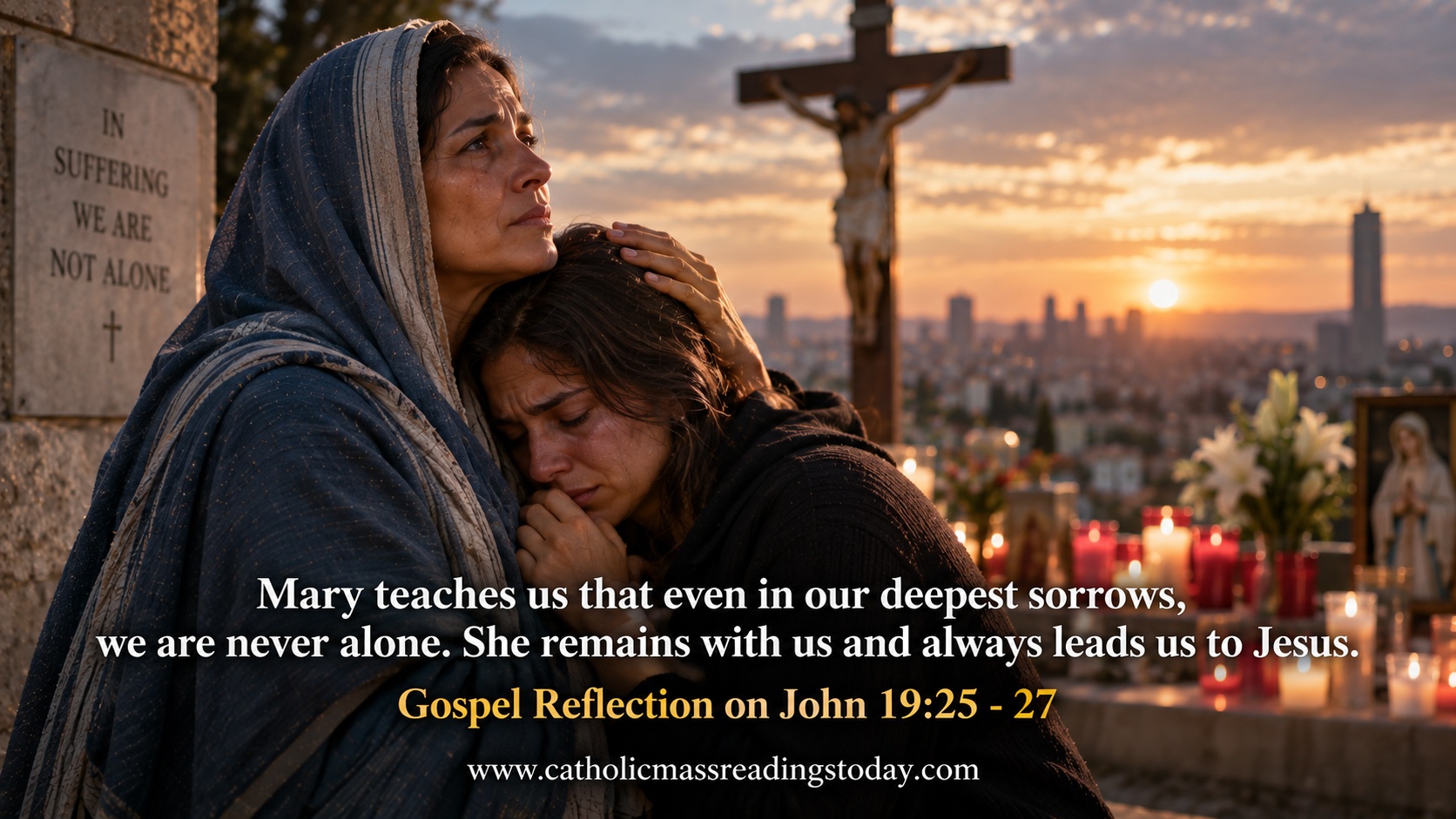
“Behold, Your Mother”
Mary Stood by the Cross
There are moments in the Gospel when very few words are needed because the scene itself speaks directly to the heart. Today Saint John takes us to Calvary. Jesus is dying upon the Cross, and beneath Him stands His Mother.
Saint John does not tell us that Mary fled, collapsed in despair or turned away because the suffering was unbearable. He simply tells us that she was “standing by the cross of Jesus.”
That word “standing” reveals something profound about Mary. She is suffering terribly, but she remains. She cannot remove the nails. She cannot silence the mockery. She cannot take her Son down from the Cross. Yet there is one thing she can still give Him: her presence and her love.
This is the faithfulness of Mary.
Her strength does not come from being untouched by sorrow. On the contrary, she suffers precisely because she loves so deeply. Yet even when she cannot understand everything taking place before her, she continues to trust God.
The Sword That Pierced Her Heart
Many years earlier, when Mary and Joseph presented the infant Jesus in the Temple, Simeon had spoken mysterious words to her: “And a sword will pierce through your own soul also.”
At Calvary, those words reach their terrible fulfilment.
The Mother who once held the infant Jesus in Bethlehem now looks upon His wounded body on the Cross. The hands she held when He was a child have been nailed to the wood. The voice she first heard in the home at Nazareth now speaks through the agony of Crucifixion.
This is why the Church venerates Mary under the beautiful and sorrowful title Our Lady of Sorrows. Her suffering is not separate from her love for Christ. She enters deeply into the Passion of her Son, not as the source of our redemption, for Christ alone is the Redeemer, but as the Mother who remains faithfully united with Him beneath the Cross.
Mary teaches us something essential here: faith does not mean that we will never experience sorrow. Faith means that sorrow does not have to separate us from God.
“Woman, Behold Your Son”
Then something extraordinary happens.
Even while enduring His own suffering, Jesus looks down and sees His Mother. Beside her stands the disciple whom He loves.
Jesus says to Mary, “Woman, behold your son!”
Then He turns to the disciple and says, “Behold, your mother!”
These words certainly express the loving concern of a dying Son for His Mother. Jesus entrusts Mary to the care of the beloved disciple. But the Church has always contemplated a deeper meaning in this moment.
The beloved disciple stands beneath the Cross not only as an individual. He also represents the disciples of Christ. In entrusting Mary to him, Christ gives His Mother a new maternal relationship with those who belong to Him.
This is why Catholics call Mary our Mother.
We do not place Mary in the place of Christ. Everything about authentic Marian devotion leads us toward Jesus. Her entire life points toward Him. At Cana she said, “Do whatever he tells you.” At Calvary, she says nothing. She simply remains beside Him.
Mary never keeps us for herself. She brings us to her Son.
A Mother Given to Us from the Cross
It is deeply significant that Jesus gives us Mary at Calvary.
He does not give her to us during the joy of the wedding feast at Cana. He gives her to us from the Cross.
Perhaps this is because we especially need a mother when life becomes painful.
There are times when our own lives resemble Calvary more than Cana. A family receives frightening medical news. A parent stands beside the grave of a child. A marriage passes through a painful season. Someone loses the person around whom much of life had been built. Another carries a private grief that nobody around them fully understands.
In such moments, explanations alone are often not enough.
Sometimes what we need most is someone who will remain.
Mary understands this kind of presence because she stood at Calvary when there was nothing she could do to change what was happening before her.
She teaches us that sometimes Christian love does not begin with finding the perfect words. Sometimes love means standing beside another person’s cross and refusing to leave them alone.
When We Cannot Understand God
Mary also speaks powerfully to those moments when we do not understand what God is doing.
At the Annunciation she had answered, “Let it be to me according to your word.” But her yes did not mean that every part of the journey would be easy.
That yes eventually led her to Calvary.
There are moments in our own lives when faith may feel like this. We have prayed, yet the answer we hoped for has not come. We have tried to remain faithful, yet suffering has entered our home. We know that God is good, but we cannot understand why He has permitted something painful.
Mary does not offer us an easy explanation for suffering.
She offers us something more powerful: her example of remaining faithful in the darkness.
She stands beneath the Cross without knowing yet how Easter morning will unfold.
That is faith.
Faith is not always seeing the road ahead. Sometimes it is remaining with Christ when all we can see is the Cross.
“Behold, Your Mother”
Jesus’ words to the beloved disciple are also addressed, in a spiritual sense, to every disciple: “Behold, your mother.”
To behold Mary means more than simply to admire her.
It means to welcome her into our life of faith as the beloved disciple did. Saint John tells us, “And from that hour the disciple took her to his own home.”
There is something beautiful about those words. The disciple made room for Mary.
We too are invited to make room for her—not instead of Christ, but precisely because we belong to Christ. We ask for her intercession. We meditate upon the mysteries of Christ with her in the Rosary. We learn from her humility, obedience and trust. We ask her to accompany us when our faith becomes difficult.
And Mary always does what she did throughout the Gospel: she directs our attention toward Jesus.
Standing Beside the Crosses of Others
Today’s Gospel should also change the way we look at suffering around us.
There are people carrying crosses very close to us whom we may hardly notice.
Someone may be grieving quietly. Someone may be caring for an elderly parent and becoming exhausted. Someone may be struggling financially while pretending everything is fine. Someone may be frightened by a diagnosis. Someone may be lonely even while surrounded by people.
We cannot always remove another person’s cross. Mary could not remove Christ’s Cross. But we can refuse to let people carry their crosses alone.
Sometimes the most Christlike thing we can do is stay. Listen. Pray. Visit. Sit beside someone. Make the telephone call we have been postponing. Let another person know, without grand speeches, “I am here.”
The world has many people who know how to speak. It desperately needs more people who know how to remain.
Mary remained.
From Calvary to Hope
Yet Calvary is not the end of Mary’s story, and it is not the end of ours.
The Mother who stood beneath the Cross would also belong to the community that rejoiced in the Resurrection. The darkness of Good Friday would not have the final word.
This is Christian hope.
We do not deny suffering. We do not pretend that death does not wound us or that grief disappears simply because we believe. But we face these realities knowing that Jesus Christ has passed through death and conquered it.
The Cross leads to the empty tomb.
And Mary, who teaches us how to stand faithfully at Calvary, also teaches us how to wait for God’s victory when we cannot yet see it.
So when our own crosses become heavy, we can hear again the words of Jesus:
“Behold, your mother.”
And with Mary beside us, we can turn our eyes toward Christ and remain there, trusting that the God who brought Resurrection out of Calvary can also bring light into the places of our lives that presently seem darkest.
Let us Pray
O Lord Jesus Christ, who from the Cross entrusted Your Blessed Mother to the beloved disciple, grant that we may receive her with faith and love as our Mother and follow her example of unwavering fidelity to You.
When sorrow enters our lives, strengthen us to remain close to Your Cross. When we cannot understand Your ways, give us the trust of Mary. When others suffer beside us, teach us not to turn away, but to remain with them in compassion, prayer and love.
O Blessed Virgin Mary, Mother of Sorrows, who stood faithfully beneath the Cross of your Son, accompany us in the hours of our own suffering. Take us by the hand and lead us always to Jesus. Teach us to trust when we cannot see, to hope when darkness surrounds us, and to remain faithful until the Cross gives way to the joy of Resurrection.
Through Christ our Lord.
Amen.