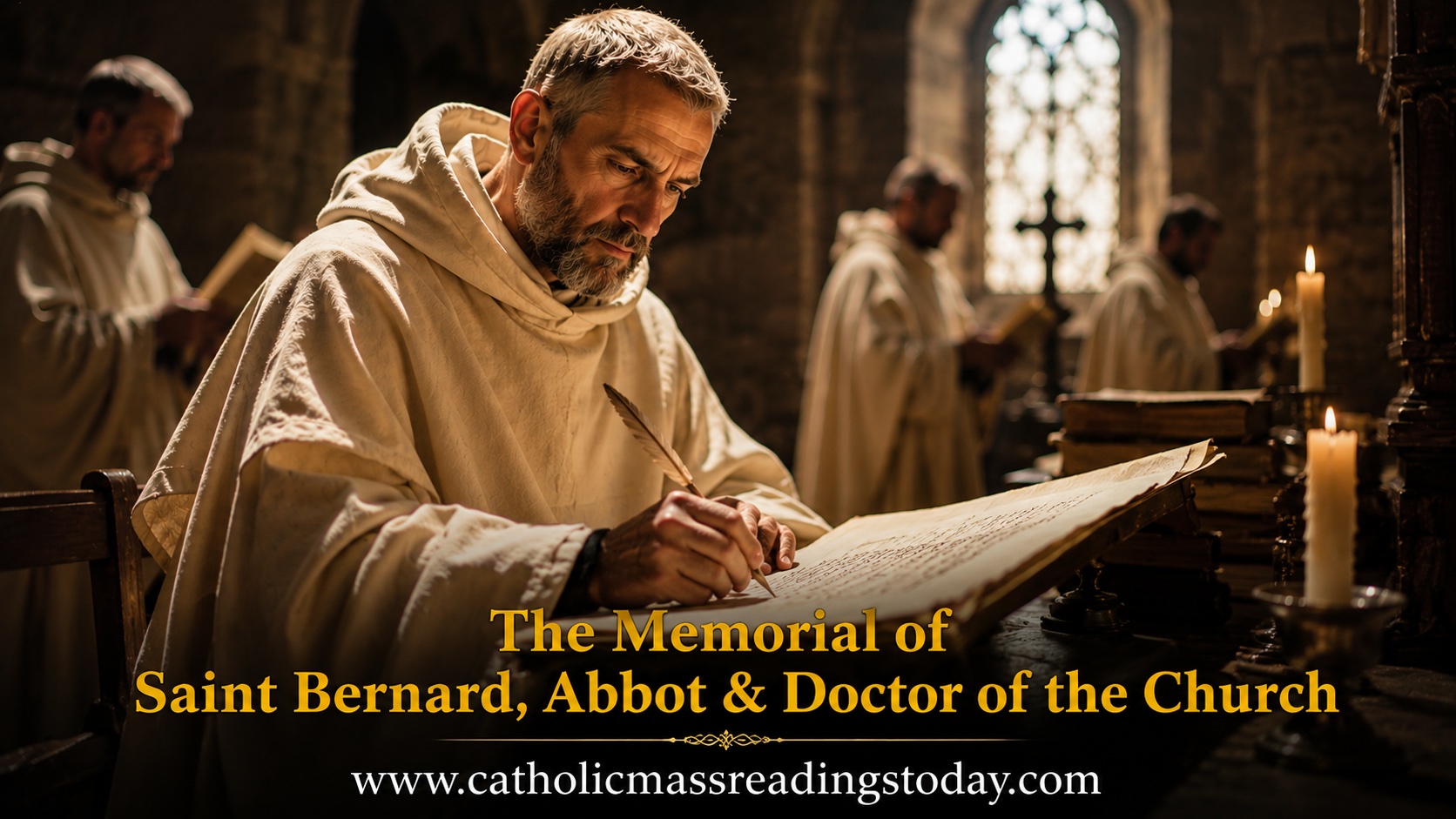
Every year on 20th August, the Catholic Church celebrates The Memorial of Saint Bernard, Abbot & Doctor of the Church, one of the most influential saints of the Middle Ages. A gifted preacher, a brilliant theologian, a humble monk, and a devoted servant of the Blessed Virgin Mary, Saint Bernard left a lasting mark on the Church that continues to inspire Christians nearly nine centuries after his death.
His life was one of extraordinary holiness, yet it was lived amid the challenges of a rapidly changing world. He guided kings, advised popes, strengthened religious life, defended the Catholic faith against error, and reminded countless souls that the true purpose of every Christian life is to know, love, and follow Jesus Christ.
To understand why the Church honours Saint Bernard with the rare title of Doctor of the Church, one must first journey back to the noble family into which he was born, where the seeds of his remarkable vocation were first planted.
A Child Born into Nobility
Saint Bernard was born in 1090 at the Castle of Fontaine-lès-Dijon near Dijon in Burgundy, in present-day France.
His father, Tescelin de Fontaine, was a respected knight known for his courage and loyalty. His mother, Aleth of Montbard, was remembered for her deep faith, charity, and devotion to God. She was determined that her children should grow up not merely with privilege but with holiness.
From an early age, Bernard displayed remarkable intelligence. He received an excellent education in literature, philosophy, Sacred Scripture, and the liberal arts. Those who knew him noticed not only his sharp mind but also a reflective spirit that often preferred silence and prayer over worldly entertainment.
His mother’s influence shaped him profoundly. She frequently encouraged him to seek wisdom above wealth and holiness above honour. Her early death deeply affected the young Bernard and became one of the turning points that drew his heart away from earthly ambitions toward God.
Choosing Christ Above Everything
As Bernard entered adulthood, Europe admired military glory, noble titles, and political influence. He could easily have pursued any of these paths.
Instead, he chose one that surprised everyone.
In 1112, at only twenty-two years of age, Bernard entered the newly founded Cistercian Abbey of Cîteaux. The monastery had been established only a few years earlier to restore the original simplicity, poverty, manual labour, and prayer envisioned in the Rule of Saint Benedict.
The decision shocked many of his relatives. Yet Bernard’s conviction was so persuasive that his witness inspired an extraordinary number of others to follow him.
His four brothers entered religious life with him.
His uncle joined him.
Several cousins and close friends also entered the monastery.
More than thirty young noblemen followed Bernard to Cîteaux, transforming what had been a struggling monastery into a flourishing community.
It was the beginning of one of the greatest monastic revivals in Church history.
Learning the Way of Humility
Life at Cîteaux was demanding.
The monks rose before dawn for prayer, worked in the fields, copied manuscripts, fasted regularly, and embraced a life of poverty and silence.
Bernard embraced every aspect of this discipline with wholehearted generosity.
Sometimes he was so absorbed in prayer and contemplation that he scarcely noticed the hardships around him. His intense fasting and penances eventually affected his health, something he would struggle with for the rest of his life.
Yet those who lived beside him were struck not by his severity but by his kindness, humility, and genuine joy.
His love for Christ became contagious.
The Founding of Clairvaux
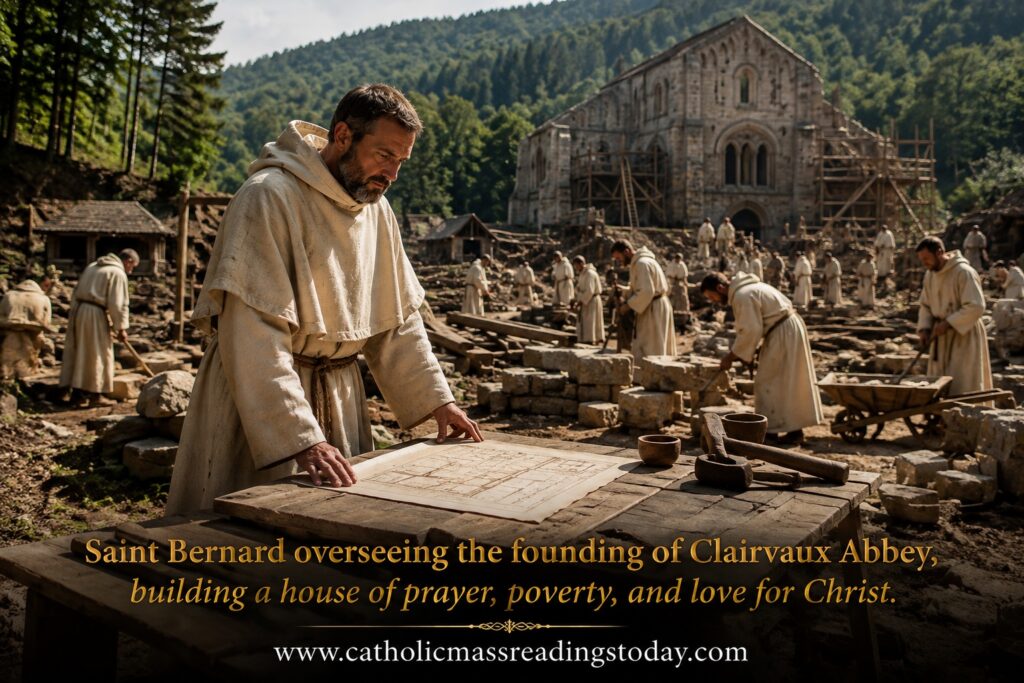
Only three years after entering Cîteaux, Bernard’s gifts were already impossible to overlook.
In 1115, he was sent to establish a new monastery in a secluded valley that came to be known as Clairvaux, meaning “Clear Valley.”
The beginnings were difficult, the land was wild, buildings were few and food was scarce.
The monks worked tirelessly with their own hands to build the monastery. Bernard led not from comfort but by example.
He laboured beside the brothers, prayed beside them, encouraged them during hardship, and constantly reminded them that every sacrifice offered with love became pleasing to God.
Under his leadership, Clairvaux became one of the most influential monasteries in Europe.
By the end of Bernard’s life, more than sixty monasteries had been founded directly from Clairvaux, while the wider Cistercian Order had expanded to over three hundred abbeys across Europe.
A Man Whose Words Moved Nations
Although Bernard longed for the quiet life of the monastery, the wider Church continually called upon him.
His wisdom became widely known, bishops sought his advice. Kings requested his counsel and Popes trusted his judgement.
Whenever disputes threatened the unity of the Church, Bernard was often asked to intervene.
He defended the rights of the papacy during times of political conflict while urging both rulers and clergy to seek peace rather than personal ambition.
He reminded those in positions of authority that leadership was not about power but about humble service.
His influence reached every corner of Christian Europe.
Defender of the Catholic Faith
Saint Bernard also became one of the Church’s greatest theological voices.
When false teachings threatened to confuse the faithful, Bernard responded not with anger but with careful teaching rooted in Sacred Scripture, Sacred Tradition, and the wisdom of the Fathers of the Church.
One of his best-known theological confrontations was with the philosopher Peter Abelard, whose methods and certain theological positions Bernard believed endangered authentic Catholic doctrine.
Bernard defended the mystery of faith against reducing Christianity to mere intellectual speculation.
For him, knowledge without humility could never lead to God.
True theology, he believed, must always begin in prayer and end in love.
His Great Love for the Blessed Virgin Mary
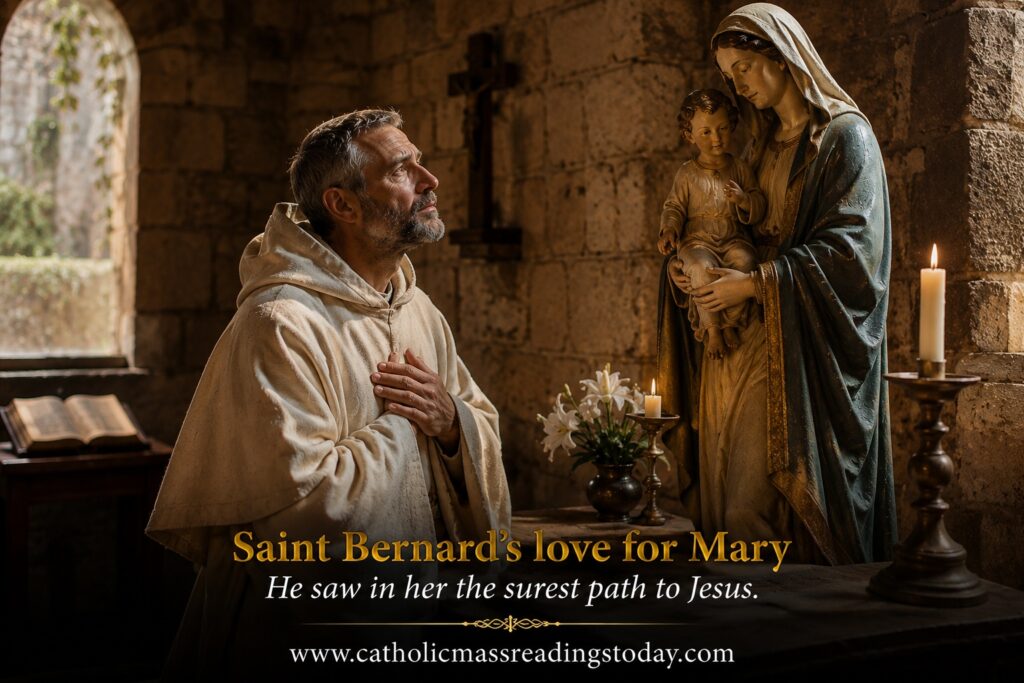
Perhaps no aspect of Saint Bernard’s spirituality is remembered more warmly than his profound devotion to the Blessed Virgin Mary.
He spoke of Mary not simply as an historical figure but as a loving Mother who continually leads believers to Jesus.
Many of his sermons on the Blessed Virgin remain among the finest ever written.
He encouraged Christians to seek Mary’s intercession with complete confidence, believing that every grace ultimately comes through Christ but that Mary lovingly accompanies her children toward her Son.
The famous prayer “Memorare” is traditionally associated with Saint Bernard. Although scholars debate whether he composed its exact wording, the prayer beautifully expresses the Marian confidence that marked his entire life.
His sermons helped deepen Marian devotion throughout Europe and continue to nourish the Church today.
A Spiritual Master
Bernard wrote extensively throughout his life.
His greatest works include sermons on the Song of Songs, in which he described the Christian life as a beautiful journey of love between Christ and the human soul.
Unlike many scholars of his day, Bernard wrote not merely to instruct the mind but to move the heart.
His writings invite readers into deeper prayer, greater trust in God’s mercy, and a more intimate relationship with Jesus Christ.
His spiritual insights remain remarkably fresh, speaking not only to monks and priests but to every Christian seeking holiness amid the demands of daily life.
The Final Years
Years of travel, preaching, fasting, and constant labour gradually weakened Bernard’s health.
Even when illness confined him, he continued writing letters, encouraging religious communities, and offering guidance to Church leaders.
His concern was never for himself but always for the good of the Church.
On 20 August 1153, at Clairvaux Abbey, Saint Bernard peacefully surrendered his soul to God.
He was sixty-three years old.
The monks who surrounded him understood they were witnessing the passing of a man whose entire life had been spent pointing others toward Christ.
Canonisation and Doctor of the Church
The holiness of Bernard’s life was recognised almost immediately.
He was canonised by Pope Alexander III in 1174, only twenty-one years after his death.
Several centuries later, in 1830, Pope Pius VIII declared him a Doctor of the Church, recognising the enduring importance of his writings, teaching, and spiritual wisdom.
The title reflects not only his intellectual brilliance but also the extraordinary way his teaching continues to nourish the faith of the universal Church.
Why Saint Bernard Still Matters Today
The world in which Saint Bernard lived was very different from our own, yet the challenges remain surprisingly familiar.
People still seek success more eagerly than holiness. Many still pursue possessions while neglecting the soul. Noise and distraction often leave little room for silence and prayer.
Saint Bernard reminds us that true peace is never found in achievements alone but in loving God above everything else.
He teaches us that prayer is not an escape from the world but the source of strength to serve it faithfully.
His life also reminds us that authentic devotion to the Blessed Virgin Mary always leads us closer to Jesus Christ.
His witness continues to inspire priests, religious, theologians, students, families, and all who desire a deeper friendship with God.
Nearly nine hundred years after his death, Saint Bernard’s voice still echoes through the Church with the same simple invitation: love Christ above all things, trust the Mother of God, seek holiness with humility, and never tire of pursuing the eternal treasures that neither time nor death can take away.
Let us Pray
In the name of the Father, and of the Son, and of the Holy Spirit. Amen.
O glorious Saint Bernard, Abbot and Doctor of the Church, faithful servant of Christ and devoted son of the Blessed Virgin Mary, you sought God’s will above every earthly ambition and taught countless souls to love Jesus with undivided hearts.
Pray for us, that we may grow in humility, persevere in prayer, and remain faithful to the teachings of the Holy Catholic Church. Help us to seek wisdom that comes from God rather than the passing wisdom of the world. Inspire us to live lives of charity, purity, and joyful obedience to the Gospel.
Teach us to entrust ourselves to the loving care of the Blessed Virgin Mary, so that, through her maternal intercession, we may draw ever closer to her Divine Son.
May your example encourage us to pursue holiness with courage, to serve others with generosity, and to keep our eyes fixed on the eternal kingdom prepared for those who love the Lord.
Through your prayers, may we remain steadfast in faith until the day we rejoice with you in the presence of God forever.
Through Christ our Lord.
Amen.
1 thought on “The Memorial of Saint Bernard, Abbot & Doctor of the Church”