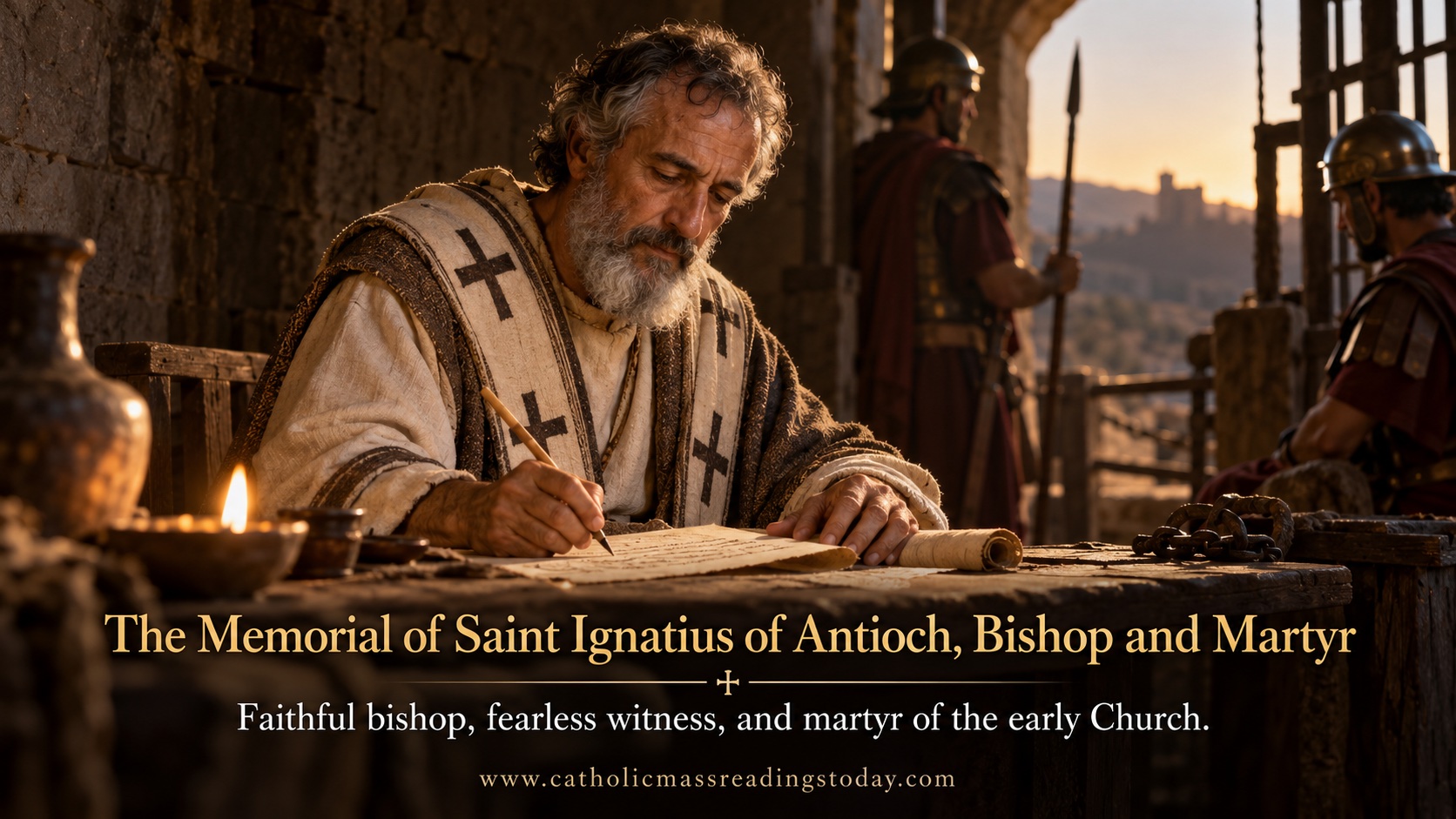
Each year on October 17, the Catholic Church celebrates the Memorial of Saint Ignatius of Antioch, Bishop and Martyr, one of the most important Christian witnesses from the generation immediately after the Apostles. His life belongs to the earliest centuries of Christianity, a time when the Church was still young, often persecuted, and working to preserve the faith handed on by those who had known Christ and the Apostles personally.
Saint Ignatius of Antioch is remembered not only because he died for Christ, but because of the extraordinary testimony he left behind on his journey to martyrdom. His letters reveal a Church already deeply conscious of the divinity of Christ, the reality of the Eucharist, the importance of bishops, the unity of believers, and the meaning of Christian martyrdom. They offer a rare and precious glimpse into what Catholics believed and practiced at the beginning of the second century.
For the Church today, Saint Ignatius remains a powerful figure because his faith was neither theoretical nor comfortable. He believed so deeply in Christ that he was willing to give his life rather than deny Him. At the same time, he spent his final journey strengthening other Christians, urging them to remain united, faithful, and rooted in the Eucharist.
The World Into Which Saint Ignatius of Antioch Was Born
The exact year and place of the birth of Saint Ignatius of Antioch are not known with certainty. He was probably born sometime around the middle of the first century, perhaps between A.D. 35 and 50. That means his life overlapped with the final decades of the apostolic age.
Ignatius grew up in a world dominated politically by the Roman Empire and culturally shaped by a mixture of Greek, Roman, Jewish, and local traditions. Christianity was still a small and frequently misunderstood movement.
The city of Antioch, where Ignatius would eventually become bishop, was one of the great urban centers of the ancient world. Located in Roman Syria, it was a major center of commerce, government, culture, and communication.
Antioch also held enormous significance for the early Church. According to the Acts of the Apostles, it was in Antioch that the followers of Jesus were first called Christians. The city became an important missionary center, and it was from Antioch that Saint Paul and Saint Barnabas were sent out on missionary journeys.
To become bishop of Antioch, therefore, was to inherit leadership in one of the most important Christian communities outside Jerusalem.
Saint Ignatius and the Apostolic Generation
Tradition places Saint Ignatius of Antioch very close to the Apostles.
Some early Christian traditions hold that he knew or was influenced by Saint John the Apostle. Others associate him with Saint Peter and the apostolic leadership that first shaped the Church in Antioch.
It is difficult to reconstruct every detail of Ignatius’ early life with historical certainty, but what matters is clear from his own writings: he understood himself as standing firmly within the faith received from the Apostles.
His Christianity was not experimental or detached from the community. It was rooted in the visible Church, the bishops, the Eucharist, the Scriptures, and the confession of Jesus Christ as truly divine and truly human.
This makes Ignatius one of the most valuable witnesses to early Christianity.
He lived close enough to the Apostolic age to show how the faith handed on by the Apostles was being lived only a generation later.
Saint Ignatius Becomes Bishop of Antioch
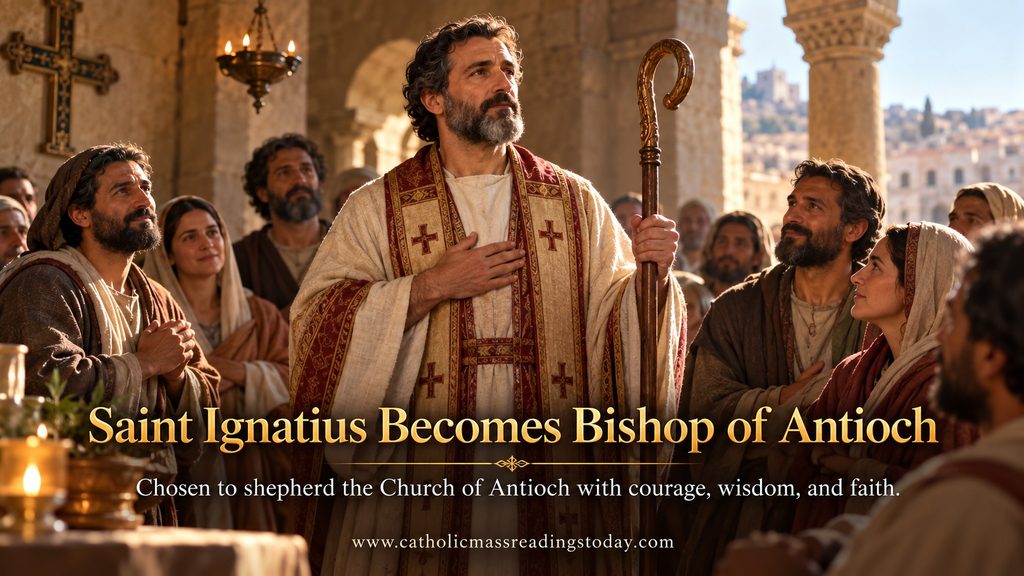
Saint Ignatius eventually became Bishop of Antioch, probably serving as one of the earliest successors to the apostolic leadership in that city.
Some ancient traditions identify him as the second or third bishop of Antioch after Saint Peter, depending on how the succession is counted.
As bishop, Ignatius carried responsibility for preserving unity and doctrine in a Church that faced pressures from both within and outside.
The Christian community had to deal with persecution from Roman authorities, but also with theological confusion.
Some groups denied that Jesus had truly taken human flesh. Others attempted to separate Christianity too sharply from the visible structure of the Church.
Ignatius responded strongly to these dangers.
He insisted that Jesus Christ was truly born, truly suffered, truly died, and truly rose from the dead.
For Ignatius, the Incarnation was not a metaphor.
God had truly entered human history in Jesus Christ.
That conviction shaped everything he believed about salvation, the Eucharist, the Church, and martyrdom.
Persecution Under the Roman Empire
During the early second century, Christians lived under constant uncertainty.
Roman authorities did not always persecute Christians everywhere in the same way, but Christians could be arrested, interrogated, and punished for refusing to offer worship to the Roman gods or to participate in the imperial religious system.
Under the Emperor Trajan, who ruled from A.D. 98 to 117, Christianity was regarded with suspicion. Christians were not always actively hunted down, but those formally accused and unwilling to renounce their faith could face execution.
At some point during Trajan’s reign, Saint Ignatius of Antioch was arrested.
The exact circumstances of his arrest are not preserved in detail.
What we do know is that he was condemned and ordered to be taken to Rome, where he was to face death.
This journey to Rome became one of the most remarkable episodes in early Christian history.
The Journey Toward Martyrdom
Ignatius did not travel to Rome freely.
He was transported under guard by Roman soldiers.
He refers to his guards bitterly in his writings, comparing them to wild beasts because of their harsh treatment.
Yet even in captivity, Ignatius did not become silent.
Instead, his journey became a final pastoral mission.
As he passed through Christian communities in Asia Minor, believers came to meet him. Some offered encouragement. Others brought messages from neighboring churches.
Ignatius responded by writing letters.
These letters became his greatest written legacy.
They were not carefully composed theological textbooks. They were written by a bishop on the way to death.
That gives them their extraordinary power.
Every line carries the urgency of a man who knows he may have only a short time left to speak.
The Seven Letters of Saint Ignatius of Antioch
Seven letters traditionally recognized as authentic survive from Saint Ignatius of Antioch.
He wrote to the churches of Ephesus, Magnesia, Tralles, Rome, Philadelphia, and Smyrna, as well as a personal letter to Saint Polycarp, Bishop of Smyrna.
These letters are among the most important Christian writings outside the New Testament from the early second century.
They reveal what Ignatius considered essential for the life of the Church.
Again and again, he speaks about unity.
He urges Christians to remain united with their bishop, priests, and deacons.
He warns against false teaching.
He speaks of the Eucharist with extraordinary reverence.
He insists upon the real humanity and suffering of Christ.
And he prepares himself spiritually for martyrdom.
These letters give us an intimate look into the heart of an early Christian bishop who believed he was approaching the final act of his discipleship.
Saint Ignatius and the Meaning of the Catholic Church
One of the most historically important lines written by Saint Ignatius of Antioch appears in his letter to the Smyrnaeans.
There he uses the expression “Catholic Church.”
This is one of the earliest surviving written uses of that phrase in Christian history.
The word “Catholic” comes from the Greek meaning universal or according to the whole.
For Ignatius, the Church was not simply a collection of independent groups with no visible unity.
It was a universal body gathered around Christ and expressed locally through communion with the bishop, clergy, Eucharist, and faithful.
This is one reason Saint Ignatius is so important for understanding the early Catholic Church.
His writings demonstrate that belief in a visible, structured, sacramental Church was present extremely early in Christian history.
Saint Ignatius and the Authority of the Bishop
Ignatius repeatedly emphasizes the importance of the bishop.
For him, unity with the bishop was not about personality or worldly authority.
It was about preserving unity in the faith.
The bishop served as a visible center of communion within the local Church.
Ignatius presents the Church as a community ordered around the bishop, presbyters, and deacons.
This structure mattered because the Church needed protection from division and false teaching.
Christianity could not survive if every believer simply created his or her own version of the faith.
There had to be continuity, order, and fidelity to what had been handed down.
Ignatius therefore urged Christians to remain united.
His writings are among the earliest witnesses to the threefold ministry of bishop, presbyters, and deacons as it developed in the early Church.
The Eucharistic Faith of Saint Ignatius
One of the strongest reasons Saint Ignatius of Antioch remains so important to Catholics is his teaching on the Eucharist.
Ignatius speaks of the Eucharist in unmistakably realistic terms.
He opposed groups who denied that Christ had truly taken flesh and therefore refused to accept the Eucharist as the true flesh of Christ.
For Ignatius, the Eucharist was not merely symbolic food representing an absent Jesus.
It was intimately connected with the real Incarnation.
The same Christ who truly became flesh and truly suffered is the Christ encountered in the Eucharist.
Ignatius’ Eucharistic teaching is especially significant because it comes from such an early period.
His letters show that belief in the real presence of Christ in the Eucharist did not arise centuries later.
It belonged to the life and faith of Christians close to the apostolic age.
Christ Truly Became Man
A major theological concern in the writings of Saint Ignatius was the danger of Docetism.
The term is associated with the Greek idea of “seeming” or “appearing.”
Certain early groups claimed that Jesus only appeared to have a real human body or only seemed to suffer.
Ignatius strongly rejected this teaching.
For him, salvation depended upon the reality of the Incarnation.
Jesus Christ was truly born.
He truly ate and drank.
He truly suffered under Pontius Pilate.
He truly died.
And He truly rose.
If Christ’s humanity had only been an appearance, then the Cross would have been an appearance as well.
Ignatius understood that Christianity stands or falls with the reality of the Incarnation.
God did not pretend to enter human history.
He entered it.
Saint Ignatius and the Desire for Martyrdom
Perhaps the most striking of Ignatius’ letters is the one he wrote to the Christians in Rome.
By the time he wrote it, Ignatius knew that some Roman Christians might attempt to intervene on his behalf.
He begged them not to prevent his martyrdom.
His words can sound extreme to modern ears.
Ignatius did not seek suffering because suffering itself was good.
Rather, he believed martyrdom would allow him to imitate Christ completely.
He saw his approaching death as the final offering of his life.
One of his most famous images describes himself as “God’s wheat,” to be ground by the teeth of wild beasts so that he might become pure bread for Christ.
This Eucharistic imagery reveals the depth of his spirituality.
He saw his martyrdom as participation in the self-giving sacrifice of Jesus.
Why the Martyrdom of Saint Ignatius Matters
Martyrdom was one of the most powerful witnesses of the early Church.
The Greek word from which “martyr” comes means witness.
The martyr’s death therefore proclaimed something.
It said that Jesus Christ was worth more than life itself.
For Saint Ignatius, death was not defeat.
He believed resurrection lay beyond it.
His willingness to die demonstrated the seriousness of his conviction that Christ had truly risen.
A man does not usually surrender his life willingly for what he regards as a comforting metaphor.
Ignatius knew what Roman execution meant.
Yet he went forward.
His courage became a source of strength for Christians who would face persecution in later generations.
Saint Ignatius Arrives in Rome
The precise details of the final stage of Saint Ignatius’ journey are not preserved with complete certainty.
Ancient tradition holds that he reached Rome and was martyred there, most likely sometime during the reign of Trajan in the early second century.
The traditional account states that Ignatius was thrown to wild beasts in the arena.
This form of execution was known in Roman public spectacles and became associated with several early Christian martyrs.
Ignatius had already anticipated this possibility in his letter to the Romans.
His words show that he was spiritually prepared.
He had spent the journey toward Rome surrendering himself more completely to Christ.
When the moment came, according to tradition, he remained faithful.
The Death of Saint Ignatius of Antioch
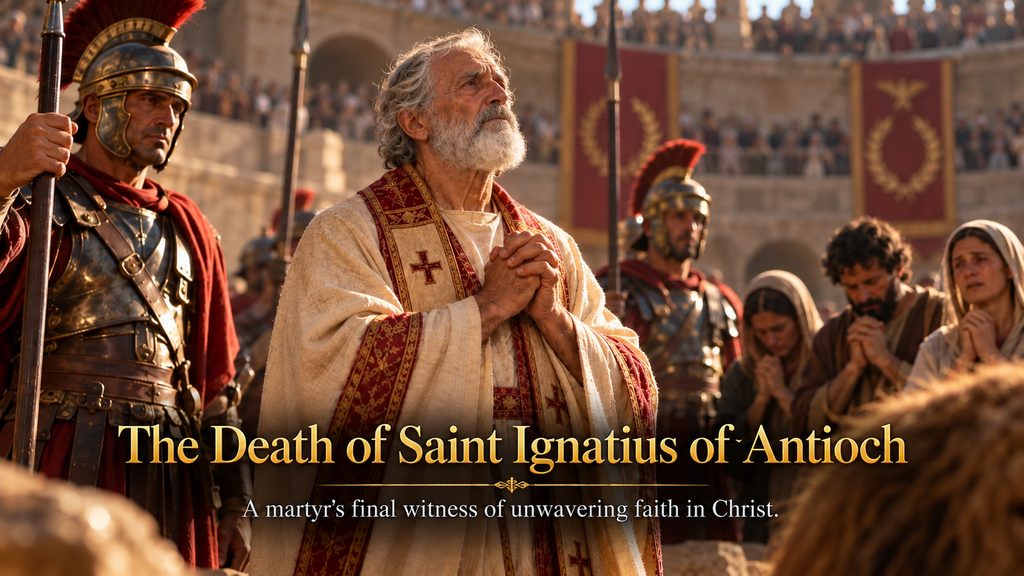
Saint Ignatius died as Bishop and Martyr.
The exact year is uncertain, but his martyrdom is often placed around A.D. 107, though some scholars date it somewhat later within Trajan’s reign.
What matters most is not the precise year but the witness he gave.
The bishop who had spent his life preserving the unity of the Church ended his earthly life united to Christ through martyrdom.
His death did not silence him.
His letters survived.
They were copied.
They were read in churches.
They were passed from one Christian community to another.
And nearly two thousand years later, they continue to be studied.
The Preservation of His Relics and Memory
Early Christian tradition maintained a strong memory of Ignatius after his death.
Accounts developed concerning the preservation of his remains and their eventual association again with Antioch.
His memory became part of the liturgical and spiritual tradition of both Eastern and Western Christianity.
He came to be honored not merely as a local bishop but as one of the great Apostolic Fathers.
The Apostolic Fathers were early Christian writers whose lives and teachings stood especially close to the generation of the Apostles.
Ignatius occupies a central place among them because his letters are so rich in theology, ecclesiology, and personal faith.
Saint Ignatius of Antioch and the Apostolic Fathers
Alongside figures such as Saint Clement of Rome and Saint Polycarp of Smyrna, Saint Ignatius helps bridge the historical gap between the New Testament and later generations of the Church.
This makes his writings invaluable.
When Christians ask what the Church looked like shortly after the time of the Apostles, Ignatius provides part of the answer.
His writings show churches celebrating the Eucharist.
They show bishops leading Christian communities.
They show priests and deacons serving alongside them.
They show Christians confessing Jesus as both divine and human.
They show a concern for apostolic teaching and visible unity.
And they show believers willing to die for their faith.
In other words, Ignatius allows us to hear the voice of Christianity while it was still very close to its apostolic beginnings.
The Importance of Saint Ignatius of Antioch to Catholic Teaching
The importance of Saint Ignatius of Antioch to the Catholic Church is difficult to overstate.
He gives early testimony to several elements that remain central to Catholic life.
His writings point toward the visible unity of the Church.
They emphasize the ministry of the bishop.
They give powerful witness to the real presence of Christ in the Eucharist.
They defend the true Incarnation of Jesus.
They reveal how early Christians understood martyrdom.
And they use the language of the Catholic Church at an extraordinarily early date.
His testimony therefore provides historical evidence that these beliefs were not inventions of the medieval Church.
They were already deeply embedded in Christian life near the beginning of the second century.
Saint Ignatius and Unity in the Church
Ignatius lived during a time when division could have destroyed fragile Christian communities.
He therefore pleaded constantly for unity.
For him, Christian unity was never merely organizational.
It was theological.
The Church is one because Christ is one.
The Eucharist is one.
The faith is one.
The bishop serves that unity.
Christians therefore cannot treat division lightly.
Ignatius believed that when Christians remain united in truth and charity, the Church becomes a visible witness to Christ.
His message remains urgently relevant.
The modern world often encourages individualism, including religious individualism.
People can be tempted to construct faith entirely around personal preference.
Ignatius points toward another vision.
Christianity means belonging.
It means communion.
It means receiving the faith rather than inventing it.
The Eucharist at the Center of Christian Life
Ignatius’ vision of the Church cannot be separated from the Eucharist.
The Eucharist gathered Christians together around Christ.
For this reason, Eucharistic communion and ecclesial communion belonged together.
This remains deeply relevant for Catholics today.
The Eucharist is not simply one devotion among many.
It stands at the center of Catholic worship.
The altar gathers the Church.
Christ nourishes His people.
And the Eucharist expresses the unity of believers with Him and with one another.
When modern Catholics read Ignatius, they encounter a bishop from the earliest centuries speaking a language that remains unmistakably Eucharistic.
Saint Ignatius and Courage in an Age of Fear
Ignatius also speaks powerfully to Christians who struggle with fear.
He was not facing minor inconvenience.
He was facing execution.
Yet his letters are not dominated by panic.
They are filled with conviction.
His courage did not come from believing that death was meaningless.
It came from believing that Christ had conquered death.
That distinction matters.
Christian courage is not pretending suffering does not hurt.
It is believing that suffering does not have the final word.
Ignatius looked toward martyrdom because his hope lay beyond the arena.
His life reminds Christians today that faith must eventually become stronger than fear.
Saint Ignatius and the Meaning of Authentic Discipleship
Ignatius repeatedly expresses his desire not merely to be called a Christian but actually to become one fully.
That distinction remains challenging.
It is possible to carry the name Christian without allowing the Gospel to reshape our lives.
Ignatius wanted no such separation.
For him, faith had to become visible through fidelity.
If Christ had given everything, then the disciple should be willing to give everything in return.
Few Christians will be called to literal martyrdom.
But every Christian is called to die to selfishness, dishonesty, bitterness, pride, and sin.
In that sense, the spirituality of martyrdom belongs to ordinary discipleship.
Following Jesus always requires surrender.
The Memorial of Saint Ignatius of Antioch
The Catholic Church celebrates the Memorial of Saint Ignatius of Antioch, Bishop and Martyr, on October 17.
This memorial places before the faithful one of Christianity’s earliest and strongest witnesses.
The Church does not remember Ignatius because he belongs only to history.
She remembers him because his witness continues to speak.
- His love for Christ speaks.
- His devotion to the Eucharist speaks.
- His loyalty to the Church speaks.
- His insistence upon unity speaks.
- His courage before death speaks.
His voice still challenges Christians to ask whether their own faith is deep enough to survive difficulty.
Saint Ignatius of Antioch in the Church Today
Nearly two thousand years after his martyrdom, Saint Ignatius of Antioch remains widely read by theologians, historians, clergy, seminarians, religious, and lay Catholics.
His writings continue to appear in collections of the Apostolic Fathers.
They are quoted in theological studies.
They are used in discussions about the early Church, apostolic succession, episcopal authority, Eucharistic theology, and Christian martyrdom.
He is honored in both the Catholic and Orthodox traditions, demonstrating the depth of his importance to Christianity before later divisions between East and West.
Churches, schools, seminaries, and institutions throughout the world bear his name.
But perhaps his greatest influence remains in the simple fact that Christians can still read his own words.
They do not encounter merely a legendary figure.
They encounter a bishop speaking directly from the road to martyrdom.
What Saint Ignatius Teaches the Modern Christian
The world of Saint Ignatius was very different from ours, yet the fundamental struggles of Christian discipleship remain recognizable.
Christians still face pressure to hide their faith.
The Church still faces division.
False teaching still exists.
There is still temptation to reduce the Eucharist to something less than the mystery Catholics profess it to be.
Christians still struggle between fear and courage.
And the temptation remains to call ourselves Christians without allowing Christ to claim the whole of our lives.
Ignatius answers these challenges with the same message he gave in the second century.
Remain united.
Remain faithful.
Stay close to the Eucharist.
Hold fast to the truth about Christ.
Do not be ashamed of Him.
And never allow fear to become greater than faith.
The Lasting Legacy of Saint Ignatius of Antioch
The legacy of Saint Ignatius of Antioch rests not upon political power, wealth, or worldly success.
He died as a prisoner.
Yet his words outlived emperors.
The Roman Empire that condemned him disappeared.
The Church he served remained.
The Eucharist he defended is still celebrated.
The bishops whose ministry he urged Christians to respect continue to shepherd the Church.
The Christ for whom he died continues to be proclaimed throughout the world.
There is something deeply moving about that contrast.
Trajan was one of the most powerful rulers on earth.
Ignatius was a prisoner being escorted toward execution.
History might have expected the emperor’s voice to endure and the prisoner’s voice to disappear.
Yet Christians throughout the world still gather every October 17 to remember Ignatius.
His strength came from something Rome could not destroy.
Christ.
He died, but his witness remained
The story of Saint Ignatius of Antioch, Bishop and Martyr, takes us back to Christianity’s earliest generations.
Born sometime in the first century, formed within the apostolic tradition, called to lead the Church of Antioch, arrested during Roman rule, and transported toward Rome under guard, Ignatius transformed his final journey into an extraordinary testimony of faith.
His seven surviving letters became treasures of the early Church.
Through them we hear his devotion to Christ, his defense of the Incarnation, his reverence for the Eucharist, his insistence upon unity with the bishop, his use of the expression “Catholic Church,” and his extraordinary willingness to accept martyrdom.
He died, but his witness remained.
For Catholics today, Saint Ignatius of Antioch is more than an ancient bishop.
He is a reminder of what Christianity looks like when faith becomes complete surrender.
He challenges us to love Christ not only when belief is comfortable but when faith demands courage.
He reminds us that the Eucharist is at the heart of the Church.
And he shows us that a life offered completely to Christ is never wasted.
Prayer to Saint Ignatius of Antioch
O Saint Ignatius of Antioch,
faithful bishop and courageous martyr of Christ,
you loved the Lord more than your own life
and remained steadfast as you journeyed toward death.
Pray for us, that our faith may become strong and sincere.
Teach us to love Jesus Christ with an undivided heart
and to remain faithful when discipleship becomes difficult.
Help us to treasure the Holy Eucharist
and to approach the Body and Blood of Christ
with reverence, gratitude, and faith.
Pray for unity within the Church,
that bishops, priests, deacons, religious, and lay faithful
may remain united in truth and charity.
When fear weakens us, obtain for us courage.
When confusion surrounds us, help us remain faithful to the teaching handed down from the Apostles.
When suffering comes, remind us that Christ has conquered death.
May our lives, like yours, become a witness to the Gospel,
so that whether in comfort or hardship
we may belong completely to Jesus Christ.
Saint Ignatius of Antioch, Bishop and Martyr, pray for us.
Amen.