“They preach, but do not practice.”
There are words of Jesus that console us, words that heal us, and words that disturb us because they reach into places in the heart we would rather leave untouched. Today’s Gospel belongs to that last category.
Jesus speaks with unusual force about the scribes and the Pharisees: “They preach, but do not practice.”
Yet we should be careful not to hear these words merely as a condemnation of people who lived two thousand years ago. If we do that, the Gospel remains safely in the past. Christ speaks these words before His disciples and the crowds because He wants every generation of believers to examine the distance that can sometimes grow between what we profess and how we actually live.
And that examination begins with each one of us.
When faith becomes something we only speak about
Jesus does not accuse the scribes and Pharisees simply because they teach. In fact, He tells the people to observe what they teach when it is faithful to God’s law. The problem is deeper: their lives have become separated from their words.
They know what is right, but do not necessarily do it. They tell others what God requires, yet excuse themselves from the same demands. They speak about holiness, while becoming increasingly concerned with honour, recognition and appearances. This temptation did not disappear with the Pharisees.
A Christian can speak beautifully about forgiveness while refusing to forgive someone at home. We can defend the dignity of human life while treating the difficult person before us without dignity. We can speak about generosity while remaining indifferent to someone who genuinely needs our help. We can attend Mass faithfully and still allow pride, dishonesty, resentment or cruelty to govern the rest of the week.
Christ is asking something more demanding than religious appearance. He asks for integrity. Our words and our lives must gradually become one.
This does not mean that Christians must first become perfect before speaking about God. None of us would ever be able to speak. The Church is a community of sinners continually being called to conversion. There is an enormous difference between struggling sincerely to live the Gospel and pretending to possess a holiness that we do not seek to live.
The humble Christian can say, “Lord, I believe Your teaching. I am still weak in living it. Help me.” This is already very different from hypocrisy.
“They bind heavy burdens”
There is another painful accusation in today’s Gospel. Jesus says that the religious leaders “bind heavy burdens, hard to bear, and lay them on men’s shoulders; but they themselves will not move them with their finger.”
True religion should lead a person toward God, not use God to dominate another person.
Christian authority, therefore, can never simply be about giving commands. Whether one is a priest, parent, teacher, employer, leader or simply someone whom others look up to, authority carries a responsibility to help bear the burdens of others.
This is precisely what we see in Christ. Jesus does not stand at a distance from human suffering and tell humanity how to carry its cross. He carries the Cross Himself.
- He enters our suffering.
- He touches the sick.
- He welcomes sinners.
- He weeps with those who mourn.
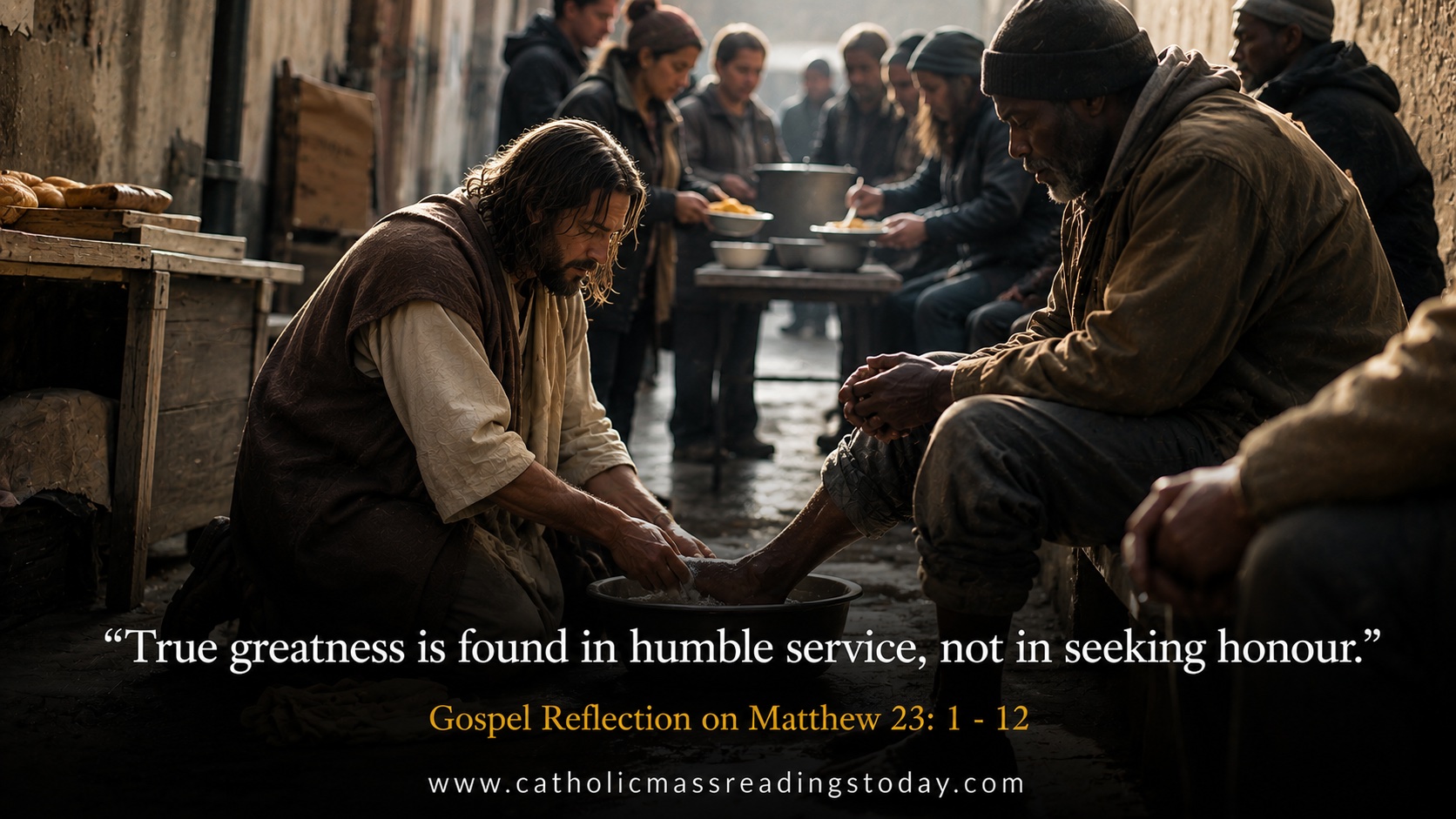
- He washes the feet of His disciples.
- And finally, He gives His life upon Calvary.
This is the measure of Christian leadership. The closer a person comes to Christ, the less interested he should become in appearing important and the more willing he should become to serve.
The danger of wanting to be seen
Jesus also exposes another temptation of the human heart: doing good so that others will notice us.
The Pharisees, He says, “do all their deeds to be seen by men.” There is something remarkably contemporary about those words.
We live in a world where much of life can be displayed before others. Acts of generosity, prayer, success, charity and even suffering can quickly become things through which we seek approval. It is possible to begin doing something for God and slowly become more interested in whether people have noticed us doing it.
Christ invites us back into the hidden places of the heart.
Some of the greatest acts of holiness occurring in the world today will never be photographed, applauded or publicly recognised.
- A mother quietly sacrificing for her children.
- A husband remaining faithfully beside a suffering wife.
- Someone caring patiently for an elderly parent.
- A person forgiving an offence nobody else knows about.
- A worker refusing dishonesty when cheating would have been easier.
- A believer kneeling beside the bed at night and praying when no one is watching.
- A person quietly giving to someone in need and telling nobody.
Heaven sees these things and in most times that must be enough.
“You are all brethren”
At the centre of today’s Gospel is a beautiful reminder of who we are before God.
“You are all brethren.”
Before the Father, our titles, positions, wealth, education and social standing become very small indeed. Every human person stands before God as a creature loved by Him and in need of His mercy.
This is one reason the Church insists so strongly upon the dignity of every human life. The poor man and the wealthy man, the unborn child and the elderly person, the migrant and the citizen, the healthy and the sick, the powerful and the forgotten all possess a dignity that does not come from society.
It comes from God. If we truly understand that we have one Father in heaven, we cannot easily look upon another human being as worthless.
The person before us is not merely a stranger, employee, rival, inconvenience or statistic.
He is our brother and She is our sister. Christ has taught us how brothers and sisters belonging to the Father are meant to treat one another.
“The greatest among you shall be your servant”
Jesus finally overturns the world’s understanding of greatness:
“He who is greatest among you shall be your servant.”
The world often measures greatness by how many people serve us. Christ measures greatness by how many people we are willing to serve.
The world says: rise above others.
Christ kneels and washes feet.
The world says: make yourself important.
Christ says: become a servant.
The world says: make sure people know what you have accomplished.
Christ says: “Whoever exalts himself will be humbled, and whoever humbles himself will be exalted.”
Christian humility does not mean believing that we have no gifts or pretending that our abilities do not exist. Our gifts come from God and should be developed fully. Humility means recognising their source and placing them at the service of others.
The question is no longer simply, “What have I achieved?” The deeper Christian question becomes:
“What have I done with what God entrusted to me?”
- Whom have I helped?
- Whom have I encouraged?
- Whose burden have I made lighter?
- Whom have I forgiven?
- Whom have I served when there was nothing for me to gain?
These are questions that bring today’s Gospel very close to home.
Let our lives proclaim what our lips profess
Perhaps the most important response to this Gospel is not to search for hypocrites around us.
It is to look within. There will always be inconsistencies in us. Conversion is the work of a lifetime. But Christ asks us not to become comfortable with those contradictions.
- If we speak of mercy, let us become merciful.
- If we speak of forgiveness, let us forgive.
- If we speak of the dignity of every person, let our treatment of others show it.
- If we profess that Christ is Lord, let Him also be Lord of our decisions, our relationships, our money, our ambitions and our private lives.
And when we fail, as inevitably we sometimes will, let us return humbly to Him, especially through prayer and the Sacrament of Reconciliation.
The world does not simply need Christians who can explain Christianity. It needs Christians whose lives make Christ believable.
May there be less distance each day between the Gospel we proclaim with our lips and the Gospel others encounter through our lives.
Let us Pray
Lord Jesus Christ,
You came among us not to be served,
but to serve and to give Your life for many.
Deliver us from pride, hypocrisy
and the desire for human praise.
Grant us the grace to practise what we profess,
to carry the burdens of our brothers and sisters,
and to serve without seeking recognition.
Make our hearts humble before You.
When our lives fail to reflect Your Gospel,
give us the courage to repent
and begin again.
May our words be truthful,
our faith sincere,
our charity generous,
and our lives a faithful witness to Your love.
For You live and reign
with God the Father,
in the unity of the Holy Spirit,
God, for ever and ever.
Amen.