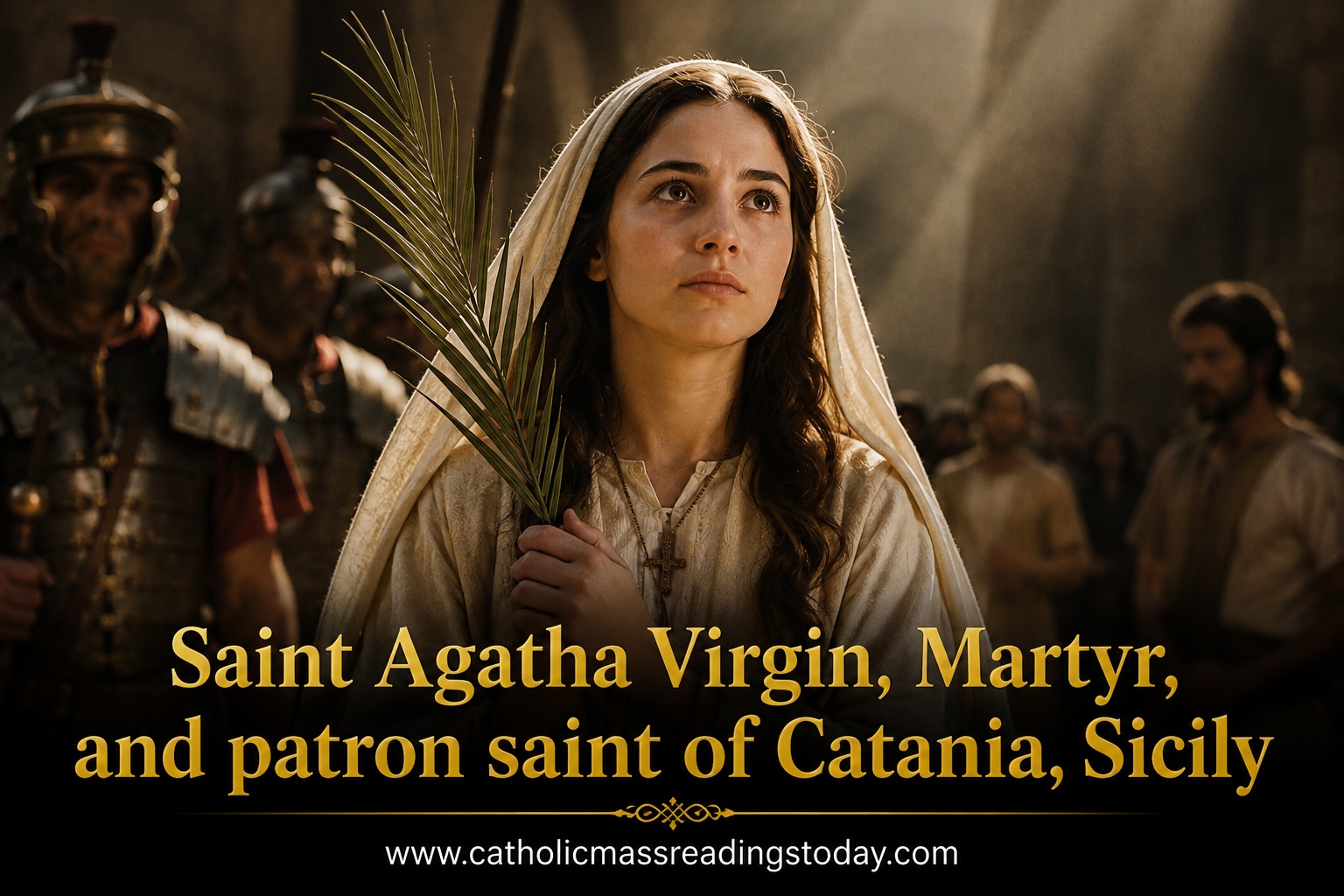
Saint Agatha Virgin, Martyr, and patron saint of Catania, Sicily, belongs to the first generations of Christian men and women whose fidelity to Jesus Christ was tested not merely by hardship, but by the threat of torture and death. Nearly eighteen centuries after her martyrdom, the young Sicilian saint remains so deeply woven into the faith and identity of Catania that the city still calls her affectionately Santuzza, its “little saint.”
Her story stretches across an extraordinary span of history: from Roman Sicily and the persecution of Christians in the third century, through the removal of her relics to Constantinople, their celebrated return to Catania in 1126, and finally to the remarkable events of August 2026, when the Church marked the 900th anniversary of that homecoming.
On 17 August 2026, Catania witnessed one of the most significant celebrations in its centuries-old devotion to Saint Agatha. After an early-morning pilgrimage retracing the memory of the return of her relics, Saint Agatha’s sacred skull was placed once again within her restored reliquary bust. Cardinal Pietro Parolin, acting as the Pontifical Legate of Pope Leo XIV, then solemnly crowned the reliquary of Catania’s patron saint.
It was an extraordinary meeting of the ancient and the present: a Christian woman who died rather than deny Christ in the third century being honoured by the Church and the people of her city almost eighteen hundred years later.
The Early Life of Saint Agatha
Much of what is known about Saint Agatha comes to us through ancient Christian tradition and accounts of her Passio. The precise details of her earliest years cannot always be established with the certainty expected of a modern biography, and even ancient traditions differ over some particulars. The Vatican’s account places her birth around AD 235, most probably in Catania, into a wealthy and noble Sicilian family.
Agatha grew up when Sicily was part of the Roman Empire. Christianity had already reached the island, but professing the Christian faith could carry enormous personal risk.
From a young age, Agatha resolved to belong completely to Christ.
Christian tradition remembers her as a consecrated virgin. Vatican News records the tradition that she received the velatio, or taking of the veil, from her bishop — a visible expression of her consecration to God.
This decision is essential to understanding everything that followed.
Agatha’s virginity was not simply a rejection of marriage. For her it was a positive and radical offering: her life belonged to Christ. Her body, her future, her social position and ultimately her life itself were placed at His service.
That conviction would soon be tested in a way she could scarcely have imagined.
The Persecution of Christians Under Emperor Decius
Around AD 250, the Roman Emperor Decius ordered inhabitants of the empire to participate in acts of sacrifice to the Roman gods and for the welfare of the emperor. Christians who refused could face arrest, imprisonment and punishment.
In Sicily, tradition places Agatha’s confrontation with the Roman authorities under the proconsul Quintianus.
Accounts of her martyrdom describe Quintianus as desiring the young Agatha and attempting to force her to abandon both her Christian faith and her commitment to virginity.
She refused.
That refusal placed a young Christian woman against the machinery of Roman authority.
She possessed neither an army nor political influence with which to defend herself. Her strength was of another kind: she would not surrender her conscience.
The authorities could imprison her body, but they could not compel her heart to abandon Christ.
That is one reason the Church has remembered Saint Agatha for so many centuries.
Agatha Refuses to Renounce Christ
According to the traditional accounts, attempts were made to break Agatha’s determination before physical torture was used.
She was subjected to humiliation and pressure intended to make her renounce the life she had chosen. Yet she remained steadfast.
Eventually she was brought before Quintianus.
What the authorities demanded was outward conformity. A public renunciation of Christianity could have spared her.
For Agatha, however, faith could not simply be discarded when it became dangerous.
Christ was not an idea she happened to favour. He was the Lord to whom she had entrusted her life.
Her refusal therefore carried a terrible cost.
The Torture and Martyrdom of Saint Agatha
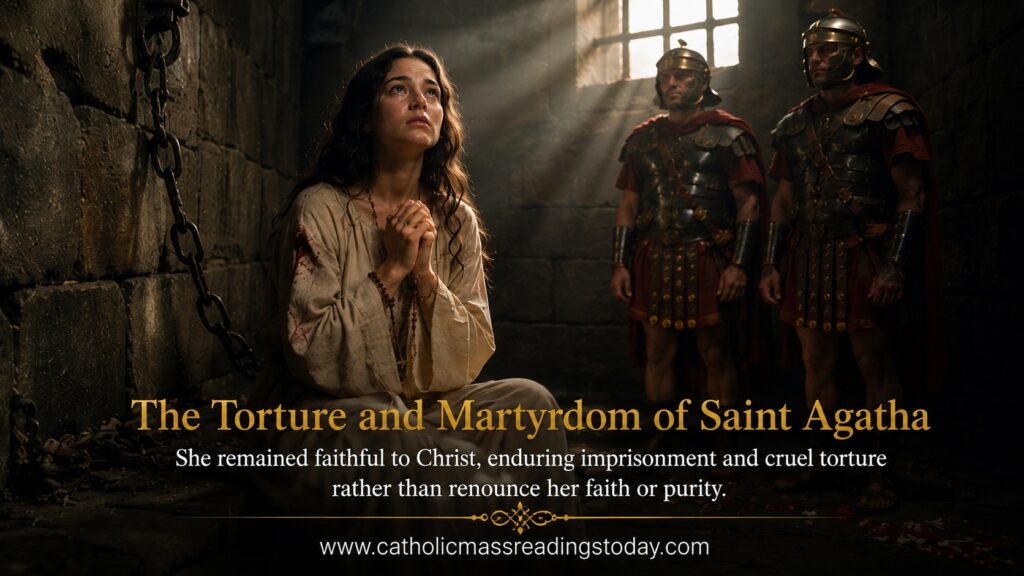
The account of Saint Agatha’s suffering is among the most disturbing of the early Christian martyrdom traditions. She was imprisoned and subjected to brutal torture. Most famously, tradition records that her breasts were mutilated.
For this reason, Christian devotion through the centuries has developed a particular association between Saint Agatha and women suffering from diseases of the breast, including breast cancer.
Yet Christian art does not remember her suffering because cruelty deserves to be glorified. It remembers what was done to her because violence failed to obtain what her persecutors wanted.
Agatha still refused to deny Christ. One ancient tradition tells that while she was imprisoned and badly wounded, Saint Peter appeared to her and healed her wounds. The Sanctuary of Sant’Agata al Carcere in Catania continues to preserve the tradition of the place associated with her imprisonment.
Her ordeal was not over. She was tortured again and eventually returned to prison, grievously injured. Knowing that death was near, Agatha entrusted herself to God.
According to the traditional account preserved by Vatican News, she thanked the Lord who had guarded her from childhood and given her strength to withstand her sufferings before surrendering her spirit. Her martyrdom is traditionally dated to 5 February AD 251.
The Roman authorities had succeeded in killing a young Christian woman but failed to extinguish her faith.
Why Saint Agatha’s Martyrdom Became So Powerful
Agatha’s death reveals something fundamental about the Christian understanding of martyrdom. A martyr does not seek death. Nor is martyrdom the triumph of suffering for suffering’s sake. The martyr bears witness that there are truths greater than physical survival.
For Saint Agatha, Christ was worth more than security, social position, bodily integrity or even life itself. This is why Pope Leo XIV, writing for the 900th anniversary celebrations in 2026, described her martyrdom as displaying “the victory of grace over violence, of faith over fear, and of charity over death.”
That sentence captures why Agatha’s story survived when the names of countless powerful officials of the Roman Empire disappeared from ordinary memory. Quintianus possessed authority for a time. Agatha possessed a witness that endured.
Saint Agatha and Mount Etna
The bond between Saint Agatha and Catania became even stronger after her death. According to ancient Christian tradition, about a year after her martyrdom, Mount Etna erupted, threatening Catania.
The people turned to their young martyr for intercession. Tradition holds that Agatha’s veil was carried toward the advancing lava and the flow stopped before destroying the city. Vatican sources recount this event as central to the development of her role as Catania’s patron saint.
Whether standing beneath the shadow of Etna, facing earthquakes, fires or other dangers, generations of Catanese Christians have consequently turned to Saint Agatha.
The relationship between Agatha and Catania gradually became more than historical memory. She became part of the spiritual identity of the city itself.
The Growth of Devotion to Saint Agatha
Devotion to Saint Agatha spread far beyond Sicily. She came to be numbered among the most celebrated virgin martyrs of the early Church, and her name entered the ancient Roman liturgical tradition.
Catholics who attend Mass in the Roman Rite continue to encounter her name in one of the Church’s most venerable Eucharistic prayers.
In the Roman Canon, Eucharistic Prayer I, Saint Agatha is named among the holy women of the early Church, alongside Felicity, Perpetua, Lucy, Agnes, Cecilia and Anastasia.
That is an extraordinary legacy. Across continents and languages, priests have spoken Agatha’s name at the altar for generation after generation.
Her liturgical memorial is celebrated on 5th February, the traditional date of her martyrdom.
For Catania, however, devotion to Agatha reaches a scale difficult to appreciate until one sees the city during her feast.
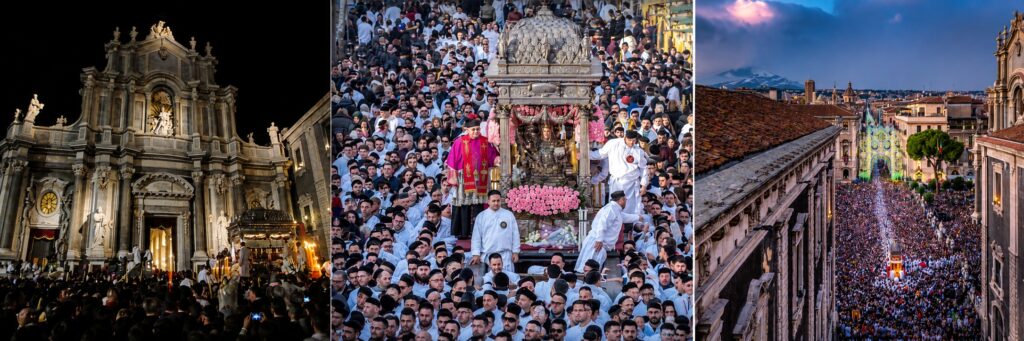
6th Every February, enormous crowds accompany her relics through the streets. Devotees traditionally wear the sacco, the distinctive white votive garment associated with the devotion. Red carnations recall her martyrdom, while white flowers recall her purity.
The feast is simultaneously solemn and intensely personal. To understand Catania, one must understand something of its love for Agatha.
The Relics of Saint Agatha Are Taken to Constantinople
The story took another dramatic turn centuries after Agatha’s death.
In 1040, during the Byzantine attempt to reconquer Sicily, General George Maniakes removed the relics of Saint Agatha from Catania and carried them away. They eventually reached Constantinople.
For the people of Catania, this was an immense loss.
The saint remained their patroness, but her bodily relics, tangible connections with the young woman who had lived and died in their city were gone.
According to the historical tradition preserved by the City of Catania, they would remain away for 86 years. Then came one of the most celebrated episodes in Catania’s history.
Gisliberto and Goselmo Bring Saint Agatha Home
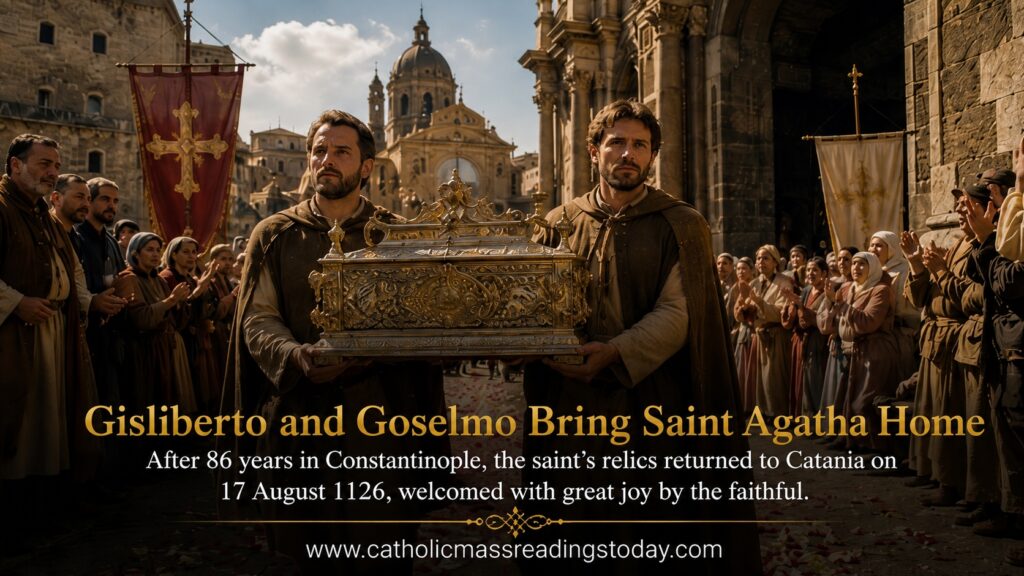
Tradition identifies two men, Gisliberto and Goselmo, as those responsible for bringing Agatha’s relics back from Constantinople. The story handed down through the centuries tells that Saint Agatha appeared to them and desired that her remains should return to her homeland. The two men secretly removed the relics and began the dangerous journey westward eventually reaching Sicily.
Before publicly announcing their return, Bishop Maurice of Catania arranged for the remains to be examined and authenticated according to the records available to the Church. Then the news was released. It was 17 August 1126 and Saint Agatha had come home.
The City of Catania’s historical account preserves a wonderful detail about that night: the bells awakened the inhabitants, who rushed from their houses so quickly that many went into the streets barefoot and still dressed in their night clothes to welcome the returning relics.
That memory survives even in Catania’s devotional traditions today. Nine hundred years later, the city would deliberately walk that road of memory again.
The Reliquary Bust and the Sacred Relics
Over the centuries, Saint Agatha’s relics were placed within magnificent reliquaries worthy of the devotion surrounding them. Part of the relics, including the sacred skull, became associated with the famous silver reliquary bust through which generations of pilgrims have encountered the visible memory of the martyr. Other relics are preserved within a great silver casket.
The reliquaries are not simply valuable works of art. Catholic teaching does not regard relics as magical objects, nor does the Church worship saints.
Adoration belongs to God alone.
Catholics venerate the saints because God’s grace became visible in their lives. Relics honour the body of a Christian who became a temple of the Holy Spirit and express the Church’s belief in the resurrection of the body.
In Agatha’s case this has particular poignancy. The body that was deliberately humiliated and wounded because she belonged to Christ became a body honoured by Christians for centuries.
What her persecutors attempted to degrade, generations of believers have treated with reverence.
900 Years Later: Catania Prepares for an Extraordinary Anniversary
The year 2026 marked exactly nine centuries since the return of Saint Agatha’s relics.
The Archdiocese of Catania prepared an extensive programme commemorating the IX Centenary of the Translation of the Relics of Saint Agatha, 1126–2026.
The anniversary included prayer, catechesis, cultural initiatives, veneration of the relics and restoration work. Particularly remarkable was the exceptional exposition of Saint Agatha’s sacred skull in July 2026, the first such close public veneration since the canonical recognition of the relics in 1963.
Then came an announcement that gave the anniversary an importance extending beyond Sicily.
Pope Leo XIV appointed Cardinal Pietro Parolin, Secretary of State of the Holy See, as his Pontifical Legate for the principal celebrations. The Vatican confirmed that the appointment had been made on 20 June 2026.
The Pope would therefore be represented in Catania at the highest level.
Pope Leo XIV and Saint Agatha
Pope Leo XIV sent a special letter for the ninth centenary. Rather than treating the anniversary merely as the remembrance of something that happened in 1126, the Pope directed attention back to Agatha herself.
He described her as a witness whose fidelity reveals the triumph of God’s grace over violence and faith over fear. He also presented Santuzza as a “living presence” who preserves the Christian memory of her people and calls believers to consistency of life, hope and charity.
This gave the 900th anniversary a deeper meaning. The Church was not simply celebrating the return of ancient bones to a medieval city. It was asking whether the faith for which those bones had suffered still lived in Christians today.
16 August 2026: Remembering the Journey Home
The principal commemorations began on Sunday, 16 August 2026. Cardinal Parolin participated as the Pope’s representative and later presided over a prayer vigil at Aci Castello, recalling the arrival of Agatha’s relics nine centuries earlier.
In his preaching, Cardinal Parolin returned to the source of Agatha’s extraordinary courage: her communion with Christ. Her resistance to threats and violence, he explained, did not arise simply from a naturally stubborn personality. It came from being rooted in Christ.
That evening connected the Sicily of 2026 with the Sicily of 1126. But the most remarkable scenes were still to come.
17 August 2026: Catania Walks with Agatha Again
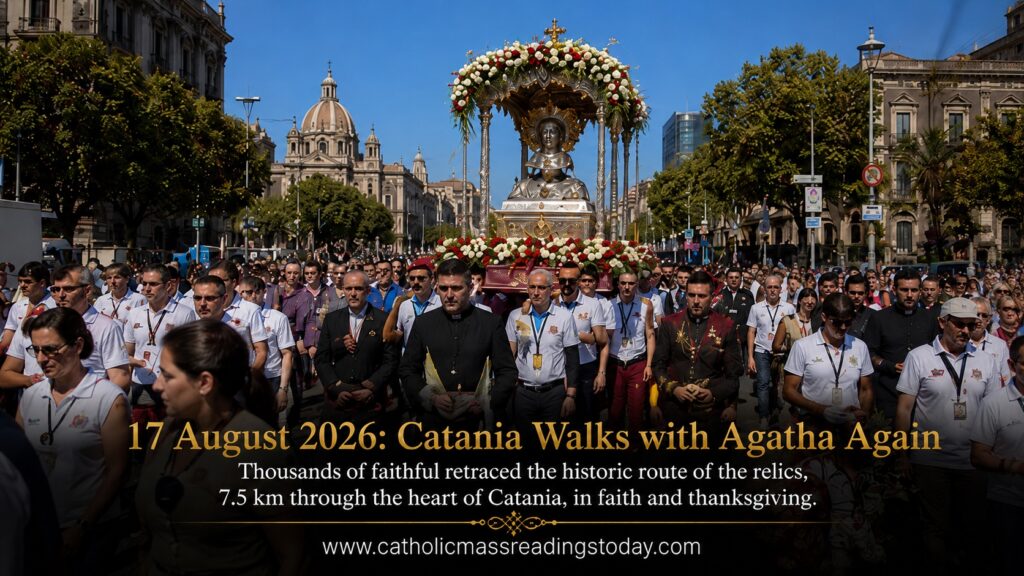
Before sunrise on Monday, 17 August 2026, thousands of faithful gathered for the pilgrimage.
At approximately 5 a.m., as church bells rang across the Archdiocese, the people began accompanying Saint Agatha’s relics toward the Cathedral. The official route passed from Piazza del Rotolo along the seafront, through Piazza Europa, Corso Italia, Viale XX Settembre and Via Etnea before reaching Piazza Duomo.
It was an approximately 7.5-kilometre pilgrimage, consciously recalling the homecoming of 1126. Many devotees wore the traditional white sacco. There is something deeply moving about the continuity of the scene.
Nine centuries earlier, bells had announced that Agatha was coming home. Nine centuries later, bells rang again as her people walked beside her relics.
Generations had been born and died. Kingdoms had disappeared. Empires had fallen. Catania itself had been repeatedly transformed by earthquakes, eruptions and rebuilding.
Yet Agatha was still there and Catania was still walking with her.
Saint Agatha’s Skull Returns to the Reliquary Bust
When the pilgrimage reached the Basilica Cathedral, one of the anniversary’s most significant ceremonies took place.
For the centenary observances, the sacred skull had been removed from the reliquary bust for exceptional veneration and the historic bust had undergone restoration work connected with the Vatican Museums.
Now the relic was to return. On the cathedral steps, Archbishop Luigi Renna of Catania placed Saint Agatha’s sacred skull back within the restored reliquary bust, while the other sacred relics were returned to their reliquary casket. Then came the crowning.
The Historic Crowning of Saint Agatha in 2026
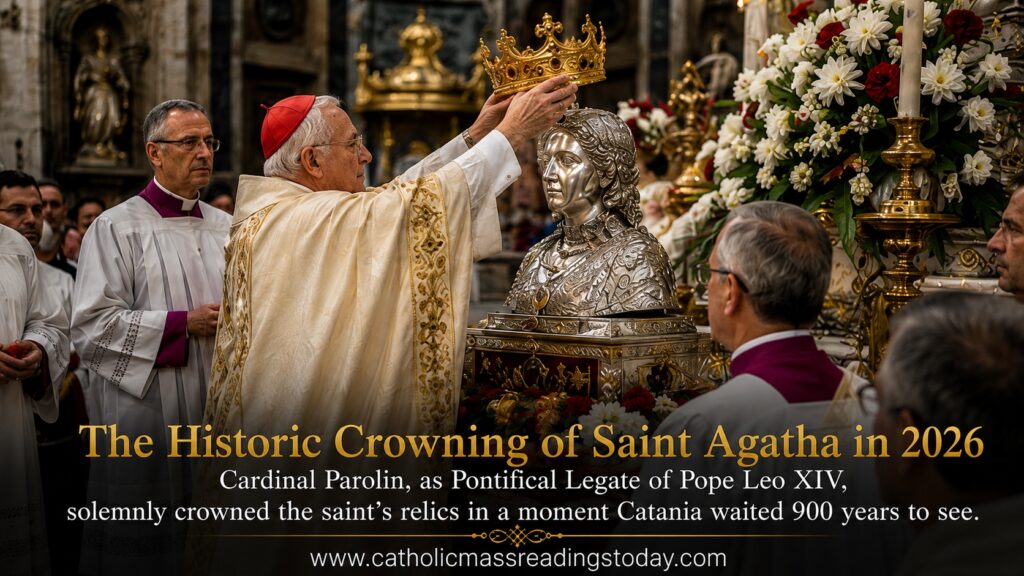
Cardinal Pietro Parolin, acting as Pontifical Legate of Pope Leo XIV, solemnly proceeded with the incoronazione, the crowning of Saint Agatha’s reliquary bust.
The official programme of the Archdiocese explicitly prescribed the sequence: the relics were to be returned to the casket, the sacred skull placed in the reliquary bust, and then the Cardinal Legate would perform the crowning. The ceremony concluded with the Te Deum and blessing.
Contemporary reporting after the event confirms that this sequence took place following the pilgrimage into Catania.
It is important to describe the event accurately: Saint Agatha was already a saint venerated by the Church for many centuries. This was not a canonization and did not make her a saint. The solemn crowning of her restored reliquary bust was an act of honour and devotion during the ninth-centenary celebrations.
Its symbolism, however, was extraordinary. The young woman once condemned by earthly authority because she would not betray Christ was being honoured eighteen centuries later.
The body once subjected to humiliation was surrounded with reverence. The Christian whom an empire attempted to silence had outlived the empire that persecuted her.
And the city from which her relics had been taken in 1040 stood together nine centuries after their return to proclaim that it had not forgotten her.
The Great Pontifical Mass in Piazza Duomo
The celebrations continued throughout 17 August.
That evening Cardinal Parolin presided over the solemn Pontifical celebration in Piazza Duomo, with bishops of Sicily and delegations connected historically with the journey and devotion of Saint Agatha.
The following day, 18 August, the anniversary celebrations reached their conclusion with the solemnity of the dedication of Catania Cathedral and a Mass of thanksgiving presided over by Archbishop Renna, bringing the Agathian jubilee year to its close.
The ceremonies had looked backward across nine centuries. Their real purpose, however, was directed toward the future.
Why Saint Agatha Still Matters to the Catholic Church
Saint Agatha’s importance cannot be measured simply by the size of the crowds attending her feast. Her witness speaks to questions every Christian eventually confronts.
What happens to faith when following Christ becomes costly?
It is relatively easy to profess convictions when they demand nothing from us. Agatha’s faith was tested when fidelity required everything. She teaches that human dignity cannot be bestowed or removed by those who possess earthly power. Her persecutors could wound her body, imprison her and ultimately kill her. They could not decide whom she loved or whom she worshipped.
There is also something profoundly relevant in Agatha’s witness for women. Her story involves an attempt by a powerful man to exercise control over a young woman’s body, conscience and future. Agatha’s answer was unequivocal: she belonged to God. Her dignity did not depend upon Quintianus recognizing it.
It came from God. For Catholics today, her martyrdom therefore speaks not only about courage in persecution but about purity, conscience, human dignity, freedom of faith and the inviolable worth of every person.
Virgin, Martyr and Daughter of Catania
The Church remembers Saint Agatha with two ancient titles: Virgin and Martyr. Virgin, because she offered herself completely to Christ. Martyr, because she sealed that offering with her blood.
Catania adds another identity that cannot be separated from her story:
Patroness.
The people who hurried into the streets to welcome her relics in 1126 could never have imagined what their descendants would do exactly nine hundred years later and yet on 17 August 2026, another generation came.
They walked, they prayed, they accompanied her relics through Catania, they watched as her sacred skull was returned to the restored reliquary bust and through the Pontifical Legate of Pope Leo XIV, the Church solemnly crowned the reliquary of the young martyr whom Rome once tried to break.
Nine hundred years separated the two homecomings. The faith joining them was the same.
Prayer to Saint Agatha
O glorious Saint Agatha,
Virgin and Martyr,
faithful servant of Jesus Christ,
you remained steadfast when your faith was tested
and placed your whole life into the hands of God.
Pray for us,
that we may have courage when we are afraid,
purity of heart when we are tempted,
hope when suffering weighs upon us,
and fidelity to Christ in every circumstance of life.
Intercede for those who are persecuted for their faith,
for women who suffer violence and injustice,
for those afflicted by illness,
and for all who seek the healing mercy of God.
Watch over the people of Catania,
who have honoured you through the centuries,
and help the whole Church to remain faithful to Christ,
so that, strengthened by His grace,
we may never allow fear to overcome faith
or hatred to overcome charity.
Through Christ our Lord. Amen.
Saint Agatha, Virgin and Martyr, pray for us.