August 22
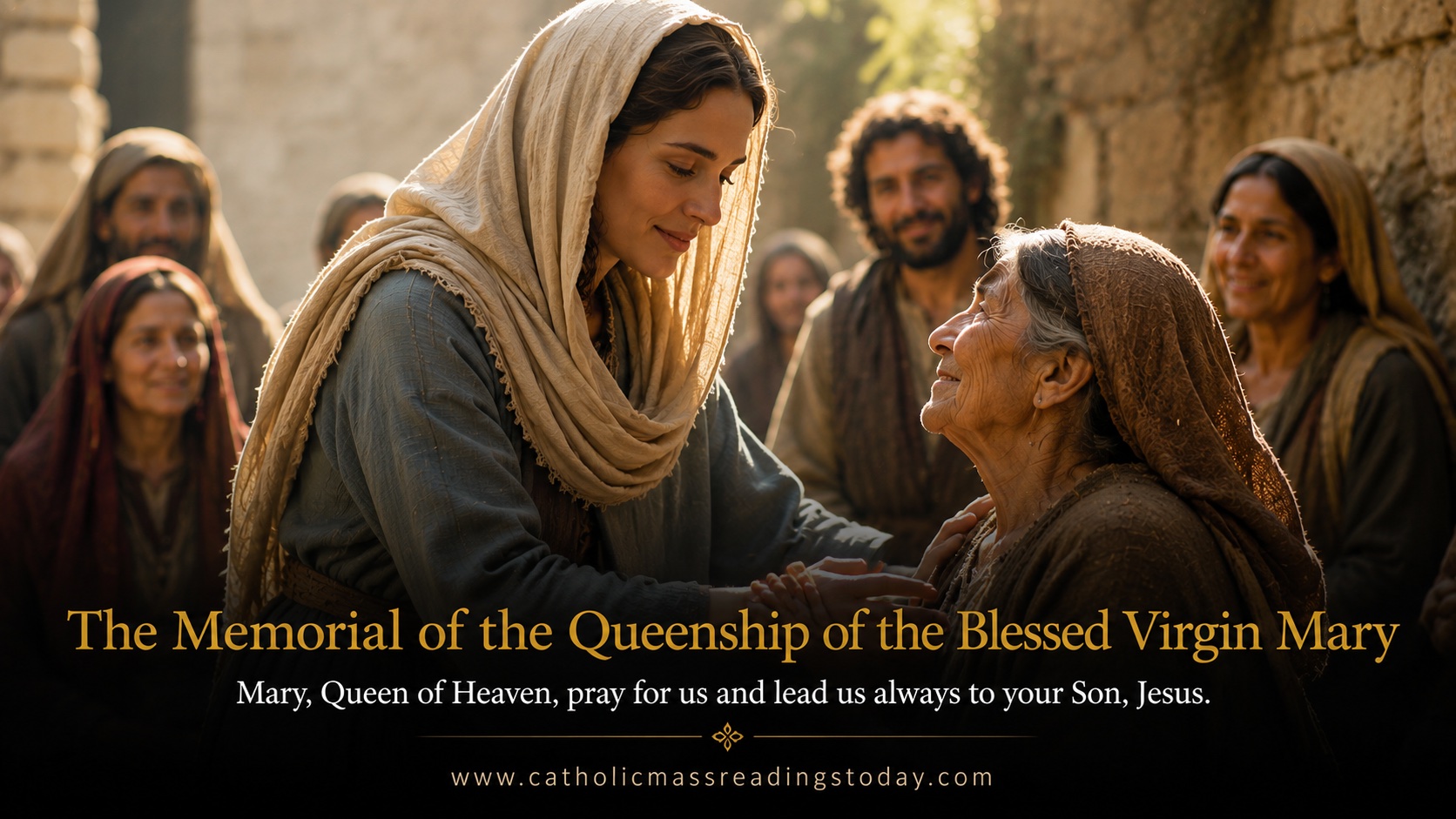
Eight days after the Church celebrates the glorious Assumption of the Blessed Virgin Mary, Catholics throughout the world turn once more toward the Mother of Jesus and honour her as Queen of Heaven and Earth.
The Memorial of the Queenship of the Blessed Virgin Mary, celebrated each year on August 22nd, is not simply about placing a crown upon Mary’s head. It points toward something much deeper: the victory of Jesus Christ and the extraordinary place His Mother occupies within the mystery of salvation.
Mary’s queenship cannot be separated from Christ’s kingship. She is Queen because her Son is King and she is honoured because God first honoured her. The woman whom the Gospel presents as the humble servant of the Lord is now, after completing her earthly life, exalted beside her Son in heavenly glory.
The Catechism of the Catholic Church teaches that when the course of Mary’s earthly life was completed, she was taken body and soul into heavenly glory and “exalted by the Lord as Queen over all things.”
This makes the Memorial of the Queenship of the Blessed Virgin Mary a celebration not merely of Mary’s dignity, but of what God can accomplish through a human life surrendered completely to Him.
From Nazareth to the Queen of Heaven
The story of Mary’s queenship begins somewhere that appears to have very little to do with royalty.
It begins in Nazareth. There was no earthly palace, royal court or crown when the angel Gabriel came to Mary. Scripture introduces us instead to a young Jewish virgin living an ordinary life in a relatively obscure town of Galilee.
Then came the words that changed human history:
“Hail, full of grace, the Lord is with you.”
Gabriel announced that Mary would conceive a Son who would be called Jesus. But the angel also said something essential for understanding today’s memorial: her Son would receive “the throne of his father David,” and “of his kingdom there will be no end.”
The child Mary was being asked to carry was the long awaited Messiah and King. Her response was not one of self importance but surrender:
“Behold, I am the handmaid of the Lord; let it be to me according to your word.”
There is something beautiful about beginning the story of the Queen of Heaven with those words.
I am the handmaid of the Lord.
Mary’s greatness begins in humility. She does not grasp for greatness. She allows God to lead her into it.
The Mother of the King
In the biblical world, particularly within the Davidic kingdom, the mother of the king possessed a distinctive place of honour. This provides an important background for understanding why Christians came to recognise the Mother of Christ the King as Queen.
But Mary’s queenship goes far beyond an earthly royal custom. Jesus Christ is not merely one king among many. He is the eternal Son of God, the King whose kingdom will have no end, and as the Book of Revelation proclaims, the King of kings and Lord of lords.
Mary’s royal dignity therefore comes first from her extraordinary vocation as Mother of God, Theotokos. Pope Pius XII explained this connection when formally establishing the feast of Mary’s Queenship. He taught that Mary’s royal dignity rests above all upon her Divine Motherhood: the woman who became Mother of the Creator could rightly be called Queen of creation.
This does not make Mary divine. Catholic teaching has never placed Mary on the same level as God.
Catholics worship God alone, Father, Son and Holy Spirit.
Mary is a creature redeemed by Christ, but she is a uniquely graced creature whose entire life was bound intimately to the mystery of her Son. Everything about Mary ultimately leads us to Jesus.
A Queen Who Hurried to Serve
Soon after the Annunciation, Mary gives us one of the clearest indications of what her queenship would eventually mean. She travels to visit Elizabeth. Mary has just received the greatest announcement imaginable. She has been chosen to become the Mother of the Messiah. Yet she does not withdraw into herself or demand to be treated as someone important.
She goes to serve. When Elizabeth hears Mary’s greeting, the child in her womb leaps for joy, and filled with the Holy Spirit she asks:
“And why is this granted me, that the mother of my Lord should come to me?”
Mary answers with the Magnificat:
“My soul magnifies the Lord, and my spirit rejoices in God my Saviour.”
Notice where Mary directs the attention. Not toward herself but toward God. She recognises that generations will call her blessed, but immediately acknowledges why:
“For he who is mighty has done great things for me.”
This remains essential to genuine Marian devotion. We honour Mary because of the great things God has done in her. Mary, in turn, directs us toward the God who accomplished them.
Bethlehem: The Queen Beside a Manger
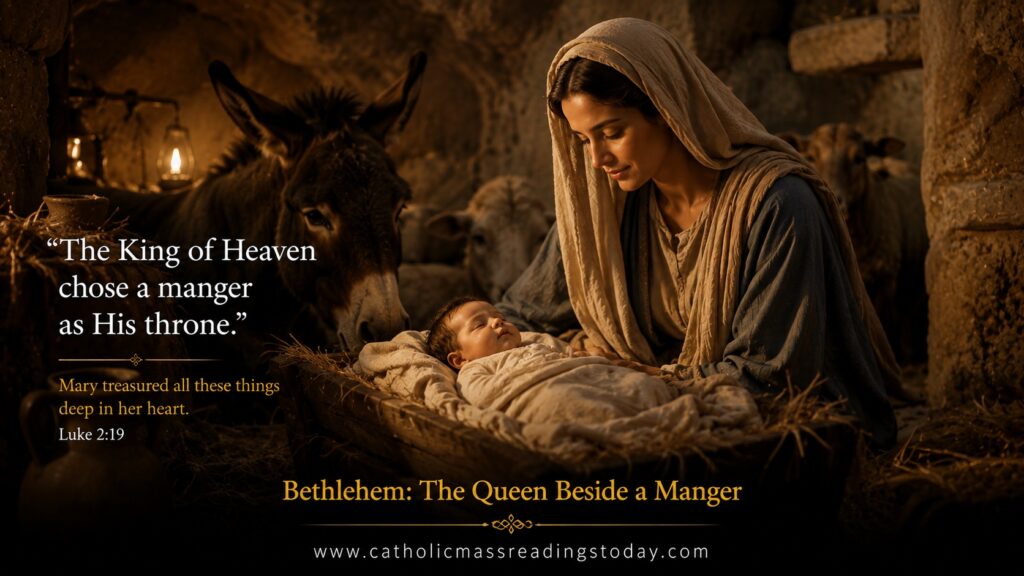
Human beings normally associate royalty with privilege. Mary’s life overturns that expectation. The Mother of the King gives birth not amid royal splendour but in poverty. At Bethlehem she wraps the infant Jesus in swaddling clothes and lays Him in a manger.
The Queen Mother has no palace. The King lies where animals feed, yet heaven understands what earth does not. Angels announce His birth. Shepherds come to adore Him and the Magi eventually arrive and kneel before the Child.
Mary watches all of this and, Scripture tells us, treasures these things in her heart.
Already we see the kind of kingdom Jesus has come to establish. It is not built upon wealth, military power or political domination. Its King comes in humility and it should not surprise us, therefore, that His Mother is also characterised by humility.
A Mother’s Life of Faith
The Gospel gives us relatively few details about the hidden years of Jesus’ life, and that silence itself tells us something about Mary. Much of her holiness was lived away from public attention.
She cared for Jesus, living the ordinary duties of family life. Together with Joseph, she protected and raised the Child entrusted to them. There were also moments of profound suffering. Simeon had warned Mary in the Temple:
“A sword will pierce through your own soul also.”
Those words would gradually unfold throughout her life. She and Joseph fled with the infant Jesus when Herod sought to kill Him. They became a family escaping violence and seeking safety in Egypt.
Years later Mary experienced the anguish of searching for the twelve year old Jesus before finding Him in the Temple and eventually she would watch her Son rejected, condemned and crucified.
Mary’s crown was preceded by a cross.
Cana: “Do Whatever He Tells You”
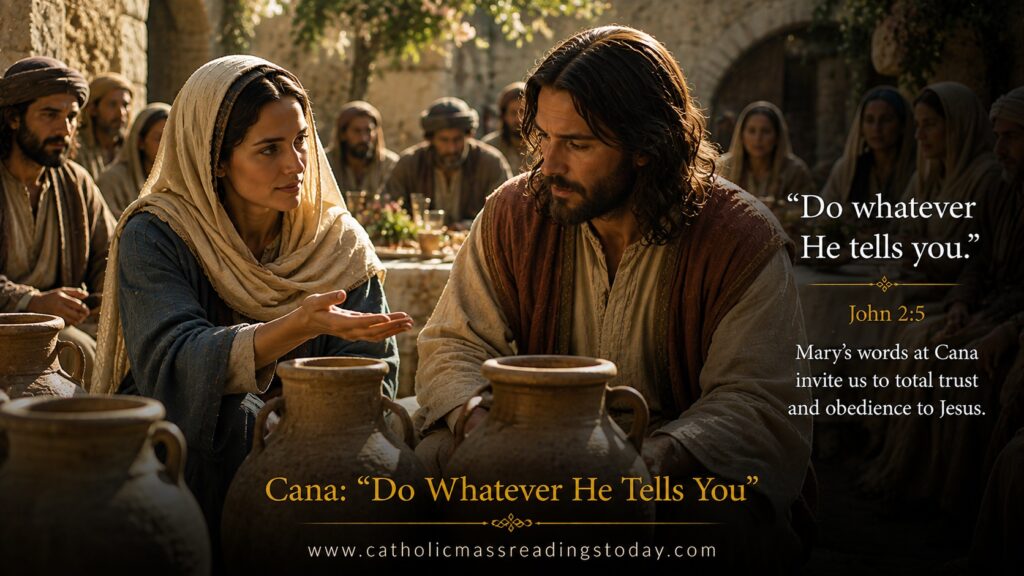
One of Mary’s most revealing appearances during Jesus’ public ministry takes place at the wedding feast at Cana. The wine runs out and Mary notices. Her words to Jesus are remarkably simple:
“They have no wine.”
She brings a human need before her Son. Then she turns to the servants and gives the instruction that has echoed through Christian spirituality ever since:
“Do whatever he tells you.”
Those words capture the authentic mission of Mary within the Church. She does not replace Christ but points toward Him. She does not say, Do whatever I tell you. She says:
Do whatever He tells you.
Every genuine devotion to the Blessed Virgin Mary should eventually lead the Christian to precisely that place deeper obedience to Jesus Christ.
Mary Beneath the Cross
If we want to understand Mary’s queenship, we cannot avoid Calvary. When many had fled, Mary remained. The Mother who had once held the infant Jesus in Bethlehem now stood before the Cross upon which her Son was dying.
There were no crowds praising her, no visible crown. There was suffering. The Gospel of John records that Jesus looked toward His Mother and the beloved disciple and said:
“Woman, behold, your son.”
Then to the disciple:
“Behold, your mother.”
Catholic tradition has always seen something profound in this moment. Mary’s motherhood, while never ceasing to be uniquely connected to Jesus, takes on a spiritual dimension toward Christ’s disciples.
The Catechism teaches that Mary stood beneath the Cross united with her Son’s suffering and lovingly consenting, in a mother’s heart, to His sacrifice. She does not save humanity independently of Christ. There is only one Redeemer: Jesus Christ.
But Mary participates uniquely in His saving mission through her faith, obedience, maternal suffering and unwavering union with Him.
Saint John Paul II later explained that Catholic tradition understands Mary’s queenship not only in relation to her Divine Motherhood but also to this unique cooperation in Christ’s work of Redemption. The road toward Mary’s heavenly crown therefore passes beneath the Cross.
Mary and the Birth of the Church
Mary’s story does not end on Good Friday. After Christ rises from the dead and ascends into heaven, Scripture gives us another quiet but extraordinarily significant picture of His Mother.
Mary is with the apostles. They are gathered in prayer awaiting the coming of the Holy Spirit. The woman who had received the Holy Spirit at the Annunciation is now praying with the infant Church as it prepares for Pentecost.
The Catechism notes that after Christ’s Ascension, Mary assisted the beginnings of the Church through her prayers and joined the apostles in imploring the gift of the Holy Spirit.
Here again Mary does not place herself at the centre. She prays, she waits and she remains with Christ’s disciples.
For Catholics, therefore, Mary is not merely a figure belonging to the Christmas story. She belongs intimately to the story of the Church.
How Did the Blessed Virgin Mary Die?
This is one area where careful distinction between Catholic doctrine and ancient tradition is important. Sacred Scripture does not tell us when, where or precisely how Mary’s earthly life ended.
The Catholic Church therefore does not teach as a defined article of faith a detailed historical account of Mary’s death.
Ancient Christian tradition, particularly in the East, speaks of the Dormition of the Mother of God her “falling asleep.”
Different traditions developed concerning the location and circumstances surrounding the completion of Mary’s earthly life, particularly traditions associated with Jerusalem and Ephesus.
What the Catholic Church definitively teaches concerns what happened when Mary’s earthly life was completed.
The Catechism states:
“Finally the Immaculate Virgin, preserved free from all stain of original sin, when the course of her earthly life was finished, was taken up body and soul into heavenly glory.”
This is the mystery Catholics celebrate on August 15: the Assumption of the Blessed Virgin Mary.
The wording is deliberate. The dogma does not settle the historical question of whether Mary experienced bodily death in exactly the ordinary manner before her Assumption. What it proclaims is the glorious conclusion:
Mary was assumed body and soul into heavenly glory. She who carried Christ in her womb, followed Him faithfully throughout her earthly pilgrimage and stood beside His Cross was brought into the glory of her risen Son.
From the Assumption to the Queenship
This explains why the Church celebrates today’s memorial precisely eight days after the Assumption.
The two celebrations belong together.
- On August 15, we contemplate Mary assumed body and soul into heaven.
- On August 22, we contemplate Mary exalted as Queen.
Pope Benedict XVI explained that the placement of the memorial eight days after the Assumption deliberately emphasises the close relationship between Mary’s Assumption and her queenship: she is glorified beside her Son and exalted as Queen of the universe.
The crown follows the Assumption and both point toward Christ.
The Ancient Roots of Mary as Queen
Although the liturgical memorial itself is relatively modern, calling Mary Queen is anything but a modern Catholic invention. Christians have used royal language for the Mother of Jesus for many centuries.
Pope Pius XII, in his 1954 encyclical Ad Caeli Reginam, surveyed this long tradition, citing early Christian writers including St. Ephrem the Syrian, St. Gregory Nazianzen, St. Andrew of Crete, St. Germanus and St. John Damascene. Christian art likewise depicted Mary crowned and enthroned long before the modern feast was established.
Catholics encounter the same tradition every time they pray familiar Marian prayers.
In the Hail Holy Queen – Salve Regina Christians address her:
Hail, Holy Queen, Mother of Mercy.
The Litany of Loreto invokes her as:
- Queen of Angels.
- Queen of Patriarchs.
- Queen of Prophets.
- Queen of Apostles.
- Queen of Martyrs.
- Queen of Confessors.
- Queen of Virgins.
- Queen of All Saints.
- Queen conceived without original sin.
- Queen assumed into heaven.
- Queen of the Most Holy Rosary.
- Queen of Families.
- Queen of Peace.
Today’s memorial therefore gave a specific place in the Roman calendar to a belief and devotion already deeply embedded within Catholic life.
Pope Pius XII Establishes the Feast
The formal establishment of the feast came during the twentieth century.
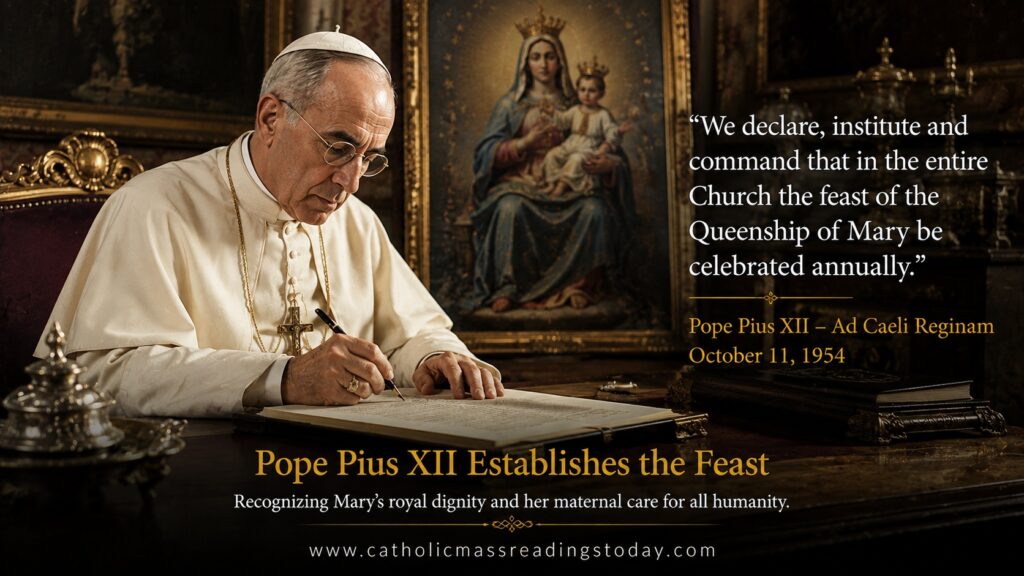
On October 11, 1954, during the Marian Year, Pope Pius XII issued the encyclical Ad Caeli Reginam and instituted the liturgical feast of the Queenship of the Blessed Virgin Mary.
He originally assigned its celebration to May 31.
The Pope made an important point: he was not inventing some new belief about Mary. He explicitly stated that the title and theological foundations of Mary’s royal dignity were already present in ancient Church documents and the sacred liturgy.
Following the reform of the Roman calendar after the Second Vatican Council, the celebration was transferred to August 22.
That placement gives the feast an even clearer theological meaning.
- Assumption.
- Then Queenship.
- The earthly pilgrimage is completed.
- Heaven receives Mary.
- The humble handmaid is exalted by God.
What Does It Mean to Call Mary “Queen”?
Catholic teaching must always be clear here. Mary’s queenship does not compete with the sovereignty of Jesus Christ. It depends entirely upon Him. Christ alone is the divine King and Redeemer.
Mary possesses nothing independently of God. Her dignity is God’s gift, her holiness is God’s grace. Her maternal mission comes from Christ and her intercession depends upon Christ.
The Catechism makes this especially clear when discussing Mary’s maternal role: her influence does not obscure or diminish the unique mediation of Christ but instead depends entirely upon it and draws all its power from it.
Mary is therefore not an alternative to Jesus. She belongs entirely to Jesus. As Benedict XVI explained, everything in Mary is relative to Christ and dependent upon Him. That is the Catholic understanding of the Queen of Heaven.
What Kind of Queen Is Mary?
Perhaps the most beautiful thing about Mary’s queenship is the kind of Queen she is.
The Gospel gives us no image of Mary demanding privilege.
- We see her serving Elizabeth.
- We see her giving birth in poverty.
- We see her worrying when the young Jesus is missing.
- We see her noticing that a newly married couple has run out of wine.
- We see her standing beneath the Cross.
- We see her praying with the apostles.
Her queenship therefore reflects the kingdom of her Son. Jesus said:
“The Son of man also came not to be served but to serve.”
Christ reigns from a Cross before He is seen in heavenly glory. Mary’s queenship likewise reveals that greatness in God’s Kingdom is inseparable from humility, obedience and love. The Queen of Heaven is the woman who once said:
“Behold, I am the handmaid of the Lord.”
That apparent contradiction is one of the great lessons of today’s memorial. The one who humbled herself was exalted by God.
Mary, Queen and Mother
Mary’s queenship also has a deeply maternal character. Pius XII described her reign not as distant domination but as a mother’s solicitude for humanity. This is why Catholics confidently ask for Mary’s intercession. We do not believe Mary replaces God. We ask Mary to pray to God with us and for us.
It is the same instinct that leads Christians on earth to ask one another:
Please pray for me.
But Christians believe that those who have died in Christ are alive in Him. Mary, assumed into heavenly glory, remains united to the Body of Christ. The Catechism teaches that Mary’s motherhood in the order of grace continues and that, taken up into heaven, she continues her maternal intercession.
And what does Mary desire for her children? The Gospel of Cana gives us the answer:
“Do whatever he tells you.”
Mary always points toward her Son.
Queen of Peace in a Troubled World
Among Mary’s most beloved titles is Queen of Peace.
That title carries particular weight whenever the world is wounded by war, hatred, division, violence and fear.
Pius XII established the feast in the shadow of a century devastated by enormous conflict. In Ad Caeli Reginam, he specifically encouraged Christians to turn toward Mary and implore peace, describing her maternal queenship as a source of hope in a world shaken by hatred.
The title remains painfully relevant. Peace does not begin only around negotiating tables. It must also begin inside human hearts. There can be no lasting peace where hatred is deliberately cultivated, where human dignity is ignored, where revenge becomes a virtue or where another person’s suffering ceases to matter.
Mary points us instead toward Christ, the Prince of Peace. To honour Mary as Queen of Peace while refusing reconciliation in our own lives would miss something essential about this feast.
What Mary’s Queenship Teaches Us Today
The Memorial of the Queenship of the Blessed Virgin Mary contains a powerful lesson for modern Christians. Our culture often teaches us to pursue visibility, recognition, status and influence.
Mary pursued none of them, she sought God’s will and God exalted her. The world tells us to make ourselves important.
Mary says:
“My soul magnifies the Lord.”
The world asks how many people recognise us.
Mary teaches us to ask whether God recognises faithfulness within us.
The world often measures success by what we possess.
Mary possessed very little by worldly standards, yet generations call her blessed.
Her life teaches us that the greatest human achievement is ultimately not becoming important in the eyes of the world. It is becoming holy in the sight of God.
Why the Queenship of Mary Matters to the Church
Mary matters profoundly to the Church because her story is inseparable from Christ. Through her freely given “yes,” the eternal Word took flesh.
- She gave Jesus His human nature.
- She carried Him.
- She gave birth to Him.
- She raised Him.
- She followed Him.
- She stood beside His Cross.
- She prayed with His disciples.
And when her earthly pilgrimage was completed, she was taken into the glory of the Son whom she had loved from Nazareth to Calvary. The Church therefore sees in Mary something of her own destiny.
The Catechism calls Mary the Church’s model of faith and charity and an exemplary realization of what the Church herself is called to become.
Mary’s Assumption and Queenship remind Christians that death does not have the final word, Christ does, the Resurrection does and Heaven does.
The Crown Began With a “Yes”
Perhaps the story of the Queenship of Mary can ultimately be understood through two images.
The first is a young woman in Nazareth saying:
“Behold, I am the handmaid of the Lord.”
The second is that same woman received into heavenly glory and honoured as Queen.
Between those two moments lies an entire life of faith.
Nazareth.
Bethlehem.
Egypt.
Cana.
Calvary.
Pentecost.
And finally, heaven.
Mary did not know everything that her “yes” would require when Gabriel departed from her. But she remained faithful. That may be the greatest lesson of the Memorial of the Queenship of the Blessed Virgin Mary.
Holiness is built through many acts of faithfulness that the world may never notice.
- Every sincere yes to God matters.
- Every hidden sacrifice matters.
- Every act of charity matters.
- Every prayer offered in difficulty matters.
- Every decision to remain faithful when faithfulness is costly matters.
Mary’s crown tells us that God does not forget the humble faithfulness of His children.
Celebrating the Memorial of the Queenship of the Blessed Virgin Mary
As Catholics celebrate the Memorial of the Queenship of the Blessed Virgin Mary on August 22, we honour the woman whom God chose to become Mother of His Son and whom He has exalted in heavenly glory.
But Mary would never want our attention to stop with her. Her whole life points beyond herself.
At Nazareth, she accepted Christ, at Bethlehem, she gave Christ to the world, at Cana, she directed others toward Christ, at Calvary, she remained beside Christ, at Pentecost, she prayed with the Church of Christ and from heaven, her maternal mission remains centred upon Christ.
That is why genuine devotion to the Blessed Virgin Mary should make us more faithful disciples of Jesus. If we honour Mary as Queen, let us listen again to the words she gave the servants at Cana:
“Do whatever he tells you.”
And if we wish to understand the crown she now wears, let us remember the words with which her extraordinary journey began:
“Behold, I am the handmaid of the Lord.”
The Queen of Heaven first taught us how to be a servant and therein lies one of the deepest mysteries of the Kingdom of God.
Prayer to Mary, Queen of Heaven
Let us pray.
O Blessed Virgin Mary,
Mother of God and Queen of Heaven,
you gave yourself completely
to the will of the Father
and brought into the world
Jesus Christ, our King and Saviour.
Queen assumed into heaven,
pray for us that we may remain faithful
through every joy and every trial.
Queen of Families,
protect our homes
and lead parents and children closer to your Son.
Queen of Peace,
intercede for nations divided by hatred and war,
comfort those who suffer,
and obtain for the world the peace
that comes from Christ alone.
Queen of the Most Holy Rosary,
teach us to contemplate the mysteries of Christ
with the faith with which you treasured them in your heart.
Queen of All Saints,
help us to seek holiness rather than earthly praise,
service rather than honour,
and the will of God above our own.
O Mary, our Mother and Queen,
take our prayers to your beloved Son
and teach us always to obey your words at Cana:
“Do whatever he tells you.”
May Jesus Christ reign in our hearts,
in our families
and throughout the world,
now and for ever.
Amen.