The Solemnity of All Saints: Celebrating the Glory of Heaven and the Universal Call to Holiness
Every year on 1 November, the Catholic Church celebrates one of the most beautiful and hope filled occasions in the liturgical calendar: the Solemnity of All Saints. On this sacred day, the Church turns her gaze towards heaven and rejoices in the countless men and women who have completed their earthly pilgrimage and now live forever in the presence of God.
Some of these holy men and women are familiar to us. Their names are found in the history of the Church, their lives have inspired generations, and their feast days are celebrated throughout the world. We remember the Blessed Virgin Mary, Saint Joseph, Saint Peter and Paul, Saint Augustine, Saint Francis of Assisi, Saint Thérèse of Lisieux, Saint Teresa of Calcutta, and countless others whose extraordinary witness continues to strengthen the Christian faith.
Yet the Solemnity of All Saints celebrates far more than the saints whose names appear in the Church’s calendar.
It also honours the unknown saints: mothers and fathers who raised their children in faith, men and women who quietly served the poor, missionaries who carried the Gospel into distant lands, ordinary workers who remained honest despite great difficulties, and faithful Christians who lived lives of prayer, sacrifice, forgiveness, and love without ever receiving public recognition.
Their names may have disappeared from human memory, but they have never been forgotten by God.
The beauty of this solemnity lies in its extraordinary message: holiness is not reserved for a few exceptional people. Every human being is called to become a saint, and heaven is the eternal home for which God created us.
As the Church gathers around the altar on this day, she does not merely remember the past. She celebrates the living communion between the faithful on earth and those who have already entered the glory of heaven.
The Early Christians and the Beginning of the Celebration of All Saints
The history of the Solemnity of All Saints reaches back to the earliest centuries of Christianity, when following Jesus Christ often meant accepting rejection, imprisonment, persecution, and even death.
Under the Roman Empire, many Christians suffered martyrdom because they refused to abandon their faith. Their courage deeply moved the Christian communities that survived them, and believers began gathering at their burial places to pray, celebrate the Eucharist, and remember the witness of those who had remained faithful to Christ.
The anniversary of a martyr’s death came to be regarded as a heavenly birthday, the day on which that faithful servant entered into the fullness of life with God.
As persecution spread and the number of martyrs increased, it became increasingly difficult for Christian communities to commemorate every martyr individually. The Church gradually developed the practice of honouring many martyrs together in a common celebration.
Evidence of such commemorations can be found in the Christian East during the fourth century. Early Christian writers and preachers, including Saint Ephrem the Syrian and Saint John Chrysostom, bear witness to the growing tradition of remembering the holy martyrs collectively.
In time, the Church’s understanding of public veneration expanded beyond those who had shed their blood for Christ.
Christians increasingly honoured confessors of the faith, bishops, monks, virgins, and other men and women whose lives demonstrated extraordinary fidelity to the Gospel.
Their witness revealed that martyrdom was not the only path to holiness. A lifetime of prayer, charity, self-denial, perseverance, and obedience to God could also become a powerful testimony to the transforming grace of Christ.
This gradual development prepared the way for the celebration that Catholics throughout the world now know as the Solemnity of All Saints.
How 1st November Became the Solemnity of All Saints
An important chapter in the development of the feast took place in Rome during the early seventh century.
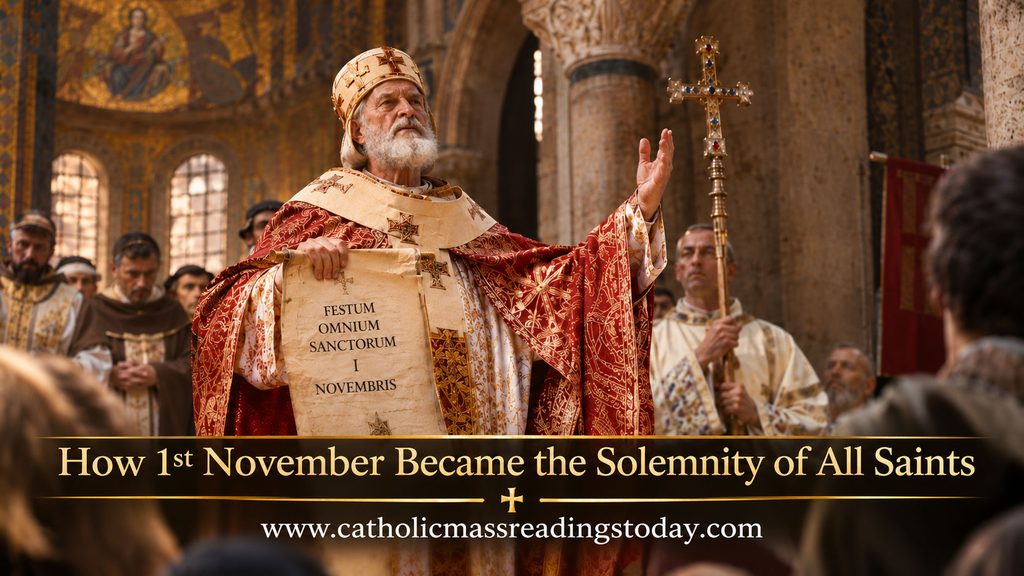
In 609 or 610, Pope Boniface IV dedicated the ancient Pantheon, formerly a Roman temple, as a Christian church honouring the Blessed Virgin Mary and all the martyrs.
The building became known as Santa Maria ad Martyres, and its dedication on 13 May was associated with a celebration in honour of the martyrs.
This event represented an important moment in the history of Christian Rome. A building once connected with the religious life of the ancient empire had become a place of Christian worship, dedicated to the glory of God and the memory of those who had given their lives for Christ.
During the eighth century, Pope Gregory III, who served from 731 to 741, dedicated a chapel in Saint Peter’s Basilica in honour of all the saints. The commemoration associated with this dedication was observed on 1 November.
The celebration continued to develop, and during the ninth century Pope Gregory IV helped extend the observance of All Saints on 1 November more widely throughout the Western Church.
Over time, the feast became firmly established in the Roman liturgical calendar.
Its history reflects the Church’s growing recognition that the company of the saints is far greater than the number of holy men and women who can be individually remembered.
What began with the commemoration of the martyrs eventually became a solemn celebration of all those who now share in the glory of heaven.
Today, the Solemnity of All Saints stands as a joyful proclamation of the victory of Christ over sin and death, and of the destiny that awaits those who persevere in His grace.
The Great Multitude Before the Throne of God
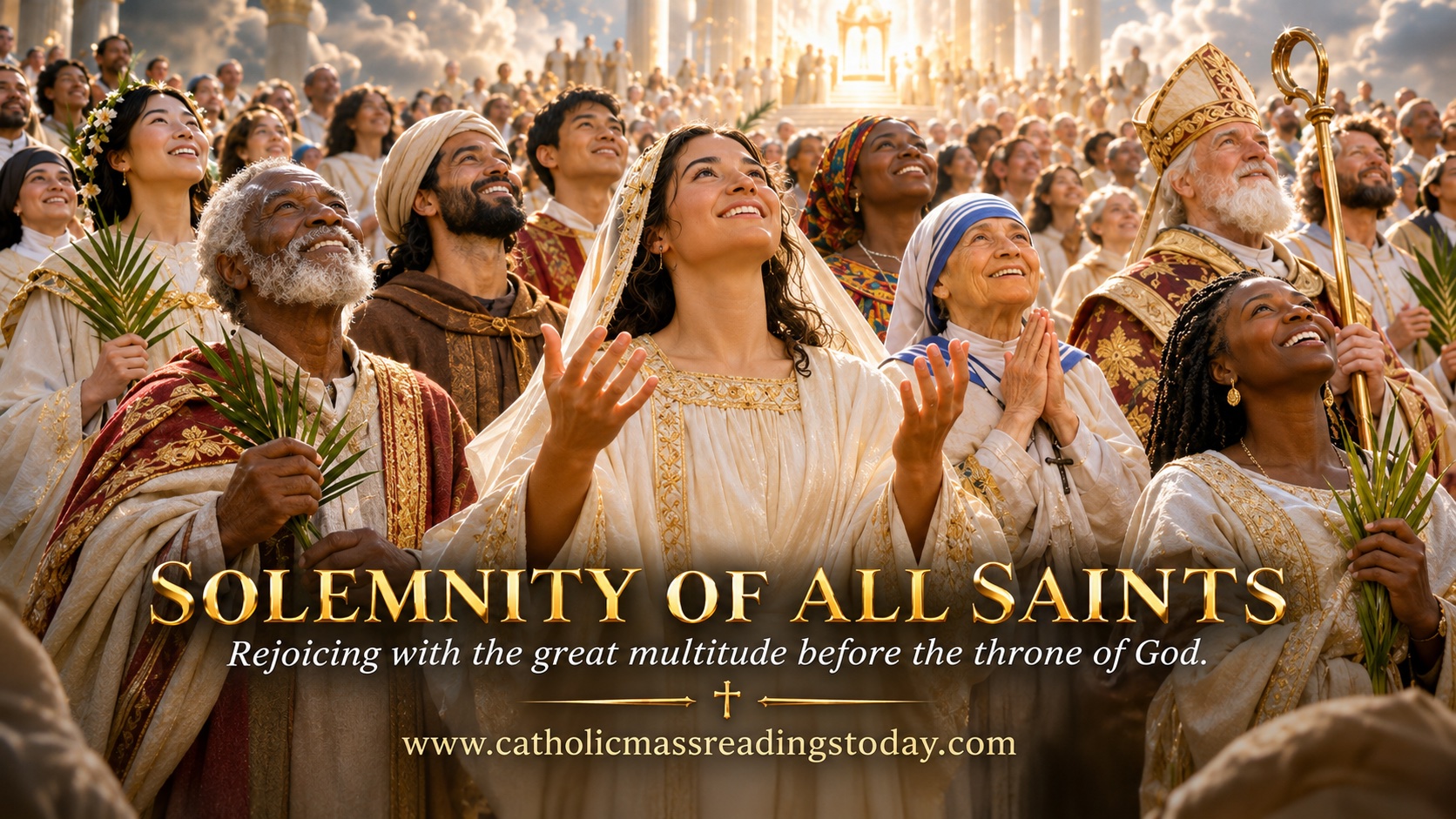
One of the most moving passages associated with the Solemnity of All Saints comes from the Book of Revelation. Saint John describes a heavenly vision in which he sees a vast multitude standing before the throne of God and before the Lamb.
These people come from every nation, tribe, people, and language. They are clothed in white robes, carrying palm branches, and offering praise to God for the gift of salvation.
This vision, proclaimed in Revelation 7:2 – 4, 9 – 14, reveals the universal character of God’s saving love.
Heaven is not reserved for one nation, one culture, one language, or one social class. The multitude of saints includes people from every corner of the earth, united not by earthly status or worldly achievement, but by their belonging to Jesus Christ.
Their white robes signify the victory and purification received through the saving sacrifice of the Lamb, Jesus Christ.
They have endured suffering, temptation, and the trials of earthly life, yet through the grace of God they have been brought into the joy of His presence.
This vision is particularly meaningful in a world often divided by ethnicity, nationality, wealth, and social differences.
Before the throne of God, earthly distinctions no longer determine a person’s dignity or worth. What unites the saints is the love of Christ, who gave Himself for the salvation of all humanity.
The Solemnity of All Saints therefore reveals something profoundly beautiful about the Catholic Church.
She is called to be universal, embracing people of every nation and generation, and leading them towards communion with God.
The saints remind us that heaven is not the inheritance of a particular people, but the promised home of all who are saved through Jesus Christ.
The Communion of Saints: One Church United in Christ
At every celebration of Holy Mass, Catholics profess their faith in the communion of saints.
These words express a fundamental truth of Catholic belief: the Church is not limited to those who are presently living on earth.
All who belong to Christ and share in His life remain united in Him, even beyond death.
The Catholic Church traditionally speaks of the faithful on earth, the souls undergoing purification after death, and the blessed who already enjoy the glory of heaven.
These are not separate communities without any connection to one another. They belong to the one Church of Jesus Christ.
The faithful on earth continue their pilgrimage through prayer, the sacraments, charity, and perseverance in faith. Those undergoing purification are being prepared for the fullness of heavenly communion. The saints in glory behold God and rejoice in His eternal presence.
The Catechism of the Catholic Church explains this beautiful mystery in its teaching on the communion of saints, particularly paragraphs 946–962.
Through Christ, the bonds of Christian love are not destroyed by death.
This is why Catholics ask the saints to pray for them.
We do not worship the saints, nor do we regard them as substitutes for Jesus Christ. Worship belongs to God alone.
The saints are honoured because of the work that God’s grace accomplished in their lives. Their holiness reflects the glory of the Lord, and their intercession is always dependent upon the one saving mediation of Jesus Christ.
Just as we may ask a fellow Christian on earth to pray for us, the Church believes that the saints, who are perfectly united with Christ in heaven, continue to intercede for the faithful.
When we ask the Blessed Virgin Mary, Saint Joseph, Saint Peter, or any of the saints to pray for us, we express our confidence that the family of God remains united in love.
The Solemnity of All Saints makes this communion especially visible.
While the Church on earth celebrates the sacred mysteries, the saints in heaven offer everlasting praise to the same Lord.
In the Eucharist, our earthly worship is united with the heavenly worship of those who have already reached the fulfilment of their Christian journey.
The Difference Between All Saints’ Day and All Souls’ Day
The Solemnity of All Saints is followed on 2 November by the Commemoration of All the Faithful Departed, commonly known as All Souls’ Day.
Although the two observances are closely connected, each has its own spiritual emphasis.
On All Saints’ Day, the Church rejoices in the glory of all those who are already in heaven. It is a celebration of holiness fulfilled, eternal life attained, and the victory of God’s grace in human lives.
On All Souls’ Day, the Church remembers and prays particularly for the faithful departed, including those who are still undergoing purification before entering the fullness of heavenly glory.
The Catholic teaching on purgatory reminds us that God’s mercy continues His work of purification in those who die in His grace and friendship but are not yet perfectly purified.
The Church therefore offers prayers, especially the Holy Sacrifice of the Mass, for the faithful departed.
These two days express the same Christian hope from different perspectives.
All Saints’ Day celebrates those who have reached their heavenly destination. All Souls’ Day invites us to pray for those who have died and to entrust them to the mercy of God.
Together, they remind us that death does not destroy the love that unites the members of Christ’s Body.
They also call us to remember the seriousness of our earthly lives and the eternal destiny towards which we are journeying.
The Beatitudes: The Path That Leads to Sainthood
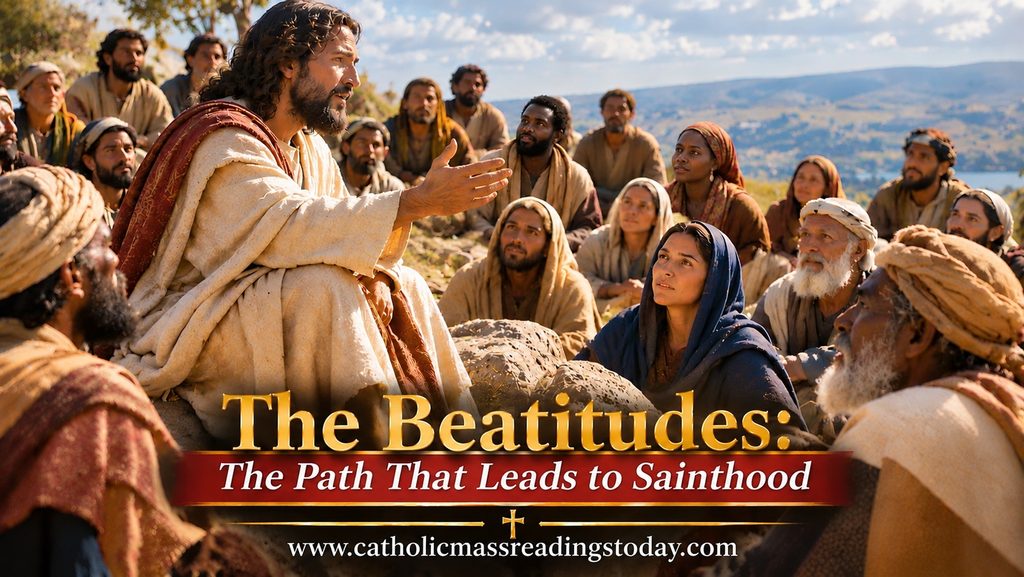
The Gospel proclaimed on the Solemnity of All Saints is taken from Matthew 5:1–12a, in which Jesus delivers the Beatitudes during the Sermon on the Mount.
These teachings reveal the character of those who belong to the Kingdom of God.
Jesus calls blessed the poor in spirit, those who mourn, the meek, those who hunger and thirst for righteousness, the merciful, the pure in heart, the peacemakers, and those who are persecuted for righteousness.
The Beatitudes challenge many of the values by which worldly success is often measured.
The world may praise power, wealth, influence, and personal recognition. Christ speaks instead of humility, mercy, purity, righteousness, and peace.
He reveals that true happiness is not found simply in possessing the things of this world, but in living in communion with God.
The saints are those whose lives became an expression of this teaching.
Some demonstrated extraordinary mercy towards the poor. Others pursued justice in difficult circumstances. Many remained faithful during suffering, illness, imprisonment, or persecution.
Yet beneath their different vocations lay the same essential calling: to follow Jesus Christ with wholehearted love.
The Beatitudes do not promise that holiness will remove every hardship from our lives.
Instead, they assure us that those who remain faithful to Christ possess a hope that reaches beyond earthly suffering.
The promise that concludes the Gospel is especially appropriate for this solemnity.
“Rejoice and be glad, for your reward is great in heaven.”
These words express the joy of the saints and offer encouragement to every Christian still travelling along the path of faith.
The Saints Were Ordinary People Transformed by God’s Grace
When we look at statues of saints in our churches or read accounts of their extraordinary lives, it can be tempting to imagine that holiness belongs to people very different from ourselves.
We may think that saints never experienced fear, uncertainty, temptation, discouragement, or failure.
Yet the lives of many saints reveal something quite different.
Saint Peter loved Jesus deeply, but he also denied Him during the Passion. His story did not end with that failure. Through repentance and the mercy of Christ, he became a courageous witness to the Resurrection.
Saint Paul once persecuted the Church, yet his encounter with the risen Lord transformed his life and made him one of Christianity’s greatest missionaries.
Saint Augustine spent years searching for fulfilment before surrendering his life more completely to God. His conversion remains a powerful testimony to the patience of divine grace.
Saint Francis of Assisi abandoned the pursuit of worldly ambition and embraced a life of simplicity, poverty, and joyful service.
Saint Thérèse of Lisieux showed that holiness could be pursued through small acts performed with extraordinary love.
Saint Teresa of Calcutta demonstrated how the Gospel becomes visible when the suffering, abandoned, and forgotten are treated with dignity and tenderness.
Their circumstances were different, and their spiritual journeys were not identical.
What united them was their willingness to allow God to transform their hearts.
The saints were not saved by their own perfection or achievements. They responded to the grace of Jesus Christ, who is the source of all holiness.
Their lives teach us that weakness need not become a permanent obstacle to sanctity when we sincerely repent and place our trust in the Lord.
Holiness does not begin when we become extraordinary. It begins when we allow God to work faithfully through the ordinary circumstances of our lives.
The Unknown Saints Whose Names Are Written in Heaven
One of the most consoling aspects of the Solemnity of All Saints is the recognition that the saints in heaven are not limited to those formally canonised by the Church.
Canonisation is the solemn recognition by the Church that a particular person is in heaven and may be publicly venerated throughout the Church, yet there are countless holy people whose lives will never be examined in a formal canonisation process.
- A mother who spent her life caring for her children with patience and prayer may be among them.
- A father who worked honestly, remained faithful to his family, and quietly placed his trust in God may be among them.
- A person who endured serious illness without losing hope, a priest who served his parish faithfully for decades, a religious sister who devoted her life to prayer, or an ordinary Christian who practised mercy and forgiveness may now belong to that heavenly multitude.
Their names may never appear in a book or be remembered in a public celebration.
But the Lord knows every hidden act of love, every sacrifice made in faith, and every sincere prayer offered in difficult circumstances.
This is why the Solemnity of All Saints brings hope to people living ordinary lives. It reminds us that the path to heaven is not measured by fame, influence, or public recognition.
What matters is our response to God’s grace and our perseverance in faith, hope, and charity.
In his homily for All Saints on 1 November 2000, Pope Saint John Paul II reflected upon this vast company of holy people, including faithful parents, religious, priests, missionaries, and countless others whose lives were devoted to God and neighbour.
Their witness reminds the Church that sanctity is possible in every state of life.
The Solemnity of All Saints and the Universal Call to Holiness
The Second Vatican Council gave particular emphasis to the universal call to holiness, teaching that all the faithful, whatever their state or vocation, are called to the fullness of Christian life and the perfection of charity.
This teaching is especially relevant on the Solemnity of All Saints.
Holiness is not reserved for bishops, priests, religious sisters, monks, or missionaries.
It is the calling of every baptised person.
- A married couple is called to holiness through faithful love, mutual sacrifice, and the responsibilities of family life.
- A young person is called to holiness through honesty, purity, prayer, respect for others, and the courage to remain faithful to Christian values.
- A professional is called to holiness through integrity, justice, and the responsible use of talents.
Those who care for the sick, teach children, work in difficult circumstances, or serve their communities are also called to make Christ present through their daily responsibilities.
The path may be different for each person, but the destination is the same.
God calls us to become holy because He desires us to share forever in His divine life.
We do not achieve this through human effort alone. Holiness is the work of God’s grace, received and lived through faith, the sacraments, prayer, repentance, and charity.
The Solemnity of All Saints therefore places a deeply personal question before every Catholic.
Am I allowing God to make me holy in the life I am living today?
We need not wait for extraordinary circumstances before beginning to respond.
The opportunity to practise patience, forgive an offence, assist someone in difficulty, speak truthfully, or spend time in prayer may be the very place where God is inviting us to grow in holiness.
How Catholics Celebrate the Solemnity of All Saints
The Solemnity of All Saints is among the highest-ranking celebrations in the Roman liturgical calendar.
On 1 November, Catholics gather to celebrate the Holy Eucharist, honouring God for the holiness manifested in His saints and praying for the grace to follow their example.
The readings proclaimed during Mass direct the faithful towards heaven and remind them of the dignity of their Christian calling.
The Book of Revelation presents the innumerable multitude worshipping before God’s throne.
The First Letter of Saint John reminds believers that they are already children of God and that the fullness of their destiny will be revealed when they see Him as He is.
The Gospel of Matthew presents the Beatitudes, through which Jesus describes the blessedness of those who live according to the values of His Kingdom.
Together, these readings reveal the journey of Christian life: we are called by God’s love, transformed by His grace, and invited to share forever in His glory.
For Catholic families, the celebration also offers an opportunity to teach children about the lives of the saints and the importance of seeking holiness in everyday life.
Parents may share the stories of patron saints, pray the Litany of the Saints, reflect upon the Beatitudes, or speak about the examples of faith found within their own families.
The observance is also a fitting occasion to remember the saints associated with one’s baptismal name, confirmation name, parish, or homeland.
Above all, the celebration should draw us into deeper love for Jesus Christ, whose grace made the saints holy.
What the Solemnity of All Saints Teaches Us About Death and Eternal Life
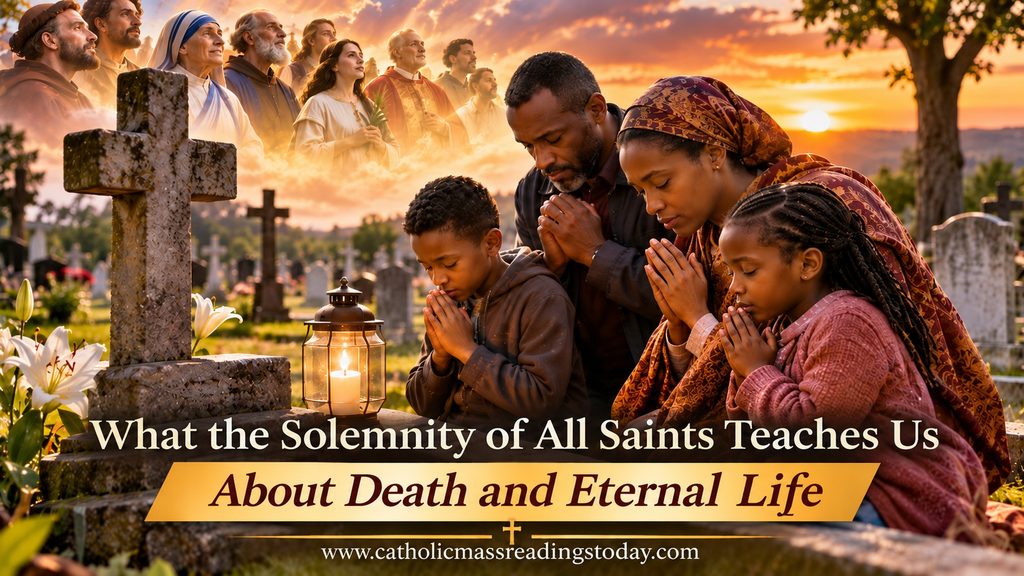
Modern life often encourages us to avoid thinking about death.
We make plans for tomorrow, pursue our ambitions, and sometimes live as though our earthly journey will continue indefinitely, yet the Solemnity of All Saints gently reminds us that our lives have an eternal purpose.
Death is a serious reality, but for those who die in Christ, it is not the destruction of the hope placed in Him. Through His Passion, death, and Resurrection, Jesus Christ has opened the way to eternal life. The saints now enjoy the fulfilment of the hope that sustained them during their earthly pilgrimage. They behold God and share in the joy of His presence.
For us, this promise should not encourage indifference towards the responsibilities of this world. On the contrary, the hope of heaven should make us more attentive to how we live today.
Our choices matter. The way we treat our families matters. Our willingness to forgive, our concern for the poor, and our fidelity to the commandments of God all form part of our response to the gift of salvation.
The saints remind us that human life is too precious to be wasted in bitterness, selfishness, hatred, or the endless pursuit of things that cannot satisfy the heart.
The joy of heaven is not simply a distant idea. It is the promise that gives direction to our Christian lives.
The Message of All Saints’ Day for the Church and the World Today
As we celebrate the Solemnity of All Saints, we do so in a world where many people are struggling with uncertainty, conflict, loneliness, poverty, and the pressures of daily life.
The lives of the saints offer a different way of responding to these difficulties.
They teach us that the answer to hatred is not greater hatred, that true strength is not measured by domination, and that human dignity must never be sacrificed for personal advantage.
The saints lived in different centuries and cultures, yet their witness continues to speak to the needs of the world today.
Their lives challenge us to become people of prayer in a distracted world, people of integrity where dishonesty is accepted, people of compassion where suffering is ignored, and people of peace where division has become familiar.
Their examples also remind us that Christian holiness is not meant to remain hidden within private religious observance. It must bear fruit in the way we serve others.
A Church that honours the saints must also strive to reflect their faith, courage, humility, and charity.
It is not enough to admire Saint Francis for his simplicity while remaining attached to selfish ambition, or to praise Saint Teresa of Calcutta for her service while ignoring those who suffer around us.
The saints are not given to us merely as figures to remember. They are witnesses who invite us to follow Jesus Christ more faithfully. Their greatest achievement was not that they became famous or admired, but that they allowed the love of God to shape their lives.
Our Own Journey Towards Sainthood
Perhaps the most important message of the Solemnity of All Saints is that the celebration concerns our own future.
The saints have completed the journey that we are still making. They have endured the struggles of earthly life, persevered through grace, and reached the joy for which every human heart was created. Their example tells us that holiness is possible.
We may never accomplish the extraordinary works associated with some of the Church’s greatest saints. We may never travel across continents as missionaries, establish religious communities, or become known for heroic public achievements, yet we can choose to love God faithfully in the circumstances of our own lives.
We can pray even when prayer feels difficult. We can forgive when resentment seems easier. We can remain honest when dishonesty promises greater advantage. We can show compassion to those who have little to offer us in return.
We can return to the Sacrament of Reconciliation when we have fallen into sin and receive the Holy Eucharist with renewed reverence and gratitude.
Through these ordinary acts of fidelity, God’s grace gradually transforms the human heart.
The saints remind us that the road to heaven is travelled one faithful day at a time.
There will be moments of weakness and disappointment, but these need not become reasons for despair. The mercy of Christ remains greater than our failures, and His grace is sufficient to help us begin again.
As the Church celebrates the Solemnity of All Saints, let us remember that heaven is not merely a beautiful promise offered to others. It is the destination towards which God lovingly calls each one of us.
And when our earthly pilgrimage comes to an end, may we be found among that great multitude from every nation and people, standing before the throne of God and the Lamb, praising Him in the joy of eternal life.
May the Solemnity of All Saints renew within us the desire to become holy, strengthen our confidence in God’s mercy, and remind us that the greatest success of a human life is to belong to Jesus Christ forever.
A Prayer for the Solemnity of All Saints
Almighty and eternal God, source of all holiness and giver of every good gift, we praise and thank You for the countless saints who now rejoice in the glory of Your heavenly Kingdom.
Through Your grace, they remained faithful to Your Son, Jesus Christ, and became witnesses of Your mercy, truth, and love.
As we celebrate the Solemnity of All Saints, awaken within our hearts a sincere desire for holiness.
Grant us the humility to recognise our weaknesses, the courage to turn away from sin, and the perseverance to follow Your commandments throughout our lives.
May the example of the Blessed Virgin Mary, Saint Joseph, the holy Apostles, the martyrs, and all Your saints strengthen us in faith, hope, and charity.
Through their prayers, help us to remain faithful when trials arise, to forgive those who offend us, to comfort those who mourn, and to serve those who are poor, lonely, or suffering.
Bless our families and guide our children along the path of righteousness.
May our homes become places of prayer, forgiveness, patience, and sincere Christian love.
Lord, teach us to seek holiness not only in extraordinary moments, but also in the ordinary responsibilities of each day.
Protect us from pride, selfishness, and indifference, and help us to use the gifts You have entrusted to us for the good of others.
When our earthly pilgrimage is complete, receive us into Your mercy, and grant that we may one day join the countless multitude of saints in praising Your holy name forever.
Through our Lord Jesus Christ, Your Son, who lives and reigns with You in the unity of the Holy Spirit, God, for ever and ever.
Amen.
All holy men and women, pray for us.